
If I want the short answer: the Portugal D8 works best if I earn at least €3,680 a month from work outside Portugal, can prove about 6 months of steady income, and know that staying more than 183 days can make me a Portuguese tax resident.
Before I move, I’d focus on four things:
- Visa fit: the D8 is for non-EU remote workers with active foreign income
- Income bar: in 2026, the base minimum is €3,680/month
- Paperwork: I’d need income proof, housing, insurance, a criminal record certificate, and a NIF
- Taxes: the visa itself does not decide tax status; time in Portugal and whether I set up a home there do
Here’s the part I’d pay close attention to: Portugal can tax my worldwide income if I become a tax resident. For many applicants, that matters more than the visa approval itself. The article also points out that NHR is closed to new applicants, and IFICI only fits a small group of workers, so most remote workers should expect the standard tax rules.
If I were sizing this up fast, this is what I’d take away:
| Topic | What matters in 2026 |
|---|---|
| Who the D8 is for | Non-EU/EEA/Swiss nationals working remotely for income from outside Portugal |
| Main income rule | €3,680/month for one applicant |
| Family add-ons | €460 for a spouse, €276 for each child |
| Proof consulates want | Contracts, invoices, pay stubs, and bank statements showing steady foreign income |
| First visa length | Entry visa valid for 120 days |
| Tax residency trigger | Usually more than 183 days in a 12-month period, or Portugal as my main home |
| Resident tax treatment | Worldwide income taxed at 12.5% to 48% |
| Social security issue | Freelancers may owe Portuguese social security unless a U.S. Certificate of Coverage applies |
So my bottom line would be simple: the D8 is a visa question first, but a tax question right after that. If my income is steady and easy to document, the route can work well. If my income is uneven, partly passive, or tied to Portuguese clients, I’d expect more friction.
Portugal D8 visa eligibility and 2026 income requirements
Who qualifies for the D8 visa
The D8 is for non-EU, non-EEA, and non-Swiss nationals who earn remote income from outside Portugal.
That includes:
- Employees
- Contractors
- Freelancers
- Founders
The big rule is simple: your income needs to be active remote income, not passive income. So if most of your money comes from dividends, rental property, or a pension, the D8 usually isn’t the right visa, and you may need the Portugal D7 visa.
There’s another line you can’t cross here. Portuguese employment or work for local Portuguese clients can’t be the main basis for a D8 application. Consulates look at that income test first, before they get into the rest of your paperwork.
Income threshold and acceptable foreign income
In 2026, the minimum income requirement is €3,680 per month for a single applicant.
If you’re adding family members, the monthly requirement goes up:
| Household Composition | Monthly Requirement |
|---|---|
| Main applicant only | €3,680 |
| Applicant + spouse | €4,140 |
| Applicant + spouse + 1 child | €4,416 |
| Applicant + 1 child | €3,956 |
For a spouse, add €460 per month. For each dependent child, add €276 per month.
Consulates usually want to see six months of steady income above the threshold, not just one big month that looks good on paper. If your earnings go up and down, having a cash reserve can help smooth things out.
Accepted proof usually includes contracts, invoices, payslips, and bank statements that show foreign income coming in.
When the D8 visa is not the right fit
The D8 works well for consultants, remote employees, and founders with clean, well-documented foreign income. It gets harder when income is uneven, patchy, or tough to prove.
Once you’ve cleared the eligibility piece, the next step is showing the rest of the file: income proof, housing, insurance, and background checks.
sbb-itb-39d39a6
D8 visa document checklist: income proof, accommodation, insurance, and background checks
Portuguese consulates can differ a bit, but the main paperwork is steady enough that you can get most of it ready before you even book your appointment.
Proof of remote work and income
Meeting the income rule is one thing. Proving it on paper is the next hurdle.
Your documents need to show that your income is foreign, active, and steady. In plain English, that usually means a valid employment contract or client contracts with companies outside Portugal, along with the last three to six months of pay stubs, invoices, and bank statements that show those deposits coming in. Those records need to make it clear that your foreign active income is above the D8 threshold.
Consulates are also looking more closely at patterns, not just snapshots. A single big month usually isn’t enough. More often, they want to see a steady six-month average above the threshold.
Accommodation, health insurance, and criminal record certificate
For accommodation, the standard proof is a valid rental contract or a property deed. Nothing fancy here, but it does need to match what the consulate expects.
You’ll also need international health insurance that stays valid for the full length of your stay in Portugal. If the policy has gaps or weak geographic coverage, that can cause problems.
For the criminal record certificate, timing and format matter. You need one from your home country, and it must be apostilled or legalized, translated into Portuguese, and issued within three months of your appointment.
NIF and consulate-specific requirements
Get a NIF before you apply. You’ll need it for lease and banking steps. If you’re a non-resident applying from the U.S., you’ll generally need a tax representative in Portugal to get it.
After that, check the exact list from your consulate. That’s where small differences tend to show up, and those small details can trip people up. Visa application fees usually fall between $83 and $165.
| Document | What to show | Common Mistake |
|---|---|---|
| Bank statements | 3 to 6 months of history showing stable income | Submitting too little history |
| Criminal record certificate | Apostilled or legalized and translated into Portuguese | Using an expired certificate |
| Accommodation proof | Valid rental contract or property deed | Using the wrong accommodation proof |
| Health insurance | International policy valid for the full stay | Using non-global coverage |
| NIF | Obtained before applying and used for rental and banking steps | Waiting until after arrival |
With these documents lined up, you’re ready for the consular filing step.
How to apply for the Portugal D8 visa: step-by-step process
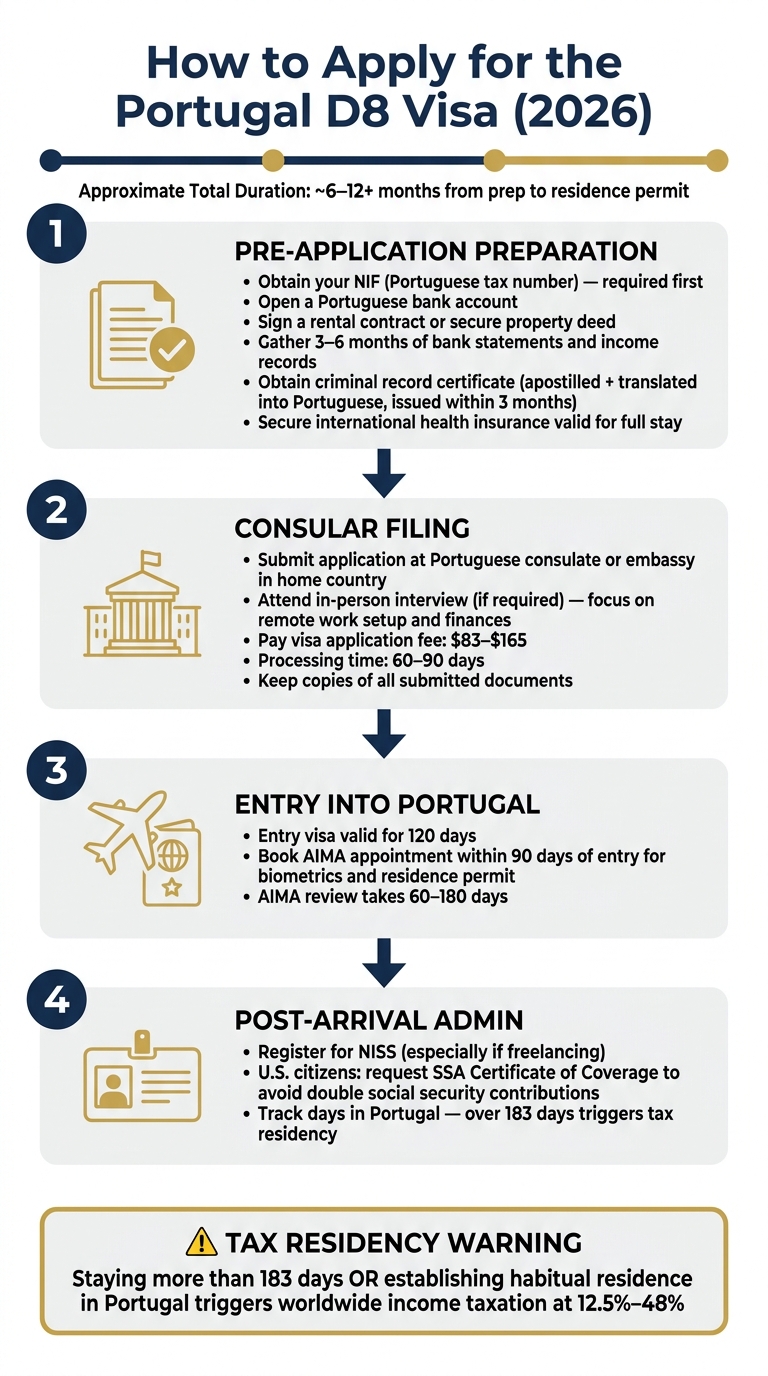
Once your documents are in place, the process usually moves in three parts: file the application, enter Portugal, and finish the residence steps after arrival.
Pre-application preparation
Before you file, get the main items ready: your NIF, accommodation, proof of foreign income, insurance, and a criminal record certificate.
Your NIF comes first because you’ll need it for key setup tasks like signing a lease and handling bank steps. After that, open a Portuguese bank account and line up accommodation with either a signed rental contract or a property deed.
You’ll also need bank statements and income records that show steady qualifying income. It helps to get the criminal record certificate early too, so it doesn’t slow down your filing later.
Once the file is complete, you’re ready for the consular stage.
Consular filing and approval timeline
Submit the application through the Portuguese consulate or embassy in your home country. There may also be an in-person interview, usually focused on your remote work setup and your financial position.
Processing often takes 60 to 90 days. While you wait, keep copies of every document you submitted. It sounds basic, but it can save a lot of stress if anything needs to be checked again.
Arrival in Portugal and residence follow-up
Your first visa lets you enter Portugal and stays valid for 120 days. After you arrive, book your AIMA appointment within 90 days of entry so you can provide biometrics and complete the residence permit step. AIMA’s review can then take another 60 to 180 days.
Two admin tasks matter soon after arrival:
- Register for a NISS, especially if you’re working as a freelancer.
- If you’re a U.S. citizen, request an SSA Certificate of Coverage early so you may avoid paying into both U.S. and Portuguese social security systems under the bilateral totalization agreement.
Timing matters here. The date you arrive can affect whether you become a Portuguese tax resident, which the next section covers.
Portugal tax residency, US tax obligations, social security, and short-stay vs. long-stay outcomes in 2026
When you become a Portuguese tax resident
Once your visa is approved, the next thing to watch is how long you stay and whether Portugal starts to see the country as your main home.
The big rule is simple: if you spend more than 183 days in Portugal during any 12-month period, you can become a Portuguese tax resident. But day count isn’t the only issue. Portugal can also treat you as a tax resident if you keep a habitual residence there, meaning a home that shows Portugal is your main base.
So yes, you can stay under 183 days and still run into residency if your life starts to look settled in Portugal. A long-term lease, kids enrolled in school, or other signs that Portugal has become the center of your life can trigger tax residency too.
| Situation | Residency Result | Tax Exposure |
|---|---|---|
| Under 183 days, no habitual residence | Non-resident | Portuguese-source income only |
| Over 183 days in a 12-month period | Tax resident | Worldwide income at progressive rates |
| Portugal is your principal home on Dec. 31 | Tax resident, even if you stayed under 183 days | Worldwide income |
Income tax and social security for remote workers
Once Portugal treats you as a tax resident, it taxes your worldwide income at progressive rates from 12.5% to 48% on the mainland in 2026. That includes income from U.S. employers, clients, or business entities, not just money earned inside Portugal.
If you’re a U.S. citizen, the IRS still expects a return from you no matter where you live. The U.S.-Portugal tax treaty and the Foreign Tax Credit can help cut down double taxation, but they do not end your U.S. filing duties.
Then there’s social security, which can catch people off guard. Self-employed workers using the recibos verdes system usually pay 21.4% on the net freelance income used for contribution purposes. In practice, that often lands at about 15% of gross income. New registrants usually get a 12-month exemption starting from the registration date.
Americans may also use the U.S.-Portugal Totalization Agreement to avoid Portuguese social security contributions. To do that, they need a Certificate of Coverage from the SSA before the move or soon after arriving.
Most remote workers don’t qualify for IFICI, so the normal progressive tax rates usually apply.
That makes length of stay the main planning issue.
Short-stay vs. long-stay planning examples for 2026
These rules usually lead to two common 2026 paths.
With a short stay, you keep your time in Portugal under 183 days and avoid setting up a habitual residence. In that case, Portugal will usually treat you as a non-resident. That means Portugal taxes only Portuguese-source income, if there is any.
With a long stay, the picture changes. If you go past the 183-day mark or make Portugal your principal home, you will usually become a tax resident. Your worldwide income then moves into Portugal’s progressive tax system. If you’re self-employed, Portuguese social security may apply too unless you already have a Certificate of Coverage. And your U.S. filing duties don’t go away, even if Foreign Tax Credits help offset Portuguese tax.
If your goal is to stay non-resident, track your days with care and avoid setting up a clear home base in Portugal. If your plan is to stay for the long haul, go in expecting residency tax and social security rules to matter from the start.
Conclusion: Is the Portugal D8 visa right for you in 2026?
Put simply: the D8 makes sense only when your income, paperwork, and tax setup all match. It’s mainly for non-EU remote workers with steady income from outside Portugal who can show six months of earnings above €3,680 per month and enough cash to cover early living costs. But that income test is only part of the picture. In many cases, your tax residency ends up being the bigger issue.
The biggest mistake isn’t failing the visa test. It’s moving first and only later finding out what you owe. Before you apply, run the numbers for life in Portugal. If you become a tax resident, your worldwide income may be taxed at progressive rates up to 48%, and if you’re self-employed, you may also have to pay social security unless a Certificate of Coverage applies. The D8 tends to work best in two cases: a shorter stay of under 183 days, or a longer move where Portuguese residency already fits your plans.
It’s probably not the right path if part of your income comes from Portuguese clients, or if you can’t prove six months of steady foreign earnings above the required level.
If your income is stable, foreign, and easy to prove, the D8 can work well. If it isn’t, the process usually brings more friction than freedom.
FAQs
Can passive income help qualify for the D8?
No. The D8 visa is for active professional work like remote employment, freelancing, or self-employment. It is not meant for people living only on passive income.
If your income comes only from pensions, dividends, or rental income, the D7 is the better fit. The D8 requires proof of steady monthly income tied to active work, such as an employment contract or a service agreement with foreign clients.
What if my monthly income changes month to month?
For a D8 visa application, authorities usually focus on your average monthly income from the last three months.
If your income goes up and down from month to month, that’s usually fine. What matters is that your average still meets or exceeds the required threshold, which is often four times the Portuguese minimum wage.
To make your case clear, include proof such as:
- Bank statements
- Service agreements
- Professional contracts
That way, you can show that even with month-to-month swings, you still meet the income requirement.
How can I stay in Portugal without becoming a tax resident?
To avoid becoming a Portuguese tax resident, you usually need to stay clear of the main triggers: don’t spend more than 183 days in Portugal during any 12-month period, and don’t set up your habitual residence or your “center of life” there.
If you stay under 183 days, Portugal will generally tax only Portuguese-source income, not your worldwide income. That said, a D8 visa can make things less straightforward. Longer stays, renting or buying a home, and building your day-to-day life in Portugal often point toward tax residency anyway.
