
Dubai can work well for expats in 2026, but only if the math, visa, and rules fit your life. I’d sum it up like this: you get 0% personal income tax in the UAE, a stable AED/USD peg at 3.67, and many visa paths. But you also face high rent, steep school costs, strict laws, and extra U.S. tax filing if you’re American.
If I were making the call, I’d focus on these points first:
- Visa first: your residency route affects housing, banking, and family sponsorship.
- Housing is expensive: singles often spend AED 8,100–16,900 a month; families can spend AED 26,200–57,200+.
- Upfront cash is high: deposit, agency fee, Ejari, DEWA, and cooling can add up fast.
- Americans still file U.S. taxes: Dubai is tax-free locally, but the IRS still applies.
- Daily life is safe but strict: public behavior, alcohol, drugs, speech, and even photography have hard limits.
- Families need early school planning: top schools can have 12–18 month waitlists.
Here’s the short version: if you have a strong income, a clear visa route, and you’re fine with the rules, Dubai can be a good base. If you’re moving for “tax savings” alone, that’s often not enough.
A few numbers make the picture clearer:
- About 50,000 to 60,000 Americans live in Dubai
- Remote Work Visa: at least $3,500/month income
- Golden Visa: often starts at AED 2 million in property
- VAT: 5%
- Summer DEWA bills: often AED 1,200–1,800/month
- Internet: about AED 399/month
- Family health insurance: often AED 1,200–3,000/month
Quick comparison
| Topic | What I’d know upfront |
|---|---|
| Residency | Employment, Green, Golden, Remote Work, Investor, and Retirement visas all have different rules |
| Cost | Rent is the main pressure point, then school fees and healthcare |
| Banking | Usually easier after Emirates ID and Ejari are done |
| Taxes | No UAE personal income tax, but U.S. citizens still file and report |
| Lifestyle | Modern, safe, hot, expensive, and rule-heavy |
| Best fit | Professionals, founders, investors, retirees, and remote workers with enough income |
If you’re thinking about Dubai, I’d treat it like a numbers-and-paperwork move first, and a lifestyle move second.
sbb-itb-39d39a6
Residency and visa routes: how expats legally live in Dubai
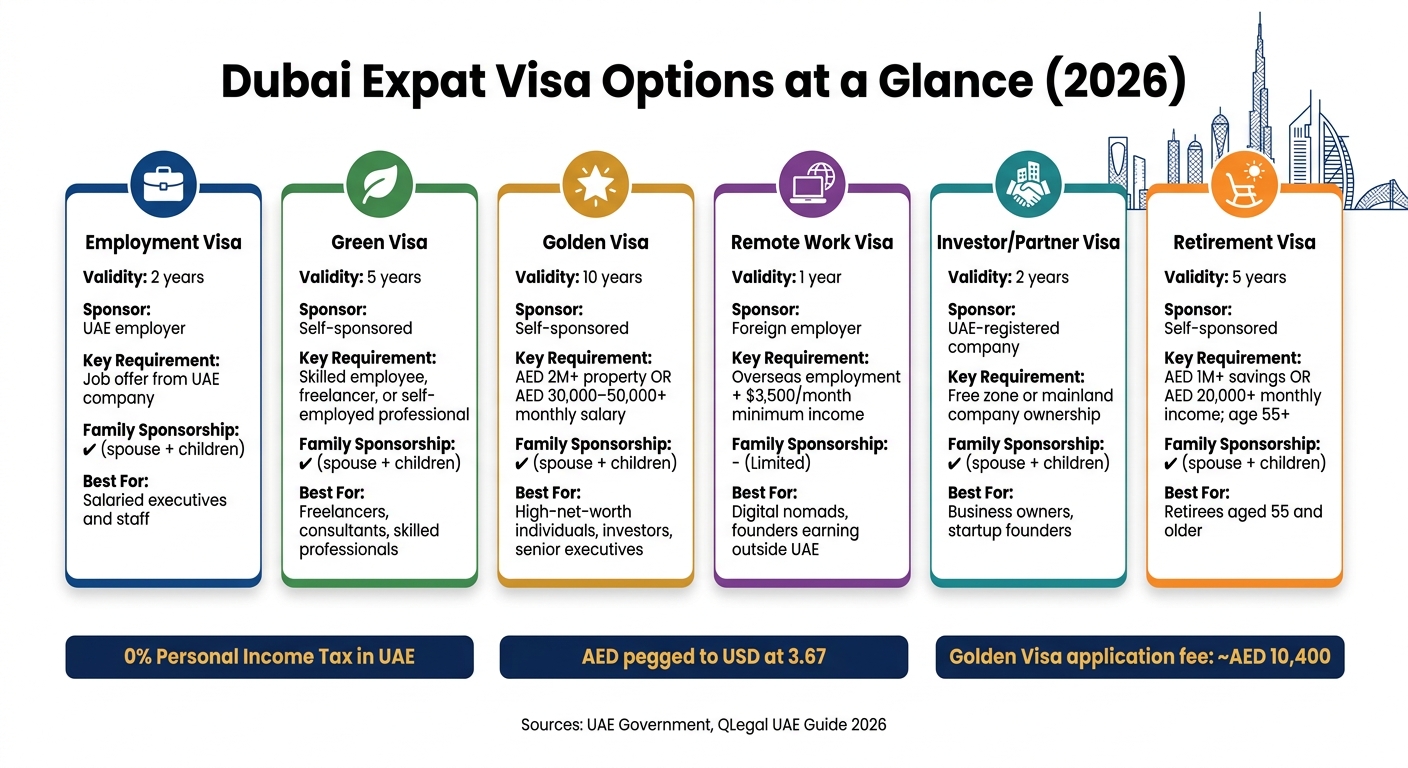
Your visa choice shapes almost everything in Dubai. It affects whether you can rent a home, open a bank account, and sponsor your family. Dubai gives expats several residency paths, including options you can sponsor yourself. The table below helps line up each route with how you earn, whether you need family sponsorship, and how long you plan to stay.
| Visa Type | Validity | Sponsor Required | Main Requirement | Best For | Family Sponsorship |
|---|---|---|---|---|---|
| Employment Visa | 2 years | UAE employer | Job offer from UAE company | Salaried executives and staff | Can sponsor spouse and children |
| Green Visa | 5 years | Self-sponsored | Skilled employees, freelancers, self-employed professionals | Freelancers, consultants, skilled professionals | Can sponsor spouse and children |
| Golden Visa | 10 years | Self-sponsored | AED 2M+ property or AED 30,000–50,000+ monthly salary | High-net-worth individuals, investors, senior executives, exceptional talent | Can sponsor spouse and children |
| Remote Work Visa | 1 year | Foreign employer | Proof of overseas employment + $3,500/month minimum income | Digital nomads, founders who earn outside the UAE | Limited family sponsorship |
| Investor/Partner Visa | 2 years | UAE-registered company | Free zone or mainland company ownership | Business owners, startup founders | Can sponsor spouse and children |
| Retirement Visa | 5 years | Self-sponsored | AED 1M+ in savings or AED 20,000+ monthly income | Retirees aged 55 and older | Can sponsor spouse and children |
A clear shift is happening: more expats are choosing self-sponsored routes like the Green Visa and Golden Visa. That makes sense. On a standard employment visa, your residency is tied to your employer. If the job ends, the grace period starts, and then visa cancellation follows.
"The right UAE visa is only one part of relocation. For founders, investors, and senior professionals, the bigger question is whether the full legal structure supports your business, tax, banking, and asset protection goals." – QLegal UAE Guide
Best visa options by expat profile
If you’re a salaried executive working for a UAE company, the standard 2-year employment visa is usually the default route. The employer handles it, and it can be renewed. The downside is simple: your residency goes with your job. If your contract ends, you get a short grace period before cancellation.
For freelancers and independent consultants, the Green Visa is often the better fit. It lasts five years and comes with degree and income thresholds. Freelance permits through free zones cost from AED 5,750 to AED 15,000, depending on the zone.
If you’re a founder earning outside the UAE, the Remote Work Visa gives you a one-year option. You need proof of overseas employment and at least $3,500 in monthly income. A lot of expats use it as a test run before going all in on a company setup or a longer visa route.
For property investors, the Golden Visa opens up at AED 2 million in real estate value. It runs for 10 years, and the application fee is about AED 10,400. There’s also a salary route: senior executives earning AED 30,000 or more per month may qualify without buying property.
Retirees age 55 and older can apply for a 5-year retirement visa. The financial threshold is either AED 1 million in savings or at least AED 20,000 in monthly income.
For family sponsorship, the rules are narrower than some people expect. Dependent visas cover legally married spouses and children. Other partnership setups do not qualify. Fees for dependent visas usually range from AED 3,500 to AED 5,500 per person.
Documents, timelines, and compliance steps
The residency process usually moves in a set order. Miss one step, or do it too late, and delays start piling up. Banking is often where people feel that delay the most.
| Step | Action | Typical Timeline |
|---|---|---|
| 1 | Document attestation in the U.S. | 4–8 weeks before departure |
| 2 | Entry permit issuance | 1–5 business days |
| 3 | Medical fitness test and biometrics | Week 1 in Dubai |
| 4 | Visa issuance and Emirates ID delivery | Weeks 2–4 in Dubai |
| 5 | Tenancy contract and Ejari registration | Immediately after Emirates ID |
| 6 | DEWA utility setup | After Ejari |
| 7 | Bank account opening | 1–3 weeks after Emirates ID |
The part that catches many people off guard is document attestation. If your degree, marriage certificate, or birth certificate was issued in the U.S., it needs an apostille and then UAE embassy attestation. That process takes 4 to 8 weeks, so it needs to start before you book your flight.
Once you arrive in Dubai, the medical fitness test comes early. It includes a blood test and chest X-ray, and it’s mandatory for all residency applicants. This usually happens in the first week. After that, visa issuance moves ahead, and the physical Emirates ID card usually arrives within two to four weeks.
Your Emirates ID is the key that opens the next set of steps. You need it to register your tenancy contract through Ejari. That registration is required before utilities and many banking tasks can move forward. Ejari costs about AED 220 per year, and it is not optional. Without it, the lease is not fully registered.
Banking usually comes after your Emirates ID is active. Banks ask for proof of source of funds, source of wealth, and a valid Emirates ID. If you’re a U.S. citizen, you’ll also need to complete FATCA-related bank forms.
Once the visa process is in motion, housing is the next practical step, because both Ejari and DEWA depend on your Emirates ID.
Housing and cost of living: neighborhoods, rent, and monthly budgets
Once your Emirates ID is active, housing becomes the next big call. Most leases run for 12 months, and rents jumped in 2024 and 2025. They’re still going up in 2026, just not as fast.
In most cases, landlords want payment through 1, 2, or 4 post-dated checks. Monthly direct debit exists, but mostly in some newer buildings. If you can pay with a single check, you may get a 5% to 10% discount on rent.
The move-in bill is often where people get caught off guard. Along with rent, plan for:
- A 5% deposit for unfurnished units
- A 10% deposit for furnished units
- A 5% agency fee
- About AED 220 for Ejari
- AED 2,000 for apartment DEWA
- AED 4,000 for villa DEWA
- AED 1,000 to AED 3,000 for cooling, if the building charges it separately
Where expats live: Marina, Downtown, JVC, Al Barsha, Dubai Hills, and lower-cost areas
Start with your commute, not the view. That sounds boring, but it saves a lot of pain later. Being close to the Metro can add 10% to 15% to rent, so compare areas and travel times before you sign anything. And don’t trust map apps at face value. Test the trip at 8:00 AM on a weekday. Dubai traffic can make a short distance feel much longer.
Here are the main neighborhoods and typical monthly rent bands for 2026:
| Area | Best Fit | Typical Monthly Rent | Metro Access | Notes |
|---|---|---|---|---|
| Dubai Marina | Young professionals | AED 6,600 – 9,600 (1BR) | Yes | Waterfront lifestyle, high-energy dining scene |
| Downtown Dubai | Corporate, high-budget | AED 7,500 – 10,800 (1BR) | Yes | Prestige address, walkable, very high building quality |
| DIFC | Senior finance professionals | AED 15,000 – 30,000+ | Yes | Walk-to-office convenience, premium pricing |
| JVC | Families, budget-conscious | AED 4,300 – 6,000 (1BR) | No (car required) | Quiet, community feel, newer mid-range buildings |
| Dubai Hills | Families, premium | AED 14,000 – 22,000 (3BR villa) | Limited | Greenery, schools, premium feel |
| International City | Budget singles | AED 1,800 – 2,700 (studio) | No | Most affordable, limited lifestyle amenities |
Al Barsha is a common pick for families focused on schools. Mirdif tends to appeal to people who want a suburban villa setup. If keeping costs down is the main goal, International City and Al Nahda are usually the first places people check.
One-time setup costs and ongoing monthly expenses
After choosing an area, the next shock is usually the upfront cash. Move-in costs pile up fast.
| Item | Cost (AED) |
|---|---|
| Security deposit (unfurnished) | 5% of annual rent |
| Security deposit (furnished) | 10% of annual rent |
| Agency commission | 5% of annual rent |
| Ejari registration | ~AED 220 |
| DEWA deposit (apartment) | AED 2,000 |
| DEWA deposit (villa) | AED 4,000 |
| Cooling deposit | AED 1,000 – AED 3,000 |
Housing usually takes up 30% to 55% of an expat’s monthly budget. DEWA bills are easier in winter, but from June through September, you should plan for AED 1,200 to AED 1,800 a month because the air conditioning runs almost nonstop. There’s also a 5% municipality fee added to your DEWA bill, split across 12 monthly installments. Internet is about AED 399 per month for a 1 Gbps fiber connection.
For families, school fees sit in a category of their own. In many cases, they can cost more than housing.
Here’s what a realistic monthly budget looks like in 2026:
| Profile | Monthly Budget (AED) | Monthly Budget (USD approx.) |
|---|---|---|
| Single person | AED 8,100 – 16,900 | $2,205 – $4,600 |
| Couple | AED 14,100 – 27,400 | $3,840 – $7,460 |
| Family | AED 26,200 – 57,200+ | $7,135 – $15,575+ |
Those ranges show how big the gap can be between a lower-cost setup in JVC or International City and a more upscale life in Marina, Downtown, or DIFC. Families see the biggest swing, mainly because school fees can change the math in a hurry.
Banking, taxes, and wealth structuring for U.S.-connected expats
Banking gets much easier once your residency, address, and tax paperwork are sorted. Dubai doesn’t charge personal income tax, but U.S.-connected expats still have to deal with U.S. filing and reporting.
After housing, banking is the next big gatekeeper for day-to-day life in Dubai.
Opening accounts and moving money in practice
Opening a bank account in Dubai is pretty straightforward once you have the right documents ready. Most banks will ask for your Emirates ID, passport, an Ejari-registered tenancy contract as proof of address, and six months of bank statements that show where your money came from. Banks also ask source-of-funds and source-of-wealth questions as part of KYC checks.
If you’re a U.S. citizen or green-card holder, there’s one more layer. UAE banks usually require a signed W-9 form for FATCA compliance, and they report U.S. account details under FATCA.
Some salary-transfer accounts have no monthly fee. And because the AED is pegged to the U.S. dollar, USD/AED transfers tend to stay stable.
It’s smart to keep your U.S. bank accounts open after you move. Opening new U.S. accounts while living abroad can be hard, and you’ll still want U.S. banking access for income flows and your credit profile.
For investing, Americans abroad often use brokerages like Charles Schwab and Interactive Brokers (IBKR). Stick with U.S.-domiciled funds if you can, since that helps you avoid PFIC problems.
Tax reality for Dubai residents in 2026
For U.S.-connected expats, banking and tax planning go hand in hand from the start.
Dubai applies 5% VAT to most goods and services. For Americans, though, the tax picture doesn’t stop there. The U.S. taxes citizens on worldwide income no matter where they live. In 2026, the Foreign Earned Income Exclusion (FEIE) lets you exclude about $130,000 of foreign earned income, and the Foreign Housing Exclusion can add around $50,000 more for Dubai residents. To use the Physical Presence Test, you need to spend at least 330 full days outside the U.S. during a 12-month period.
Self-employed Americans get less of a break. The FEIE does not cover Self-Employment tax, so sole proprietors still owe the full 15.3% SE tax to the IRS even if they live in Dubai. In practice, that’s the part many people miss at first.
You’ll also want to budget for compliance. Annual expat tax prep from a specialist usually runs from $500 to $1,500.
If you’re leaving a high-tax U.S. state, cut residency ties before you go. That usually means canceling your driver’s license, updating voter registration, and keeping clear records of the move.
Here’s how the main structures compare for U.S.-connected expats in 2026:
| Structure | UAE Tax Treatment | U.S. Reporting Burden | Typical Use Case |
|---|---|---|---|
| Individual (Expat) | 0% personal income tax | High: Form 1040, FEIE, FBAR, FATCA | Salaried employees and freelancers under the FEIE limit |
| UAE Onshore (Mainland) | 9% on profits above AED 375,000 | Very high: U.S. forms may apply, including Form 5471 for CFCs | Businesses needing local UAE contracts or physical retail presence |
| UAE Free Zone | 0% on qualifying income; 9% otherwise | Very high: U.S. forms may apply, including Form 5471 for CFCs | International consulting, tech startups, and service providers |
| Offshore Holding | 0% if no local business activity | High: asset reporting requirements | Asset protection, privacy, and holding international real estate or IP |
How entrepreneurs and investors can structure before or after the move
For founders and investors, structure shapes how much of Dubai’s tax upside you actually keep. Your entity choice affects banking access, tax treatment, and asset protection from day one.
For founders, the main decision is usually mainland vs. free zone. A mainland company gives you access to UAE government contracts and local retail. But profits above AED 375,000 are taxed at 9%, and compliance is heavier. A free-zone company can get a 0% rate on qualifying income if it meets the legal rules, which is why many people use it for international services.
If you have major assets, a DIFC will matters. Without one, UAE assets pass under Sharia inheritance rules by default. That’s not the kind of issue you want to discover too late.
With banking and tax sorted, the next set of questions usually shifts to healthcare, schools, transport, and local rules.
Daily life in Dubai: healthcare, schools, transport, laws, and safety
With residency and banking sorted, everyday life usually comes down to a few practical things: healthcare, school, getting from place to place, and knowing the rules.
Healthcare, schooling, and getting around the city
Health insurance is a legal requirement for all Dubai residents, and you need an active policy to issue or renew a residency visa. Employers must cover employees, but they do not have to cover dependents. So if you’re sponsoring a spouse and children, plan for that cost yourself. A mid-range family policy for four usually runs about AED 1,200 to AED 3,000 per month.
Most expats use private healthcare. Public healthcare is mostly set aside for UAE nationals. In practice, that means private clinics and hospitals, including JCI-accredited facilities, are where most foreign residents go for care, and same-day specialist access is often available. If you pay out of pocket, a GP visit usually costs AED 250 to AED 600, while a specialist visit tends to cost AED 350 to AED 900. Many insurance plans also use co-pays, often around 20%, with caps of AED 50 to AED 100 per visit.
Bring your Emirates ID or UAE Pass with you. Most providers use one of them to verify insurance. In an emergency, call 999 for general emergencies or 998 for an ambulance. Government hospitals do provide emergency care, but if your insurance does not cover those facilities, you may be billed the full amount.
For families, school is often the next big budget item after housing.
School fees can easily sit in the same range as rent. Top British, American, and IB schools often have waitlists of 12 to 18 months, so it makes sense to apply to four to six schools at least a year before your move. Tuition is only part of the picture. You also need to budget for school buses, uniforms, and after-school activities. Those extra costs often look like this:
- School bus: AED 5,000 to AED 8,000 per year
- Uniforms: AED 1,000 to AED 2,000
- Extracurriculars: AED 2,000 to AED 5,000
Typical annual fee ranges are below:
| Curriculum | Annual Fee Range | Example Schools | Key Notes |
|---|---|---|---|
| American | AED 50,000 – 120,000 | American School of Dubai, Dubai American Academy | Follows U.S. GPA/AP system; strong U.S. college counseling |
| British | AED 40,000 – 100,000+ | Dubai College, JESS Arabian Ranches | Highly competitive; strong academic reputation |
| IB | AED 60,000 – 110,000 | GEMS World Academy, Dubai International Academy | Global curriculum; high university acceptance rates |
| Indian | AED 10,000 – 35,000 | Various GEMS Indian curriculum schools | Most affordable; follows CBSE or ICSE standards |
After housing and school, transport tends to shape daily life more than people expect.
Getting around Dubai is often a choice between cheaper public transit and the reality of needing a car. A lot depends on where you live versus where you work. The Metro usually costs about AED 300 to AED 500 per month and works best when both home and office are near a station. In villa areas like Mirdif or Arabian Ranches, driving is often part of daily life. That also means planning for Salik tolls of AED 4 to AED 6 per pass, fuel, and fast-moving highway traffic.
Before buying a car, check whether your U.S. license can be converted directly to a UAE license. If it can, you may be able to skip a full driving test.
Daily life also gets smoother once you know what is and is not acceptable in public.
Local rules, social expectations, and personal safety
Dubai is widely seen as one of the safest cities in the world, and a big part of that comes down to strict enforcement. Put simply, the rules are not there just for show.
Some of the biggest surprises for new expats are listed below.
| Category | Rule | Penalty / Risk |
|---|---|---|
| Alcohol | Legal for non-Muslims 21+ in licensed venues or private homes | Fines or arrest for public intoxication; zero tolerance for drinking and driving |
| Drugs | Absolute zero tolerance, including CBD and some prescription medications | Minimum 4 years in prison, followed by deportation |
| Public Behavior | No profanity, obscene gestures, or excessive public displays of affection | Fines, arrest, or deportation |
| Photography | Illegal to photograph people without consent or to film government and military buildings | Device confiscation, fines, or legal action |
| Dress Code | Modest dress in malls and government buildings; swimwear is fine at beaches | Refusal of entry; security may ask you to cover up |
| Ramadan | No eating, drinking, or smoking in public during daylight hours | Fines or warnings for non-compliance |
| Online Speech | No defamatory or insulting content about individuals or the UAE government | Heavy fines and imprisonment under cybercrime laws |
Conclusion: deciding whether Dubai fits your lifestyle, tax, and residency goals
Dubai tends to work best for people with strong income, a clear plan, and the discipline to follow the rules. The 0% personal income tax gets most of the attention. But the upside only makes sense when you weigh it against housing, school fees, and the paperwork that comes with living there. At this stage, the main issue is simple: does the full move make sense for your income, your family, and your visa route?
Housing is usually the biggest swing factor. In plain English, where you live can make Dubai feel either doable or very expensive. That’s why picking the right neighborhood matters just as much as picking the right visa. If you have kids, school planning needs to happen early because tuition can end up costing as much as rent.
Your visa choice also shapes almost everything that comes next. An employee, founder, investor, remote worker, and retiree all face different sponsorship rules, renewal dates, and family coverage terms. Get that choice wrong, and the rest of the move gets harder than it needs to be.
For U.S. citizens, there’s still another layer to handle. You still need a clean U.S. tax and brokerage setup before relocating. Skip that prep, and things can get messy fast on the admin side.
Dubai is safer than many major Western cities, but that comes with a clear tradeoff: learn the rules and follow them from day one. Zero tolerance for drugs and strict rules around public behavior and debt apply to every resident, no matter their nationality. If you can handle the cost, the compliance work, and the lifestyle tradeoffs, Dubai can be an efficient base. If you can’t, the tax angle on its own won’t carry the move.
FAQs
How much income do I need to live comfortably in Dubai?
In 2026, a comfortable budget in Dubai means your total monthly spending plus rent.
A practical benchmark is about $4,463 per month in total, with rent for a central one-bedroom at around $2,288 per month.
Here’s a simple way to think about it:
- Single expat: AED 12,000–18,000 per month
- Couple: AED 20,000–30,000 per month
- Family of four: AED 35,000–60,000 per month
That range gives you a decent buffer for day-to-day costs while keeping housing in the picture, which is where budgets in Dubai can swing fast.
Which Dubai visa is best for my situation?
The best Dubai visa depends on your profile.
- If you have a job offer, the usual route is an employment visa.
- If you’re a high-net-worth investor, a 10-year Golden Visa may fit. This can be through AED 2M+ in property or a qualifying AED 2M+ business.
- If you’re a senior specialized professional, you may qualify for the Golden Visa under Talent. That includes some categories with a monthly salary of AED 30,000+.
- If you’re self-employed, a freelance permit is often the best pick. These usually run for 1–2 years in a free zone.
What do Americans still have to file after moving to Dubai?
Americans who move to Dubai usually still have to file U.S. taxes. That’s because the United States taxes its citizens on worldwide income, even if they live and work abroad.
In many cases, that means filing Form 1040 each year. Depending on your situation, you may also need:
- Form 1116
- Form 2555
- FBAR (FinCEN 114)
- Form 8938
There’s another issue many people miss: PFIC rules can apply to non-U.S.-domiciled investments. Those rules can create tax headaches if you hold certain foreign funds or similar assets.
State taxes can also stay in the picture. If you don’t properly cut ties with your former state, you may still have a state tax filing duty even after relocating to Dubai.
