
Panama can cost about $1,130/month for one person or $2,500/month for a couple, but the visa you pick and your U.S. tax filings matter just as much as rent.
If I were sizing up a move to Panama in 2026, I’d boil it down to three things:
- Cost: Panama City is at the top end, while places like Boquete, Coronado, David, and Santiago are often lower.
- Visa: Americans usually look at Friendly Nations, Pensionado, Qualified Investor, or the Digital Nomad Visa.
- Taxes: Panama usually taxes only Panama-source income, but I still have to file U.S. taxes, and I may also need FBAR and FATCA forms.
A few numbers stand out fast:
- Rent: about $400 to $2,500/month, based on city and neighborhood
- Private specialist visit: about $50 to $100
- Digital Nomad income floor: $36,000/year
- Pensionado pension floor: $1,000/month
- Friendly Nations entry point: $200,000
- Qualified Investor real estate floor: $300,000 until October 15, 2026
Quick comparison
| Topic | What I’d know first |
|---|---|
| Monthly cost | Roughly $1,130 for a modest single budget, $2,500 for a comfortable couple, and $4,850+ for a higher-spend couple |
| Lowest-cost long-stay option | Digital Nomad Visa has low filing fees, but it is temporary and does not lead to permanent residency |
| Best fit for retirees | Pensionado gives permanent residency from day one if I meet the pension rule |
| Fast permanent residency | Qualified Investor gives permanent residency right away, but costs much more |
| Main tax point | Panama may not tax my foreign income, but the IRS still does |
The short version: if I want lower living costs, a clear residency path, and a dollar-based economy, Panama is easy to see why people pick it. But I’d still sort out my visa plan, banking setup, and U.S. filing duties before I move.
sbb-itb-39d39a6
Cost of living in Panama for Americans in 2026
Housing is the main thing that swings your monthly budget up or down. Panama City sits at the top of the range, while inland towns are far easier on the wallet. Overall, Panama costs less than the U.S., but your total spend comes down to where you live and how you like to live.
Housing, utilities, and neighborhood costs by location
Housing will usually be your biggest monthly expense. And in Panama, location matters more than almost anything else.
If you want Panama City’s top-tier neighborhoods, Punta Pacifica is where costs jump. You’re paying for luxury towers, nearby major hospitals, and a more polished city setup. Head to a mountain town like Boquete or a beach area like Coronado, and rent drops quite a bit. Boquete also has a cooler climate, which can trim your air-conditioning bill.
| Location | 1-Bedroom Rent | Utilities & Internet | Lifestyle Notes |
|---|---|---|---|
| Panama City (Punta Pacifica) | $1,200 – $2,500 | $150 – $200 | Luxury towers, major hospitals, requires a car for most errands |
| Panama City (El Cangrejo) | $700 – $1,200 | $80 – $150 | Walkable, central, popular with expats |
| Boquete | $600 – $1,200 | $100 – $150 | Mountain climate, lower AC costs, large retiree community |
| Coronado | $500 – $1,000 | $120 – $170 | Gated beach community, 90 minutes from Panama City |
| David / Santiago | $400 – $800 | $60 – $120 | Affordable provincial hubs, hot climate, local feel |
Fiber internet in most expat-heavy areas costs about $30 to $60 per month for 50–200 Mbps service.
For many Americans, the first big budget choice is pretty simple: Panama City convenience or lower-cost inland living.
Groceries, dining, healthcare, and transportation costs
Groceries for a couple usually land between $300 and $500 per month, depending on how often you buy imported products instead of shopping at local markets. That difference adds up fast.
Eating out can stay cheap if you stick with local spots. A meal at a fonda, which is a small neighborhood diner, runs about $3 to $10. Mid-range restaurant meals are more in the $15 to $25 per person range.
Healthcare is one area where many Americans notice a big gap versus back home. A private specialist visit costs $50 to $100, and dental cleanings run $40 to $60. Private health insurance usually falls between $100 and $300 per month, based on your age and plan. Medicare does not cover medical expenses in Panama, but private care is often 40% to 70% less than in the U.S..
Getting around Panama City is cheap if you use public transit. The Metro costs just $0.35 per ride. Uber and taxis usually start around $5 to $10 for most trips in the city. If you drive, gasoline costs about $0.85 per liter.
Sample monthly budgets by lifestyle and location
The table below gives a solid picture of monthly totals across three spending levels.
| Category | Modest (Single) | Comfortable (Couple) | Higher-End (Couple) |
|---|---|---|---|
| Housing | $600 | $1,200 | $2,200 |
| Utilities & Internet | $80 | $150 | $250 |
| Groceries | $250 | $450 | $700 |
| Healthcare / Insurance | $50 | $250 | $500 |
| Transportation | $50 | $150 | $400 |
| Entertainment | $100 | $300 | $800 |
| Total | ~$1,130 | ~$2,500 | ~$4,850+ |
Retirees living on fixed income get one more piece to factor in. The Pensionado visa includes legally required discounts, including:
- 25% off utility bills
- 50% off movies and concerts
- 25% off airline tickets
- 20% off medical consultations
There are also two costs that catch many new arrivals by surprise. First, initial visa and legal fees usually run $3,000 to $5,000 upfront. Second, some Panamanian banks limit U.S. accounts due to FATCA compliance. Because of that, it’s smart to keep one U.S. bank account open for transfers and bill pay.
Those startup costs and banking limits depend on which residency path you choose, which the next section compares.
Visa and residency options Americans can use in Panama
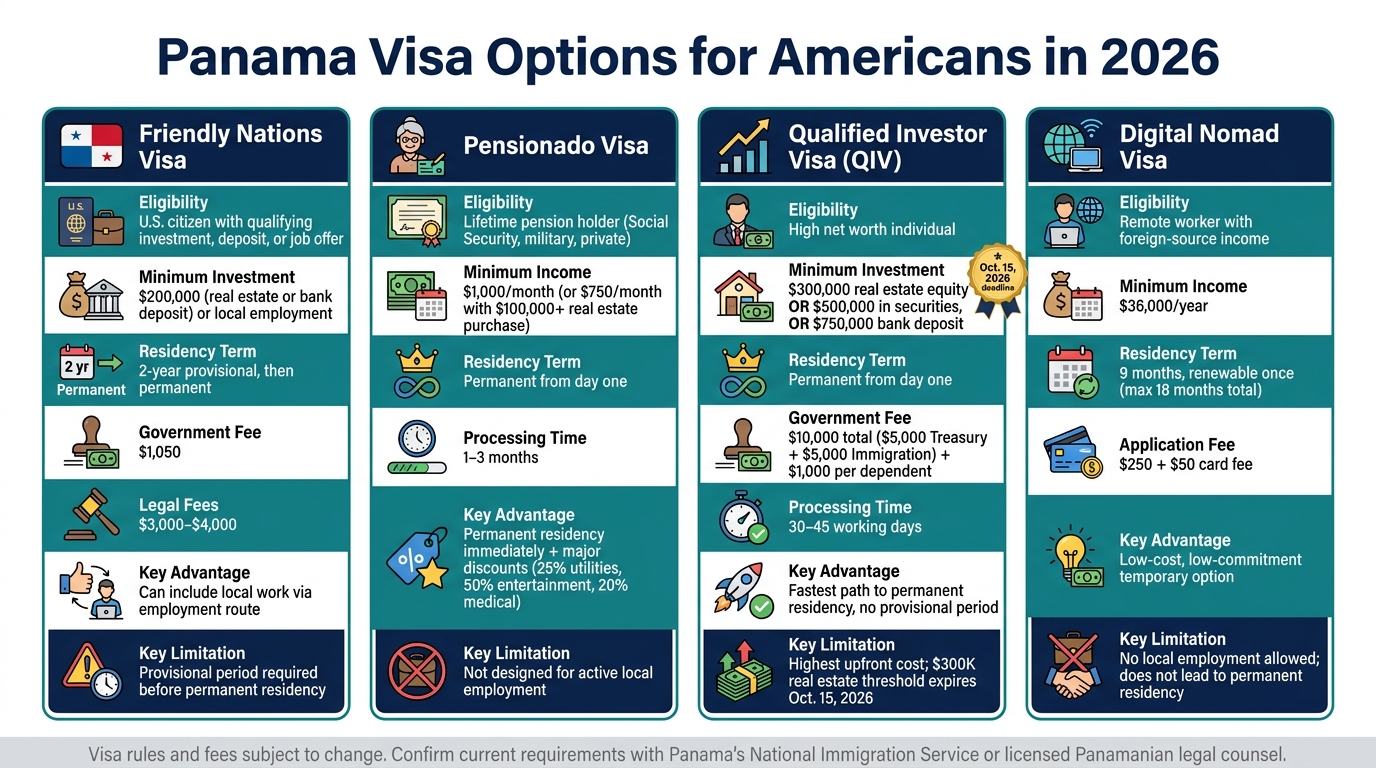
Panama gives Americans a few legal ways to stay long term. The best fit comes down to three things: where your income comes from, your age, and how much money you can put to work.
One practical note up front: all applications must go through a licensed Panamanian immigration attorney. So when you compare options, don’t look only at government fees. Add legal fees too. Your budget should help you match the right residency path to your income and your timing.
Friendly Nations residency for U.S. citizens
The Friendly Nations Visa is one of the most common paths for U.S. citizens. To qualify, you need one of the following: a real estate purchase worth at least $200,000, a $200,000 Panamanian bank deposit held for three years, or a formal job offer from a Panamanian company.
This route starts with a 2-year provisional card. After that, you can apply for permanent residency. Government fees are $1,050 for the main applicant, and legal fees usually add $3,000 to $4,000.
| Step | Requirement | Time Frame | Main Cost Items |
|---|---|---|---|
| 1. Hire attorney | Licensed Panamanian immigration lawyer | Before filing | $3,000 to $4,000 legal fees |
| 2. Prepare U.S. documents | FBI background check and birth certificate apostilled before submission | Before filing | Apostille fees |
| 3. Establish qualifying investment, deposit, or job offer | Real estate, bank deposit, or employment | Before filing | $200,000 minimum |
| 4. Submit application | Full dossier to immigration authority | Filing day | $1,050 government fee |
| 5. Receive provisional card | 2-year residency card issued | About 2 to 4 months after filing | Included in above |
| 6. Convert to permanent | Petition within 6 months of card expiry | After the two-year provisional period | Additional legal fees |
There’s one deadline here that matters a lot: you must start the permanent residency conversion within six months of your provisional card’s expiration. If you miss that window, the case lapses.
Pensionado and digital nomad visa options
The Pensionado visa is aimed at retirees who receive a lifetime pension of at least $1,000 per month. Accepted income sources include U.S. Social Security, military pensions, and private pension plans. If you also buy Panamanian real estate worth at least $100,000, the minimum monthly pension drops to $750. This visa grants permanent residency from day one, and processing usually takes one to three months.
For remote workers who want to try Panama without going straight into permanent residency, the Digital Nomad Visa is the lighter option. It requires at least $36,000 per year in foreign-source income. The application fee is $250, plus $50 for the physical card. It lasts 9 months and can be renewed once, for a total stay of up to 18 months. It does not allow employment in Panama and does not lead to permanent residency.
If your goal is permanent residency right away, the investor paths below move faster because they skip the provisional stage.
Investor and business-based residency routes
The Qualified Investor Visa (QIV) gives you permanent residency immediately. There is no provisional period. To qualify, you need one of these investments: at least $300,000 in Panamanian real estate equity, $500,000 in securities, or a $750,000 bank deposit.
Government fees are steep: $10,000 total – split between $5,000 to the Treasury and $5,000 to Immigration – plus $1,000 per dependent. Processing usually takes 30 to 45 working days.
The timing matters here. The $300,000 real estate threshold is a temporary reduction that ends on October 15, 2026. After that, it goes back up to $500,000. If you’re close to buying property and want to use this route, that date is worth watching.
| Visa Type | Main Eligibility | Min. Income or Investment | Term | Key Advantage | Key Limitation |
|---|---|---|---|---|---|
| Friendly Nations | U.S. citizen with qualifying investment, deposit, or job offer | $200,000 (real estate or bank deposit) or employment | 2-year provisional, then permanent | Can include local work via employment route | Provisional first, then permanent |
| Qualified Investor | High net worth | $300,000 real estate equity (until Oct. 15, 2026), $500,000 securities, or $750,000 deposit | Permanent from day one | Permanent immediately | High government fees |
| Pensionado | Lifetime pension holder | $1,000/month ($750 with real estate) | Permanent from day one | Permanent immediately | Not designed for active local employment |
| Digital Nomad | Remote worker | $36,000/year foreign income | 9 months, renewable once | Low-cost temporary option | No local employment; no path to permanent residency |
Visa rules and government fee schedules can change. Before you file anything, confirm the current requirements with Panama’s National Immigration Service or with qualified Panamanian legal counsel.
How taxes work when an American lives in Panama
Panama makes part of the tax picture simpler. The U.S. does not. If you’re an American in Panama, you still have to deal with two tax systems at once, and they don’t use the same playbook.
Panama’s territorial tax system explained
Panama uses a territorial tax system. That means Panama taxes Panama-sourced income and usually does not tax foreign-sourced income. So the big issue is simple on paper but tricky in practice: where did the income come from?
For income that is Panama-sourced, Panama’s individual tax brackets are:
- 0% on the first $11,000
- 15% on income from $11,001 to $50,000
- 25% on income above $50,000
Panama also charges a 7% sales tax (ITBMS), with higher rates on alcohol and tobacco.
Here’s how common income types usually fall under Panama’s system:
| Income Type | Panama-Sourced (Taxable) | Foreign-Sourced, not taxed by Panama |
|---|---|---|
| Employment | Work for a Panama employer or local Panama clients | Remote work for foreign employers or clients |
| Business | Sales to Panama customers | Online business serving exclusively non-Panamanian clients |
| Investment | Dividends from Panama corporations; rent from Panama property | U.S. stock dividends; interest from foreign banks; foreign real estate rent |
| Retirement | Local Panamanian pensions | U.S. Social Security; U.S. military or private pensions |
One detail trips people up all the time: work performed while you are physically in Panama can still be treated as Panama-sourced income in some cases. So “my client is abroad” does not always end the discussion.
On the property side, primary residences valued under $120,000 are fully exempt from Panama property tax. If you sell real estate, capital gains are taxed at 10% of the gain, or there is a 3% withholding on the total sale price as an advance payment.
U.S. tax filing, FEIE, and foreign account reporting requirements
Living in Panama does not end your U.S. filing duty. The U.S. taxes citizens on worldwide income, no matter where they live, so you still file Form 1040 every year.
One of the main tools for expats is the Foreign Earned Income Exclusion (Form 2555). For 2026, it lets qualifying Americans exclude up to $132,900 of foreign wages. To use it, you need to meet either the bona fide residence test or the physical presence test.
That said, there’s a catch many freelancers learn the hard way: the FEIE can reduce income tax, but it does not wipe out self-employment tax. If you’re self-employed, you can still owe 15.3% self-employment tax on net earnings.
Because there is no U.S.-Panama income tax treaty, the Foreign Tax Credit (FTC) is usually the main way to prevent double taxation on income that both countries tax.
Once you’ve sorted out where the income is sourced, the next step is figuring out which U.S. forms still follow you.
| Requirement | Form | Threshold |
|---|---|---|
| Annual income tax return | Form 1040 | All U.S. citizens, regardless of income |
| Earned income exclusion | Form 2555 | Up to $132,900 (2026) of foreign wages |
| Foreign bank reporting | FinCEN 114 (FBAR) | More than $10,000 total in foreign accounts at any time during the year |
| Foreign asset reporting | Form 8938 (FATCA) | Over $200,000 on Dec. 31 or $300,000 at any time for unmarried filers abroad |
| Foreign corporation | Form 5471 | More than 10% ownership in a foreign corporation |
| Foreign trust or foundation | Form 3520 | Transfers to or distributions from a Private Interest Foundation or trust |
Panama has an Intergovernmental Agreement (IGA) with the U.S. In plain English, that means Panamanian banks report U.S. account holder data to the IRS automatically.
And yes, the penalties can be brutal. A non-willful FBAR violation can start at $10,000, and missing Form 5471 can start at $10,000 per filing, then climb to $50,000.
Deadlines matter too. Panama returns are due March 31. U.S. expats get an automatic filing extension to June 15, but any U.S. tax due still has to be paid by April 15.
Tax planning issues for entrepreneurs, investors, and retirees
The biggest tax mistakes usually show up in three places: business ownership, investment income, and retirement withdrawals.
Since there is no U.S.-Panama tax treaty, you have to review Panama tax treatment and U.S. tax treatment separately. Each dollar of income needs two checks: how Panama treats it, and how the U.S. treats it.
For business owners, one item stands out. In 2026, the shift from GILTI to Net CFC Tested Income (NCTI) matters a lot. If you own more than 50% of a Panamanian corporation, the 2026 NCTI rules can trigger U.S. tax on active profits. A Section 962 election may lower that hit by changing how the income is taxed in the U.S. and may also allow indirect foreign tax credits.
Here’s how this usually looks for the most common expat profiles:
| Profile | Panama Tax Treatment | U.S. Tax Impact | Main Planning Concern |
|---|---|---|---|
| Retiree | 0% on foreign pensions | Taxable (Social Security, 401k distributions) | No treaty relief for U.S. withholding |
| Investor | 0% on foreign dividends and gains | Fully taxable; FEIE does not apply to passive income | FATCA/FBAR reporting for local accounts |
| Freelancer | 0% if income is foreign-sourced | FEIE applies to income tax | 15.3% self-employment tax still applies |
| Business Owner | 0% on foreign-sourced profits | NCTI (12.6%) and Subpart F rules | Form 5471 compliance and CFC rules |
A move like this also has a state tax angle. If you’re leaving the U.S., it helps to sever state residency before you move, especially if you’re coming from California or New York. You also want solid records showing income is foreign-sourced and a system for making IRS estimated payments on time.
With the tax rules mapped, the next step is figuring out which Panama setup matches your budget and residency goals.
Conclusion: choosing the right Panama plan in 2026
After looking at costs, visas, and taxes, this choice is mostly about fit, not just price. The right Panama plan comes down to three things: budget, residency, and tax setup. Those three choices shape the move.
Start with your budget. Panama City usually costs more. Boquete and Coronado often cost less.
Then move to residency. Match your income and your timeline to the path that fits:
- Pensionado for retirees
- Friendly Nations for qualifying applicants
- Qualified Investor for immediate permanent residency
- Digital Nomad for a temporary stay
Then comes the part that catches many Americans off guard: taxes. Tax planning needs to happen before the move, not after. Panama taxes local-source income, while U.S. citizens still have U.S. filing and reporting duties.
Cut ties to your old state of residency before you move, document foreign-source income, and pick the simplest setup that fits your goals.
Match the budget to the city, the visa to the income, and the tax plan to where your earnings come from.
FAQs
Can I live comfortably in Panama on Social Security alone?
Yes, many Americans do – as long as their monthly Social Security benefit meets the $1,000 minimum for the Pensionado Visa.
Panama uses the U.S. dollar, so you don’t have to worry about exchange-rate loss eating into your monthly check. That makes budgeting a lot simpler.
There’s one tax point to keep in mind. Social Security benefits are exempt from Panamanian local income tax, but they may still be subject to U.S. federal income tax.
Healthcare is the other big piece. Medicare does not cover care in Panama, so it’s smart to set aside money for local healthcare or private insurance.
Which Panama visa is best for fast permanent residency?
For the fastest path, the Qualified Investor Visa is the best option. It gives you permanent residency from day one, and processing usually takes 30 to 45 business days.
To qualify, you need to make one of these investments through October 15, 2026:
- $300,000 in qualifying real estate
- $500,000 in Panamanian securities
- $750,000 in a fixed-term bank deposit
The Pensionado Visa also grants permanent residency once approved for retirees who meet the program rules.
Will I owe taxes in both Panama and the United States?
Potentially, yes. It depends on where the income comes from.
Panama usually uses a territorial tax system. That means Panama-source income is generally taxed, while foreign-source income is usually not taxed in Panama.
The United States works differently. If you’re a U.S. citizen or resident, the IRS generally taxes you on your worldwide income. So even if you live in Panama, you’ll usually still need to file a U.S. tax return and may still owe U.S. federal tax.
In many cases, the main tax relief comes from the Foreign Earned Income Exclusion and/or foreign tax credits.
