
If I had to boil this down to one point, it’s this: the “best” country to incorporate in is the one that matches where I run the business, where Amazon stores my inventory, and where I sell. A low-tax setup can still leave me with U.S. state sales tax, UK VAT, or EU VAT duties. And for many Amazon FBA sellers, inventory in fulfillment centers is what causes the tax problem first.
Here’s the short answer:
- UAE fits me best if I want low corporate tax and can support a real local presence.
- Estonia works if I want an EU company with simple remote setup.
- Singapore is a strong pick if I care most about banking and payment access in Asia and beyond.
- Hong Kong stands out for no VAT and offshore-profit treatment, but bank setup can be harder.
- UK makes sense if I sell into the UK and want a familiar company structure.
- U.S. LLC or C-Corp is often the top pick if I sell on Amazon.com and want smooth access to U.S. banks and payment tools.
A few numbers matter right away. The UAE offers 0% corporate tax up to AED 375,000 (about $102,000) and 9% above that. Singapore’s headline corporate tax rate is up to 17%. And in the U.S., one Amazon warehouse can trigger state nexus even if my company was formed somewhere else.
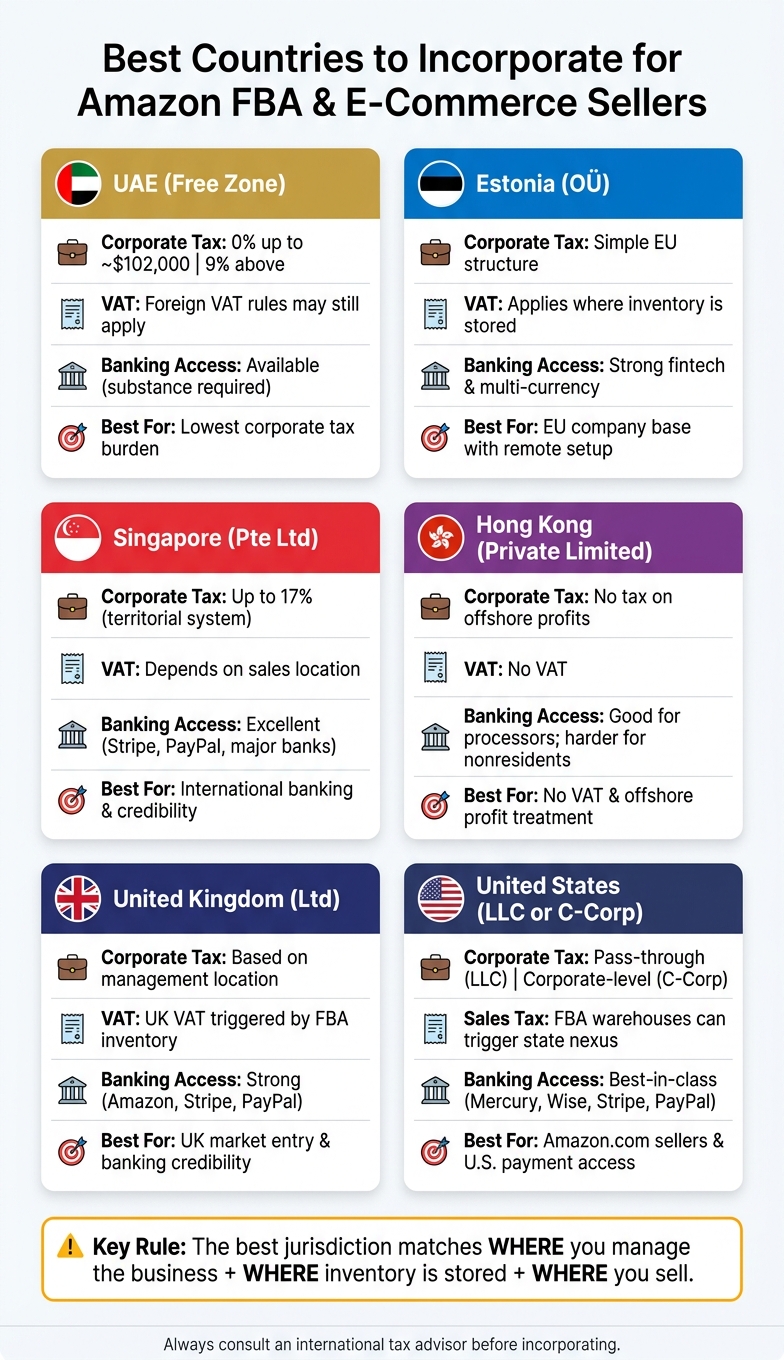
Best Countries to Incorporate for Amazon FBA Sellers (2025 Guide)
Quick Comparison
| Country | Best for | Main upside | Main watchout |
|---|---|---|---|
| UAE | Low corporate tax | 0% up to about $102,000, then 9% | I need local substance, not just paperwork |
| Estonia | EU company base | Easy remote setup and digital admin | Tax can still follow where I live and work |
| Singapore | Banking and global trade | Strong bank and processor access | More filings and more substance checks |
| Hong Kong | No VAT setup | No VAT and offshore-profit appeal | Annual audit and tougher banking for nonresidents |
| UK | UK market entry | Familiar legal setup and good fintech access | UK VAT and cross-border tax friction |
| U.S. | Amazon.com sellers | Strong banking, Stripe, PayPal, and marketplace fit | FBA inventory can create state tax duties |
My takeaway: I wouldn’t pick an incorporation country based on tax rate alone. I’d look at tax, banking, compliance work, and where inventory sits before I decide.
sbb-itb-39d39a6
1. United Arab Emirates (Free Zone company)
The UAE can look attractive to e-commerce sellers who are able to build real local substance. A Free Zone company may qualify for 0% corporate tax on taxable income up to AED 375,000, or about $102,000. Once income goes above that amount, the standard UAE corporate tax rate is 9%. That said, VAT and sales tax still depend on where your customers are. So forming a company in the UAE does not erase foreign filing duties.
Banking is possible, and UAE Free Zone companies can get access to bank accounts and payment processors. But for nonresident founders, opening those accounts can be a hassle. A PO box and a remote assistant usually won’t cut it. Banks want to see actual substance on the ground, such as local operations, office space, and management activity inside the UAE.
The UAE has also rolled out stricter economic substance rules and is auditing Free Zone companies more often. If day-to-day management remains outside the country, another jurisdiction may still argue it has taxing rights under permanent establishment rules. In plain English: the company may be in the UAE on paper, but tax risk can still follow where the business is run.
| Factor | UAE Free Zone |
|---|---|
| Corporate tax | 0% up to AED 375,000; 9% above |
| VAT exposure | Foreign VAT/sales tax rules may still apply |
| Banking access | Available, but substance requirements apply |
| Compliance burden | High, due to ESR and audit requirements |
| Best fit | Founders who can establish genuine UAE presence |
For founders looking for a lighter remote setup, Estonia is the next option to compare.
2. Estonia (OÜ / e-Residency company)
Estonia stands out for e-commerce founders because an OÜ is simple to set up from abroad and gives you a clean EU company base. If you sell online across borders, that can make day-to-day operations feel a lot less messy. The catch is pretty simple: where your stock sits and where the business is managed still drive tax and filing duties.
Local VAT, sales tax, and permanent-establishment rules still follow the places where inventory is stored and where management happens. Put plainly, an Estonian company can clean up the top-level setup, but it doesn’t replace country-level registrations in markets where inventory is held or business activity takes place.
Estonian companies also pair well with cross-border banking and payment tools. Multi-currency payment platforms can help with international payments and currency conversion. For founders who want an EU company structure without extra corporate drag, that’s a strong point.
| Factor | Estonia OÜ |
|---|---|
| Corporate tax | Simple EU tax structure |
| VAT exposure | Local VAT and sales tax can still apply where inventory is stored or sales are made |
| Banking access | Multi-currency fintech options can help with cross-border payments |
| Compliance burden | Cross-border compliance still continues after setup |
| Best fit | Founders who want an EU company structure and can handle local tax registrations where inventory is stored |
The OÜ also separates personal and business liabilities, which helps protect personal assets. At the same time, U.S. citizens still owe U.S. tax no matter where the company is formed.
Singapore offers a similar cross-border setup, but with stronger banking credibility and a more established Asia-facing profile.
3. Singapore (Private Limited Company)
Singapore is a step up for sellers who want stronger banking and a more trusted international base. Setting up a company is fairly simple, and the country uses a territorial tax system. That means some foreign-sourced income may be exempt in certain cases. On top of that, banking access is strong, with broad support from Stripe, PayPal, and major international banks.
But there’s a catch: the filing alone doesn’t decide the tax outcome. What matters is where the company is actually managed and whether the business has enough substance to match the setup.
The main risk is management location. If you run your Singapore company from Spain, Thailand, or another country where you’re tax resident, that country may still claim the right to tax the company’s profits, no matter where the company is registered. As of 2026, Singapore has also tightened transfer-pricing enforcement and documentation rules for foreign-resident directors.
For Amazon FBA sellers, this matters even more when inventory sits across borders. A company structure by itself does not wipe out local tax filing duties. If your products are stored in a U.S. fulfillment center, like an Amazon warehouse in Texas, that can create state tax exposure. So while a Singapore entity can work well as a central profit structure, sellers with U.S.-based inventory still need to handle U.S. tax duties on their own track.
| Factor | Singapore Private Limited |
|---|---|
| Corporate tax | Up to 17%; territorial tax system; foreign-sourced income may be exempt under specific conditions |
| Banking and payments | Strong access; compatible with Stripe, PayPal, and major banks |
| Compliance burden | Higher in 2026; stricter transfer-pricing and director documentation |
| Asset protection | Limited liability separates personal and company assets |
| Best fit | Global sellers who need a reputable international structure and strong banking access |
Singapore makes sense for sellers who want banking stability and a company setup that carries more weight in 2026.
4. Hong Kong (Private Limited Company)
Hong Kong gives you a setup that feels a lot like Singapore for cross-border business, but with no VAT and a lighter indirect-tax load. That can make life simpler for online sellers. Hong Kong also generally does not tax offshore profits. That said, this only helps if your management, inventory, and sales don’t create tax exposure somewhere else.
For many sellers, the no-VAT point is a big deal. It cuts down indirect-tax friction and keeps things simpler on the sales side.
Hong Kong companies also tend to work well with international payment processors. The catch is banking. If the directors are nonresidents, bank onboarding can be tougher with old-school banks.
The bigger issue isn’t where the company is formed. It’s where it’s managed. Tax residency still depends on where the company is actually run, and Hong Kong’s annual audit requirement adds a real compliance cost.
| Factor | Hong Kong Private Limited |
|---|---|
| Corporate tax | Hong Kong generally does not tax offshore profits |
| VAT exposure | No VAT |
| Banking and payments | Works well with international payment processors, but bank onboarding can be difficult for nonresident directors |
| Compliance burden | Annual audit required; higher scrutiny for remote-managed entities |
| Asset protection | Limited liability, but protection weakens if management and substance rules are not respected |
| Best fit | International sellers and FBA businesses with clear tax residency outside high-tax countries and limited nexus in other markets |
The UK is the next comparison point for sellers who want a familiar legal system but are willing to accept more tax exposure.
5. United Kingdom (Ltd company)
If Hong Kong stands out for low indirect tax, the UK is more about credibility and access than shaving taxes down to the bone. A UK Ltd makes sense for sellers who want a solid UK footprint for banking, VAT, and Amazon operations.
For Amazon FBA sellers, the big issue isn’t the headline tax rate. It’s VAT and where your inventory sits. If your stock is stored in a UK Amazon fulfillment center, that alone can trigger local VAT and tax duties, even if you live somewhere else.
There’s another wrinkle here. If you run the company from another country, that country may still tax the profits under its own rules based on where management happens. Put simply, a company formed in the UK can still be taxed elsewhere if that’s where the day-to-day control happens. Banks may also ask for extra proof of residence.
So while some jurisdictions are picked for low tax, the UK tends to land on the compliance-friendly, bank-friendly side of the spectrum. The trade-off is simple: things are clear and easier for financial partners to assess, but privacy is limited.
| Factor | UK Ltd Company |
|---|---|
| Corporate tax | Depends on where management occurs; chosen more for credibility than tax minimization |
| VAT exposure | UK inventory in Amazon fulfillment centers can trigger local VAT and tax obligations |
| Banking and payments | Strong with Amazon, Stripe, PayPal, and UK banks; nonresidents face extra checks |
| Compliance burden | Annual reports and beneficial ownership updates are required |
| Asset protection | Limited liability, but only with clean separation between business and personal funds |
| Best fit | Sellers targeting the UK market or needing strong banking credibility |
6. United States (LLC or C-Corp)
The U.S. is a common pick when banking, payments, and marketplace access matter most. The big upside here isn’t simple tax treatment. It’s day-to-day access. U.S. entities tend to work well with payment processors like Stripe and PayPal, and they often have strong banking access through providers such as Mercury and Wise.
The right entity depends on your tax setup, governance needs, and whether you plan to bring in outside money. An LLC is usually the simpler starting point because it uses pass-through taxation. A C-Corp is a better match if you want tighter governance rules or plan to seek outside investment, but it can come with entity-level tax.
For Amazon FBA sellers, one detail matters a lot: inventory stored in Amazon warehouses can create state nexus. On top of that, sales thresholds can trigger filing duties in other states too.
If you’re a non-U.S. resident, the story doesn’t stop at formation. Management location can still affect tax, and CTA reporting adds another compliance layer. So yes, the U.S. can work well for nonresidents, but tax residency and reporting still follow the person who actually controls the business. CTA reporting has also reduced privacy for U.S. entities.
| Factor | U.S. LLC | U.S. C-Corp |
|---|---|---|
| Corporate tax | Pass-through taxation; profits flow directly to the owner | Taxed at the corporate level; dividends can create double taxation |
| Sales tax exposure | Physical inventory in FBA warehouses can create state nexus obligations; economic thresholds may also apply | Same as LLC |
| Banking and payments | Strong access to banking and payment platforms like Stripe, PayPal, Mercury, and Wise | Strong access to banking and payment platforms |
| Compliance burden | State filings and CTA beneficial ownership reporting | More formal governance, including board and shareholder records |
| Asset protection | Limited liability protection when personal and business funds are kept separate | Limited liability protection; better suited to investment-ready structures |
| Best fit | Solo sellers and non-residents who want U.S. banking, payment access, and pass-through taxation | Founders who want stricter governance or plan to raise outside investment |
That LLC-vs.-C-Corp split is usually the main decision point for U.S. entities. In plain English, it comes down to what you care about most: lower tax drag, stronger banking access, or simpler compliance.
Pros and cons by seller goal
No single jurisdiction fits every goal. The right pick depends on your main pressure point: tax drag, banking, compliance, or market access.
That said, these options still come back to the same three facts: where management happens, where inventory sits, and where tax residency ends up.
| Seller Goal | Best Fit | Key Pro | Key Con |
|---|---|---|---|
| Lowering tax drag | UAE (Free Zone) | 0% or low corporate tax; strong asset protection | You need real local substance, such as an office or management activity, to stay compliant |
| EU marketplace operations and low admin load | Estonia (OÜ) | Digital administration; one EU company base | Tax residency still follows real management |
| Amazon.com + U.S. payment access | United States (LLC) | Strong Amazon.com fit; strong U.S. banking and payment access; pass-through taxation | FBA inventory stored in warehouses can create nexus and state tax exposure |
| Reputable international banking | Singapore (Pte Ltd) | Strong banking; stable legal system; broad fintech support | Higher compliance costs; stricter substance and director documentation requirements |
| No VAT / offshore profits | Hong Kong (Private Limited) | No VAT and generally no tax on offshore profits | Annual audit and harder bank onboarding for nonresident directors |
| UK market entry | United Kingdom (Ltd) | Fast incorporation; trusted by Stripe and PayPal | Post-Brexit VAT rules add friction for direct EU sales |
| Asset protection + global stability | UAE (Free Zone) | Strong legal framework and financial infrastructure | You need genuine local substance to keep the structure compliant |
The key point is simple: a jurisdiction only works if it lines up with your inventory footprint and where the business is actually managed.
Final recommendation
After looking at tax, banking, compliance, and marketplace fit, the choice usually comes down to your main goal. The table below makes that easier to see.
| Seller Priority | Best Fit | Reason | Main Caution |
|---|---|---|---|
| Lowest corporate tax burden | UAE (Free Zone) | Potential 0% corporate tax on qualifying income | Requires local office and staff to meet substance rules |
| Amazon.com + U.S. payment access | United States (LLC) | Best fit for U.S. banks, Stripe, and Amazon.com; pass-through taxation | FBA inventory in U.S. warehouses creates state-level nexus; foreign-owned LLCs face added reporting scrutiny |
| EU market access | Estonia (OÜ) | Digital administration and an EU company base | "Place of management" rules may shift tax liability to where you actually live |
| Strong international banking | Singapore (Pte Ltd) | Strong banking access and a territorial tax system | High compliance costs and strict documentation for foreign directors |
| UK market access | United Kingdom (Ltd) | Quick incorporation and solid payment gateway access | Stricter reporting for cross-border income and beneficial ownership |
For sellers focused on the U.S., a U.S. LLC is usually the cleanest path. It tends to work best with U.S. banks, Stripe, and Amazon.com, which can save a lot of friction once the business starts moving.
If your top goal is lowering tax and you can support a real presence on the ground, the UAE often stands out. That said, this only works well when the substance rules are met in practice, not just on paper.
If your inventory, customers, or day-to-day management stretch across more than one country, have an international tax advisor review the setup before you commit. The best jurisdiction is usually the one that lines up with where you actually manage the business, where your inventory sits, and where you plan to sell.
FAQs
How do I choose the right country for my FBA business?
Start with where your customers are and where you run the business day to day. Your tax residence and the place where key decisions happen can trigger tax duties, even if you set up the company somewhere else.
Then look at the big factors side by side: corporate tax, VAT or sales tax, banking and payment access, setup speed, ongoing compliance, and asset and IP protection. Match each option to your top priorities, and make sure you can meet any economic substance rules.
Does Amazon inventory create tax obligations?
Yes. Storing goods in an Amazon fulfillment center can create nexus. That means a state or country may have the right to tax your business even if you don’t have an office, staff, or a direct physical setup there.
The big issue is where your inventory sits. If Amazon stores your products in a given location, that alone can trigger sales tax, VAT, or income tax duties. And an offshore company doesn’t make this go away. The inventory itself may still create a taxable presence.
Which setup is best for U.S. banking and Stripe?
For entrepreneurs focused on U.S. banking and smooth Stripe integration, a U.S. LLC is usually the best setup.
It tends to give you the clearest path to U.S. bank accounts and helps you avoid many of the paperwork, in-person, and banking roadblocks that foreign companies can run into. Some overseas setups may bring tax perks, but a U.S. LLC is often the strongest option for compatibility, predictability, and trust with banks and payment platforms.