
If you own at least 10% of a foreign company, you may owe U.S. tax before you take out a single dollar. That can happen when U.S. owners together hold more than 50% of the company, which can turn it into a Controlled Foreign Corporation (CFC).
Here’s the short version:
- CFC status is based on ownership, not where the company is managed
- Subpart F often taxes passive income like interest, dividends, rent, and royalties right away
- GILTI can tax much of the company’s active income even if no dividend is paid
- Form 5471 filing rules can apply even when there is no extra U.S. tax
- Missing Form 5471 can trigger $10,000 penalties per form, per year, per company, and that can climb to $60,000
If I were reviewing an offshore company, I’d focus on five things first:
- Who owns it, including family and entity attribution
- What income it earns, line by line
- Whether related-party deals exist
- Whether books, records, and E&P are up to date
- Whether Form 5471 was filed on time
This article is about one core point: offshore does not mean outside U.S. tax rules. If your company is foreign but U.S.-owned, the tax cost and filing burden can start much earlier than most owners expect.
What makes a foreign company a CFC under U.S. tax law
A foreign corporation becomes a CFC when U.S. shareholders own more than 50% of its vote or value on any day during the tax year. That “any day” rule is a big deal. Even a short-lived jump in U.S. ownership can make the company a CFC for the entire year.
And the math isn’t always as simple as reading the cap table. Once you add indirect ownership and family attribution, the picture can change fast.
Ownership thresholds and attribution rules
U.S. tax law counts more than direct share ownership. It also includes indirect and constructive ownership, such as shares attributed from family members and certain entities. Some entity-owned shares are pulled in under these attribution rules too.
In layered structures, ownership is traced through each tier by multiplying percentages across the chain. So the effective U.S. ownership can end up higher than what the share register seems to show at first glance.
Example: A Cayman Islands company has two U.S. persons each holding 30% and two non-U.S. persons each holding 20%. Two minority U.S. owners can still create CFC status when their combined stake exceeds 50%.
So yes, ownership drives the CFC test. But that’s not the whole story when you’re looking at cross-border tax risk.
Why management and control still matter
CFC status under U.S. law is based on ownership, not management. Still, management and control matter for another reason: many foreign countries decide corporate tax residency based on where central management and control is exercised.
That can create a messy overlap. The same company might be taxed abroad as a local resident company while also being treated as a CFC for U.S. tax purposes. When that happens, you may be dealing with Subpart F, GILTI, and Form 5471 reporting at the same time.
U.S. CFC rules vs. common foreign approaches: a comparison
The U.S. approach is broader and more ownership-focused than many foreign CFC regimes.
| Regime | Ownership threshold | Income focus |
|---|---|---|
| United States (Subpart F / GILTI) | >50% vote or value held by U.S. shareholders; each must own at least 10% | Broad: specified passive and mobile income under Subpart F, plus residual low-taxed active income under GILTI |
| Typical EU/OECD regime | Often 50% or similar control threshold | Often focused on low-taxed passive income or income in low-tax jurisdictions |
| United Kingdom | Generally >50% control by U.K. residents | Targeted mainly at profits artificially diverted to low-tax entities |
Here’s the key difference: U.S. CFC rules can apply even if the foreign company already pays a lot of tax abroad. Many foreign regimes are narrower and tend to zero in on passive income or income booked in low-tax jurisdictions.
After the ownership test comes the tax test: which profits are pulled into current U.S. income.
sbb-itb-39d39a6
How CFC rules tax offshore profits in practice
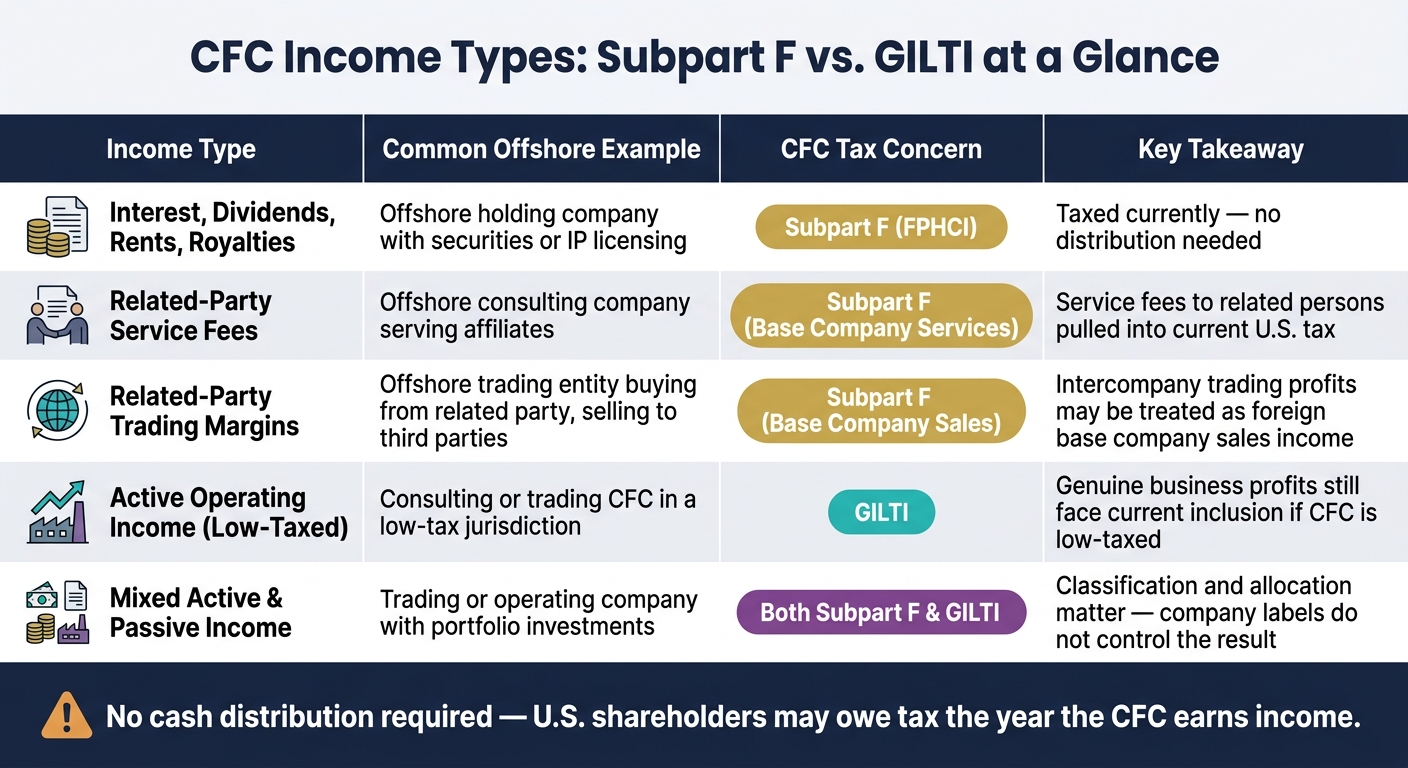
CFC Income Types: Subpart F vs. GILTI Tax Treatment Explained
If a foreign company meets the ownership test and becomes a CFC, the next issue is which profits the IRS taxes right now. That’s where Subpart F and GILTI come in. Both can pull income into current U.S. taxation even if no dividend is paid.
Here’s the basic split:
- Subpart F usually goes after passive income and some related-party income
- GILTI generally picks up leftover CFC income after a deemed return on the CFC’s tangible assets
That sounds abstract on paper. In practice, it often comes down to the type of income the CFC earns.
When passive income gets pulled into current U.S. taxation
Passive income is one of the most common ways a CFC runs into Subpart F. Interest, dividends, rents, and royalties earned by a CFC will often fall under foreign personal holding company income, or FPHCI. So if a CFC holds a portfolio of stocks or bonds, licenses intellectual property to related parties, or collects rent from foreign real estate, that income is generally treated as Subpart F income and taxed currently to U.S. shareholders.
Subpart F can also apply outside the passive income bucket. Related-party service fees and related-party sales margins are a common trap. If a CFC performs services for a related U.S. company, or buys goods from a related party and resells them, those profits may be treated as foreign base company income, which is another Subpart F category.
And this is the part many people miss: no cash distribution is needed. The U.S. shareholder still reports and pays tax on their share of Subpart F income for the year the CFC earns it, even if the funds never leave the foreign account. That’s where the sting shows up in day-to-day business structures.
Examples: how tax outcomes differ for consulting, trading, and asset-holding companies
A consulting CFC with actual operating income will often sit outside Subpart F. But that doesn’t mean the income escapes current U.S. tax. If the profits are low-taxed, GILTI may still apply, and that amount is usually taxed currently at ordinary rates, with limited foreign tax credit relief.
An asset-holding company usually gets hit much harder. If it owns a securities portfolio and earns dividends and interest, a large share of that income will often count as FPHCI. That means Subpart F can pull it into current U.S. taxation, with no deferral for U.S. individual shareholders.
A trading CFC can land somewhere in the middle. Its third-party business profits may be active income, but interest income, dividend income, and related-party margins can still trigger Subpart F. In other words, the company label doesn’t settle the tax result. The income mix does.
Passive income, active income, Subpart F, and GILTI: a side-by-side comparison
| Income type | Common offshore example | Likely CFC concern | Practical takeaway |
|---|---|---|---|
| Interest, dividends, rents, royalties | Offshore holding company with securities or IP licensing | Subpart F (FPHCI) | Taxed currently even without a distribution |
| Related-party service fees | Offshore consulting company serving affiliates | Subpart F (base company services income) | Service fees can be pulled into current U.S. taxation if performed for related persons |
| Related-party trading margins | Offshore trading entity buying from a related party, selling to third parties | Subpart F (base company sales income) | Intercompany trading profits can be treated as foreign base company sales income |
| Active operating income, low-taxed | Consulting or trading CFC in a low-tax jurisdiction | GILTI | Even genuine business profits may face current inclusion if the CFC is low-taxed |
| Mixed active and passive income | Trading or operating company with portfolio investments | Both Subpart F and GILTI possible | Classification and allocation matter; labels alone do not control the result |
These income inclusions also trigger filing duties, which the next section covers.
Reporting requirements, penalties, and compliance risks
After Subpart F and GILTI, the next pressure point is reporting. A CFC can create filing duties even when it doesn’t create extra U.S. tax. Miss those filings, and penalties can show up anyway.
Once a CFC is on the table, the next risk is reporting, not just tax.
Form 5471 and annual owner reporting
For consulting, trading, and holding-company setups, Form 5471 is the main compliance check. It attaches to the filer’s federal income tax return and follows that same due date, including extensions.
Most CFC owners file as Category 4 or Category 5 filers:
- Category 4 applies to control
- Category 5 applies to 10% ownership
The hard part is usually the schedules. That’s where the workload sits: income statements, balance sheets, E&P, Subpart F, GILTI, and related-party transactions. And this isn’t just paperwork for the sake of paperwork. The same income mix that can trigger Subpart F or GILTI also shapes what has to be reported.
In practice, asset-holding companies often need the heaviest E&P tracking. Trading and consulting companies, by contrast, often run into trouble with related-party reporting. On top of that, all figures must be translated into U.S. dollars.
E&P and PTEP have to be tracked every year. These aren’t one-time snapshots. They’re annual, cumulative records, which means gaps can snowball. If the books are missing or messy, rebuilding them later can turn into a grind.
Penalty exposure and recordkeeping problems
Incomplete schedules often matter more than the form title itself because that’s where penalties and audit risk tend to start.
IRC §6038(b) penalties are strict. Under IRC §6038(b), the penalty is $10,000 per late or incomplete Form 5471, per corporation, per year. After IRS notice, that amount goes up by $10,000 for each 30-day period, up to $50,000 more, for a total maximum of $60,000 per CFC per year.
That adds up fast. A U.S. owner with two CFCs and three years of missed filings could face $360,000 of total exposure before continuation penalties are added. Noncompliance can also limit foreign tax credits and, under §6501(c)(8), keep the statute of limitations open until the required international information returns are filed, plus three more years after that.
The usual breakdowns are pretty familiar:
- weak foreign books
- undocumented related-party payments
- mismatched tax years
The fix is not complicated: use double-entry books, put intercompany agreements in writing, and close the year on time. Clean records and clear ownership tracking are the base of any lower-risk structure.
How to reduce CFC risk without creating bigger problems
Once the risk rules are clear, the next move is cutting exposure without weakening the setup.
The main idea is simple: reduce CFC exposure by lining up ownership, income, and substance with the rules.
Review ownership, income mix, and business substance
Start by mapping direct and attributed ownership before you assume the structure falls below the CFC threshold. This is where people get tripped up. A company can look fine at first glance, then attribution rules change the picture.
Next, review each revenue stream against Subpart F and GILTI. Pay close attention to passive income and related-party income. If the money flow doesn’t match the tax position, trouble can show up fast.
Then look at substance. The company should have real business activity, not just paperwork. That means local directors making real decisions, employees whose jobs fit the business purpose, and contracts signed by offshore officers. If the company says one thing on paper but works another way in practice, that’s a red flag.
When to get professional structuring help
If ownership, income, and substance don’t line up, the next step is a cross-border review.
Some setups are too tangled for a DIY fix. A U.S. person who owns a Belize IBC that holds shares in a Hong Kong trading company and is also a beneficiary of a Cayman trust is dealing with CFC rules, foreign trust rules, and local tax regimes at the same time. Move one part without checking the rest, and you might fix one issue while causing a new one.
Get coordinated advice from U.S. tax counsel and local advisers before changing ownership, entities, or jurisdiction. That review should cover entity selection, jurisdiction, income structure, and documentation. That’s where much of the risk reduction happens.
Key points offshore owners should act on now
Timely annual reporting is the lowest-cost way to manage CFC risk. Cleaning up missed filings after the fact is harder and costs more. Act on these now:
- Map ownership – include attributed and indirect holdings before assuming the structure is below the CFC threshold.
- Review income line by line against Subpart F and GILTI categories.
- Document substance with real directors, employees, premises, and contracts.
- File on time – Form 5471 penalties add up fast and keep the statute of limitations open.
- Run a structure review before problems surface, not after.
The next priority is keeping the structure compliant year after year, not just at formation.
FAQs
How do attribution rules affect my ownership test?
Attribution rules matter because the IRS looks beyond the shares you hold in your own name. It also counts indirect ownership and constructive ownership when measuring your stake in a foreign corporation.
That can change the math fast. If you overlook these rules, you might calculate control the wrong way, label the company incorrectly, and open the door to penalties.
A CFC exists when U.S. shareholders, each owning at least 10% of the corporation’s vote or value, together own more than 50% of it.
Can my company be a CFC for part of the year?
Yes. A foreign company can be treated as a Controlled Foreign Corporation (CFC) for only part of the year.
Under U.S. tax law, if U.S. shareholders own more than 50% of the voting power or value at any point during the tax year, the company may be a CFC for that stretch of time. That can trigger reporting duties and possible U.S. tax on income earned during that period.
What should I do if I missed Form 5471 filings?
Act fast. Missing Form 5471 can trigger steep penalties that start at $10,000 per form, per year. And if the issue isn’t fixed, those penalties can add up over time.
You should talk to a qualified tax professional as soon as possible. They can look at your facts, explain whether the IRS may leave the statute of limitations open, and help you review options like streamlined filing procedures for unintentional reporting gaps.