
Yes, you can get a 1% tax rate in Georgia, but only if you do two separate filings and stay under the annual cap of ₾500,000 (about $200,000). If I were looking at this setup, I’d focus on four things first: the right business form, the Small Business Status application, the 183-day tax residency rule, and the ₾100,000 VAT trigger.
Here’s the short version:
- I’d register as an Individual Entrepreneur, not an LLC
- I’d then apply separately for Small Business Status
- I’d track turnover to stay below ₾500,000 per year
- I’d file and pay the 1% tax each month by the 15th
- I’d watch for VAT registration once turnover passes ₾100,000
- I’d keep a close eye on my days in Georgia because 183 days in any rolling 12-month period can make me a tax resident
This setup tends to fit freelancers, consultants, developers, SaaS founders, and other online service businesses with foreign clients. It tends to be a poor fit if I plan to hire in Georgia, open a local office, or run the business from another country that may still tax the income.
Before I spent any money, I’d ask one simple question: Does my business fit the rules, or am I just chasing the 1% headline? That’s the part that matters.
To make the decision easier, here’s a short snapshot:
| Item | What matters |
|---|---|
| Tax rate | 1% of gross turnover |
| Who can use it | Individual Entrepreneurs with Small Business Status |
| Turnover cap | ₾500,000 per year |
| VAT point | ₾100,000 turnover |
| Tax residency risk | 183 days in Georgia in a rolling 12-month period |
| Main trap | IE registration alone does not give the 1% rate |
So if I were summarizing the whole process in one line, it would be this: set up the right structure, apply for the tax status, keep clean records, and do not drift over the tax or residency lines by accident.
Check whether you qualify for the 1% regime
Before you file, check two things first: you need to use the IE structure, and your work needs to fit the regime.
Who qualifies and who does not
The 1% rate is available only to Individual Entrepreneurs (IEs) who obtain Small Business Status. Freelancers, remote developers, SaaS founders, and other location-independent service providers will often fit this setup. LLCs and larger corporations will not.
The best match is usually a remote service business with foreign clients and no office or staff in Georgia.
Turnover limits, activity restrictions, and tax triggers
The annual turnover cap is ₾500,000, or about $200,000. Stay under that threshold and the tax is 1% of gross revenue. Go over it, and you lose the 1% treatment.
Your status can also shift if you cross the turnover cap or create a local presence. If you spend 183 days or more in Georgia within any rolling 12-month period, you become a Georgian tax resident. A permanent establishment, such as a local office or employees, can also trigger local taxation.
That’s why it’s smart to track your days in Georgia and look closely at any plans to hire locally or rent office space.
If you meet these points, the next step is IE registration and Small Business Status.
sbb-itb-39d39a6
Register as an Individual Entrepreneur and apply for Small Business Status
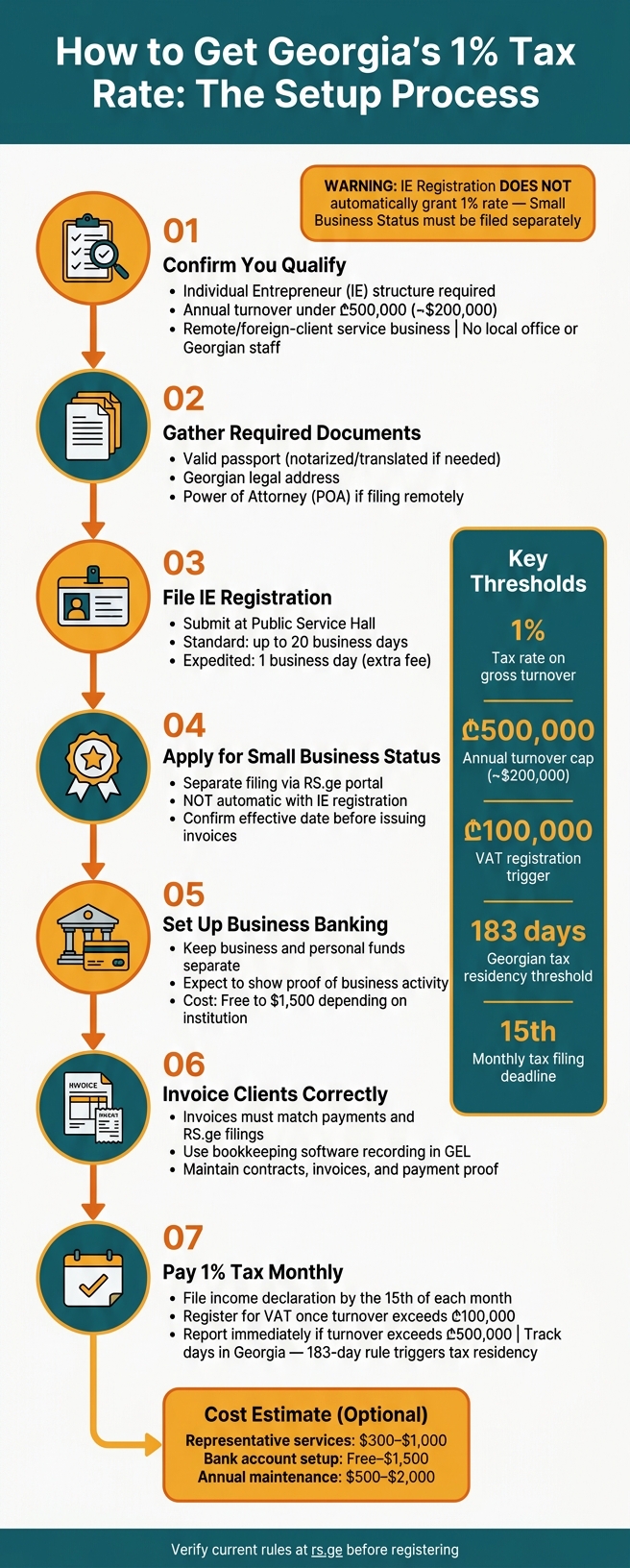
How to Set Up a Company in Georgia for 1% Tax: Step-by-Step Guide
This process has two separate steps. First, you register as an Individual Entrepreneur (IE) at the Public Service Hall. After that, you apply for Small Business Status through the Revenue Service. Those are the minimum steps needed to activate the 1% tax rate.
Step 1: Prepare documents and file the IE registration
To register, you need a valid passport and a Georgian legal address. That address is required for registration. If you’re outside Georgia, you can appoint a local representative to file for you with a notarized Power of Attorney (POA).
| Step | Action | Required Documents | Responsible Authority |
|---|---|---|---|
| 1 | IE Registration | Passport (notarized/translated), local address details, POA if remote | Public Service Hall |
| 2 | Small Business Status Application | IE registration certificate, tax portal access | Revenue Service (RS.ge) |
Step 2: Apply for Small Business Status through the Revenue Service
After your IE registration is done, submit the Small Business Status application in RS.ge. This is a separate filing, not part of the IE registration itself. Before you issue invoices at the 1% rate, make sure the effective date is confirmed in RS.ge.
Step 3: Timeline and first costs to expect
Standard processing takes up to 20 business days. If you need it done faster, there’s an expedited option that delivers approval in 1 business day for an extra state fee.
You should also plan for a few up-front costs before the status is ready to use:
- Representative services: $300 to $1,000
- Bank account setup: Free to $1,500, depending on the institution and whether remote onboarding is needed
- Annual filing and maintenance services: $500 to $2,000
These fees are charged in Georgian lari (₾), and the USD amounts are approximate.
Once the approval is active, the next move is banking and invoicing, so your first client payments are recorded the right way.
Set up banking, invoicing, and clean payment records
When a business bank account is usually necessary
Once Small Business Status is approved, separate your business cash flow right away.
Georgian law doesn’t strictly require a local business account for IE registration. But in practice, one is often needed to keep records clean and protect your 1% status. Mixing business income with personal funds can create recordkeeping problems and increase compliance risk, along with the chance of account restrictions.
If opening a standard bank account takes time, a local bank or payment provider can still help remote entrepreneurs handle business income. When you open any account, expect to show proof of business activity and source of funds.
How to invoice clients and document income correctly
Once the account is active, each invoice should line up with a matching payment and filing.
Your invoices, payments, and RS.ge filings need to match exactly. That’s the core of a clean paper trail. A separate account helps you keep the records needed to maintain Small Business Status. To keep the 1% rate, maintain a clear audit trail with contracts, invoices, and proof of payment. Also make sure your service descriptions match your registered business activity.
Use bookkeeping software that records in GEL so your bank statements, invoices, and RS.ge filings stay in sync.
Clean records make the monthly filing step much easier.
Stay compliant, avoid losing the 1% status, and decide if Georgia fits your situation
Monthly, annual, and event-triggered compliance duties
This is the part that keeps the 1% setup alive. Opening the bank account and sending invoices is only the start. After that, the job is simple in theory and easy to mess up in practice: stay inside the rules.
| Frequency | Duty | What It Means |
|---|---|---|
| Monthly | Tax declaration and payment | File the monthly income declaration and pay the 1% tax by the 15th of the following month through the Revenue Service portal. |
| Annual | Beneficial ownership filing | Update ownership details with the Revenue Service. |
| Annual | Bank compliance document update | Update your bank’s compliance documents to reduce the risk of account freezes. |
| Event-triggered | VAT registration | Register once turnover passes the VAT threshold, usually ₾100,000. |
| Event-triggered | Notify the Revenue Service | Report immediately if turnover exceeds ₾500,000 or your activity type changes. |
| Ongoing | Recordkeeping | Keep invoices, contracts, payment proof, and a travel-day log tied to residency risk. |
One detail matters more than many people think: track your days in Georgia on a rolling 12-month basis. Hitting 183 days can trigger tax residency.
Common mistakes that can cost you the 1% status
Most people lose this status for pretty predictable reasons: missed filings, blown thresholds, or the wrong business activity.
A big one catches people early. IE registration does not automatically give you the 1% rate. You must file a separate application for Small Business Status with the Revenue Service.
Activity type is another trap. If you run a restricted activity, you can be disqualified from day one. Revenue limits matter too. If your income goes above ₾500,000 and you don’t report it right away, the amount over the limit may be taxed at a higher rate, often 3%, or you could lose Small Business Status altogether.
There’s also the management issue. Tax authorities look at where the business is actually managed, not just where it’s registered. So if you’re sitting in another country and running the business from there, that country may say it has the right to tax the income.
And for U.S. taxpayers, Georgia filing is only part of the picture. You can be fully up to date in Georgia and still face penalties if you miss FBAR or FATCA duties.
Conclusion: Who should use this structure and what to do next
Georgia’s 1% regime can work well for digital nomads, freelancers, remote workers, and SaaS founders with foreign-source income, as long as they stay under ₾500,000 and keep filings, records, and travel days up to date.
It tends to be a weaker option if you work with local Georgian clients, hire local staff, run the business from a high-tax country, or deal with U.S. reporting rules that add another layer of admin work.
Before you register, check the current activity restrictions and turnover rules directly with the Georgian Revenue Service at rs.ge.
FAQs
Can I qualify if I live outside Georgia?
Yes. You can register and run a Georgian company while living outside Georgia, and many location-independent entrepreneurs use Individual Entrepreneur (IE) status to get the 1% tax regime.
You can manage the business remotely, but you still need accurate bookkeeping and steady compliance. If you spend more than 183 days in another country or make day-to-day business decisions from abroad, that country may also claim taxing rights.
What happens if I exceed the income limit?
If your individual entrepreneur business in Georgia brings in more than ₾500,000 in annual revenue (about $200,000), you lose access to the 1% small business tax regime.
Once you pass that limit, your business moves to the standard 15% corporate income tax. So it’s smart to watch your yearly revenue closely. Going over the cap, or failing to meet compliance rules, can trigger tax reclassification and possible penalties.
Do I need both IE registration and Small Business Status?
Yes. IE registration sets up your legal business entity in Georgia. But to use the 1% tax regime, you also need to apply separately for Small Business Status.
If you skip that step, your business income will be taxed under the standard rates instead.
Both steps go through the Georgian Revenue Service.