
Want to cut your tax bill to just 1%? Georgia might be the answer.
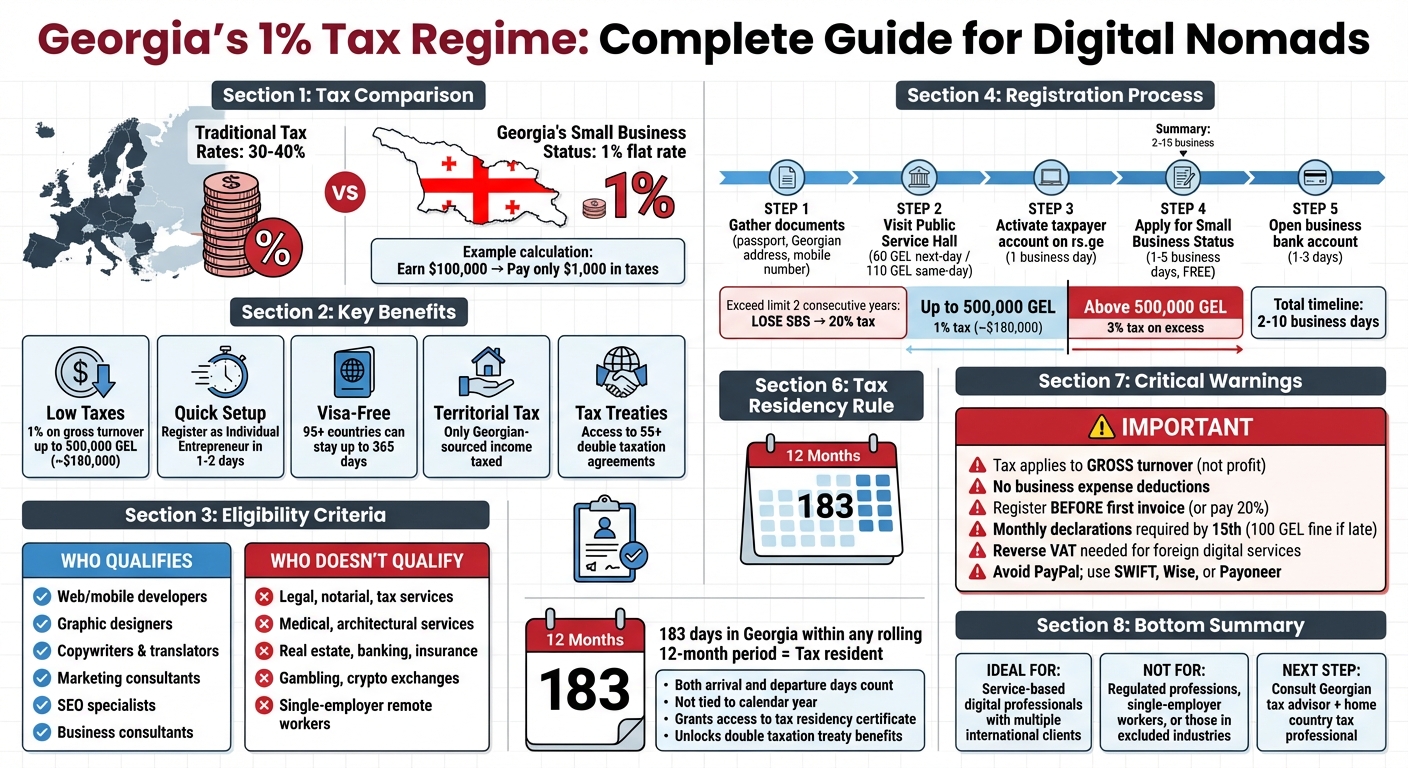
Here’s the deal: Georgia’s Small Business Status (SBS) offers eligible digital professionals a flat 1% tax on gross turnover up to 500,000 GEL (around $180,000 USD annually). For freelancers and entrepreneurs tired of paying 30–40% in taxes, this is a legal way to keep more of your income.
Why Georgia?
- Low taxes: Earn $100,000 and pay just $1,000 in taxes.
- Simple setup: Register as an Individual Entrepreneur in 1–2 days.
- Visa-free stay: Citizens from 95+ countries can stay for up to 365 days.
- Territorial tax system: Only Georgian-sourced income is taxed.
Here’s what you need to know:
- The 1% rate applies to gross turnover, not profit.
- If you exceed 500,000 GEL, the rate rises to 3%, and surpassing the cap for two straight years disqualifies you.
- Professions like legal, medical, and real estate services don’t qualify.
To qualify, you must register as an Individual Entrepreneur, apply for SBS, and file monthly tax declarations. Spending 183+ days in Georgia makes you a tax resident, but only Georgian-sourced income is taxed under most circumstances.
Georgia’s tax system is ideal for digital nomads with multiple clients, but it’s not for everyone. If you’re ineligible or tied to higher-tax countries, consult a tax advisor to navigate your options.
Ready to keep more of your earnings? Let’s dive into the details.
Eligibility and Residency Requirements
Who Qualifies for the 1% Tax Rate
Georgia’s 1% tax rate is exclusively available to Individual Entrepreneurs with Small Business Status. This tax-friendly program is geared toward professionals in service-based industries, such as web and mobile developers, graphic designers, copywriters, translators, marketing consultants, SEO specialists, and business consultants.
That said, some professions are excluded from this program. These include legal, notarial, tax, audit, medical, and architectural services. Additionally, most licensed activities are not eligible, except for M1 category taxi permits in Tbilisi. Other exclusions cover gambling, staffing, foreign exchange, and the production of excisable goods. Employment income – like remote work for foreign companies – is taxed at the standard 20% rate instead of 1%. If the Revenue Service determines that you’re essentially a "disguised employee" – for instance, if you have only one client who dictates your work schedule and tools – you may also face the higher 20% tax rate.
Other income types, such as rental income, capital gains, interest, dividends, royalties, gifts, and inheritances, are taxed at the standard 20% rate regardless of your Small Business Status.
These rules make it clear that Georgia’s tax regime is designed to attract service-based digital entrepreneurs. Knowing these eligibility details is essential before exploring residency requirements.
The 183-Day Residency Rule Explained
You don’t need to be a Georgian citizen or permanent resident to register as an Individual Entrepreneur. However, if you spend 183 days or more in Georgia within any rolling 12-month period, you automatically become a Georgian tax resident. This isn’t tied to the calendar year; the 12-month period is continuous, so it’s important to monitor your physical presence closely.
Both the days you arrive in and depart from Georgia count toward the 183 days, even if your visits aren’t consecutive. Once you meet this threshold, you are considered a tax resident and must report worldwide income. However, under Georgia’s territorial tax system, only income sourced within Georgia is typically taxed.
For digital nomads planning longer stays, Georgian tax residency offers access to the country’s 55+ double taxation treaties, including agreements with countries like Germany, the UK, and the USA. You can also apply for a tax residency certificate, which can help you claim treaty benefits and potentially reduce or eliminate tax obligations in your home country.
If you’d prefer to avoid Georgian tax residency, ensure your stay remains under 183 days within any 12-month period and maintain detailed travel records. Next, let’s dive into the process of registering as an Individual Entrepreneur.
sbb-itb-39d39a6
How to Register as an Individual Entrepreneur
Documents and Information You’ll Need
To register as an Individual Entrepreneur in Georgia, you’ll need a few key items. First, bring your original valid passport (if registering in person). This must be translated into Georgian and notarized locally – there’s no way around this step. Additionally, you’ll need a Georgian legal address and a local mobile number. Keep in mind that temporary accommodations like hotels or Airbnb rentals won’t work as a legal address. Instead, you’ll need a formal lease or proof of residential property. If you don’t have a local address yet, many service providers offer "legal address" rentals specifically for registration purposes.
Next, you’ll need to choose the correct NACE code that matches your business activity. For instance, web developers often use code 62.01, while consultants typically use 70.22. Be careful here – picking the wrong code could disqualify you from the 1% tax rate or lead to reclassification. Double-check your choice before submitting your application.
If traveling to Georgia isn’t an option, you can still register remotely. To do this, you’ll need to grant a notarized Power of Attorney (and have it apostilled, if necessary) to a local representative who can handle the process on your behalf.
Completing the Registration Process
To complete your registration, visit any Public Service Hall with your documents. The fee for next-day processing is 60 GEL (about $22), while same-day service costs 110 GEL (around $40). Once registered, you’ll receive a Personal Number, which you’ll use to activate your taxpayer account on rs.ge. This step takes one business day.
"Registering your business before you issue your first invoice makes a huge difference. Any income earned before registration will be taxed at 20%, not 1%." – Gegidze
If you’re registering remotely through a service provider, costs typically range from $200 to $400, depending on the complexity. The entire registration and tax activation process is usually wrapped up within two business days.
After your taxpayer account is active on rs.ge, the next step is to secure your Small Business Status (SBS) certification.
Getting Your Small Business Status Certification
Once you’ve registered as an Individual Entrepreneur, you’ll need to apply separately for Small Business Status (SBS) through rs.ge to qualify for the 1% tax rate. The SBS application is free, and approval typically takes one to five business days. Your Small Business Status becomes effective on the first day of the month following approval.
After approval, you’ll receive a Small Business certificate from the Revenue Service. You can easily verify and download it through your taxpayer portal on rs.ge. This certificate confirms your eligibility for the 1% tax rate on annual turnover up to 500,000 GEL (roughly $180,000). It’s crucial to avoid issuing invoices or receiving payments until your SBS status is active – any income earned before this will be taxed at the standard 20% rate.
Once your SBS is approved, open a local business bank account with institutions like TBC or Bank of Georgia. This step, which typically takes one to three days, helps you separate your personal and business finances.
How to Get the Most from the 1% Tax Regime
Income Limits and What Happens When You Exceed Them
The annual cap of 500,000 GEL (around $180,000) is the key figure to keep in mind. As long as your income stays below this amount, you’ll enjoy the 1% tax rate on your total turnover. However, if you exceed this threshold, the tax rate increases to 3% on the amount above the cap for the remainder of the year.
Here’s the catch: exceeding the cap for two consecutive years will result in the permanent loss of your Small Business Status. This means you’ll no longer qualify for the reduced tax regime and will have to pay the standard 20% income tax rate instead. This isn’t a temporary penalty – it’s a complete exit from the system.
"If you earned 499,000 GEL, you’d pay 4,990 GEL in tax (1%). Earn 501,000 GEL, and suddenly you owe 15,030 GEL (3%). That’s a 10,000 GEL difference for earning 2,000 GEL more." – FileTax.Ge [1]
To avoid surprises, keep an eye on your year-to-date income by checking Column 15 on rs.ge when submitting your monthly declarations. This running total will show you how close you are to the 500,000 GEL limit. If you’re nearing the cap toward the end of the year – say in October or November – consider delaying invoices until the next calendar year.
One crucial point to remember: the 1% tax applies to your gross turnover, not your net profit. This means you can’t deduct business expenses like coworking spaces, software subscriptions, or travel costs. Every payment received in your business account counts toward the cap, so plan accordingly.
Next, let’s talk about banking and record-keeping to ensure compliance.
Banking and Record-Keeping Requirements
Once you’ve activated your Small Business Status (SBS), maintaining a clean financial setup is essential. Open a dedicated business bank account to separate personal and business finances. Popular options among digital nomads include TBC Bank and Bank of Georgia, both of which offer multi-currency sub-accounts (USD, EUR, GEL). This allows you to receive payments in the original currency, helping you avoid unfavorable conversion rates.
Keeping personal and business transactions separate isn’t just good practice – it’s critical. Georgian banks closely monitor whether your declared income matches your bank turnover. Any discrepancies could lead to account freezes or restrictions. To avoid issues, ensure that only actual business revenue flows through your IE account. Avoid mixing in personal transfers, loan repayments, or refunds.
File your monthly tax declarations by the 15th of each month to avoid a 100 GEL fine. Repeated delays can even lead to the loss of your SBS.
If you use foreign digital services like Meta Ads, Google Ads, or other SaaS tools, you’ll need to submit reverse VAT declarations each month, even if you’re not VAT-registered for your income. Keep a detailed record of these subscriptions, as the Revenue Service may request them during audits.
Finally, avoid using PayPal due to compliance challenges. Instead, opt for SWIFT transfers, Wise, or Payoneer to receive payments. These methods simplify the process, eliminate unnecessary intermediaries, and help maintain a clean paper trail.
Limitations and Things to Watch Out For
Professions That Don’t Qualify
Georgia’s 1% tax regime has specific exclusions that bar several professional services from qualifying. Beyond the previously mentioned ineligible professions, the following are also excluded:
- Financial and legal services: This includes banking, lending, investment management, insurance, legal consultancy, notarial services, advocacy, auditing, bookkeeping, and accounting.
- Real estate and construction activities: Property brokerage, third-party property management, and contractual construction or renovation work are not eligible.
- Regulated professional services: Professions like medical, architectural, or engineering consulting, as well as government-certified educational services, fall outside the scope.
Other disallowed categories include gambling and iGaming (such as casino operations, online betting, and lottery organization), crypto and VASP activities (like operating an exchange or custodial wallet), and businesses dealing in restricted goods (e.g., alcohol, tobacco, or fuel). Additionally, intermediary services, including recruitment or staffing, are excluded.
Even if your application is approved, your eligibility isn’t set in stone. The Revenue Service has the authority to reclassify your income if your business activities are deemed to fall under a prohibited category.
"Just because your Small Business application got through, it does not mean that you are legally entitled to put yourself in the 1% tax bracket."
– Levan Chkhenkeli, Tax Director, ExpatHub.ge
Another critical issue is disguised employment. If the Revenue Service determines that you’re essentially working full-time for a single client, your income could be taxed at 20%. To avoid this, work with multiple clients and steer clear of employment-like terms in contracts, such as "salary", "paid leave", or "manager."
Given these exclusions and the risk of reclassification, seeking professional advice is highly recommended.
Why You Need a Georgian Tax Advisor
Navigating Georgia’s tax system isn’t straightforward. The RS.ge portal, primarily in Georgian, can make clerical errors more likely. Even something as simple as selecting the wrong business activity code during registration could disqualify you from the 1% tax regime.
A local tax advisor can simplify this process. They can help you:
- Navigate the RS.ge portal efficiently.
- Choose the correct NACE codes for your business.
- Manage monthly filings to avoid triggering audits.
They can also assist with reverse VAT declarations, which often trip up those using foreign digital services for advertising. Proper guidance ensures you’re fully compliant while maximizing the benefits of Georgia’s tax system.
"Georgia rewards transparency and consistency, not guesswork."
– Gegidze
The cost of hiring a tax advisor is well worth avoiding penalties like the 100 GEL fine for missed declarations. Repeated issues could even lead to losing your Small Business Status.
Tax Obligations in Your Home Country
While Georgia offers attractive tax benefits, you can’t ignore your home country’s tax rules. Becoming a Georgian tax resident doesn’t automatically eliminate obligations elsewhere. For instance, U.S. citizens are taxed on worldwide income, although the Foreign Earned Income Exclusion (FEIE) may apply. Other countries, such as Germany, France, or Italy, may also tax global income, especially if you maintain strong ties like a permanent home or family.
Georgia has 58 Double Taxation Avoidance Agreements (DTAAs) in place. These treaties ensure income isn’t taxed twice or allow for a tax credit on taxes paid in Georgia. However, if your home country’s tax rate exceeds Georgia’s 1%, you may still owe the difference.
To claim foreign residency with your home country’s tax authorities, you’ll need a Tax Residency Certificate from Georgia’s Revenue Service. Without this document, your home country might reject your claim – even if you’ve spent over 183 days in Georgia. It’s crucial to check whether your home country has a DTAA with Georgia and consult tax professionals in both countries to avoid any surprises regarding double taxation.
Is Georgia’s 1% Tax Regime Right for You?
Georgia’s 1% tax regime is a game-changer for freelancers and digital professionals – think IT specialists, designers, marketers, or content creators who juggle multiple international clients. If you’re used to paying 30–40% in taxes in Western Europe, this system could drastically lower your tax bill.
That said, not everyone qualifies. If you work in regulated professions like banking, legal services, real estate, accounting, or medical consulting, this regime isn’t an option. Additionally, if your income comes from one employer rather than multiple clients, your earnings will be taxed at the standard 20% rate instead. Another key point: your business activities must happen while you’re physically in Georgia for the income to count as "Georgian-sourced".
To qualify as a tax resident, you’ll need to spend at least 183 days in Georgia over any 12-month period. Keep a close eye on your entry and exit dates, and once you meet the requirement, apply for an official Tax Residency Certificate. However, residency is just one piece of the puzzle. Your home country’s tax rules still apply. Georgia has Double Taxation Agreements with over 55 countries, which can help avoid being taxed twice, but if your home country’s tax rate is higher than 1%, you may owe the difference. For U.S. citizens, citizenship-based taxation remains in effect, though the Foreign Earned Income Exclusion might help reduce your overall tax liability. Consulting tax experts in both Georgia and your home country is critical to understanding your full obligations.
Before you start invoicing, make sure to complete your Individual Entrepreneur registration – any income earned before approval will be taxed at 20% instead of 1%. Since the RS.ge portal is only in Georgian, you may need professional help navigating the system. Also, don’t forget that monthly filings are required, even if you didn’t earn anything that month. Failing to file can result in a 100 GEL penalty.
For digital nomads earning within the qualifying limits, Georgia’s 1% tax regime is one of the simplest ways to optimize your taxes legally. Just make sure you understand the rules and requirements before diving in.
FAQs
Does Georgia’s 1% tax cover U.S. taxes too?
Georgia’s 1% tax regime applies strictly to income generated within Georgia. However, U.S. citizens and residents are still subject to U.S. tax laws, which mandate reporting and paying taxes on income earned worldwide. To navigate these rules effectively, it’s crucial to consult a tax professional who can help ensure compliance with both U.S. and Georgian tax requirements.
How do I prove I’m not a “disguised employee”?
To demonstrate that you’re an independent contractor and not a “disguised employee,” you’ll need to provide clear evidence of your status. This includes having a valid contract that specifies your role as a contractor, issuing invoices for payments made directly to you, and showing that you have control over your work schedule and the tools you use. Additionally, maintaining proper business registration and staying compliant with tax requirements strengthens your position as a genuine independent contractor.
What counts as “Georgian-sourced” income for freelancers?
"Georgian-sourced" income refers to money earned from services or work carried out within the borders of Georgia. Under Georgia’s territorial tax system, taxes apply exclusively to income that is generated within the country.
