
If your offshore company earns dividends, royalties, interest, leasing income, or group service fees, registration alone may not be enough. In many offshore jurisdictions, your company must show local management, local decision-making, people or service providers on the ground, a place to work from, and records that match the story.
Here’s the short answer:
- Economic substance means your company must have activity in the place where it is formed.
- Your company is usually in scope only if the entity type is covered and it earns income from a listed activity.
- The most common in-scope activities are holding company business, IP, finance and leasing, headquarters, fund management, banking, insurance, shipping, and group distribution or service centers.
- A paper-only setup can lead to fines, extra filings, loss of treaty or tax treatment, information sharing with foreign tax authorities, or even strike-off.
- In many cases, you’ll need proof like board minutes, attendance records, leases, payroll or contractor agreements, service contracts, and local bank statements.
In other words: an offshore company can be legal to form and still fail the substance test. That usually happens when the company exists on paper, but the work and decisions happen somewhere else.
A fast way to check your position is to ask:
- Is my entity covered?
- Did it earn income from a listed activity this year?
- Were key decisions made in the jurisdiction?
- Do I have local people, space, spending, and records to prove it?
Here’s a quick snapshot:
| Question | What to check |
|---|---|
| Is the company in scope? | Covered entity + income from a listed activity |
| What activity triggers review? | Holding, IP, finance/leasing, HQ, banking, insurance, shipping, fund management, distribution/service center |
| What do regulators look for? | Local board control, local income-producing work, staff, premises, spending |
| What proof helps? | Minutes, attendance logs, lease, payroll, contracts, bank records |
| What if the company falls short? | Penalties, extra reporting, tax issues, referrals, strike-off |
One point stands out: IP and finance structures usually get more scrutiny than a plain holding company, while some pure equity holding companies may face a lighter test. And even if you claim foreign tax residence, you may still need annual notices and backup documents.
So if I were reviewing this today, September 13, 2026, I’d keep it simple: match each company’s income to the local rule list, check where decisions were made, and see whether the records line up. If they don’t, that’s the gap to fix before the next filing.
When an offshore company falls under economic substance rules
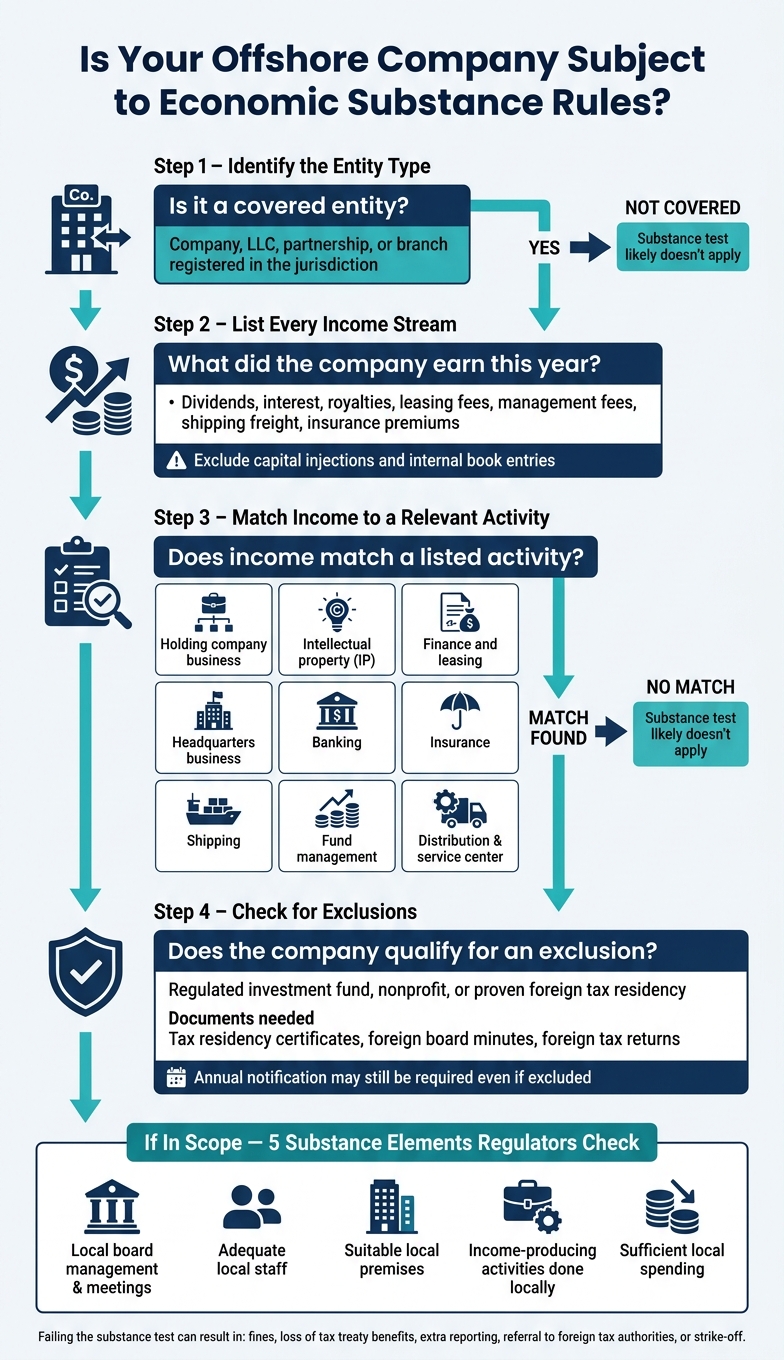
Economic Substance Check: 4-Step Compliance Process for Offshore Companies
Not every offshore company falls under economic substance rules. In most cases, the rules apply only when two things are true at the same time: the entity is a covered type under local law, and it earns income from an activity the jurisdiction treats as relevant. If one of those pieces is missing, the full substance test usually doesn’t apply.
So the first job is simple: figure out whether the entity and the income are inside the rules.
Which entities are covered and which are excluded
Most regimes cover standard limited companies, LLCs, limited partnerships with separate legal personality, and foreign company branches registered locally.
Common exclusions often include regulated investment funds, which are usually handled under separate fund rules, and nonprofit organizations that don’t carry on commercial activities. An entity may also be exempt if it can show foreign tax residency, usually with documents such as tax residency certificates, foreign board minutes, and foreign tax returns. Even then, the entity may still need to file an annual notification.
Which activities most often trigger a substance test
Offshore jurisdictions usually publish a closed list of relevant activities. If your company earns income from one of those activities during the year, it will usually be in scope and must meet the substance test.
Here are the activity types you’ll run into most often:
| Relevant Activity | What It Covers |
|---|---|
| Holding company business | Owning equity in other companies; income from dividends or capital gains |
| Intellectual property business | Owning patents, trademarks, copyrights, or software; earning royalties or licensing fees |
| Finance and leasing | Intra-group loans or asset leasing; income from interest or lease payments |
| Headquarters business | Directing group operations, centralizing strategy, providing intra-group support |
| Banking | Taking deposits and making loans in a regulated manner |
| Insurance | Underwriting risks; issuing insurance or reinsurance policies |
| Shipping | Operating ships for passengers or cargo for consideration |
| Fund management | Managing investments or portfolios on behalf of a fund |
| Distribution and service center | Buying goods for resale or providing back-office services within a group |
Use that list to check each income stream against what the entity actually does. That’s the part that matters.
A step-by-step process to check whether your company is in scope
Go through these four steps for each offshore entity you own or control:
- Identify the entity type. Confirm whether it’s a company, LLC, partnership, or branch registered in the jurisdiction. If it fits a covered vehicle, move to the next step.
- List every income stream for the year. Include dividends, interest, royalties, leasing fees, management fees, shipping freight, and insurance premiums. Leave out capital injections and internal book entries.
- Match each income stream to a relevant activity. Compare what the entity earns with the jurisdiction’s closed list. If even one material income stream fits, the entity is likely in scope.
- Check for exclusions and foreign tax residency. See whether the entity qualifies as a regulated investment fund, nonprofit, or can prove foreign tax residency. If it does, gather the supporting documents – tax residency certificates, board minutes showing decisions were made abroad, and foreign corporate tax returns – and confirm whether a notification is still required.
It helps to keep a short annual memo of this scope review. Income patterns can shift from one year to the next, and a company that sat outside the rules last year can move into scope as soon as it starts earning royalties or interest. Once you’ve pinned down scope, the next step is checking whether the local footprint is enough.
sbb-itb-39d39a6
How the substance test works in practice
Once a company falls in scope, regulators look at a simple but tough issue: is there a real business presence in that jurisdiction, or just paperwork? They assess management, activity, people, premises, and spending as a whole. This isn’t a box-ticking exercise. It’s fact-specific.
The five core elements of a substance test
In day-to-day terms, the substance test comes down to five core questions:
- Is the company managed from the jurisdiction? The board should have the right expertise, hold meetings in the jurisdiction, maintain a physical quorum there, and keep records of strategic decisions locally.
- Are the income-producing activities done in the jurisdiction? These are the functions that directly generate the company’s income. For example, a finance entity should negotiate funding terms and manage financing risk locally.
- Does the company have enough local staff? The number of people on the ground should fit the company’s size and activities.
- Does the company have suitable local premises? Regulators expect premises that match the business and support what the company is doing locally.
- Does the company have enough local spending? The spending should tie back to the company’s activity in the jurisdiction.
"Adequate" depends on the business. A small holding company won’t be judged the same way as a large IP licensing business.
How the rules apply to holding, IP, finance and leasing, and headquarters companies
The level of review changes based on what the company actually does.
Pure equity holding companies usually face a lighter test. In places like the Cayman Islands, a pure equity holding company must meet local filing rules and keep enough human resources and premises to manage its equity participations.
IP companies often get much closer review. Regulators usually want proof that the company itself controls IP strategy and related decisions, often through qualified full-time employees who live locally.
Finance and leasing entities need to carry out their income-producing activities locally, including identifying assets, negotiating terms, and managing financing risk.
Headquarters businesses show substance by making strategic management decisions, coordinating group activities, and spending locally to support that group coordination.
When outsourcing can still satisfy substance requirements
Outsourcing can still meet substance rules, but only in a narrow set of cases. The provider must be local, and the company must supervise the work through written contracts, regular oversight, and board records. If that sounds strict, it is. It only works when the company can prove it with documents.
What evidence regulators expect and how to assess your risk
Once you know your company is in scope, the next step is simple: what proof shows real local activity?
Regulators want records that show the company is actually operating where it is registered. Not just on paper. They look for evidence that people, decisions, spending, and day-to-day work are tied to that jurisdiction.
Documents that support local substance
The main documents usually include:
- Board minutes and director attendance records showing that strategic decisions were made locally, by directors who were physically present in the jurisdiction
- Office lease agreements or utility bills confirming a real, dedicated premises in the jurisdiction
- Payroll records or contractor agreements showing local staff or service providers carrying out income-producing activities
- Local bank statements showing that the company uses accounts held in the jurisdiction for its transactions
- Service contracts with local providers, including outsourced functions, plus oversight records showing the company supervised that work
- Proof of local decision-making such as signed resolutions, meeting agendas, and correspondence showing that key business decisions started in the jurisdiction
What matters most depends on the entity type.
A holding company usually needs board minutes and records showing that equity management decisions were made locally. An IP company needs proof that qualified local employees or contractors controlled IP strategy and licensing decisions. A finance or leasing entity needs records showing that asset identification, term negotiation, and risk management took place in the jurisdiction. A headquarters business needs documents tied to group coordination, strategic direction, and local spending that supports those functions.
If those records are thin, patchy, or don’t line up with each other, filing risk climbs fast. That’s often where trouble starts.
Common red flags and the consequences of noncompliance
Regulators pay close attention to paper-only setups. That usually means companies with no local directors attending meetings in person, no staff or contractors doing income-producing work, no real office, and no local spending that fits the stated activity.
Other red flags include outsourced functions with no oversight records, board decisions made fully outside the jurisdiction, and a mismatch between the company’s stated purpose and what its bank statements and contracts show in plain English.
If an offshore company lacks local substance, the fallout can be serious. Many jurisdictions apply escalating financial penalties for each year the company fails the substance test. The company may also lose access to tax exemptions or treaty benefits it relied on when the structure was put in place.
On top of that, regulators can require extra filings, impose continued reporting duties, or refer the matter to foreign tax authorities in the jurisdictions where the beneficial owners are tax resident. In the most serious cases, the company can face strike-off or suspension of its registration.
A short risk review checklist for founders and investors
Before filing, review each of these points for every offshore entity you own or control:
- Does the company have at least one local director with relevant expertise who attends board meetings in the jurisdiction?
- Are board meetings held in the jurisdiction, with minutes that record decisions made there?
- Does the company employ local staff or engage local contractors to carry out its income-producing activities?
- Does the company maintain suitable premises in the jurisdiction – not just a registered office address?
- Are outsourced functions covered by written contracts, and does the company have records showing it supervised that work?
- Do local bank statements and spending records reflect the company’s stated activity?
- Are all key business decisions – strategy, financing, IP licensing, group coordination – documented as having been made locally?
Use these records to check whether your structure meets the local test or needs remediation before filing. The last step is matching that evidence to your entity type and activity before you submit anything.
Conclusion: How to decide whether your offshore company needs substance and what to do next
Economic substance comes down to a simple idea: where decisions get made, where the work gets done, and whether your records back that up.
Once you check whether a company falls within the rules, the next step is practical: what needs fixing before you file? An offshore registration by itself doesn’t carry much weight. What matters is real business activity. And substance depends on where the company is actually managed, not just where it’s incorporated.
If your offshore company earns income from holding shares, licensing IP, lending, leasing, or group coordination, it may be subject to substance rules. The structures that tend to face the most scrutiny include:
- holding companies
- IP entities
- finance and leasing businesses
- headquarters operations
For all of these, regulators expect real local management and actual activity.
The downside of getting this wrong can be steep. Noncompliance can lead to denied treaty benefits, penalties, retroactive tax, and, in some cases, a shift in tax residency.
So what should you do now? Review each offshore entity you own or control. Match what it does against the local substance rules. Then look for gaps in governance, staffing, or documentation. If you’re using holding companies to route dividends, interest, or royalties, or if your business runs across multiple countries, get legal or tax advice early. Review each entity now, close any governance or documentation gaps, and get advice before the next filing.
FAQs
How do I know if my company is in scope?
Check whether your company carries out a relevant activity and earns income from it. Common examples include holding company business, headquarters operations, financing and leasing, fund management, IP, shipping, or insurance.
Focus on what the company actually does. That means reviewing real contracts, deal flow, and income sources, not just the incorporation documents sitting in a file.
If your company is in scope, you’ll usually need a real local presence. On the other hand, you may be out of scope if the company pays full corporate tax or has tax residency in another place. Even then, a notification may still be required.
Can a virtual office or local service provider be enough?
Usually not. A virtual office or local service provider by itself generally does not meet economic substance rules. A registered address or mail handling service isn’t enough. You need proof of real business presence and actual activity in the jurisdiction.
That usually includes a physical office, qualified local employees, local performance of core income-generating activities, and strategic management and decision-making in the jurisdiction.
What should I fix first if my substance is weak?
First, run an internal audit to spot gaps between your current setup and local economic substance rules. Build a compliance risk register, write down each issue, and assign a clear owner to fix it.
Then focus on governance and proof. That means active local directors who take part in decisions, board minutes and attendance records, and evidence of actual operations on the ground, such as office leases, local employment contracts, payroll records, or utility bills. It also helps to work with professional advisors so your response lines up with both local rules and home-country reporting requirements.