
Yes – Americans can legally own an offshore company. The catch is simple: you still have to report the company, foreign accounts, and income to the IRS and FinCEN.
Here’s the short version:
- I’d define an offshore company as a company formed outside the United States
- It can be used for international trade, holding assets, estate planning, or offshore asset protection
- It does not remove U.S. tax duties because Americans are taxed on worldwide income
- If foreign accounts go over $10,000 at any point in the year, an FBAR may apply
- Other filings can include Form 5471, Form 8865, Form 8858, and Form 8938
- Common setups include a Belize IBC, Nevis LLC, and Cayman exempted company , or structuring offshore trusts
- If your business is fully U.S.-based, a U.S. LLC is often the simpler choice
Put another way: forming the company is usually the easy part; reporting it is where mistakes happen.
I’d also keep this in mind: offshore planning is legal, but hiding ownership or income is not. And for many people, the filing costs and paperwork can outweigh the upside.
If you want the plain-English answer, this article comes down to three points:
- Legal to own
- Tax still applies
- Disclosure matters
From there, I’d look at what an offshore company is, how it differs from a U.S. entity, when it may fit, and what Americans usually need to file.
What is an offshore company and how does it differ from a U.S. company?
Plain-English definition of an offshore company
An offshore company is a business entity formed under another country’s laws, not under the laws of a U.S. state. Put simply, it’s a company registered abroad, much like an LLC or corporation in the United States. It can own assets, sign contracts, open bank accounts, and help separate personal assets from business liabilities through asset protection for the entrepreneur.
Where things start to change is in tax treatment, disclosure, and where the entity is allowed to do business.
That said, legal separation does not make U.S. tax reporting go away. For U.S. tax purposes, the company is still treated as a foreign entity, and its tax treatment depends on how it’s set up and any elections that apply.
Key differences from a U.S. LLC or corporation
The main differences between an offshore company and a U.S. entity come down to four practical areas: taxes, privacy, formalities, and operating limits.
On the tax side, many offshore jurisdictions offer 0% local corporate tax on income earned outside that jurisdiction. That sounds attractive at first glance, but there’s an important catch: it does not wipe out U.S. tax duties. U.S. persons are still taxed on worldwide income, and using an offshore structure does not change that.
| Feature | U.S. LLC / Corporation | Offshore Company (IBC/LLC) |
|---|---|---|
| Local Taxation | Subject to federal and state income taxes | Often 0% local tax on income earned outside the jurisdiction |
| Public Disclosure | Ownership is often part of the public record | Many jurisdictions do not maintain public owner records |
| Reporting Requirements | Annual reports, tax filings, potential audits, and required meetings | Minimal local reporting; no required audit; books and meetings can be held anywhere |
| Where It Can Operate | Can operate in the U.S. and abroad | Often restricted from doing business inside its home jurisdiction |
This is why people use offshore structures for certain cross-border goals. An International Business Company, or IBC, is a good example. It’s generally set up for business outside the country where it was formed, not for doing business inside that same country.
Some jurisdictions also keep owner or director records off the public register. Even so, U.S. owners still have to report ownership to the IRS. That’s the part many people miss: offshore can mean more privacy locally, but it does not mean secrecy from U.S. tax authorities.
Those legal and filing differences help explain why offshore companies are often used for international business and asset segregation. The next step is figuring out when those features fit a real business need.
sbb-itb-39d39a6
Why people use offshore companies: common structures and use cases
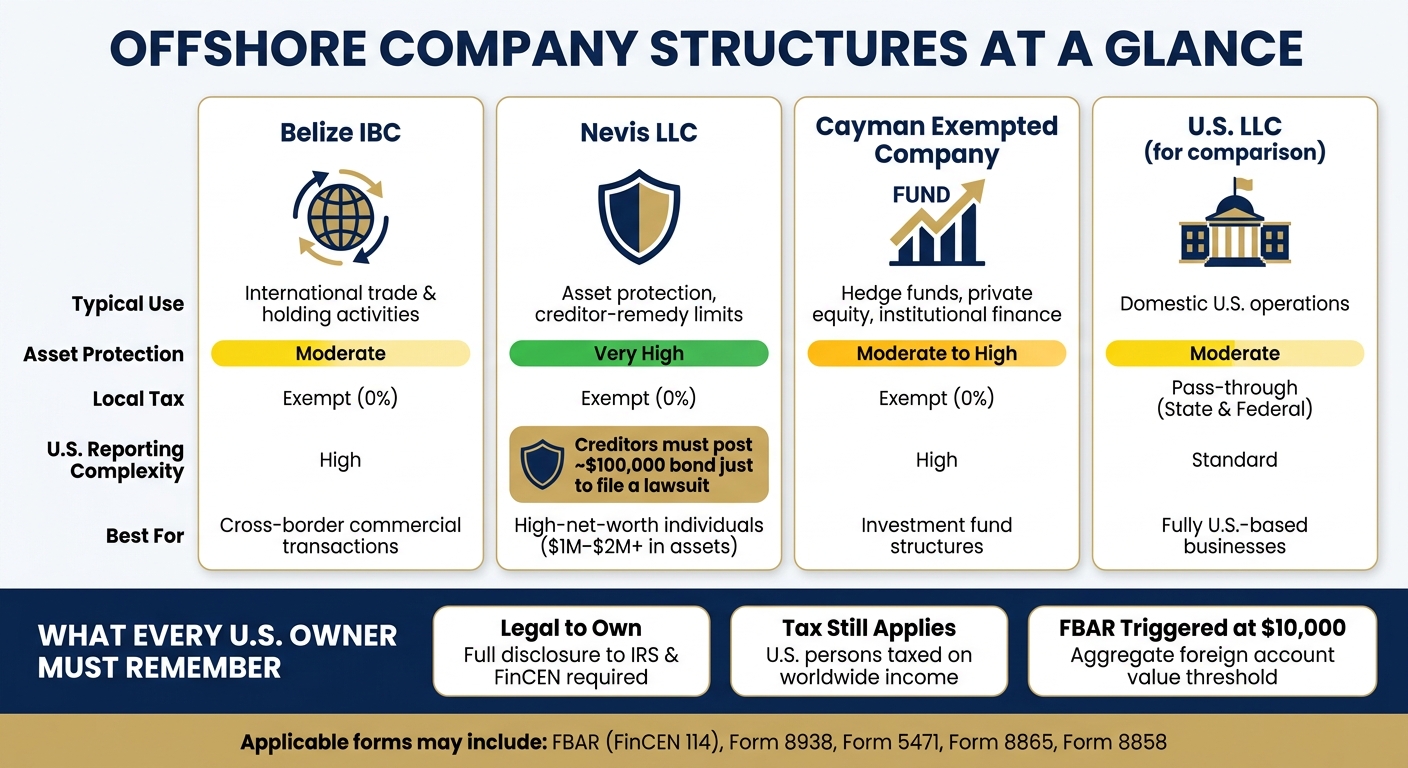
Offshore Company Structures Compared: Belize IBC vs Nevis LLC vs Cayman vs U.S. LLC
Internationally minded Americans usually use offshore companies for lawful planning, asset protection, and smoother cross-border operations. The point isn’t secrecy. It’s structure. And that structure only works if ownership, tax treatment, and reporting are handled the right way.
The most common use cases are pretty straightforward:
- Asset protection and risk isolation: An offshore entity can hold assets in a foreign company, which may make collection harder for creditors. It can also separate one business activity from another, so a problem in one area doesn’t spill over into U.S.-based assets.
- Investment holding: Places like the Cayman Islands are often used to pool capital for hedge funds and private equity in a tax-neutral setup.
- Estate planning: Offshore structures can help pass international assets to heirs without dealing with probate in several foreign countries.
- Cross-border business: A neutral legal platform, often based on British Common Law, may feel more familiar to foreign counterparties and international banks.
The best-known offshore structures don’t all do the same job. Each one tends to fit a specific use case.
Belize IBC, Nevis LLC, and Cayman exempted company: a quick overview
A Belize IBC is often used for international trade, holding activities, and cross-border commercial transactions.
A Nevis LLC is mainly used for asset protection. Nevis law puts real procedural barriers in front of creditors. For example, a creditor may need to post a bond of about $100,000 just to file a lawsuit against the entity in Nevis, and Nevis does not automatically recognize foreign court judgments.
The Cayman Islands exempted company is the standard option for hedge funds, private equity, and international fund structures.
When an offshore company makes sense – and when it does not
An offshore structure tends to make sense when there’s a real international element involved: foreign clients, non-U.S. counterparties, assets outside the United States, or business activity that isn’t purely domestic. It can also make sense for high-risk professionals or investors who want to separate one activity from their broader wealth.
On the other hand, it’s usually a poor fit for a business that is fully U.S.-based. If your clients, employees, contracts, and assets are all in the United States, a standard U.S. LLC is often simpler, less expensive, and easier to run. And for smaller asset bases, the compliance burden can outweigh the upside. If the assets you’re trying to protect are below roughly $1 million to $2 million, the costs often don’t justify the setup.
Comparison of common offshore structures
| Feature | Belize IBC | Nevis LLC | Cayman Exempted Co | U.S. LLC |
|---|---|---|---|---|
| Typical Use | International trade, holding activities | Asset protection, creditor-remedy limits | Investment funds, institutional finance | Domestic U.S. operations |
| Asset Protection | Moderate | Very High | Moderate to High | Moderate |
| Local Tax | Exempt | Exempt | Exempt | Pass-through (State/Federal) |
| U.S. Reporting Complexity | High | High | High | Standard |
Those upsides only matter if the structure is owned, reported, and taxed properly.
Is it legal for Americans? Yes – but the real issue is reporting and tax compliance
Americans can own offshore companies. That’s legal.
But here’s the part that trips people up: they still have to report the entity, related foreign accounts, and worldwide income to the IRS. That also includes beneficial ownership disclosure, not just tax reporting. The rule is the same whether the entity is a Belize IBC, Nevis LLC, or Cayman exempted company. So the main issue isn’t setting up the company. It’s reporting it properly.
Legal ownership vs. illegal concealment
The difference between lawful offshore planning and illegal conduct comes down to disclosure.
Legal use means full IRS and FinCEN disclosure, including beneficial ownership reporting. Illegal use means hiding beneficial ownership, leaving out income, filing false returns, or using sham arrangements to conceal funds.
If an advisor promises total secrecy or an untraceable account, treat that as a red flag. That’s not legal planning. That’s concealment.
U.S. filing obligations Americans should expect
The forms Americans may need to file depend on how the IRS classifies the foreign entity. That classification drives which disclosures apply.
| Form | What It Covers | When It Applies |
|---|---|---|
| FinCEN Form 114 (FBAR) | Foreign financial accounts | Aggregate account value exceeds $10,000 at any time during the year |
| IRS Form 8938 (FATCA) | Specified foreign financial assets | Thresholds vary by filing status and residency |
| IRS Form 5471 | U.S. persons in foreign corporations | Officer, director, or shareholder in a foreign corporation |
| IRS Form 8865 | Foreign partnerships | U.S. person with an interest in a foreign partnership |
| IRS Form 8858 | Foreign disregarded entities | U.S. person with an interest in a foreign disregarded entity |
One more thing: paying tax by itself isn’t enough. Separate information returns can still lead to penalties.
In practice, those filing duties and compliance costs are often what decide whether an offshore company makes sense for your goals.
Conclusion: How to decide if an offshore company is right for you
An offshore company is a foreign legal entity. For Americans, the main issue isn’t just ownership. It’s legal ownership paired with full U.S. tax and reporting compliance.
That’s the part many people get wrong.
Offshore structures are not a way to avoid U.S. tax. U.S. persons are taxed on worldwide income no matter where the company is formed. In limited cases, tax recognition may be deferred, but the rules still apply.
After you sort out the legal and reporting side, the next step is simple: does this structure fit the way your business actually works?
A Nevis LLC or Belize IBC can make sense for an international business with no U.S. employees or agents. It can also fit an investor with about $1 million to $2 million in liquid assets who wants stronger asset protection than a domestic LLC can usually offer. But if your business is fully based in the U.S., a standard domestic LLC is often easier to run and costs less.
That fit only matters if the company has real activity behind it. The offshore entity needs economic substance, including real board activity, proper records, and a genuine business purpose. If it’s just a shell with no actual activity, it faces more scrutiny and may be disregarded.
Key takeaways for U.S. entrepreneurs and investors
- Ownership is legal if fully disclosed.
- FBAR, FATCA, and entity-specific filings still apply.
- Offshore structures work only when the business case is real.
- Substance and records matter.
Compliance is what makes offshore planning legitimate. Done the right way, and with qualified professionals, an offshore company can be a useful tool. If it matches your operations and you can handle the reporting rules, it may make sense. If not, a domestic entity is usually the better call.
FAQs
Do I need an offshore company if my business is only in the U.S.?
Generally, no. If your business operates only in the U.S., a U.S. LLC is usually the better fit. It’s simpler to run, easier to keep in good standing, and better suited to domestic business.
Offshore companies are more often used for international operations, global banking, or certain asset protection setups. If your business is purely domestic, an offshore company can bring extra costs, more paperwork, and added IRS filing duties like FBAR, FATCA, and Form 5472, without giving you much in return.
What happens if I miss an FBAR or IRS filing?
Missing an FBAR or IRS filing can get expensive fast. If you don’t file FinCEN Form 114 when your foreign accounts go over the $10,000 threshold at any point during the year, you could face steep financial penalties and, in some cases, criminal charges.
U.S. reporting rules aren’t optional. That’s why it helps to keep clear records and work with a tax professional who knows international filing rules, can track deadlines, and can help you handle more complex reporting issues.
How do I know whether an offshore company has enough business substance?
An offshore company has enough business substance when you can show it’s a real operating business, not just a shell. In plain English, that usually means its main income-generating work happens in the same jurisdiction where the company is incorporated.
Common signs of substance include:
- A physical office
- Qualified local staff
- Local decision-making by active directors
- Clear records, such as board minutes, resolutions, and major transaction documents