
If I had to cut this down to one line, it’s this: Singapore is often the better pick for ASEAN-focused startups, holding companies, and regional HQ setups, while Hong Kong is often the better pick for China-linked trade, sourcing, and RMB-heavy business.
Here’s the short answer based on the article:
- Choose Singapore if I want:
- a base in Southeast Asia
- lower-friction fintech banking
- no capital gains tax
- a setup that fits a digital business or regional HQ
- Choose Hong Kong if I want:
- closer China access
- a trade or sourcing company
- lower bank deposit hurdles at many banks
- multi-currency use across HKD, USD, and RMB
- Watch out in both places for:
- bank account friction
- tax residency questions
- proof of local presence
- U.S. filing rules like FBAR once foreign accounts pass $10,000
In 2026, this choice is less about low taxes alone and more about whether I can open an account, support my tax position, and show enough local presence. That matters even more now that 171 million financial accounts worth €13 trillion were exchanged under CRS in 2024.
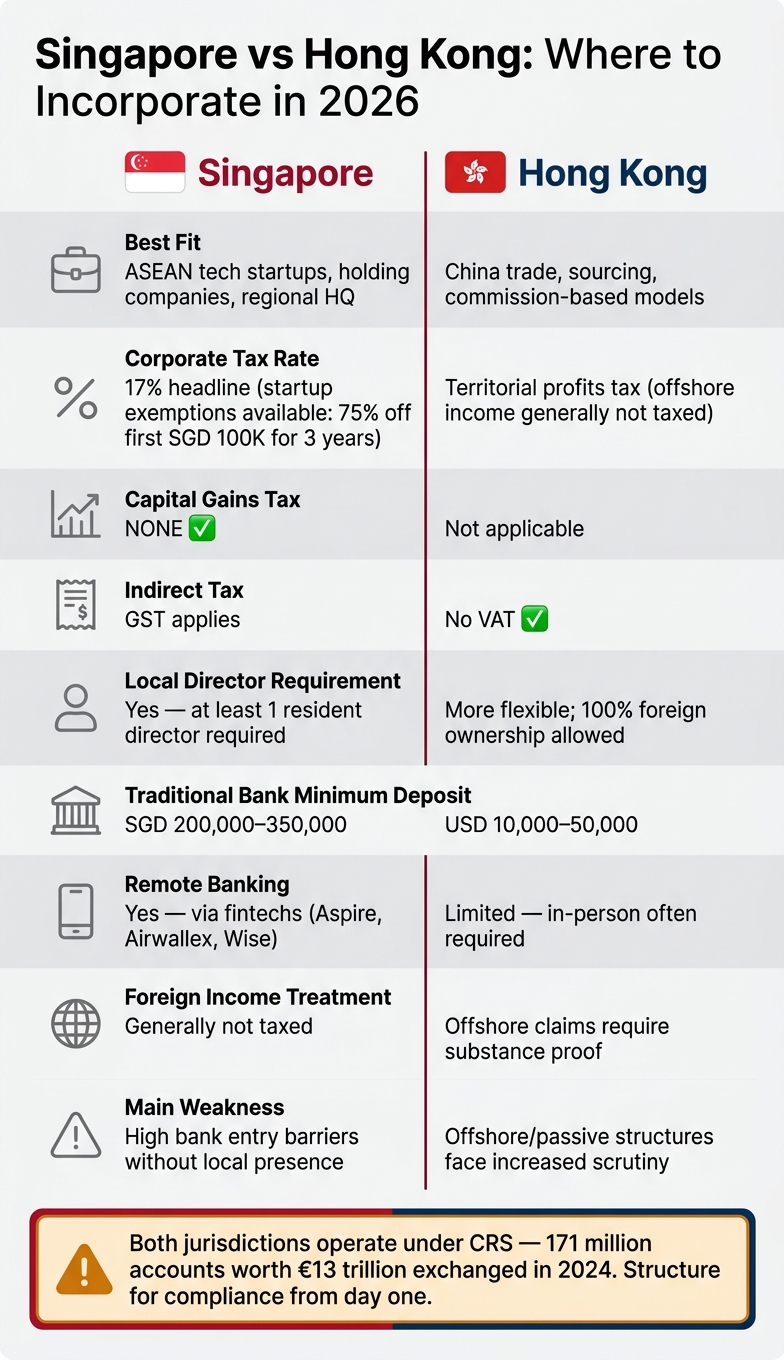
Singapore vs Hong Kong: Side-by-Side Comparison for 2026
Quick Comparison
| Criteria | Singapore | Hong Kong |
|---|---|---|
| Best fit | ASEAN tech, holding companies, regional HQ | China trade, sourcing, commission models |
| Corporate tax | 17% headline, with startup tax breaks | Territorial profits tax |
| Foreign income | Often not taxed | Usually needs offshore proof |
| Capital gains tax | No | Not the main selling point in this piece |
| Indirect tax | GST | No VAT |
| Local director | Yes, at least one resident director | More flexible on ownership |
| Banking | Banks can ask for S$200,000 to S$350,000; fintech options help | Banks often ask for $10,000 to $50,000 |
| Remote setup | Better if I use fintech | More limited; in-person is often asked for |
| Main weak point | Harder bank entry without local presence | Offshore claims and passive structures face more scrutiny |
My takeaway: if my business runs on ASEAN growth and remote-friendly banking, Singapore usually makes more sense. If it runs on China access and cross-border trade flows, Hong Kong often has the edge.
The rest of the article breaks down those trade-offs in tax, banking, cost, and compliance.
sbb-itb-39d39a6
How Singapore works in 2026
In practice, Singapore generally does not tax foreign-sourced income, and it does not tax dividends again at the shareholder level. But there’s a catch: this works best when the company has real local substance, not just a registration certificate and a mailing address.
Tax rates, exemptions, and when effective rates drop below 17%
Singapore’s headline corporate tax rate is 17%. On paper, that can sound high compared with some low-tax jurisdictions. In practice, the actual rate can land much lower, especially in the first few years.
There is also no capital gains tax. That matters if the business expects to sell assets, exit an investment, or realize gains down the road.
The main early-stage tax break is Singapore’s startup tax exemption. For the first three years, it gives:
- 75% off the first SGD 100,000 of chargeable income
- 50% off the next SGD 100,000
After year three, a partial exemption still applies on a similar tiered structure.
Director, substance, and annual compliance requirements
Every Singapore company must have at least one resident director, a local registered office address, and a resident company secretary. That’s the formal side.
The harder part is substance. Regulators pay attention to where management decisions are actually made, not just where the company is filed. A virtual address by itself can fail substance checks.
There’s also a steady stream of annual compliance work. Companies need to handle annual returns, tax returns, and beneficial ownership updates. If filings are missed, ACRA treats that as a compliance red flag.
Singapore tends to work best when the company has real local management and clean records.
Banking access and which business types fit best
Banking is often the point where Singapore feels either smooth or frustrating. It depends on how much local presence the company can show.
Singapore’s banking sector is large, stable, and widely trusted. But access varies a lot by provider. Traditional banks like DBS, UOB, and OCBC usually want in-person visits and often ask for large minimum deposits for non-resident accounts. Fintech platforms such as Aspire, Airwallex, and Wise are much easier to access, with fully remote onboarding and no minimum deposit.
Singapore is a strong match for a few business types in particular:
- Regional headquarters
- Trading firms that need FX and trade finance
- Family offices that want a compliant, well-regarded structure
It’s a weaker match for founders who want a fully remote setup with little or no local substance. That same substance test is also the main point of comparison with Hong Kong.
How Hong Kong works in 2026
Compared with Singapore, Hong Kong gives founders more room on ownership. At the same time, it leans more heavily on offshore substance.
Hong Kong taxes profits sourced in Hong Kong, while foreign-sourced income is generally not taxable.
Territorial taxation and offshore income treatment
Hong Kong uses a territorial tax system. On paper, that sounds simple. In practice, offshore treatment is not automatic.
Banks and regulators now expect real substance, such as a lease and active contracts. So the tax upside only helps if the company can back it up with actual operations. No paper-only setup. No thin story.
Ownership structure and substance
A foreign founder can own 100% of a Hong Kong company. That part is straightforward.
The harder part is substance. Ownership is flexible, but the company still needs practical proof that it exists and operates in a real way. A verified local correspondence address matters here because it helps show that local footprint.
Banking access and which business types fit best
Hong Kong has a deep banking network, but getting access is still strict. For non-resident corporate clients, many old-line banks often ask for an in-person visit. Minimum deposits for corporate accounts also tend to fall between $10,000 and $50,000.
Banks look closely at source of funds and transaction history too. That means clean narratives and documented transfers matter a lot. If money is moving across borders, the story behind those transfers needs to line up with the records.
This mix of tax rules and banking checks tends to suit some business models better than others. Hong Kong is a good fit for:
- Trading companies
- Sourcing businesses
- Commission-based structures
That is especially true for founders with Mainland China exposure or cross-border Asian trade. Multi-currency accounts in HKD, USD, and RMB are also a practical edge for day-to-day operations.
It is a weaker fit for purely passive holding companies with no real substance. Banks are asking for more proof now, and they often want to see a lease or active contracts before they approve investment-holding structures.
Singapore vs Hong Kong: side-by-side comparison
Here’s the short version of the trade-offs. If you want the fastest way to compare these two, look at tax treatment, substance, banking, and cost.
Taxes, foreign income, and indirect tax costs
Singapore generally exempts foreign-sourced income. Hong Kong can also exempt foreign income, but offshore treatment usually hinges on whether you can show enough substance.
The other big split is indirect tax. Singapore applies GST. Hong Kong has no VAT.
| Factor | Singapore | Hong Kong |
|---|---|---|
| Tax system | Territorial | Territorial |
| Foreign-sourced income | Generally not taxed | Offshore claims require proof of substance |
| Indirect tax | GST | No VAT |
Tax rules matter, of course. But in day-to-day use, banking and substance often decide whether the setup works.
Setup requirements, substance, banking, and annual costs
On substance, both places now expect hard proof: leases, contracts, audited accounts, and tax filings. A verbal story won’t cut it.
Banking is where the practical gap gets more obvious. In Singapore, traditional banks such as DBS, OCBC, and UOB usually ask non-residents for minimum deposits of SGD 200,000 to SGD 350,000, and they also want an in-person visit. In Hong Kong, traditional banks often ask for US$10,000 to US$50,000.
That difference can change the math fast. If a founder can’t clear Singapore’s bank thresholds, fintech options like Aspire and Airwallex can offer remote account opening with no minimum deposit.
| Factor | Singapore | Hong Kong |
|---|---|---|
| Traditional bank minimum deposit | SGD 200,000 to SGD 350,000 | US$10,000 to US$50,000 |
| Remote banking option | Yes, via fintech platforms like Aspire and Airwallex | Limited; in-person often required |
Which jurisdiction fits your business model
The better choice has less to do with prestige and more to do with how your company earns money, moves money, and gets banked.
| Business Profile | Recommended Jurisdiction | Key Reason | Main Caution |
|---|---|---|---|
| ASEAN tech startup | Singapore | Regulatory predictability and remote fintech access | Non-resident founders can still face high bank onboarding barriers |
| China-focused trading company | Hong Kong | Primary Asia-Pacific gateway; hosts 75 of the world’s 100 largest banks | Offshore treatment still requires proof of substance |
| International holding company | Singapore | Foreign-sourced income is generally not taxed, and Singapore has no capital gains taxes | Traditional banking can require very high deposits |
| Regional headquarters | Singapore | Strong regulatory infrastructure and professional services ecosystem | Major bank onboarding often requires an in-person visit |
| Location-independent founder | Singapore | Remote fintech banking is available | Traditional banking is harder without local presence |
Final verdict and next steps
The choice comes down to three things: your customers, your banking path, and how much compliance work you can handle.
Singapore makes sense for founders who want credibility, a base in Southeast Asia, and remote fintech banking. If you’re building a digital business or setting up a regional headquarters, Singapore is usually the stronger base.
Hong Kong makes more sense for businesses that rely on China access. The path into banking is also easier in many cases, with entry points often around $10,000 to $50,000, compared with the higher non-resident thresholds often seen in Singapore.
Banking secrecy is mostly gone. Most cross-border accounts are now visible to tax authorities. Both places operate under CRS and full transparency rules. Set up your structure for compliance from day one.
Pick the place that lines up with your tax footprint and banking reality, not just the headline tax rate.
A short decision checklist
Use this checklist to make the call.
- Where is your tax residency? Get tax residency confirmed in writing before you open accounts. Ambiguous residency is the leading cause of application failure in Singapore.
- Can you meet deposit minimums? For non-residents, traditional Singapore banks usually ask for SGD 200,000 to SGD 350,000. If that number is too high, Hong Kong banks or Singapore-based fintechs may be a better path.
- Do you need China access? If yes, Hong Kong is the clearer pick. If your customers are in Southeast Asia, Singapore is usually the better fit.
- Is a U.S. entity or person involved? If yes, your structure needs to account for FATCA and FBAR rules. FBAR is triggered when aggregate foreign accounts go over $10,000.
- Does the entity need to fit into a trust, U.S. company, or residency plan? If your setup has multiple layers, the way those layers work together matters just as much as the place you choose.
FAQs
How much local substance do I really need?
It depends on what your business actually does and where you set it up.
In Singapore, the rules are usually stricter. You’ll generally need a registered office, at least one local director, and in some cases, you may also need to carry out core income-generating activities in Singapore.
Hong Kong also looks for clear substance. That can include active leases and contracts tied to corporate accounts.
For businesses such as IP management, fund administration, banking, or regional headquarters, this usually means real economic activity on the ground, including:
- Local staff
- Office space
- Documented management decisions
Can I incorporate before opening a bank account?
Yes. You can incorporate your company before opening a bank account.
For a corporate account, banks usually ask for a Certificate of Incorporation and a company profile to confirm the business is legit. You can start talking with banks earlier, which is often a smart move if you want to compare options.
But the formal account opening step usually happens only after the company is legally registered.
Which option is better for a U.S. founder?
For a U.S. founder, the right choice comes down to what you’re trying to do.
Singapore often makes more sense if you want long-term stability, a clear legal system, and a base for reaching Southeast Asia. The trade-off is that it usually asks for more local substance.
Hong Kong often stands out for international trade, banking access, and flexibility in how you run the business.
Whichever route you choose, U.S. founders still need to handle U.S. reporting rules, including FATCA, Form 5471, and possible PFIC rules.