
The tax haven landscape has changed in 2026. It’s no longer about secrecy or zero-tax rates. Now, it’s about compliance, substance, and global perception. Jurisdictions must meet stricter international standards, like the OECD‘s 15% global minimum tax and Economic Substance rules, to remain competitive. Entrepreneurs are now seeking countries that offer a mix of tax efficiency, legal stability, and banking access.
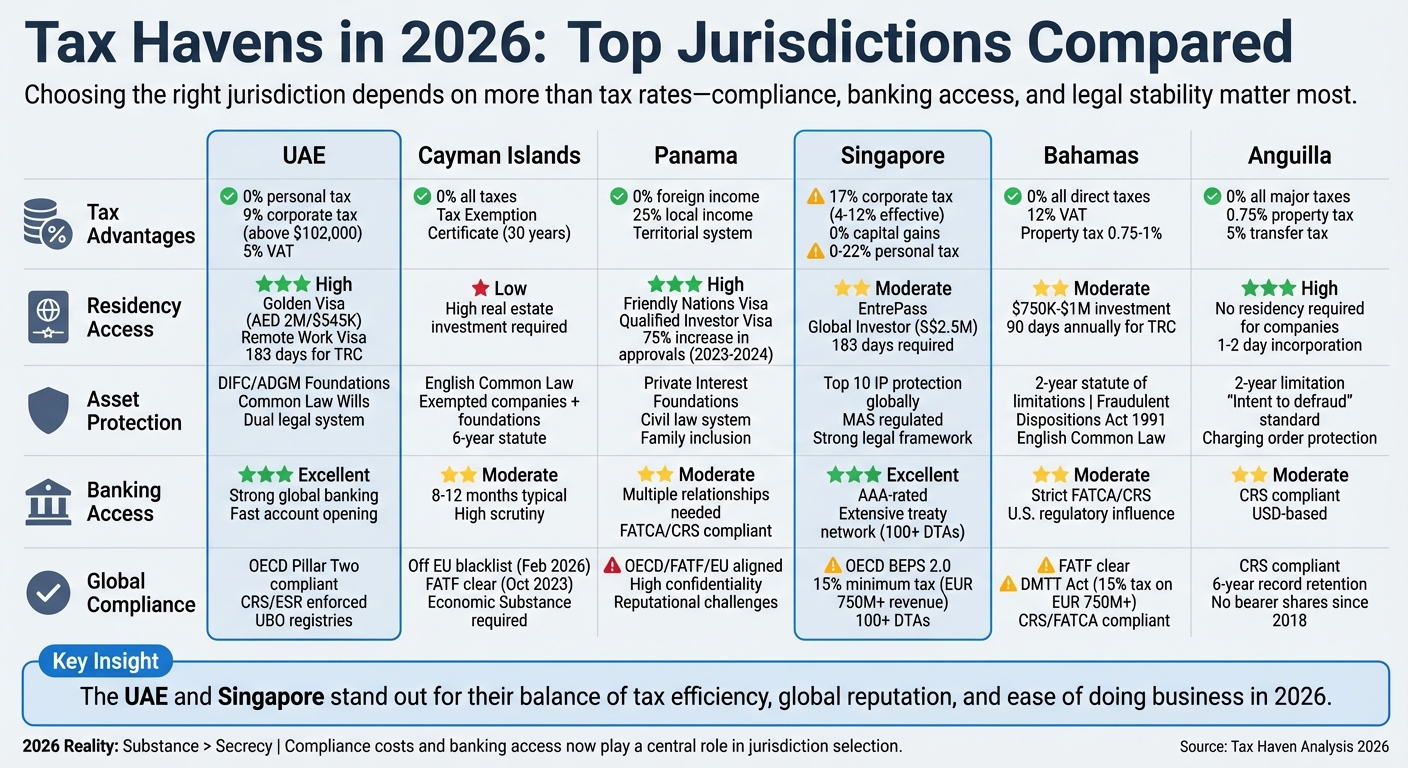
Here’s a quick summary of the top options:
- UAE: 0% personal tax, 9% corporate tax (above $102,000), excellent residency options like the Golden Visa, strong asset protection, and compliance with global standards.
- Cayman Islands: 0% tax across the board, but requires economic substance and faces rising operational costs.
- Panama: Territorial tax system with 0% tax on foreign income, accessible residency programs, and strong asset protection.
- Singapore: 17% corporate tax with exemptions, robust legal system, and extensive treaty network.
- Bahamas: Zero direct taxes, flexible residency options, and strong asset protection but limited treaty access.
- Anguilla: 0% tax, simple company formation, and strong asset protection under English Common Law.
Key takeaway: Choosing the right jurisdiction depends on more than tax rates. Factors like compliance costs, banking access, and legal stability now play a central role. The UAE and Singapore stand out for their balance of tax efficiency, global reputation, and ease of doing business.
1. United Arab Emirates (UAE)
The UAE stands out as a substance-focused jurisdiction, prioritizing transparency over secrecy. With 0% personal income tax, 0% capital gains tax, and 0% inheritance tax, it offers an attractive environment for individuals and businesses alike. However, corporate taxation varies: mainland companies face a 9% tax on profits exceeding AED 375,000 (around $102,000), while Free Zone companies enjoy 0% tax on qualifying income, provided they cater to international clients and earn less than 5% of their revenue domestically.
Tax Advantages
The UAE’s tax policies are structured to benefit businesses targeting global markets. Free Zones, such as Umm Al Quwain (UAQFTZ), offer affordable setup packages starting at AED 5,000 (about $1,360) for consultants and digital startups. Small businesses earning under AED 3 million can take advantage of a 0% tax rate until December 2026. For those seeking long-term residency, the Golden Visa requires a minimum investment of AED 2 million (approximately $545,000) and provides a 10-year residency without the need for annual sponsorship. A 5% VAT applies to most goods and services, while multinationals with annual revenues exceeding €750 million are subject to the 15% OECD Pillar Two minimum tax.
These incentives align with broader strategies for residency and asset protection, making the UAE a compelling choice for global entrepreneurs.
Residency Options
The UAE offers several residency pathways tailored to different needs. Options include the Golden Visa (10 years), the Investor/Partner Visa (renewable 5 years), and the Remote Work Visa (1 year for digital nomads). To access the benefits of the UAE’s double taxation treaties, individuals must obtain a Tax Residency Certificate (TRC), which requires residing in the country for at least 183 days per year. Recent reforms have made sponsoring family members more flexible, raising age limits for dependent children and streamlining processes through digital platforms.
Asset Protection Laws
The UAE employs a dual legal system: Civil Law governs the mainland, while English Common Law applies in financial free zones like DIFC and ADGM. Non-Muslim residents can register a Common Law Will through the DIFC Wills Service Centre to bypass Sharia inheritance laws, ensuring assets are distributed as intended and avoiding account freezes upon death. For more advanced asset management, DIFC and ADGM Foundations allow entrepreneurs to create independent legal entities. These structures protect assets from personal creditors while enabling founders to maintain control.
This legal framework reinforces the UAE’s commitment to safeguarding wealth while adhering to global standards.
Compliance with Global Regulations
The UAE aligns with international norms by enforcing the OECD’s Common Reporting Standard (CRS) and Economic Substance Regulations (ESR). To retain tax-exempt status, businesses must demonstrate genuine operations, including local employees, physical offices, and decision-making authority.
"The defining feature of successful companies in the UAE in 2026 is not speed of setup, but strategic foresight" – Maria Rubert, Lawyer and Arbitrator.
Free Zone companies are required to maintain detailed records to pass routine audits. Additionally, DIFC and ADGM have implemented Ultimate Beneficial Ownership (UBO) registries in line with standards seen in the UK and Singapore.
sbb-itb-39d39a6
2. Cayman Islands
The Cayman Islands stands out as a tax-neutral jurisdiction, offering 0% taxes on corporate profits, capital gains, personal income, and withholdings. Entrepreneurs can secure a Tax Exemption Certificate upon incorporation, guaranteeing protection against future taxes for up to 30 years. However, multinational groups earning over €750 million may face top-up taxes in their home countries due to OECD Pillar Two rules. These tax policies lay the groundwork for a deeper look into the jurisdiction’s fiscal, operational, and legal benefits.
Tax Advantages
Corporate regulations in 2026 introduced more flexibility in capital management. For instance, solvent companies can now reduce share capital through a special resolution accompanied by a directors’ solvency statement – cutting out the need for court approval. Incorporation is typically quick, taking just 1 to 3 business days unless extended by compliance checks.
As of February 18, 2026, the Cayman Islands remains off the EU’s list of non-cooperative tax jurisdictions, maintaining its reputation as a compliant financial hub. However, operational expenses have risen sharply. Work permit fees increased by 150% to 400% in early 2026, and banking licenses now follow a tiered fee structure. Institutions with assets under $1 billion pay $1,000,000 annually, those with assets between $1 billion and $3 billion pay $1,750,000, and those exceeding $3 billion face $2,250,000 by 2028.
Residency Options
Residency in the Cayman Islands requires substantial real estate investment, with minimum thresholds varying by tier in 2026. However, the jurisdiction is primarily attractive for its corporate structuring options rather than personal residency perks. Entrepreneurs can choose from Exempted Companies, LLCs, or Foundation Companies to manage their wealth effectively. Additionally, the absence of exchange controls allows seamless capital movement, simplifying global operations.
Asset Protection Laws
The Cayman Islands pairs its tax neutrality with solid asset protection laws that align with global compliance standards. Based on English Common Law, the jurisdiction provides a stable legal framework where companies operate as separate legal entities, limiting shareholder liability to unpaid share amounts.
Entrepreneurs seeking enhanced protection often combine an exempted company with a Cayman foundation or trust, creating a two-layer structure to separate business assets from personal wealth. The Exempted Limited Partnership (ELP) is another popular structure, especially for private equity and venture capital. It offers limited liability for partners while functioning as a pass-through entity.
Compliance with Global Regulations
The International Tax Co-operation (Economic Substance) Act (2026 Revision) consolidates prior amendments, requiring relevant entities to demonstrate local management, direction, and core income-generating activities. Legal expert Aneth Coloma, Social Media Manager at Cayman.com.ky, highlights the jurisdiction’s adaptability:
"Cayman presents a case study in calibrated evolution – preserving core strengths in financial services while opening pathways for innovation and structural agility".
Compliance measures have tightened further with the Beneficial Ownership Transparency (Amendment) Regulations, 2026, reducing the reporting window for data discrepancies from 30 days to 5 days. Starting January 1, 2026, the Crypto-Asset Reporting Framework (CARF) mandates reporting for crypto-asset service providers. Entities must also retain economic substance records for six years and appoint a Local Principal Point of Contact for Common Reporting Standard compliance.
3. Panama
Panama operates a pure territorial tax system, meaning all foreign-source income is completely exempt from taxation. Entrepreneurs can enjoy 0% tax on foreign dividends, capital gains, and business profits earned outside Panama’s borders. For income generated within Panama, natural persons face a progressive tax structure: 0% on the first $11,000, 15% on income between $11,000 and $50,000, and 25% on amounts exceeding $50,000. Legal entities, on the other hand, pay a flat 25% rate on net profits. Additionally, Panama does not impose taxes on inheritances, gifts, or capital gains from assets held abroad. These policies provide a strong foundation for entrepreneurial ventures, as outlined below.
Tax Advantages
Panama offers a range of incentives, including access to the Colon Free Zone and other special economic areas where businesses can benefit from reduced tax rates and additional perks. The country also maintains an extensive network of double tax treaties, simplifying cross-border operations. Luigi Wewege, President of CIB, highlights Panama’s appeal:
"It is no coincidence that Panama continues to rank highly as a jurisdiction of choice for international business structuring, family offices, and cross-border entrepreneurs".
It’s important to structure local services for foreign clients carefully to avoid triggering local tax obligations.
Residency Options
In addition to its tax benefits, Panama offers streamlined residency programs tailored for entrepreneurs. The Qualified Investor Visa and Friendly Nations Visa provide fast-track residency options with specific minimum investment requirements, making it easier for international entrepreneurs to establish themselves. Between 2023 and 2024, visa approvals jumped 75%, increasing from 187 to 327.
Permanent residents must visit Panama at least once every two years to maintain their status. After five years of legal residency, individuals can apply for naturalization and Panamanian citizenship, which grants visa-free travel to over 140 destinations, including the Schengen Area. Idaliz Guiraud, Managing Partner at Guiraud Law, remarks:
"Panama’s residency program is not merely one of the best available, it is the benchmark against which others are measured".
Asset Protection Laws
Panama pairs its tax advantages with strong asset protection mechanisms, which are crucial in today’s regulatory environment. Tools like Private Interest Foundations and customized corporate structures help safeguard wealth. The country’s civil law system guarantees property rights and contractual stability, providing a secure framework for preserving assets. Residency programs also allow applicants to include family members, such as spouses, minor children, dependent adult children, and dependent parents, under a single application.
Compliance with Global Regulations
Panama adheres to international standards set by organizations like the OECD, FATF, and EU, ensuring transparency and compliance. Residency applicants must provide comprehensive documentation, including proof of funds, evidence of the source of wealth, and a clean criminal record. To establish and maintain tax residency, applicants must demonstrate substantial economic ties to Panama and spend a significant amount of time in the country. Navigating these requirements often necessitates the assistance of licensed Panamanian legal counsel. For the Qualified Investor Visa, assets must remain in Panama for at least five years to retain residency eligibility.
4. Singapore
Singapore has evolved from being seen as a traditional tax haven to establishing itself as a hub driven by capability and innovation. While the corporate tax rate stands at 17%, many small and medium enterprises effectively pay between 4% and 12%, thanks to various exemptions and incentives. For the Year of Assessment 2026, the country is offering a one-time 40% corporate tax rebate, capped at S$30,000 per company, for businesses employing at least one local worker. The minimum rebate is set at S$1,500. David Stepat, Singapore Director at Dezan Shira & Associates, elaborates:
"Budget 2026 reinforces Singapore’s transition from a cost-efficient operating base toward a capability-driven hub. The emphasis on innovation, AI adoption, and capital market development signals a policy direction focused on long-term competitiveness rather than short-term cost advantages".
These measures strengthen Singapore’s tax policies while maintaining its distinct advantages.
Tax Advantages
Singapore’s tax system focuses only on income earned or brought into the country. There’s no tax on capital gains or dividends, giving entrepreneurs the freedom to reinvest their earnings without facing extra tax burdens. For new startups, the Start-Up Tax Exemption (SUTE) offers significant relief – 75% exemption on the first S$100,000 of chargeable income and 50% on the next S$100,000 for the first three years.
The Enterprise Innovation Scheme (EIS) provides enhanced tax deductions of up to 400% on qualifying expenses related to research, training, and AI adoption. Additionally, the Double Tax Deduction for Internationalization (DTDi) has raised its cap to S$400,000, supporting companies looking to expand overseas.
Beyond tax incentives, Singapore also offers straightforward residency programs designed for entrepreneurs.
Residency Options
Entrepreneurs looking to establish themselves in Singapore can choose from several residency pathways. The EntrePass is a specialized visa aimed at foreign startup founders, allowing them to operate businesses with a local director. The Global Investor Programme (GIP) offers an investment-based option, requiring a minimum of S$2.5 million in a new business or approved fund. Launched in 2025, the Global Founder Programme is tailored to experienced entrepreneurs in high-growth tech sectors, providing relocation support, investor connections, and fast-tracked scaling opportunities.
To qualify as a tax resident, individuals need to spend at least 183 days in Singapore within a calendar year. Business incorporation is quick and efficient, often completed digitally within one to two working days.
Asset Protection Laws
Singapore is recognized globally for its intellectual property protection, ranking among the top ten worldwide. This makes it particularly appealing to tech entrepreneurs. Its regulatory frameworks, coupled with the respected Monetary Authority of Singapore (MAS), ensure a secure environment for preserving wealth. Shawn Low, Co-founder and COO of LXA, highlights:
"Singapore’s clear, business-friendly regulatory and legal frameworks make it an ideal place to build a business… The Monetary Authority of Singapore (MAS) is not only progressive but highly respected in the region".
Foreign entrepreneurs can also access professional nominee director services during the initial stages of setting up their business, as companies are required to appoint at least one local resident director.
Compliance with Global Regulations
Singapore adheres to OECD BEPS 2.0 standards by enforcing a 15% minimum effective tax rate for multinational enterprises with global revenues exceeding EUR 750 million. The country has established over 100 Double Taxation Agreements (DTAs) to prevent tax-related issues across borders. Additionally, Section 10L of the Income Tax Act ensures that gains from foreign asset disposals by entities lacking sufficient economic substance are taxed, maintaining compliance with international standards.
Entrepreneurs can benefit from DTAs by obtaining a Tax Residency Certificate (TRC). Moreover, the Refundable Investment Credit (RIC) aligns with global minimum tax rules as a Qualified Refundable Tax Credit. These measures not only meet global compliance requirements but also solidify Singapore’s reputation as a secure and reliable base for global entrepreneurs.
5. Bahamas
The Bahamas stands out among tax-friendly jurisdictions by offering a zero-tax system combined with flexible residency and asset protection options. This country eliminates all direct taxes, as noted by Christoph Albeck from CPH Investment Group:
"The Bahamas stands out as one of the few countries in the world that does not impose any form of direct taxation on individuals".
Instead, government revenue is generated through consumption taxes, including a 12% Value Added Tax (VAT) on most goods and services. Business license fees are also relatively low, ranging from a flat $100 to a maximum of 3% of turnover, depending on revenue.
Tax Advantages
The Bahamas’ tax system is especially appealing to U.S. entrepreneurs. For instance, property tax exemptions apply to the first $250,000 of an owner-occupied residence. Beyond that, rates are 0.75% for values between $250,000 and $500,000, and 1% for amounts above $500,000. Additionally, U.S. investors can take advantage of the Foreign Earned Income Exclusion (FEIE), which allows up to $130,000 of foreign earnings to be excluded from U.S. taxes in 2025/2026.
While the Bahamas has no double tax agreements with other nations, this simplifies tax planning for some but requires careful structuring for others. Entrepreneurs in the digital asset space benefit from the Digital Assets and Registered Exchanges (DARE) Act, which provides a clear framework for operating crypto-related businesses.
Residency Options
The Bahamas pairs its tax benefits with attractive residency programs. Permanent residency can be obtained with an investment ranging from $750,000 to $1,000,000 in real estate or government bonds. Investments of $1,500,000 or more are eligible for expedited processing, often completed within nine months. Entrepreneurs can also establish businesses through the Bahamas Investment Authority with a minimum capital investment of $500,000.
For a Tax Residency Certificate, individuals must spend at least 90 days annually in the Bahamas and fewer than 184 days in any other single jurisdiction. Naturalization is possible after 10 years of legal residence, with at least six years of physical presence required. To maintain residency status, investments must remain in place for a minimum of 10 years.
Asset Protection Laws
Operating under English common law, the Bahamas offers a secure legal environment for safeguarding assets. The Fraudulent Dispositions Act 1991 is a key piece of legislation, requiring creditors to prove "intent to defraud" within a strict two-year statute of limitations. According to SCGIBC:
"Three decades of progressive legislation have made The Bahamas a first-call jurisdiction for families who want iron-clad protection without sacrificing control".
Bahamian courts do not enforce foreign judgments related to forced heirship or matrimonial claims against trusts governed by Bahamian law. Trusts are designed for long-term wealth planning, with a one-time $50 fee and no annual charges.
Compliance with Global Regulations
As of February 2026, the Bahamas holds a "clear" status with the FATF and is not listed on the EU’s blacklist of non-cooperative jurisdictions. The country adheres to the Common Reporting Standard (CRS) and complies with OECD Pillar Two standards through the Domestic Minimum Top-up Tax (DMTT) Act, which imposes a 15% tax on multinational enterprises earning over EUR 750 million annually. The Bahamas Attorney General commented on the 2025 legislative reforms:
"These are all very important pieces of legislation that will meaningfully contribute to the competitiveness of our financial services industry and ensure that we remain a well-regulated international financial center".
Additionally, Bahamian banks follow strict FATCA and CRS reporting protocols influenced by U.S. regulatory standards.
6. Anguilla
Anguilla offers a tax-neutral environment with 0% corporate, personal, capital gains, inheritance, and estate taxes. This British Overseas Territory keeps tax rates at zero across major categories. Entrepreneurs only face a 0.75% property tax on annual land value (excluding undeveloped land) and a 5% transfer tax on real estate transactions.
Tax Advantages
Anguilla’s tax system is designed to minimize administrative burdens. Companies are not required to conduct financial audits, submit local reports, or prepare annual financial statements. Stamp duty ranges from 0.01% to 5% on contracts, while non-resident property buyers may incur a 12.5% stamp duty when obtaining a landholding license.
As Offshore Protection explains:
"Anguilla’s regulations are geared to attract international investors. These provide offshore companies the freedom to move and conduct business free from administrative paperwork and complicated financial and auditing practices".
The widespread use of the US Dollar makes transactions straightforward for U.S.-based entrepreneurs. These tax benefits simplify company formation and offer flexible residency arrangements.
Residency Options
Incorporating a business in Anguilla is quick, thanks to the ACORN system (Anguilla’s Commercial Online Registration Network), which processes registrations within 1 to 2 business days. Directors, shareholders, and managers are not required to reside locally, and 100% foreign ownership is permitted. Entrepreneurs can choose between two primary structures: the Anguilla Business Company (BC), which replaced the International Business Company in 2022, and the Limited Liability Company (LLC), modeled after Delaware’s framework.
Formation packages begin at $1,040, with annual renewal costs of about $1,030. Government license fees are $350 annually for companies authorized to issue up to 50,000 shares, and $500 for those exceeding this threshold. Companies must appoint a licensed local agent and maintain a registered office, services typically bundled into formation packages.
Asset Protection Laws
Anguilla follows English Common Law, offering robust asset protection. Under the Fraudulent Transfer Act, creditors face a strict 2-year limitation to challenge asset transfers into trusts or companies. They must also prove "intent to defraud" beyond a reasonable doubt – a much higher standard than usual civil cases require. Foreign judgments are not automatically recognized, forcing creditors to re-litigate in Anguilla’s courts, significantly increasing their costs and time investment.
For LLCs, creditors are limited to a charging order, which only allows them to claim distributions made to members. They cannot seize company assets or take control of the business. Additional provisions prevent asset alienation, shielding assets from foreign creditors. Entrepreneurs with existing offshore companies can also relocate their entities to Anguilla using re-domiciliation rules, avoiding the need to liquidate their original structures.
Compliance with Global Regulations
Anguilla balances its tax-friendly environment with strict adherence to global compliance standards. As of February 2026, it remains untargeted by American and European tax authorities, reinforcing its reputation as a compliant jurisdiction. Companies must keep financial records for at least 6 years and file annual returns, though these documents remain private.
The jurisdiction complies with the Common Reporting Standard (CRS), ensuring access to international banking systems while meeting transparency standards. Since 2018, bearer shares have been abolished, requiring all shares to be registered. Additionally, businesses involved in "relevant activities" such as banking, fund management, or holding companies must demonstrate economic substance by maintaining a physical presence or incurring local expenditures.
Advantages and Disadvantages
Building on our detailed review of individual jurisdictions, let’s dive into their broader pros and cons.
Selecting the right tax haven is about more than just chasing a 0% tax rate – it’s a balancing act between short-term savings and long-term operational realities. That tempting zero-tax headline might come with hidden costs, like high compliance expenses or banking challenges. As the Tax Haven Directory Editorial puts it:
"A jurisdiction with a slightly higher nominal tax rate but better treaty access, clearer rules, and lower compliance friction can produce better after-tax outcomes over a 3-5 year horizon".
Here’s a quick comparison of key jurisdictions, summarizing their tax benefits, residency options, asset protection, and regulatory compliance:
| Jurisdiction | Tax Advantages | Residency Options | Asset Protection Laws | Compliance with Global Regulations |
|---|---|---|---|---|
| UAE | 0% personal tax; 9% corporate tax on profits above $102,000 (AED 375,000) | Accessible through company formation, Golden Visa, or property investment | Strong protection via DIFC/ADGM courts and Free Zone structures | Fully aligned with OECD Pillar Two; introducing domestic minimum top-up tax for large MNEs |
| Cayman Islands | 0% corporate, personal, and capital gains tax | Moderate accessibility; requires significant real estate investment for residency | Excellent trust framework with a 6-year statute of limitations on fraudulent transfers | Removed from FATF grey list (October 2023); strict Economic Substance rules enforced |
| Panama | 0% tax on foreign-sourced income; 25% on local income | High accessibility via the Friendly Nations Visa for citizens of 50 allied countries | Strong asset protection through Private Interest Foundations; denies 94% of foreign information requests | Territorial system intact; high confidentiality but faces reputational challenges |
| Singapore | 17% corporate tax with territorial exemptions; 0–22% progressive personal tax | Moderate accessibility through the Employment Pass or Global Investor Program (requires 183 days for tax residency) | AAA-rated legal system with a strong statutory trust framework | Very high compliance; extensive treaty network and global banking reputation |
| Bahamas | 0% personal, corporate, and capital gains tax | Moderate accessibility via Economic Permanent Residency through real estate investment | Strong asset protection backed by a 2-year statute of limitations on fraudulent dispositions | Fully compliant with CRS/FATCA; faces high regulatory scrutiny |
| Anguilla | 0% tax on all major categories | High accessibility for company formation without requiring local residency | Robust asset protection under English Common Law | Compliant with CRS |
While this table highlights the benefits, it’s crucial to weigh them against operational challenges.
For instance, banking access remains a significant hurdle in many island jurisdictions. The Common Reporting Standard (CRS) has tightened banking requirements, with banks now demanding proof of substance before opening accounts. This process can take 8–12 months in some cases. In contrast, jurisdictions like the UAE and Singapore, which emphasize substance, tend to face fewer delays. On the other hand, places like Panama and the Bahamas often push entrepreneurs to maintain multiple banking relationships for flexibility.
Another key factor is compliance costs. Even zero-tax jurisdictions face obligations like top-up taxes for large multinationals. Governments, losing up to $250 billion annually due to profit shifting, have ramped up enforcement, making so-called "paper companies" increasingly risky.
As Dharmesh Naik from Acclime points out:
"The offshore advantage has evolved from a tax-driven decision to a strategic compliance imperative".
Looking ahead to 2026, successful offshore structures will demand more than just low tax rates. Transparent ownership, verifiable local substance, and full regulatory compliance will become non-negotiable. This marks a shift from tax avoidance to a broader focus on strategic compliance, reinforcing the importance of operational substance in today’s global economy.
Conclusion
The tax haven landscape in 2026 has shifted its focus. It’s no longer just about zero tax rates – now, it’s about substance, compliance, and long-term viability. The jurisdictions offering real advantages to entrepreneurs are those that combine tax efficiency with strong banking access, legal stability, and global acceptance.
When it comes to standout options, the UAE and Singapore lead the pack. The UAE offers 0% personal income tax, excellent banking access, and is perfect for trading operations or regional headquarters. Singapore, with its extensive treaty network and top-tier infrastructure, is an ideal choice for entrepreneurs targeting Asian markets. Both countries meet the growing demand for substance and credibility in today’s compliance-driven world.
For more specialized needs, the Cayman Islands remains a strong contender for investment funds and institutional setups. However, offshore jurisdictions like this often require careful adherence to economic substance rules and may face stricter banking oversight. Meanwhile, Panama continues to serve entrepreneurs in the Americas effectively with its territorial tax system.
The key takeaway for 2026 is simple: tax rates are no longer the sole deciding factor. As Khadija Amir from e-startup.ae explains: "In 2026, choosing an offshore country is no longer just about tax rates. It’s about compliance, banking access, and global perception". Entrepreneurs must carefully match their business models, target markets, and operational needs with the strengths of each jurisdiction. Often, a moderate-tax environment with strong treaty access and reliable banking delivers better overall results than a zero-tax option riddled with compliance hurdles.
To navigate this new era, entrepreneurs should prioritize quarterly substance reviews, establish solid banking relationships early, and ensure their structures can withstand scrutiny from tax authorities and financial institutions. The era of "paper companies" is over – 2026 demands structures that are defendable, bankable, and scalable in an increasingly regulated world.
FAQs
How do I prove “economic substance” in a tax-friendly country?
To establish economic substance in a tax-friendly country, you need to demonstrate that your business is genuinely operating there and has a tangible presence. This involves several key actions:
- Maintaining a physical office space in the country.
- Employing local staff to support your operations.
- Conducting essential activities, such as management and decision-making, within the country.
- Keeping thorough records of business decisions and daily operations.
By following these steps, your entity can meet legal requirements while taking advantage of the tax benefits offered by the jurisdiction.
Will the 15% global minimum tax affect my business if I’m not a large multinational?
The 15% global minimum tax is aimed specifically at large multinational companies with consolidated global revenues of €750 million or more. Smaller businesses are typically not impacted by these rules, as they are tailored to target major corporations. That said, keeping an eye on how these regulations might change over time is crucial, as they could eventually affect a broader range of business structures.
Which jurisdiction is easiest for opening and keeping reliable bank accounts in 2026?
In 2026, Hong Kong continues to stand out as one of the simplest places to open and maintain dependable bank accounts. This is thanks to its well-established financial system, strong global standing, and compliance with international standards like FATCA and CRS. Entrepreneurs are drawn to its stability and smooth banking procedures, making it an ideal hub for secure and efficient financial operations.
