
Location-independent entrepreneurs often seek ways to reduce digital nomad taxes legally. Asia offers several tax-friendly jurisdictions with territorial tax systems, meaning foreign-earned income is generally not taxed. Here’s a quick overview of four standout options:
- Singapore: Foreign-sourced income is tax-free unless brought into the country. Corporate tax is 17%, with no capital gains or dividend taxes. High setup and living costs apply.
- Thailand: Non-residents (staying under 180 days) pay 0% on foreign income. Residents face taxes on remitted income unless on the Long-Term Resident (LTR) visa (flat 17% tax).
- Indonesia (Bali): Foreign income is untaxed for non-residents (under 183 days). Residents face progressive taxes up to 35%. New remote worker visas offer flexibility but require careful planning.
- Malaysia: Foreign-sourced income is exempt for residents until 2036. The DE Rantau pass is affordable, and living costs are low compared to other options.
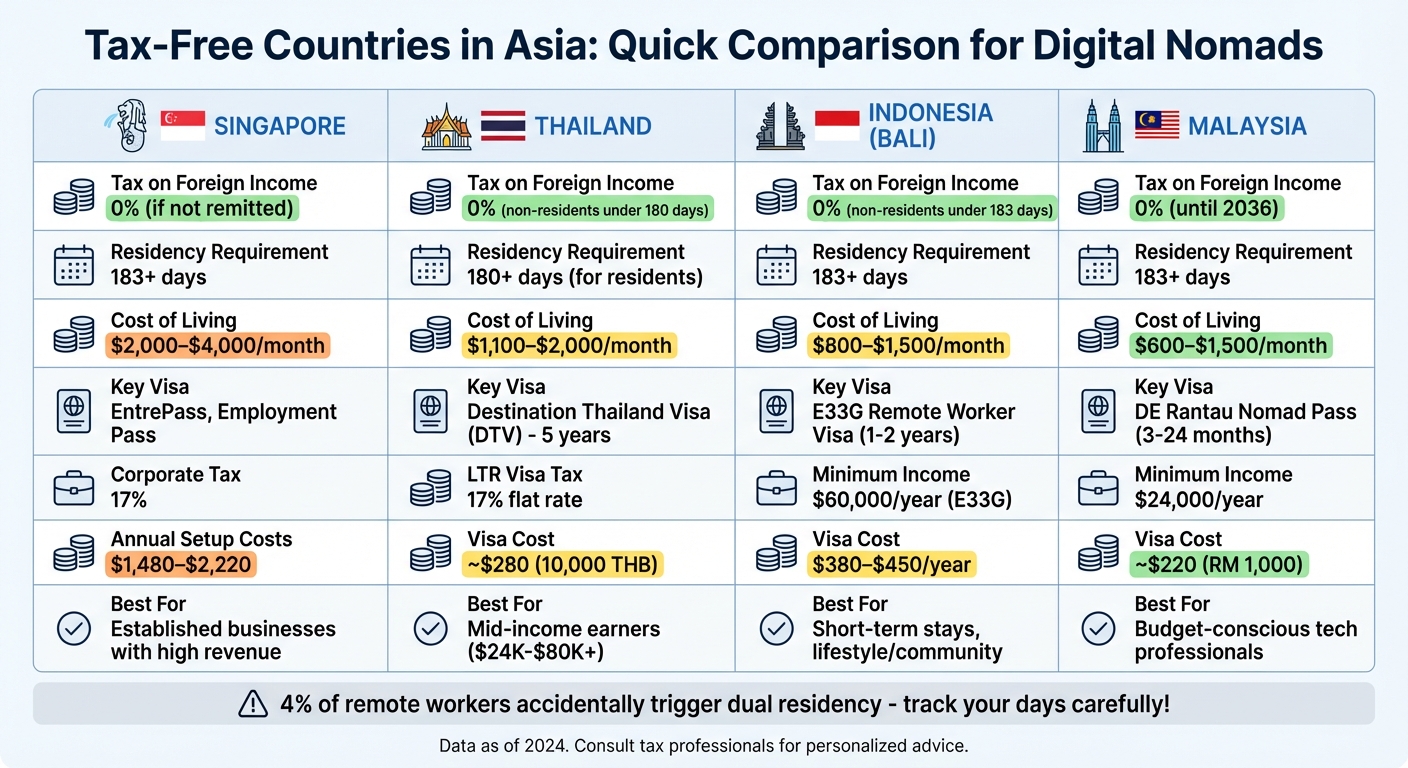
Quick Comparison
| Country | Tax on Foreign Income | Residency Requirement | Cost of Living (Monthly) | Key Visa Option |
|---|---|---|---|---|
| Singapore | 0% (if not remitted) | 183+ days | $2,000–$4,000+ | EntrePass, Employment Pass |
| Thailand | 0% (non-residents) | 180+ days (residents) | $1,100–$2,000 | Long-Term Resident (LTR) Visa |
| Indonesia | 0% (non-residents) | 183+ days | $800–$1,500 | Remote Worker Visa (E33G) |
| Malaysia | 0% (until 2036) | 183+ days | $600–$1,500 | DE Rantau Nomad Pass |
Each country has unique tax policies, visa options, and costs. Choosing the best fit depends on your income, business type, and lifestyle preferences. Proper planning is essential to avoid unexpected tax obligations.
1. Singapore
Singapore’s territorial tax system makes it a hotspot for location-independent businesses in Asia. Since January 1, 2004, foreign-sourced income received by individuals in Singapore has been completely tax-free, all while enjoying the country’s strong financial and legal systems.
The city-state sweetens the deal with no capital gains tax, no dividend tax, and no wealth or inheritance tax. For businesses generating income within Singapore, the corporate tax rate is a flat 17%. This tax-friendly setup has contributed to about 1 in 5 residents being millionaires.
Tax Rate on Foreign-Sourced Income
For individuals, any foreign-sourced income brought into Singapore remains entirely tax-free. Companies can also benefit, but they must meet specific conditions: the income must have been taxed in the foreign country at a minimum headline rate of 15%, and the exemption should benefit the recipient. Singapore’s extensive network of over 80 to 100 Double Taxation Agreements ensures income isn’t taxed twice.
Physical Presence Obligations
To access Singapore’s favorable tax rates, meeting physical presence requirements is essential. Individuals can qualify as tax residents and benefit from progressive rates (ranging from 0% to 24%) if they stay or work in Singapore for at least 183 days within a calendar year. For residents, the first S$20,000 (around $14,800) of income is taxed at 0%. Non-residents, however, face a flat 15% tax on employment income or 24% on other types, such as director’s fees.
Interestingly, foreigners working in Singapore for three consecutive years may qualify as residents for the entire period, even if they fall short of the 183-day threshold in the first or third year. Keep track of your days carefully – being off by just one day could shift your tax classification.
Estimated Annual Costs
While the tax benefits are appealing, it’s important to budget for administrative expenses to maintain compliance. Registering a business through ACRA costs about S$315 (roughly $233). Ongoing maintenance costs include:
- Corporate secretary services: S$300–S$600 ($222–$444) annually
- Virtual office services: S$150–S$500 ($111–$370) annually
- Accounting or bookkeeping: S$600–S$1,200 ($444–$888) annually
Altogether, the yearly maintenance for a typical digital nomad business ranges from S$2,000 to S$3,000 ($1,480–$2,220).
For those seeking full setup support, costs can add up. Residency assistance may cost $4,000–$8,000, banking setup $2,500–$6,000, and tax planning services $6,000–$12,000. Comprehensive packages, covering everything from setup to compliance, can range between $26,500 and $53,000.
sbb-itb-39d39a6
2. Thailand
Thailand stands out as a strong option for digital nomads, combining flexible visa options with tax-friendly policies. Its territorial tax system, paired with the newly introduced Destination Thailand Visa (DTV), makes it an attractive choice for remote professionals. Launched in 2024, the DTV is a 5-year multiple-entry visa tailored for freelancers and remote workers.
Tax Rate on Foreign-Sourced Income
Thailand’s tax framework revolves around the 180-day rule. If you spend fewer than 180 days in the country during a calendar year, you’re considered a non-resident, which means 0% tax on foreign income. However, staying 180 days or more makes you a tax resident, and foreign income remitted to Thailand becomes taxable. For tax residents, the first 150,000 THB of foreign-sourced income is exempt, while income exceeding 5 million THB is taxed at 35%.
Starting January 1, 2024, any foreign-sourced income remitted by tax residents is subject to taxation. On the other hand, high earners with an annual income of at least $80,000 can apply for the Long-Term Resident (LTR) visa, which fully exempts foreign-sourced income.
"If you stay in Thailand for more than 180 days in a calendar year on a DTV visa, you become a Thai tax resident." – Vincent Birot, Founder of VB & Partners
Visa Type and Duration
The DTV offers a 5-year validity, allowing stays of up to 180 days per entry. Extensions for an additional 180 days are available for a fee of 1,900 THB. The application fee for the DTV is 10,000 THB, though fees may vary depending on the embassy. For those seeking longer-term residency, the LTR visa provides a 10-year option with an application fee of 50,000 THB.
Minimum Income Requirements
To qualify for the DTV, applicants need to show proof of at least 500,000 THB in savings, maintained for at least three months before applying. Meanwhile, the LTR visa’s "Work-from-Thailand" category requires a minimum annual income of $80,000 over the past two years. These financial thresholds align with Thailand’s affordable living standards, making it an appealing destination.
Estimated Annual Costs
Thailand offers a cost-effective lifestyle. In Chiang Mai, monthly expenses typically range from $1,100 to $2,000, including:
- Housing: ~$420–$700 per month
- Coworking spaces: ~$100–$250 per month
- Health insurance: ~$40–$80 per month
In Bangkok, housing costs are slightly higher, ranging from $400 to $900 per month. Additional expenses include professional tax filing services, costing $200–$500 annually. Thanks to the DTV’s 5-year validity, the annualized visa cost ranges from approximately $55 to $230.
3. Indonesia (Bali)
Indonesia, particularly Bali, is a digital nomad hotspot, but it comes with stricter residency and tax rules compared to Thailand. Navigating these complexities is essential to avoid unexpected obligations.
Tax Rate on Foreign-Sourced Income
Indonesia’s tax system is based on the 183-day rule. If you stay fewer than 183 days within a 12-month period, you’re considered a non-resident, and your foreign-sourced income remains untaxed. However, surpassing that threshold makes you a tax resident, subject to progressive tax rates ranging from 5% to 35% on worldwide income.
There is an exception under Law No. 7 of 2021. Foreign professionals in fields like software development, data science, or systems analysis can benefit from a territorial tax incentive, which exempts foreign-sourced income for the first four years of tax residency.
"The ‘hide and seek’ strategy is obsolete. Compliance is now the only safe option, and transparency requires you to ensure your residency status is correctly recorded." – Karina, Legal Services
Visa Type and Duration
Bali offers several visa options, catering to different needs and durations.
- B211A Visit Visa: Ideal for short- to mid-term stays, this visa starts with a 60-day validity and can be extended up to 180 days. However, it’s single-entry, meaning you’ll need to reapply if you leave the country.
- E33G Remote Worker Visa: Introduced in April 2024, this visa is tailored for remote workers employed by companies outside Indonesia. It’s valid for one year (extendable to two) and requires proof of at least $60,000 in annual foreign income.
- Second Home Visa: Designed for high-net-worth individuals, this option provides 5- or 10-year residency. It requires depositing approximately $130,000 in an Indonesian state-owned bank.
Minimum Income Requirements
The B211A visa doesn’t enforce strict income thresholds, but agents generally expect proof of funds around $10,000. The E33G visa, however, mandates an annual foreign income of $60,000. For those setting up a PT PMA (a foreign-owned company), the financial requirements are much higher: an investment plan of IDR 10 billion (approximately $650,000) with a minimum paid-up capital of IDR 2.5 billion (around $162,500) deposited in an Indonesian bank.
Physical Presence Obligations
Indonesia’s 183-day rule operates on a rolling 12-month basis, not by calendar year. With the One-Data System introduced in 2026, immigration and tax systems are now fully integrated. This means your entry and exit records are automatically shared with tax authorities, making it nearly impossible to bypass residency requirements.
"If you spend fewer than 183 days in Indonesia during a calendar year, you are classified as a non-resident for tax purposes… foreign-sourced income is not taxed." – GetWhereNext Digital Nomad Guide
Estimated Annual Costs
Living in Bali is relatively affordable, with monthly expenses typically ranging from $800 to $1,500. This includes housing, coworking spaces (about $80–$250 per month), and daily living costs. Visa fees vary depending on the type:
- B211A Visit Visa: Costs between $400–$600 for six months, including extensions.
- E33G Remote Worker Visa: Starts at $380–$450 annually.
For those setting up a PT PMA, expect incorporation fees between $1,700 and $4,200, with additional monthly accounting and tax compliance costs of $200–$400. The Investor KITAS (work permit) adds another $975–$1,170 annually.
If you plan to stay under the 183-day mark, the B211A is the most cost-effective option. However, precise tracking of your stay is essential to avoid triggering tax residency.
While Bali’s tax and visa landscape can seem daunting, it offers a unique opportunity for those willing to navigate the rules carefully. From affordable living to specialized visas, there’s plenty to explore for remote professionals and entrepreneurs alike.
4. Malaysia
Malaysia stands out as a top choice for digital nomads looking for tax-friendly destinations in Asia. Its tax policies are designed to help location-independent professionals manage their finances effectively. One major draw is the extended foreign-sourced income (FSI) exemption for individual tax residents, which is valid until December 31, 2036. This exemption allows tax residents – those who stay in Malaysia for at least 183 days in a calendar year – to pay no tax on income earned abroad, as long as that income has already been taxed in its country of origin.
Tax Rate on Foreign-Sourced Income
Malaysia uses a territorial tax system, which means only income generated within the country is taxed. Residents benefit from progressive tax rates ranging from 0% to 30% on Malaysian-sourced income, while foreign-sourced income remains exempt. Non-residents, on the other hand, face a flat tax rate of 30% on income earned within Malaysia. Meeting the 183-day requirement is crucial to access these tax advantages.
Visa Options and Residency Programs
Malaysia offers several residency options tailored to digital professionals and high-net-worth individuals:
- DE Rantau Nomad Pass: Specifically designed for digital professionals in fields like software development, AI, data analytics, and digital marketing. This visa allows stays of 3 to 24 months and costs RM 1,000 (around $220) for the main applicant, with an additional RM 500 (about $110) per dependent. The Malaysia Digital Economy Corporation (MDEC) acts as the sponsor, simplifying the application process.
- Malaysia My Second Home (MM2H) Program: Aimed at high-net-worth individuals, this program offers renewable residency for 5 to 10 years. Applicants must place a fixed deposit of RM 1,000,000 (about $225,000) and show proof of liquid assets worth RM 1,500,000.
Minimum Income Requirements
Income thresholds vary depending on the program:
- DE Rantau pass: Requires a minimum annual income of $24,000 for tech roles and $60,000 for non-tech professions.
- MM2H program: Applicants must demonstrate offshore income of RM 40,000 per month (approximately $8,500).
Physical Presence Obligations
To qualify as a tax resident and benefit from the FSI exemption, you need to spend at least 183 days in Malaysia within a calendar year. While the DE Rantau pass doesn’t require a minimum stay for visa validity, maintaining tax residency depends on meeting this requirement. These tax benefits are complemented by Malaysia’s relatively low cost of living.
Estimated Annual Costs
Malaysia offers excellent affordability compared to many Western countries, with living expenses up to 43.5% lower than the UK and 51.7% lower than the US. Monthly costs vary by city:
| City | Monthly Cost | Primary Appeal |
|---|---|---|
| Kuala Lumpur | $1,000–$1,500 | Business hub with strong infrastructure |
| Penang | $600–$900 | Famous for its food and cultural heritage |
| Johor Bahru | $500–$800 | Conveniently close to Singapore |
| Ipoh | $450–$780 | Very affordable and relaxed lifestyle |
A comfortable lifestyle for digital nomads typically requires $12,000 to $17,400 annually, while premium living can range from $21,360 to $32,040.
Coworking spaces are reasonably priced, costing between RM 400 and RM 1,200 (about $90 to $270) per month. High-speed home internet services (100 Mbps) cost RM 100 to RM 150 (approximately $22 to $34) monthly, and unlimited mobile data plans range from RM 50 to RM 80 (roughly $11 to $18). Malaysia’s average download speed is 87.7 Mbps, with fiber-optic options offering up to 500 Mbps in urban areas.
"Malaysia’s territorial tax system excludes foreign-sourced income for residents, offering significant tax planning potential." – Black Ledger
Keep in mind that the DE Rantau Nomad Pass is limited to Peninsular Malaysia. If you plan to spend time in Sabah or Sarawak (Malaysian Borneo), separate arrangements are needed. Additionally, retain official tax receipts and certificates from foreign authorities as proof that your income was taxed at the source – this is essential for claiming the FSI exemption.
Advantages and Disadvantages
When comparing Singapore, Thailand, Malaysia, and Indonesia as destinations for digital nomads, each location brings its own set of strengths and challenges.
Singapore stands out with zero taxes on capital gains and dividends, along with a competitive personal tax rate. Its territorial tax system ensures foreign-sourced income remains untaxed unless brought into the country, and starting a business is relatively straightforward. However, the high cost of living is a significant drawback, and the lack of a dedicated digital nomad visa means entrepreneurs must rely on options like the EntrePass or Employment Pass, which come with stricter economic requirements.
Thailand offers one of the most affordable long-term visa options with its Destination Thailand Visa (DTV), costing just 10,000 THB (around $280), and granting five years of multiple-entry access. The cost of living index is about 35, making it a budget-friendly choice. However, starting January 2024, tax residents staying 180 days or more will face taxation on their worldwide income. For those holding the Long-Term Residence (LTR) visa, the flat tax rate of 17% is appealing, but qualifying requires an $80,000 annual salary, which may limit accessibility.
Malaysia proves to be a tax-friendly option, with its territorial tax system exempting foreign-sourced income for residents. The DE Rantau Nomad Pass, priced at around 1,000 MYR (about $215), allows a stay of up to two years, provided applicants earn at least $24,000 annually. Malaysia’s cost of living index is approximately 33, and coworking spaces are available at affordable rates ranging from $50 to $200 per month. These factors make it an attractive option for tech professionals and other digital nomads looking for a balance between cost and convenience.
Indonesia (Bali) boasts the lowest cost of living among the four but presents a less defined tax framework for digital nomads. Without a specific digital nomad visa, tax residents staying over 183 days are subject to a top personal tax rate of 35% on worldwide income. Additionally, the country increased VAT to 11% in July 2024, which could lead to higher operational costs for remote workers.
"Asia has become the promised land of affordable living, fast WiFi, and vibrant expat communities. Yet the tax implications… remain one of the most misunderstood – and potentially expensive – aspects." – Benjamin Collins, Asia Lifestyle Magazine
Other key considerations include the risk of dual residency, which affects roughly 4% of remote workers and can lead to conflicting tax obligations. For U.S. citizens, worldwide income reporting and the 15.3% self-employment tax remain hurdles, despite the Foreign Earned Income Exclusion allowing eligible taxpayers to exclude up to $126,500 in 2024. The absence of Totalization Agreements with Thailand, Malaysia, or Indonesia further complicates matters. These factors highlight how tax policies and residency rules can significantly impact financial planning for location-independent professionals.
Conclusion
Deciding on the best jurisdiction depends on factors like your income level, business structure, and how you plan to manage your physical presence. For remote entrepreneurs earning between $24,000 and $80,000 annually, Malaysia is an attractive option. Its territorial tax system exempts foreign-sourced income for residents until December 31, 2036, providing clarity and long-term predictability. On top of that, the affordable DE Rantau pass, costing around $215, makes it accessible for freelancers and small businesses.
For those earning over $80,000 annually, Thailand’s LTR visa offers a flat 17% tax rate and a 10-year residency option. However, recent changes mean foreign income is taxed once remitted, so careful planning around remittance timing is essential to avoid unexpected tax bills.
If you’re running a well-established company with significant revenue, Singapore remains a strong choice. Its advanced banking infrastructure and territorial tax system are ideal for larger operations. That said, the high cost of living and annual setup fees ranging from $4,000 to over $10,000 make it less appealing for those in the early stages of their business journey.
Indonesia (Bali), on the other hand, is better suited as a short-term base for lifestyle and community rather than tax optimization. Staying beyond 183 days can result in worldwide taxation at rates of up to 35%, making it less advantageous for those looking to minimize tax obligations.
One thing to keep in mind: tracking your physical presence is crucial. About 4% of remote workers accidentally trigger dual residency each year. To avoid this, simulate a 12-month tax liability based on your income and remittance plans, and secure a Tax Residence Certificate to benefit from treaties. Many digital nomads also separate their invoicing entity from their personal tax residence for additional flexibility.
As tax policies in Asia continue to evolve, staying informed is key to maintaining financial efficiency. What works today might not apply in just a few years. Keep up with local tax law updates, document your travel days meticulously, and adapt your strategy as needed to ensure long-term success.
FAQs
What counts as “foreign-sourced income” for tax purposes?
Foreign-sourced income includes any earnings made outside the country where you live or are subject to taxation. In places with territorial tax systems – like Hong Kong or Panama – this income is typically exempt from local taxes. This setup appeals to entrepreneurs and digital nomads looking for ways to manage their taxes effectively.
How do I avoid triggering tax residency by accident?
To prevent unintentionally becoming a tax resident, it’s important to monitor how much time you spend in any one country. Many countries classify you as a tax resident if you’re physically present for more than 183 days in a 12-month period.
Here’s how to stay on top of it:
- Track your time: Keep your stays under 183 days and maintain a detailed record of your travel dates.
- Document ties elsewhere: Hold onto evidence that shows your personal and financial connections remain in another country.
- Seek professional advice: Check local tax rules or consult a tax expert to make sure you’re following the regulations.
Staying organized and informed can help you avoid unexpected tax obligations.
Which visa is best for a U.S.-based remote business owner?
When considering the best visa options, it largely depends on the country and your specific goals. For instance, Thailand offers the Destination Thailand Visa (DTV), allowing stays of up to 5 years with multiple 180-day entries. Similarly, digital nomad visas are available in countries like Indonesia, Japan, and Malaysia, catering to remote workers.
If you’re an entrepreneur looking to invest in the U.S., the E-2 visa might be an option – provided your home country has a qualifying treaty with the United States. Ultimately, your choice should align with your business objectives and long-term residency plans.
