
If you’re looking to maximize profits and reduce tax burdens, incorporating in a zero corporate tax jurisdiction can be a smart move. These countries allow businesses to retain 100% of their earnings without paying corporate taxes. However, in 2026, global tax rules have become stricter, with economic substance requirements, transparency regulations, and the OECD’s global minimum tax for large multinationals now in effect. Here’s what you need to know:
- Top Zero-Tax Jurisdictions: Cayman Islands, British Virgin Islands (BVI), UAE Free Zones, Anguilla, and Vanuatu.
- Key Benefits: No corporate, capital gains, or dividend taxes; simplified compliance; and strong asset protection.
- Challenges: Compliance with economic substance rules, banking access, and potential scrutiny under international tax policies.
- Exemptions: The 15% global minimum tax applies only to multinationals with over €750M in revenue, leaving small and medium-sized businesses unaffected.
To choose the right jurisdiction, consider your business model, compliance needs, and long-term goals. The Cayman Islands are ideal for investment funds, the UAE for regional operations, and BVI for holding companies. But remember, compliance is just as important as the tax rate.
Countries with Zero Corporate Tax
Not all zero-tax jurisdictions are the same. Each one offers unique benefits tailored to different business models, industries, and long-term plans. Here are some standout options known for their stability, infrastructure, and specific advantages.
Cayman Islands
The Cayman Islands stands out as a tax-neutral location with no income, capital gains, property, payroll, or withholding taxes. This British Overseas Territory has become a go-to destination for hedge funds and private equity firms, thanks to its stable political environment and advanced banking systems.
The main corporate structure here is the Exempted Company, which requires just one shareholder and one director – who can even be the same person. Incorporation costs are approximately $800 for a standard company and $1,300 for an exempted entity, with annual management fees starting at $250.
"Cayman’s tax-neutral status means residents do not pay direct taxes. This is a significant incentive for both business and personal financial planning." – Cayman Enterprise City
The Cayman Islands also adheres to the Common Reporting Standard (CRS), balancing tax neutrality with transparency. This makes it particularly appealing for investment funds and holding companies.
British Virgin Islands (BVI)
The British Virgin Islands (BVI) is well-known for its International Business Companies (IBCs), which enjoy full tax exemptions and no reporting obligations. Incorporation is quick – typically completed in about seven days – and does not require local directors or shareholders. This ease of setup and minimal compliance makes BVI a preferred choice for holding companies and Special Purpose Vehicles (SPVs).
United Arab Emirates Free Zones
In 2023, the UAE introduced a 9% corporate tax for mainland companies, but businesses operating as Qualifying Free Zone Persons (QFZP) in sectors like manufacturing, fund management, and logistics still benefit from a 0% corporate tax rate. The 9% tax applies only to mainland profits exceeding 375,000 AED.
"The 0% corporate tax rate still exists, but it is no longer automatic. It is now contingent on a complex set of new rules." – ASY Legal
Free zones such as DMCC and DIFC offer excellent locations for international trade, 100% foreign ownership, and state-of-the-art infrastructure. These zones are especially attractive to fintech companies and regional headquarters. However, maintaining QFZP status requires annual audits and compliance with Cabinet Decision No. 55/2023. If your business focuses on international B2B activities, a free zone structure works well. For targeting local UAE consumers, a mainland company is required, which comes with the 9% tax rate. This flexibility makes the UAE a strategic choice for balancing tax benefits with market access.
Anguilla
Anguilla is a straightforward tax haven with no corporate, income, capital gains, or inheritance taxes. This British Overseas Territory imposes minimal compliance requirements – no local directors, no annual financial statements, and no audits are needed. Its International Business Company (IBC) structure can be registered online with little paperwork, making setup quick and easy.
For those seeking residency, the High-Value Resident program requires a $75,000 annual fee and a $400,000 real estate investment. Anguilla is ideal for entrepreneurs looking for privacy and minimal administrative demands.
Vanuatu
Vanuatu offers a business-friendly environment with no corporate or income taxes. Located in the South Pacific, it also provides one of the fastest citizenship-by-investment programs, requiring a $95,000 donation plus fees.
Most businesses here operate as International Business Companies (IBCs), which are not required to submit annual financial statements or undergo audits. Vanuatu also offers strong privacy protections, making it a good fit for crypto exchanges and offshore investment firms. However, businesses handling third-party funds must secure licenses under the Securities and Investment Business Act.
For permanent residency, individuals must demonstrate $340,000 in worldwide investments. It’s worth noting that setting up a solid offshore banking strategy is essential, as many global banks have reduced their presence in the South Pacific.
These jurisdictions present a variety of options to evaluate, depending on your business priorities and goals.
sbb-itb-39d39a6
Benefits and Considerations
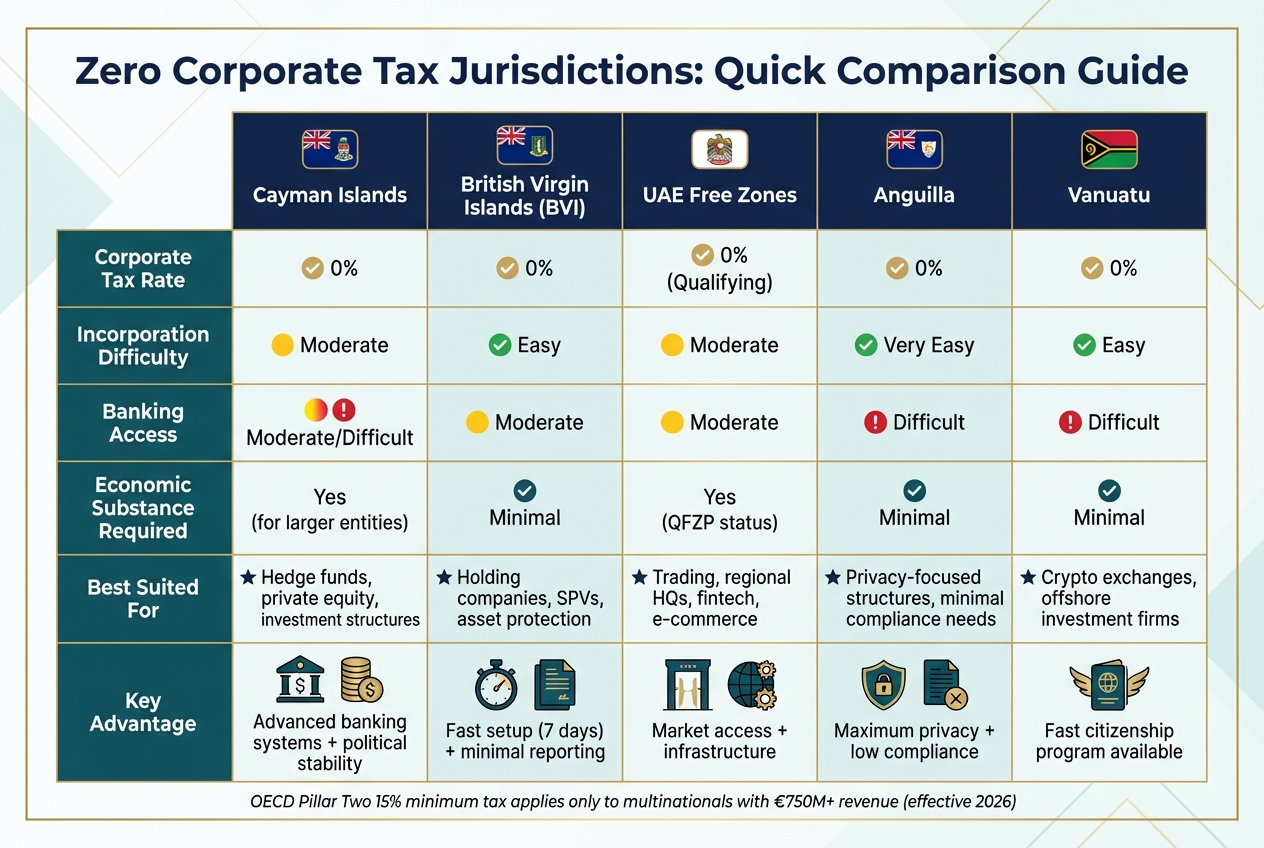
Zero Corporate Tax Jurisdictions Comparison: Key Features and Best Use Cases
Main Benefits of Zero-Tax Jurisdictions
One of the biggest perks of operating in a zero-tax jurisdiction is keeping 100% of your earnings without corporate tax deductions. This means more capital to reinvest, which can accelerate growth – especially for companies scaling up or managing investment portfolios where every dollar matters.
It doesn’t stop at tax savings. These jurisdictions often have simpler filing requirements and less paperwork compared to countries with higher taxes. Many also provide robust asset protection frameworks and, in cases like the British Virgin Islands (BVI), offer confidentiality for shareholder and director information.
Another standout advantage? No taxes on capital gains or dividends. Most zero-tax nations skip taxing capital gains, dividends, or interest payments, making them particularly appealing for holding companies or entities focused on investments.
"Zero corporate tax does not mean zero compliance, but when structured correctly, these jurisdictions remain powerful tools for global business planning." – Ancova Associates
That said, the tax landscape is evolving. Starting in 2026, the OECD Pillar Two framework will enforce a 15% effective tax rate on multinational enterprises with global revenues exceeding €750 million, even in zero-tax zones. However, smaller private companies below this threshold can still enjoy the full tax-free benefits.
What to Consider Before Incorporating
While zero-tax jurisdictions offer clear advantages, they come with operational and compliance hurdles. One major requirement is meeting economic substance rules. Most jurisdictions now mandate real business activity, such as hiring local directors, maintaining a physical office, and ensuring decisions are made locally. These requirements come with costs, so budgeting for them is crucial. Non-compliance can lead to penalties or even losing tax benefits.
Banking access is another critical factor. With stricter anti-money laundering (AML) and know-your-customer (KYC) regulations, opening and maintaining bank accounts in zero-tax jurisdictions has become more challenging. Before incorporating, confirm that banks and payment providers will work with entities from your chosen jurisdiction to avoid issues like "compliance freezes".
The days of secrecy-based planning are over. Most zero-tax jurisdictions now follow the Common Reporting Standard (CRS), which facilitates global data sharing among tax authorities. In 2024 alone, tax authorities exchanged data on over 171 million financial accounts valued at nearly €13 trillion. This means your financial information will likely be shared with your home country’s tax authorities.
Reputation matters. Operating in a jurisdiction perceived as a "tax haven" can lead to increased scrutiny from regulators and potential harm to your brand’s credibility. In some cases, choosing a jurisdiction with a slightly higher tax rate but better treaty access and clearer rules can yield better long-term results.
"A jurisdiction with a slightly higher nominal tax rate but better treaty access, clearer rules, and lower compliance friction can produce better after-tax outcomes over a 3-5 year horizon." – Tax Haven Directory
Lastly, keep an eye on Controlled Foreign Corporation (CFC) rules in your home country. These rules can tax offshore profits even if the jurisdiction itself has no corporate taxes, particularly if local management and control are insufficient. For companies nearing €750 million in revenue, the global minimum tax rules may offset the benefits of operating in a zero-tax jurisdiction.
Comparison Table of Zero Corporate Tax Jurisdictions
Here’s a quick comparison of popular zero-tax jurisdictions:
| Jurisdiction | Corporate Tax Rate | Incorporation Difficulty | Banking Access | Substance Required | Best Suited For |
|---|---|---|---|---|---|
| Cayman Islands | 0% | Moderate | Moderate/Difficult | Yes (for larger entities) | Hedge funds, private equity, investment structures |
| BVI | 0% | Easy | Moderate | Minimal | Holding companies, SPVs, asset protection |
| UAE Free Zones | 0% (Qualifying) | Moderate | Moderate | Yes (QFZP status) | Trading, regional HQs, fintech, e-commerce |
| Anguilla | 0% | Very Easy | Difficult | Minimal | Privacy-focused structures, minimal compliance needs |
| Vanuatu | 0% | Easy | Difficult | Minimal | Crypto exchanges, offshore investment firms |
How to Incorporate in a Zero-Tax Jurisdiction
Setting up your business in a zero-tax jurisdiction can be an effective way to protect your assets and optimize your tax strategy. However, the process requires careful planning and attention to detail.
Required Documents and Preparation
Before you begin, gather all necessary documents. Most jurisdictions will ask for notarized copies of your passport and proof of address, such as a utility bill or bank statement dated within the last three months. Additionally, banks and regulatory bodies often require detailed source-of-funds documentation, which may include 6–12 months of financial transactions and explanations of your capital sources.
For US-based entrepreneurs, there are specific reporting obligations. Filing Form 5471 for foreign corporations and the FBAR (FinCEN Form 114) is mandatory if your combined foreign account balances exceed $10,000. In territorial tax systems like Paraguay, the classification of income is critical. For example, international income is taxed at 0%, but misclassification could lead to a 10% tax rate. Hiring a knowledgeable accountant is essential to navigate these complexities.
Additionally, keep detailed records of board meetings and management decisions. These records can protect you from being labeled as a shell company, which could lead to legal and financial complications.
Incorporation Process by Jurisdiction
The time and cost of incorporation depend on the jurisdiction you choose. Here’s a breakdown of some popular options:
- Marshall Islands: Incorporation here is fast, often completed within 24–48 hours. Initial costs range from $2,350 to $8,100, with annual fees between $3,450 and $13,000. The jurisdiction follows Delaware-style corporate law and requires only a President and Secretary, who can be the same individual.
- Cayman Islands: Forming an "Exempted Company" typically takes 2–3 days with just one shareholder and one director. Annual government fees range from $3,000 to $5,000.
- British Virgin Islands (BVI): Incorporation is even quicker, taking only 1–2 days. Annual fees are lower, generally between $1,500 and $2,500.
- Paraguay: Setting up a Sociedad Anónima Simplificada (S.A.S.) takes about 20–30 days and requires no minimum capital. Only one shareholder is needed. For those seeking residency, a $70,000 investment (spread over 10 years) or employing at least five locals at approximately $400 per month each is required.
Some jurisdictions, like the Marshall Islands and Paraguay, allow a 100% remote incorporation process using a Power of Attorney. However, residency-related programs might require a short visit for biometric registration.
Once your company is incorporated, the next step is to ensure ongoing compliance and avoid common errors.
Staying Compliant and Avoiding Common Mistakes
After incorporation, staying compliant is crucial. One common challenge is opening a bank account. Offshore entities often face high rejection rates, so it’s a good idea to apply to multiple banks simultaneously. If traditional banks are not an option, reputable electronic money institutions can serve as alternatives.
For certain industries, like banking and finance, some jurisdictions require an on-site presence. Even if your jurisdiction doesn’t mandate this, maintaining thorough documentation is a smart way to avoid penalties and ensure you retain your tax benefits.
Be aware of upcoming regulations, like the OECD Pillar Two rules, which will take effect in 2026. US entrepreneurs must also comply with Controlled Foreign Corporation (CFC) rules and file the necessary information returns. Starting January 1, 2026, US shareholders of CFCs will be subject to Net CFC Tested Income (NCTI) rules. A common pitfall is assuming that "no local tax" means "no US tax." For US citizens and green card holders, the IRS taxes worldwide income, regardless of where your company is incorporated.
Lastly, take advantage of any tax relief programs. For example, in the UAE, companies with revenue below AED 3 million (around $800,000) can elect for a 0% tax rate by registering with the Federal Tax Authority.
Using Zero-Tax Structures for Asset Protection
Zero-tax jurisdictions can provide strong asset protection when structured correctly.
Combining Offshore Companies with Trusts and Foundations
One effective method for safeguarding assets involves layering multiple legal entities across different jurisdictions. For instance, an International Business Company (IBC) in Antigua and Barbuda can hold assets without taxes for up to 50 years. When paired with an international trust in a jurisdiction like Seychelles, this creates a robust legal shield, making it difficult for foreign courts to access your assets.
Luxembourg offers the Société de gestion de Patrimoine Familial (SPF), a specialized entity for managing private wealth. These entities are exempt from corporate income tax, municipal business tax, and wealth tax. This demonstrates how zero-tax jurisdictions can combine asset protection with wealth management. In Singapore, family office structures require a significant investment – S$10 million – but provide a stable, low-tax environment for global asset management.
Jurisdictional separation is a key benefit. Many offshore financial centers combine zero-tax rates with strict corporate and banking secrecy laws, ensuring assets are shielded from external claims while offering political and economic stability. Some jurisdictions also strengthen asset protection with specific legal provisions.
For those seeking affordability, Vanuatu offers tax exemptions for up to 20 years with a nominal annual fee of just $300.
These combinations not only protect assets but also set the groundwork for optimizing tax strategies.
Reducing Taxes While Staying Legally Compliant
Reducing taxes effectively requires adhering to local economic substance rules, which are increasingly emphasized under 2026 regulations. It’s essential to ensure that real business activities back your tax residency claims.
For U.S. citizens, the Foreign Earned Income Exclusion (FEIE) is a key tool in zero-tax jurisdictions. In 2026, the FEIE threshold increases to $132,900. The Foreign Tax Credit (FTC), however, is less useful since no foreign taxes are paid to offset U.S. tax liabilities.
"The FEIE is almost always the better choice [in a zero-tax country]." – Greenback Expat Tax Services
Residency requirements are critical. Most zero-tax jurisdictions mandate a physical presence of 90 to 183+ days annually to maintain tax residency and avoid being classified as a "tax nomad", which can leave you with limited legal protections.
In the UAE, freelancers and small business owners earning less than AED 3 million (approximately $817,000) must actively register with the Federal Tax Authority to claim 0% tax relief starting in 2026.
Examples of Effective Zero-Tax Strategies
Here are some practical examples of zero-tax strategies used in leading jurisdictions:
- Investment Funds and Family Offices: The Cayman Islands is a popular choice, hosting over 100,000 registered companies despite having a population of just 65,000. Its regulatory framework for hedge funds and private equity makes it ideal for tax-efficient investment structures while offering asset protection.
- Holding Companies and SPVs: The British Virgin Islands (BVI) is another favorite, applying a 0% tax on income generated outside its territory. Pairing this with a trust in Nevis or Seychelles enhances both asset protection and wealth management.
- Regional Headquarters and Trading Operations: UAE Free Zones offer 0% tax on qualifying international income. However, businesses with profits exceeding AED 375,000 (around $100,000) are subject to the standard 9% corporate tax.
Smaller entities and private companies often remain outside the scope of the OECD Pillar Two 15% global minimum tax, which applies only to multinational enterprises with consolidated global revenues of €750 million or more. This allows smaller structures to benefit from 0% statutory rates, provided they meet economic substance requirements.
"The question in 2026 is less ‘Where is tax lowest?’ and more ‘Where is the structure defendable, bankable, and scalable?’" – Tax Haven Directory Editorial
To ensure compliance, businesses should map out their operating models – detailing where intellectual property is developed, contracts are signed, and key staff are based – before selecting a jurisdiction. Conducting regular "substance audits" is also critical to ensure board minutes, intercompany agreements, and decision-making records align with the jurisdiction’s requirements. This proactive planning keeps structures tax-efficient, legally sound, and capable of protecting assets effectively.
Choosing the Right Zero-Tax Jurisdiction
Picking the ideal zero-tax jurisdiction isn’t a one-size-fits-all decision. It depends on your business model and long-term goals. For instance, a hedge fund manager will have very different priorities compared to a digital nomad running an e-commerce store or a family office managing generational wealth. The Cayman Islands stand out for investment funds and private equity, while the UAE Free Zones are better suited for regional headquarters and trading operations. On the other hand, the British Virgin Islands (BVI) often work well for simple holding companies and special purpose vehicles (SPVs).
However, modern economic substance rules have raised the bar. Now, jurisdictions often require a real physical presence, local staff, and legitimate business activities. The days of "paper companies" are over. And even with a 0% tax rate, it’s all meaningless without reliable banking access. Some jurisdictions also face international scrutiny, which can make them less practical despite their appealing tax rates.
"If your structure cannot pass a serious diligence review from a bank, regulator, buyer, or tax authority, it is not efficient, regardless of the headline rate." – Tax Haven Directory
Operational factors like these play a huge role in selecting the right jurisdiction. Reputation is another key consideration. Make sure your chosen jurisdiction isn’t on OECD or EU grey lists, as this can lead to added scrutiny.
Before making your decision, you’ll need to crunch the numbers. Calculate your effective tax rate by factoring in things like withholding taxes, Controlled Foreign Corporation (CFC) rules, and possible domestic top-up taxes. For businesses with global consolidated revenues under €750 million, you can still enjoy 0% rates without triggering the OECD Pillar Two rules.
If this feels overwhelming, firms like Global Wealth Protection can help. They specialize in aligning your jurisdictional choice with industry requirements, ensuring banking access, maintaining compliance, and optimizing both asset protection and tax efficiency.
FAQs
Will my home country still tax my offshore company profits?
Your home country may impose taxes on the profits of your offshore company, depending on its specific tax laws and international agreements. That said, many offshore jurisdictions are known for offering tax advantages, such as exemptions or zero corporate tax, which can reduce or even eliminate local taxes on income earned abroad. To navigate these complexities, it’s essential to consult a tax professional who can clarify your obligations based on your unique situation.
What counts as “economic substance” in a zero-tax jurisdiction?
In a zero-tax jurisdiction, economic substance refers to a company conducting real business activities. This means the company must have actual management and decision-making happening within the jurisdiction, along with a tangible physical presence. These criteria are designed to prevent companies from operating as mere shell entities solely for avoiding taxes.
Which zero-tax jurisdiction is easiest to bank with in 2026?
In 2026, Anguilla emerges as a top choice for zero-tax banking. Known for its strong privacy measures and simple incorporation process, it also aligns with international regulations, making it an attractive option for global entrepreneurs.
