
Opening an offshore business bank account usually comes down to 3 things: pick a bank that accepts your company setup, send a clean document file, and explain exactly how you’ll use the account. If you miss any one of those, delays and denials are common.
If I were doing this today, I’d focus on:
- Jurisdiction fit: banks often screen your company’s country first
- U.S. tax rules: if I’m a U.S. person, FBAR can apply once foreign balances go over $10,000
- Document match: names, addresses, and ownership details must line up across every file
- Business proof: contracts, invoices, website, and expected transaction details help show the company is active
- Bank fit: some banks want $25,000 to $100,000+, while some fintech or offshore options start much lower
Here’s the short version: I need to know why I want the account, which currencies I need, where money will come from, where it will go, and whether the provider accepts U.S.-connected founders. Then I need formation records, ID, proof of address, tax details, source-of-funds records, and a clear ownership chart ready before I apply.
A few facts matter right away:
- Foreign banks often ask for extra checks for U.S. persons
- Proof of address is often required within the last 90 days
- Compliance follow-ups often need replies within 24 to 48 hours
- Review time can range from 1 day to several weeks
This article breaks down the process in plain English, so I can avoid the most common mistakes before I submit an application.
Choose the right jurisdiction and banking provider
Pick a jurisdiction that banks will accept
Jurisdiction is often the first screen a bank uses. Before anyone digs into your documents or business model, the bank checks where your company is registered. If that jurisdiction has weak FATF standing or limited regulatory transparency, your application can fall behind from day one.
The clearest signal is FATF status. If a jurisdiction is on FATF’s "increased monitoring" list or its high-risk list, expect extra scrutiny or a flat-out rejection. Checking the FATF Country Assessments before you commit can save you months of wasted effort.
Stable, well-regulated jurisdictions tend to face less approval friction because they lower the odds of rejection before the compliance review even begins. That first screen helps narrow down which providers are even worth your time.
Compare banks, offshore banks, and licensed fintech providers
Choose based on deposit minimums, how onboarding works, your currency needs, and how fast you need the account open.
| Provider Type | Onboarding Difficulty | Typical Min. Deposit (USD) | Supported Currencies | Remote Opening | Ideal Use Case |
|---|---|---|---|---|---|
| Traditional Tier-1 Bank (e.g., Singapore, Switzerland) | High | $25,000 – $100,000+ | Multi-currency (USD, EUR, CHF, SGD) | Limited / Case-by-case | Asset protection, high-volume corporate trading, stability |
| Offshore International Bank (e.g., Belize, Mauritius) | Moderate | $500 – $5,000 | Major global currencies | Yes | Small businesses, freelancers, high liquidity requirements |
| Fintech / Payment Institution | Low to Moderate | $0 – $1,000 | Multi-currency IBANs | Yes | Digital nomads, e-commerce, rapid setup needs |
Traditional banks bring the most credibility, but they also have the highest entry bar. Licensed fintech providers and Electronic Money Institutions (EMIs) usually make online onboarding easier and setup faster, while offshore banks land somewhere in between. Examples of remote-friendly institutions include TBC Bank in Georgia and Global Bank of Commerce in Antigua.
Once you pick the provider type, the next move is simple: put together a bank-ready document file.
Match the provider to a US-connected founder profile
Many foreign banks decline U.S. persons. The ones that do accept them usually ask for extra documents and reporting.
If your total offshore account balances go above $10,000 at any point during the year, you must file FinCEN Form 114 (FBAR). If you own a foreign corporation, IRS Form 5471 may also apply.
The main thing is to confirm that the bank clearly accepts U.S. persons and that your company structure lines up with the reporting rules tied to the account. When the entity, jurisdiction, and provider don’t match, applications often stall. It also pays to verify the provider’s legal entity, license, and deposit protection in the regulator’s register. If the bank accepts U.S.-connected founders, approval then comes down to how strong your compliance file is.
sbb-itb-39d39a6
Prepare your full document package before applying
Incomplete, inconsistent, or outdated paperwork is a top cause of offshore bank delays.
After you pick a bank-friendly provider, your application often comes down to one thing: document quality. If the file is clean, clear, and up to date, the process tends to move more smoothly. If names, dates, or addresses don’t line up, things can slow down fast.
Collect company formation and authorization documents
Banks require your Certificate of Incorporation, Articles of Association (or Operating Agreement), and a Register of Directors and Shareholders. You should also include a signed board or manager resolution that names the bank and lists the authorized signatories.
This part matters more than many founders expect. A bank wants to see that the company exists, who controls it, and who has permission to act on its behalf. No guesswork, no loose ends.
Gather identity, address, and beneficial ownership records
Every director, authorized signatory, and ultimate beneficial owner (UBO) must provide a valid passport and proof of residential address dated within the last 90 days. Also prepare a source of funds/source of wealth statement for each UBO and a clear ownership chart that traces each layer back to the natural persons at the top.
For remote onboarding, expect a video KYC call. The person on camera must match the passport on file. If the bank works in a different language, translate all documents with a certified translator.
This is where many applications get tripped up. A blurry passport copy, an old utility bill, or an ownership chart that skips a layer can send the file back for review.
Use a bank-ready document checklist
Use this checklist to avoid missing a required item before you apply.
| Category | Required Document | Who Provides It | Certification / Recency |
|---|---|---|---|
| Corporate | Certificate of Incorporation | Company / Registered Agent | Notarized or apostilled |
| Corporate | Articles of Association / Operating Agreement | Company / Registered Agent | Notarized or apostilled |
| Corporate | Register of Directors & Shareholders | Company | Certified copy |
| Corporate | Board / Manager Resolution | Company | Signed and dated |
| Identity | Valid Passport | All Directors, Signers, UBOs | Certified or notarized |
| Address | Utility Bill or Bank Statement | All Directors, Signers, UBOs | Dated within 90 days |
| Ownership | Ownership Chart | Founder / Company Secretary | Signed; traces to natural persons |
| Tax | Tax Identification Number (TIN) | All Directors, UBOs | Current |
| Financial | Source of Funds / Source of Wealth Statement | UBOs | Supporting evidence |
| Business | Business Plan, Business Activity Description, or Active Contracts | Company | Proof of activity |
| Reference | Bank Reference Letter | Existing Bank | Recent, usually within 3 months |
Use identical names and addresses across all records.
Even small mismatches can cause trouble. If one document says “Street” and another says “St.,” or if a middle name appears in one place but not another, the bank may ask questions before moving the file to the next stage.
With the file complete, the next step is KYC review and submission.
Complete KYC review and submit a stronger application
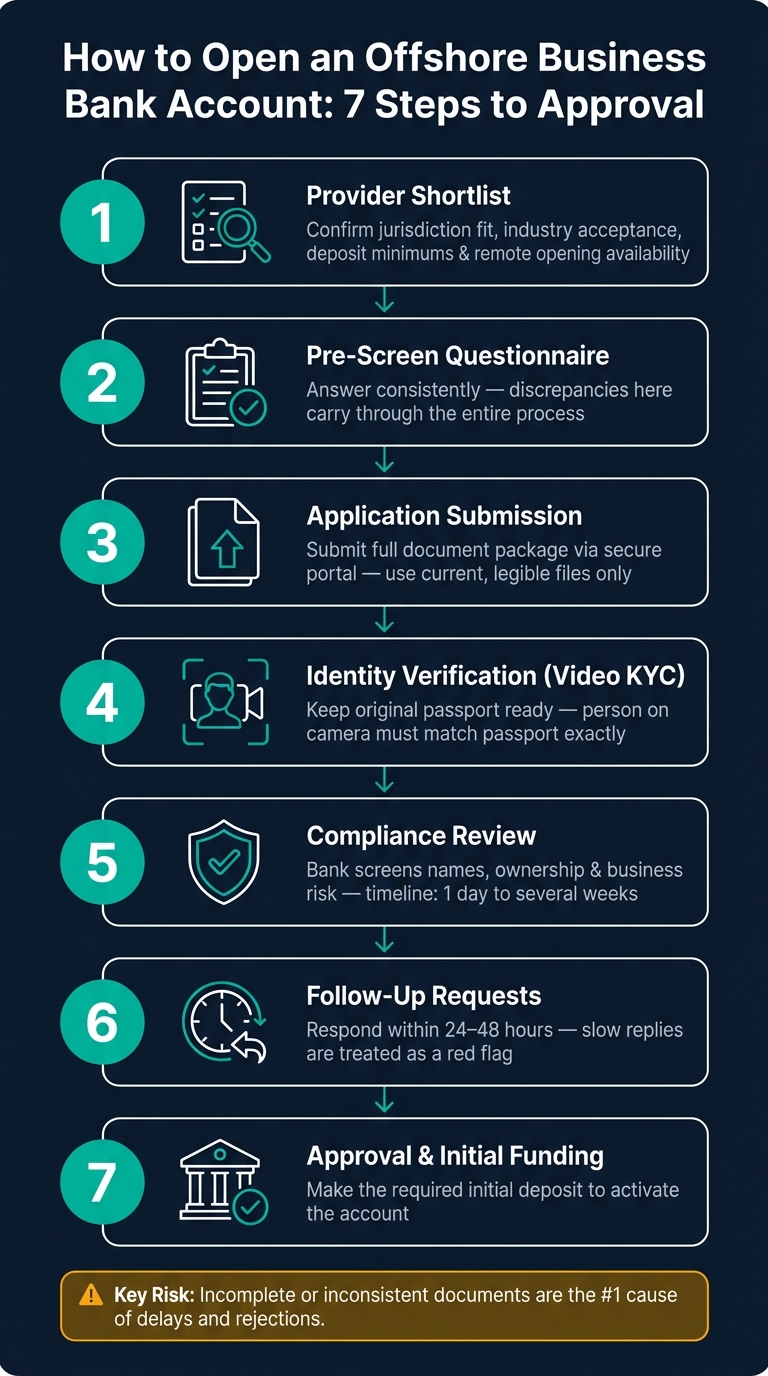
How to Open an Offshore Business Bank Account: 7-Step Process
Once your file is complete, the compliance review starts. At this point, the bank is checking whether your documents support the story your business tells.
This part comes down to two things: consistency and business purpose. Reviewers want to grasp what your company does without digging through a mess of files. They’ll check names, numbers, ownership details, and expected account activity to see if everything lines up.
Show proof of business activity and expected account use
A compliance officer needs to answer a simple question: is this business real, and will this account be used for lawful business activity?
You can help answer that fast with documents that show day-to-day trade, such as:
- Invoices
- Contracts
- Supplier agreements
- Website or domain ownership proof
It also helps to include a short business summary. Keep it plain and direct. Explain what your company does, who your customers are, and how money comes in and goes out.
You should also define your expected transaction profile before applying. Banks ask about this directly, and vague replies can set off concern. Be ready to state:
- Your estimated monthly transaction volume
- Your average transfer size
- The countries you’ll send funds to and receive funds from
- The currencies involved
- The names of your main counterparties
Specific answers show that you know how your own business works. That same profile shapes both the pre-screen and the KYC review.
Follow the onboarding process from pre-screen to approval
The account-opening process usually moves through seven stages. Once your file is ready, the review tends to follow a set path. Knowing that path makes it easier to avoid delays.
- Provider shortlist: Confirm jurisdiction fit, industry acceptance, deposit minimums, and remote opening.
- Pre-screen questionnaire: Most banks send a short form before they accept a full application. Answer each question the same way you’ll answer it later. If details change here, the problem can carry through the rest of the process.
- Application submission: Send your full document package through the bank’s secure portal or in the format requested. Use current, legible files only.
- Identity verification: Expect a video KYC call. Keep your original passport with you. The person on camera must match the passport exactly.
- Compliance review: The bank screens names, ownership, and business risk. This can take anywhere from one day to several weeks, depending on the company structure.
- Follow-up requests: Compliance teams often ask for added documents or short clarifications. Reply within 24 to 48 hours. Slow replies are often treated as a red flag.
- Approval and initial funding: If approved, you’ll make the initial deposit required by the bank.
Common rejection reasons and how to fix them
Most rejections trace back to the same few issues. Usually, it’s not one dramatic problem. It’s a gap, a mismatch, or an answer that feels too thin.
| Rejection Reason | Underlying Compliance Concern | Practical Fix Before Resubmission |
|---|---|---|
| Incomplete files | Failure to meet minimum due diligence standards | Use a bank-ready checklist; confirm all document pages are included and legible |
| Inconsistent ownership details | Potential fraud or hidden beneficial ownership | Cross-reference all IDs and corporate registries so every name and address matches exactly |
| Unclear source of funds | AML risk | Provide 3 to 6 months of bank statements plus signed contracts or invoices showing income |
| Restricted industry | Bank policy restrictions (e.g., crypto, online gambling) | Research the bank’s prohibited industries list before applying; match your business profile to a provider that accepts your sector |
| Weak substance | Shell company concerns | Add a functional website, domain ownership proof, and active supplier or client contracts |
| Weak interview responses | Founder lacks operational control or knowledge | Prepare a concise business summary to reference during the video call |
| Slow compliance responses | Lack of transparency or operational instability | Assign one person to handle all bank communications and respond within 24 to 48 hours |
If your business operates in a high-risk sector, review the provider’s acceptable-use policy before you apply.
Conclusion: Build a bank-ready offshore structure from the start
When your jurisdiction, documents, and business purpose line up, approval gets a lot easier.
Opening a business bank account for an offshore company takes prep work. Choose a jurisdiction that fits your actual business activity and the banks you plan to use. Then put together a complete file with your formation documents, ID, proof of address, ownership records, and source-of-funds evidence.
Just as important, treat KYC and AML as core business processes, not last-minute obstacles. Build your banking file before you apply, not after the bank asks for it.
FAQs
Which bank type fits my offshore company best?
The best fit is a bank that can reliably onboard non-resident corporate customers under strict KYC/AML rules and whose requirements line up with your company structure and documented business logic.
In plain English: you need a bank that is comfortable with how your company is set up, who owns it, where the money comes from, and how you expect the account to be used.
In practice, that usually means a traditional bank or an established fintech or online bank that supports non-U.S. entities, beneficial ownership declarations, source of funds checks, and your expected transaction profile, especially if in-person verification isn’t possible.
What if my offshore bank application is denied?
If your offshore bank application gets denied, the cause is often strict AML and KYC checks.
Common reasons include:
- sanctions screening issues
- complex political ties
- incomplete documents
- paperwork that wasn’t authenticated the right way
If that happens, make your business model and paperwork fully transparent. It also helps to look at institutions with experience serving international clients.
Can I open an offshore business account remotely?
Yes – you can often open an offshore business bank account remotely, but the rules change from one bank and jurisdiction to another.
Many banks now use secure digital portals, video-call KYC, and electronic document submission. That said, some still ask for an in-person visit, especially if your profile is high-risk or your company structure is more complex. In some cases, a remote application also comes with extra paperwork, such as notarized or apostilled documents.