
Here’s the short answer: I’d look at profit first, not revenue. In the UAE, corporate tax is 0% up to AED 375,000 of taxable income and 9% on the amount above AED 375,000. It applies to tax periods starting on or after June 1, 2023.
If I were checking whether tax applies, I’d ask these questions right away:
- Am I a UAE company? Mainland, free zone, and offshore entities can fall within the rules.
- Am I an individual running a business? Freelancers, sole proprietors, and consultants may be taxed once turnover goes above AED 1,000,000 in a calendar year.
- Is my taxable profit above AED 375,000? The 9% rate applies only to the part above that line.
- Am I in a free zone? A free zone company does not get 0% by default.
- Do I qualify for Small Business Relief? If revenue is AED 3,000,000 or less, taxable income may be treated as $0 for eligible periods through December 31, 2026.
A couple of points trip people up. High sales do not always mean tax is due. And crossing a threshold does not mean 9% applies to all income. It usually applies only to the slice of taxable profit over AED 375,000.
| Setup | When UAE corporate tax can apply | When 9% can apply |
|---|---|---|
| Mainland company | Usually in scope | Profit above AED 375,000 |
| Free zone company | In scope, with special free zone rules | Non-qualifying income, or all taxable income if status is lost |
| Freelancer / sole proprietor / consultant | When business turnover is above AED 1,000,000 | Profit above AED 375,000 |
| Foreign company | If it has a UAE tax link, such as a permanent establishment | Based on taxable income in scope |
My takeaway: most people should stop asking, “Is UAE corporate tax 9%?” and start asking, “Am I taxable, and if yes, what part of my profit is taxed?”
Who counts as a taxable person under UAE corporate tax
Once you know the 9% rate applies above the AED 375,000 threshold, the next step is figuring out who actually falls inside the tax system. Under UAE corporate tax, that generally means three groups: UAE-incorporated entities, individuals who run a business in the UAE, and non-residents with a UAE tax link.
UAE companies: mainland LLCs, free zone entities, and offshore companies
Any legal entity incorporated in the UAE – including mainland LLCs, free zone entities, and offshore companies – falls within the UAE corporate tax framework. That point matters more than many people think. Even if a company is 100% foreign-owned, incorporation in the UAE can still bring it into scope.
In most cases, UAE-incorporated entities need to register and file annual returns, even if no tax is payable. So yes, a company may still have filing duties even when its tax bill is $0.
An overseas-incorporated company can also be treated as a UAE resident for tax purposes if it is effectively managed and controlled within the UAE.
Individuals: freelancers, sole proprietors, and consultants
Personal income sits outside the scope of UAE corporate tax. But if someone is working as a freelancer, sole proprietor, or consultant, the line changes once that activity counts as a business and turnover goes above AED 1,000,000 in a calendar year.
That threshold is the key point. The label alone – freelancer, consultant, or sole proprietor – does not automatically make someone taxable.
Non-residents: foreign companies with a UAE permanent establishment
Foreign companies can also fall within UAE corporate tax if they have enough of a presence in the country. This can happen if the company has a UAE permanent establishment, earns UAE-sourced income, or receives income from UAE immovable property.
A permanent establishment will usually mean something like a branch, an office, or a dependent agent with authority to sign contracts. In plain English, if the business has boots on the ground in the UAE, it may not stay outside the tax net for long.
sbb-itb-39d39a6
How the 9% corporate tax is calculated
The UAE corporate tax system is pretty straightforward. It uses two tax bands.
The first AED 375,000 of taxable income is taxed at 0%. Only the amount above AED 375,000 is taxed at 9%. So if a business crosses that line, the 9% rate does not suddenly apply to all of its profit.
Corporate tax is based on taxable income, not just top-line revenue. That taxable income starts with accounting profit, then gets adjusted under UAE tax rules.
Simple examples of the 0% and 9% bands
Here’s how that plays out in practice.
A business with AED 300,000 in taxable income stays fully inside the 0% band, so it owes AED 0 in corporate tax.
A business with AED 500,000 in taxable income pays 9% only on AED 125,000, which is the amount above the AED 375,000 threshold. That comes to AED 11,250 in tax.
| Taxable Income | 0% Band | 9% Band | Tax Owed |
|---|---|---|---|
| AED 300,000 | AED 300,000 | AED 0 | AED 0 |
| AED 500,000 | AED 375,000 | AED 125,000 | AED 11,250 |
With the math out of the way, the next piece is more practical: which UAE business setups actually end up in that 9% band?
Small Business Relief and why it can matter more than the 9% rate
For many smaller companies, Small Business Relief (SBR) may matter more than the tax bands themselves.
Eligible businesses with gross revenue of AED 3,000,000 or less can elect SBR for tax periods ending December 31, 2026 or earlier. If they make that election, their taxable income is treated as zero, which means no corporate tax is due.
That’s why the headline 9% rate doesn’t always tell the full story. For some businesses, the bigger issue is whether they qualify for SBR in the first place.
The next step is identifying which common UAE setups actually end up paying 9%.
Who actually pays 9% in common UAE business setups
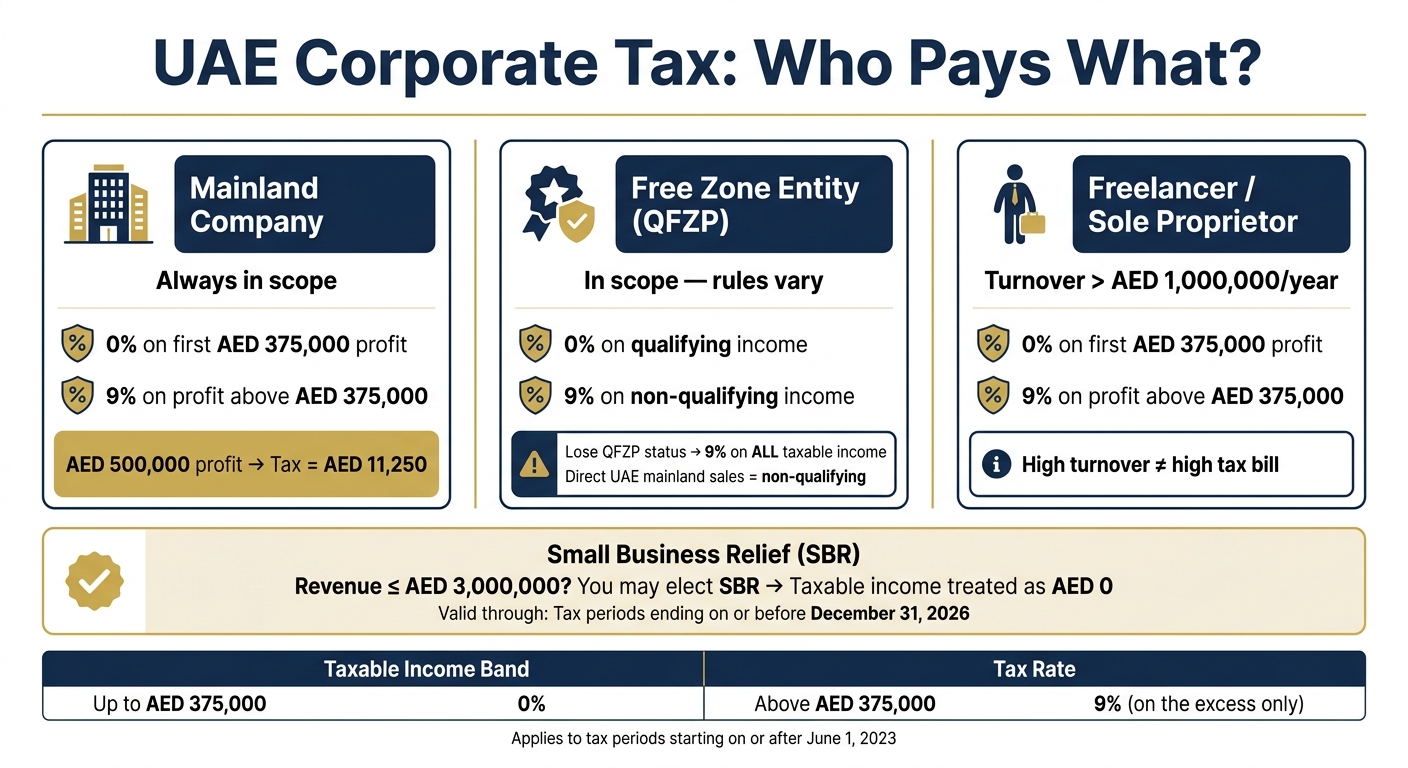
UAE Corporate Tax: Who Pays What? (2024 Guide)
Now that the rule is clear, the practical issue is simple: which UAE business setups end up paying 9%?
Mainland companies and small private businesses
Mainland LLCs and other mainland companies pay 9% corporate tax on taxable profit above AED 375,000.
That means a smaller mainland business can still pay 0% corporate tax if its taxable profit stays at or below AED 375,000.
Free zone companies: when 0% still applies and when 9% does
Free zone companies are not automatically tax-free.
To keep the 0% rate, a free zone company must qualify as a Qualifying Free Zone Person (QFZP).
Here’s how it works:
- Qualifying income stays taxed at 0%
- Non-qualifying income is taxed at 9%
- This includes direct sales to UAE mainland customers
- If the company loses QFZP status, all taxable income moves to the 9% rate
So the free zone label alone doesn’t decide the tax bill. The key issue is whether the company still meets the QFZP rules and what kind of income it earns.
Freelancers, sole proprietorships, and owner-managed consulting businesses
For freelancers, sole proprietors, and consultants, corporate tax starts only after turnover exceeds AED 1,000,000 in a calendar year.
After that threshold is crossed, the 9% rate applies only to taxable profit above AED 375,000.
That point trips people up. Crossing AED 1,000,000 in turnover does not mean 9% applies to all revenue. It applies only based on taxable profit, and only on the portion above AED 375,000.
| Business Type | When 9% applies | 9% Rate Applies To |
|---|---|---|
| Mainland LLC | Taxable profit above AED 375,000 | Profit above AED 375,000 |
| Free zone (QFZP) | Non-qualifying income or loss of QFZP status | Non-qualifying income only |
| Freelancer, sole proprietorship, or consulting business | Turnover above AED 1,000,000, then profit above AED 375,000 | Profit above AED 375,000 |
Use the final checklist to test your own structure against these rules.
Conclusion: A quick checklist to decide whether UAE corporate tax applies to you
Use these questions to see whether UAE corporate tax likely applies to your setup.
- Are you a UAE legal entity? Mainland LLCs, free zone companies, and offshore companies all sit inside the UAE corporate tax framework.
- Do you operate as a freelancer, sole proprietor, or consultant? Corporate tax starts to matter once your business turnover goes above AED 1,000,000 in a calendar year.
- Is your taxable profit above AED 375,000? The 9% rate applies only to profit above that threshold.
- Do you qualify for Small Business Relief? If yes, your taxable income may be treated as zero for that period.
- Does your free zone entity still meet QFZP rules and earn qualifying income? A free zone license by itself does not guarantee the 0% rate.
- Is your UAE entity part of a cross-border structure that needs tax review? If your setup spans more than one country, the tax outcome can shift based on how the group is arranged.
If you answer yes to any of these, review your filing and tax position before the next return.
FAQs
How do I calculate taxable profit?
Start with your company’s net profit.
For UAE corporate tax, the 9% rate applies only to the share of taxable profit above AED 375,000. Any profit up to AED 375,000 is taxed at 0%.
You’ll also need to keep detailed accounting records in Arabic or English and follow International Financial Reporting Standards so your reporting stays accurate and consistent.
Some entities may qualify for exemptions or relief based on how they’re set up and where they operate. That can include businesses in a designated free zone.
Do I need to register if no tax is due?
Yes. You still need to register for UAE corporate tax even if you don’t owe any tax.
If your legal entity is registered in the UAE, you’re expected to get a Tax Registration Number and file annual corporate tax returns. That applies even if your business may be exempt or isn’t bringing in active revenue.
Here’s the simple version:
- Registration is still required
- Annual tax returns are still required
- Accurate financial records are still required
If you skip registration, you can face fines, even if you qualify for a 0% tax rate.
You also need to keep clear financial records that back up your tax position. That paperwork matters. If the tax authority asks questions later, you’ll want records that show why no tax was due or why the 0% tax rate applied.
What causes a free zone company to lose 0% status?
A free zone company loses its 0% corporate tax status if it stops meeting the rules for a Qualifying Free Zone Person (QFZP).
That can happen in a few common situations. For example, if the company deals directly with the UAE mainland instead of using a distributor, carries out activities it isn’t allowed to do, fails to register for corporate tax, does not submit audited financial statements, or can’t show that management and control are genuinely based in the free zone, the 0% rate can be lost.