
Yes – you can form a U.S. LLC without a visa, SSN, ITIN, or trip to the United States. For most non-resident founders, Wyoming is the lower-cost pick. Delaware usually makes more sense if you plan to seek outside investors. The hard part is not the filing fee. It’s the EIN, bank account, IRS forms, BOI filing, and annual deadlines.
If I had to sum it up fast, I’d say this:
- Wyoming is often the better fit for solo founders, online businesses, consultants, and holding companies.
- Delaware is often the better fit for startups that want investor-friendly legal structure.
- State choice does not change federal tax rules.
- Foreign-owned single-member LLCs may need Form 5472 + pro forma Form 1120, and the penalty can start at $25,000.
- Wyoming starts at $60/year in state fees, while Delaware charges $400/year for LLCs.
- Most LLCs also need BOI filing with FinCEN, based on current rules.
What you need to decide before filing:
- Which state fits your business plan
- Who will be your registered agent
- How you’ll get an EIN without an SSN
- Where you’ll open your business bank account
- Which federal and state dates you need to track
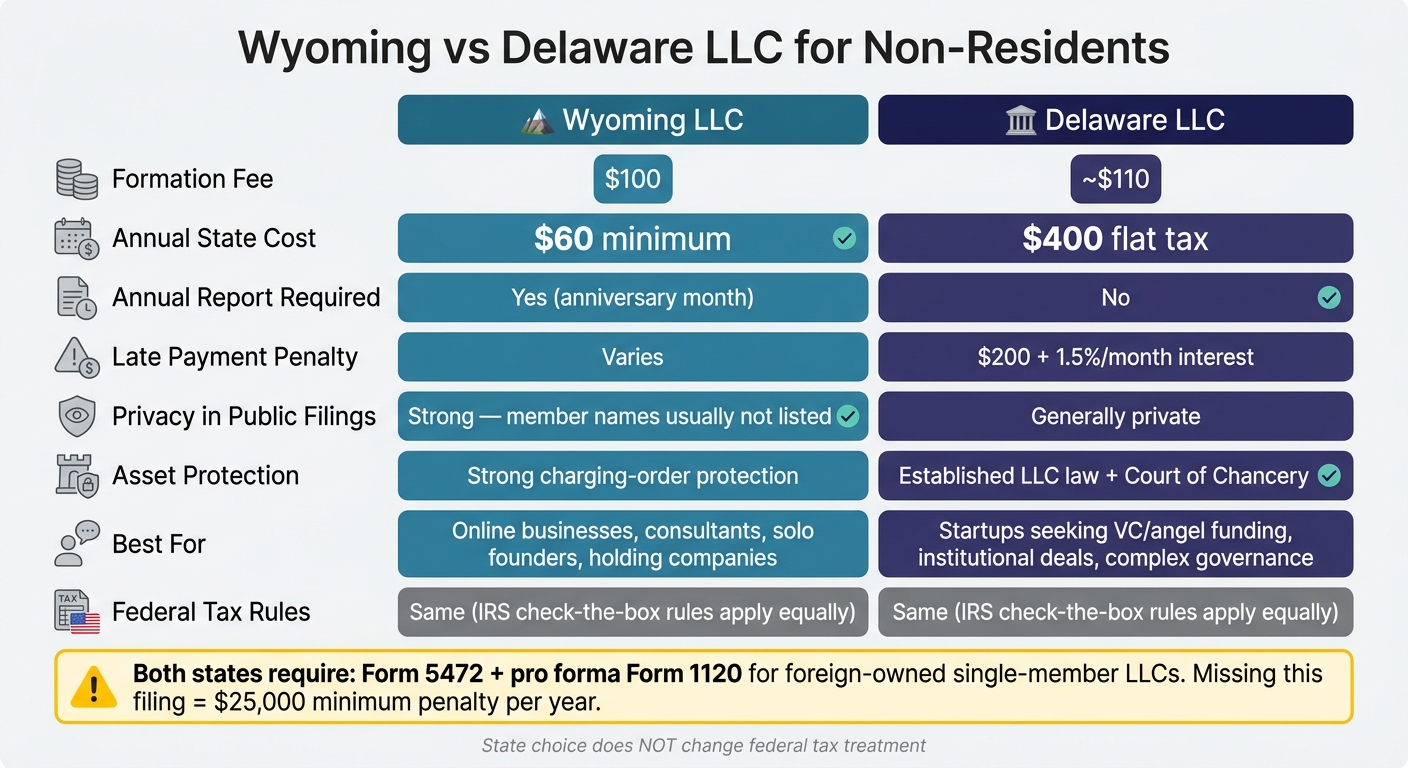
Wyoming vs Delaware LLC for Non-Residents: Side-by-Side Comparison
Quick Comparison
| Factor | Wyoming | Delaware |
|---|---|---|
| Formation fee | $100 | About $110 |
| Annual state cost | $60 minimum | $400 flat tax |
| Annual report | Yes | No |
| Privacy in public filings | Usually stronger | Usually private too |
| Best for | Cost-focused non-residents | Investor-backed startups |
I wrote this guide to help you make that call fast, avoid filing mistakes, and see the full cost of running the LLC after it is formed.
sbb-itb-39d39a6
How to form a US LLC as a non-resident: step by step
Once you pick the state, the rest comes down to filings, documents, and staying on top of deadlines.
Pick the state, name the LLC, and appoint a registered agent
First, choose the state. Then check whether your business name is open and appoint a registered agent.
Wyoming uses the Secretary of State’s online business search, while Delaware uses the Division of Corporations entity search. Your name must include "LLC" or "Limited Liability Company" and it must be available in that state. If the name you want is already taken, you can add a location or industry term, reserve a different legal name, or use a DBA.
Both states also require a registered agent with a physical street address in the formation state who is available during business hours to receive legal notices. If you live outside the US, you’ll usually need to hire a commercial registered agent. The usual cost is about $50 to $200 per year. That fee renews each year based on your agent’s billing cycle.
File the LLC, draft the Operating Agreement, and get an EIN
In Wyoming, you file Articles of Organization with the Secretary of State. In Delaware, you file a Certificate of Formation with the Division of Corporations. Both states allow online filing, so non-residents can handle the process remotely. Wyoming’s filing fee is $100, and Delaware’s is about $110. Online filings are often approved within a few business days.
Your Operating Agreement does not get filed with the state, but it still matters a lot. It spells out ownership percentages, management structure, profit and loss allocations, distribution rules, transfer limits, and dispute procedures. For a single-member LLC, it also lays out the ownership and management terms that banks and tax preparers may ask to see. A solid template can work, but if you have multiple foreign members or large assets in the business, it’s smart to work with a US business attorney.
Non-residents apply for an EIN using Form SS-4 by fax, mail, or phone. Fax usually takes 4 to 15 business days, and phone can be same-day if the form is complete. The IRS international EIN line is +1-267-941-1099.
Open a bank account and build a compliance calendar
Once you have your approval notice and EIN, you can begin bank onboarding. Do not start bank onboarding until you have the CP 575 letter.
Most banks and payment providers ask for the same core set of documents:
- The filed formation document
- The CP 575 EIN confirmation letter
- The Operating Agreement
- A valid passport
- Proof of residential address, such as a recent utility bill or bank statement
- A short description of the business
Many US banks still want in-person identity verification. Because of that, some non-resident founders go with fintech business accounts that support remote onboarding.
From here, think like an owner who never wants a surprise fee or missed filing. Put every deadline on a calendar right away.
| Deadline | Wyoming | Delaware |
|---|---|---|
| Annual state filing | Annual report, minimum $60 license tax | Annual LLC tax: $400 |
| Federal tax filing | Form 5472 + pro forma Form 1120 for foreign-owned single-member LLCs | Same requirement applies |
Track BOI deadlines under current FinCEN guidance.
Missing Form 5472 can trigger a minimum $25,000 penalty per year. Put that date on your calendar the same day you receive your EIN.
Wyoming vs Delaware for non-resident LLCs: costs, privacy, asset protection, and upkeep
Wyoming: lower annual cost, stronger privacy, lower annual admin
Wyoming is the go-to option for many non-resident founders who want an LLC that’s cheap to run and easy to keep up with. The state has no franchise tax, no personal income tax, and no corporate income tax. Its annual license tax starts at $60, which keeps recurring state costs low for an online business or a holding company.
In both Wyoming and Delaware, you still need a registered agent with a physical in-state address. So that’s one recurring cost you should plan for either way.
Wyoming is also more privacy-friendly in practice because public filings usually don’t list member names. That said, federal BOI reporting still applies when required.
Another reason people pick Wyoming is asset protection. Wyoming’s LLC law gives strong charging-order protection, which can help stop a member’s personal creditor from taking control of the company. For a solo founder, a freelance consultant, or a holding company, that can make a real difference.
The lower state fee is nice, but it’s not the whole story. Tax treatment and annual filing work still shape the total cost over time.
Delaware: market credibility, investor familiarity, higher fixed annual cost
Delaware is still the standard pick for venture-backed companies and institutional deals. A big reason is its Court of Chancery and its long history of business case law. Lawyers, investors, and larger counterparties know Delaware well, and that can make deals smoother.
If you plan to raise outside capital, add equity partners, or work with institutional counterparties, that familiarity can matter. Delaware’s annual LLC tax is $400. If you miss the June 1 deadline, the state adds a $200 penalty plus 1.5% monthly interest. Delaware LLCs do not file an annual report, so the tax payment is the main recurring state filing.
For a solo online business, though, Delaware’s added cost often doesn’t buy you much.
That legal track record tends to matter most when investors, partners, or larger deal parties are part of the plan.
State-by-state comparison for different founder goals
Pick the state based on how the business will work, not just on the filing fee. The table below makes that easier.
| Factor | Wyoming LLC | Delaware LLC |
|---|---|---|
| Formation fee | About $100. | About $110. |
| Annual state fee | $60 minimum annual license tax, or an asset-based amount if higher. | $400 flat annual LLC tax due June 1. |
| Annual report | Required, due in the anniversary month. | Not required for LLCs. |
| Privacy | Generally private in public filings. | Generally private in public filings. |
| Asset protection | Strong charging-order protection. | Established LLC law and Court of Chancery. |
| Best fit | Cost-sensitive founders: online businesses, consultants, holding companies. | Startups planning to raise capital: outside investment, complex governance, institutional counterparties. |
State choice shapes cost and governance, but tax rules and filing duties still follow the business.
Tax and compliance rules non-residents must follow
How a US LLC is taxed when the owner is not a US resident
Your state choice affects filing fees and yearly upkeep. But at the federal level, the IRS uses a different set of rules. In plain English: forming in Wyoming instead of Delaware does not change federal tax treatment. That part follows the IRS check-the-box rules.
A foreign-owned single-member LLC is usually treated as a disregarded entity, which means the IRS taxes the owner directly. A multi-member LLC is usually treated as a partnership and files Form 1065, with Schedule K-1s going to each member.
What the US taxes depends on where the income comes from and how the business earns it. If income is tied to a US office, employees, or a warehouse, it is often treated as effectively connected income, or ECI, and taxed in the US. Some US-source passive income, such as interest and certain royalties, is usually subject to 30% withholding unless a tax treaty cuts that rate. On the other hand, many online businesses with no US activity may earn foreign-source income that falls outside US tax.
This is where things can get tricky. ECI is highly fact-specific, so getting tax advice is standard practice.
Required filings: IRS reporting, BOI reporting, and state renewals
Once you know how the LLC is taxed, the next job is keeping up with the filings that come with that status.
No US income tax bill does not mean no filing duties. Foreign-owned single-member LLCs that are disregarded entities must attach Form 5472 to a pro forma Form 1120 that identifies the LLC and marks it as foreign-owned. Form 5472 reports transactions between the LLC and its foreign owner, including capital contributions, loans, and distributions. If you miss Form 5472, the penalty can be $25,000 per year. These forms are generally due by April 15 for calendar-year entities, and you can request an extension with Form 7004.
A multi-member LLC taxed as a partnership files Form 1065 and gives each partner a Schedule K-1. Foreign partners use the K-1 to figure out whether they need to file Form 1040-NR based on their share of ECI.
BOI reporting is separate. It requires ownership and identity details for beneficial owners and must be filed with FinCEN unless an exemption applies. For many new companies, the first filing is due within 30 days of formation. And it is not a one-and-done task. If ownership changes, you need to update the BOI filing.
Federal and state deadlines also run on separate schedules. Wyoming LLCs must file an annual report and pay a license tax by the first day of the LLC’s anniversary month. If the LLC has less than $300,000 in Wyoming assets, the fee is $60. Delaware LLCs pay a flat $400 annual franchise tax by June 1 each year, and they do not file an annual report. Miss either deadline and you can face late fees and other penalties.
Put Form 5472, BOI updates, and state renewal dates on one calendar. That small habit can save a lot of hassle later.
Conclusion: Which state is the right choice for your non-resident LLC
Now that the setup steps and compliance rules are clear, the decision mostly comes down to cost, privacy, and funding plans.
For most non-resident founders, Wyoming is the default pick. That’s especially true if you’re running an online business or using the LLC as a holding company. Its annual state fee is about $340 less per year than Delaware’s $400 annual LLC tax, member names usually aren’t public, and the state offers strong charging-order protection.
Delaware makes more sense when outside money is part of the plan. If you expect venture capital, angel funding, or deals with institutional parties, Delaware has a clear edge. Its court system and case law give investors and lawyers a familiar, predictable setup. That matters most for venture-backed startups, institutional deals, and ownership structures with more moving parts.
Here’s the fastest way to match the state to your goal:
| Goal | Better fit |
|---|---|
| Online business, consulting, or SaaS with no VC plans | Wyoming |
| Holding company for IP, brokerage, or rental property | Wyoming |
| Startup targeting U.S. venture capital or angel funding | Delaware |
| Venture funding, institutional deals, or complex governance | Delaware |
Pick the state that lines up with your ownership, funding, and reporting needs, then move through the same formation steps and compliance calendar.
FAQs
Do I need a U.S. address to form the LLC?
No. You do not need to be a U.S. resident or have a personal U.S. address to form a U.S. LLC.
What you do need is a registered agent with a physical address in the state where you form the LLC. That person or company receives legal and tax mail on your behalf.
If you want to open a U.S. business bank account, things can get a bit stricter. Some banks may ask for a separate physical U.S. business address or a virtual office service.
Can I open a U.S. business bank account remotely?
Yes, but it can be tough.
Many major U.S. banks want you to show up in person to open a business account, and that’s even more common for non-residents.
Some banks do allow remote setup if you have the right paperwork, including:
- Your LLC formation documents
- Your EIN confirmation letter
- Your operating agreement
- Your passport
- Proof of address
If the bank doesn’t offer remote setup, you may need to travel to the United States or appoint a U.S.-based authorized representative with the proper legal documents.
When does a non-resident LLC owe U.S. tax?
A non-resident owner of a U.S. LLC usually owes U.S. federal income tax only in two main cases:
- The LLC is engaged in a U.S. trade or business (ETBUS)
- The LLC earns U.S.-sourced income
In plain English, income is often treated as effectively connected when the company has a physical presence in the United States or uses dependent agents there. That’s the line the IRS tends to look at.
If the LLC earns U.S.-sourced income, you’ll generally need to file a U.S. tax return. And there’s another piece people often miss: passive income, like dividends or interest, can also be hit with a flat 30% withholding tax, unless a tax treaty lowers that rate.