
If I boil it down to one line: most founders should budget more than the advertised license price. In 2026, I’d expect a lean Dubai free zone setup to land around AED 18,000 to AED 25,000 (about $4,900 to $6,800) in year one, while a higher-cost setup in places like DMCC or DAFZA can reach AED 35,000 to AED 50,000+ (about $9,500 to $13,600+).
Here’s the short version of what drives the bill:
- License fee: often AED 10,000 to AED 50,000 per year
- Registration: often AED 5,000 to AED 15,000 one time
- Establishment Card: often AED 2,000 to AED 5,000
- Visa cost: often AED 3,000 to AED 7,000 per person
- Office or flexi-desk: from included desk packages to AED 15,000 to AED 50,000+ per year for an office
- Tax and compliance: tax registration may be free if self-filed, but bookkeeping, audit, and filing costs can add AED 2,500 to AED 15,000 a year
The big point: the cheapest package is often not the cheapest company once you add visas, ID costs, office rules, and renewals.
If I were budgeting this in the U.S., I’d focus on four choices first:
- IFZA: lower-cost, lean setup
- Meydan: lower-cost, fast launch
- DAFZA: higher-cost, office-heavy setup
- DMCC: higher-cost, stricter compliance and office rules
Quick comparison
| Free Zone | Year 1 Cost Level | Visa/Office Setup | Best Match |
|---|---|---|---|
| IFZA | Lower | Flexi-desk often used | Solo founders, consultants, online services |
| Meydan | Lower | Flexi-desk or virtual setup | Fast setup, lean structure |
| DAFZA | Higher | Office often needed | Logistics, aviation, import/export |
| DMCC | Higher | Office or flexi-desk, with tighter filing rules | Trading, commodities, crypto |
I’d use this article to do one thing: set a more honest first-year budget, then compare that with your year-two renewals, visa plan, banking needs, and filing costs before you apply.
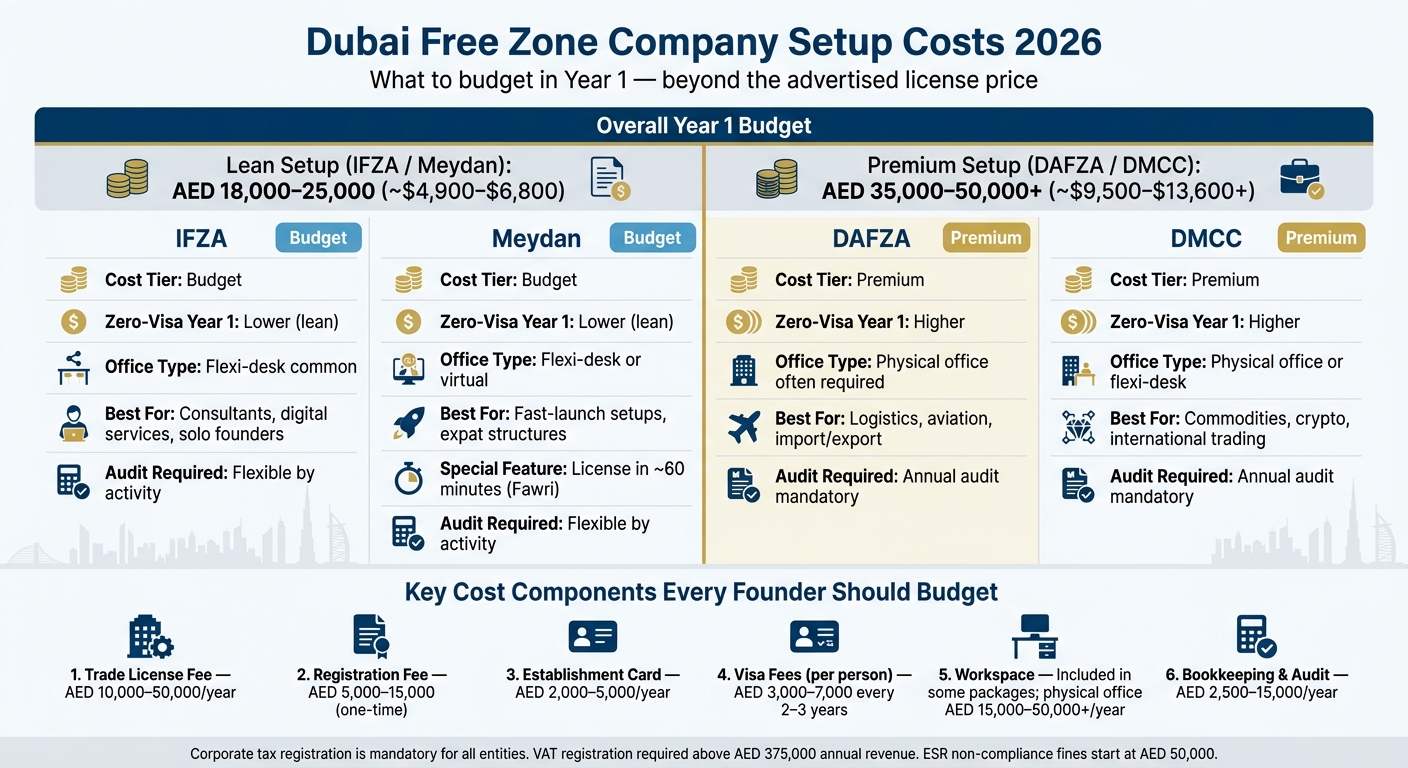
Dubai Free Zone Setup Costs 2026: IFZA vs Meydan vs DAFZA vs DMCC
Full cost breakdown for a Dubai free zone company in 2026
Core setup fees: license, registration, and establishment card
In year one, the total usually comes down to five cost buckets: license, registration, establishment card, visas, and workspace.
The license fee is usually the biggest recurring expense. In most cases, it ranges from AED 10,000 to AED 50,000 per year, and regulated business activities tend to sit on the higher end.
On top of that, founders should set aside money for registration and initial approval fees, which often fall between AED 5,000 and AED 15,000. Then there’s the Establishment Card, which is the company’s immigration file. That fee usually runs AED 2,000 to AED 5,000 on a recurring basis. And this part matters: without an Establishment Card, you can’t process any visa.
Residency and operating costs: visas, medical tests, Emirates ID, and workspace
Once the company is licensed and registered, the next layer is residency and day-to-day operating cost.
Visa processing usually costs AED 3,000 to AED 7,000 per person, with validity of two to three years. Each visa cycle also comes with medical fitness testing and Emirates ID processing. If the visa is issued while the applicant is already inside the UAE, a status change fee may also apply.
Workspace is one of those costs people often miss at first. Some free zone packages include a flexi-desk, which can help keep the launch budget lower. But if you need a physical office, expect about AED 15,000 to AED 50,000+ per year, depending on the office size and how many visas the space supports.
Comparison table: mandatory vs. optional cost components
The table below splits fixed setup costs from items that change based on visa count or office needs.
| Cost Item | Typical 2026 Cost | Frequency | Mandatory or Optional |
|---|---|---|---|
| Trade License Fee | AED 10,000 to AED 50,000 | Annual | Mandatory |
| Registration Fee | AED 5,000 to AED 15,000 | One-Time | Mandatory |
| Establishment Card | AED 2,000 to AED 5,000 | Recurring | Mandatory |
| Visa Fees (per person) | AED 3,000 to AED 7,000 | Every 2 to 3 Years | Optional (per need) |
| Medical Test + Emirates ID | Varies | Per visa cycle | Required if getting a visa |
| Workspace | Included in some packages; physical offices AED 15,000 to AED 50,000+ annually | Annual | Required in some zones |
| Corporate tax registration assistance | AED 0 if self-filed; up to AED 2,000 with paid assistance | One-Time | Mandatory |
| Bookkeeping and audit | AED 2,500 to AED 15,000 | Annual | Recurring compliance |
| Tax Residency Certificate | AED 50 submission fee; AED 500 to AED 1,750 issuance fee | Annual | Optional |
Corporate tax registration is free if you handle it yourself through the Federal Tax Authority portal. Even if no tax is due, every entity must register. Skip that step, and penalties can follow.
VAT registration becomes mandatory once annual revenue goes above AED 375,000.
If you expect to use a Tax Residency Certificate, budget for the AED 50 submission fee plus the issuance fee tied to your entity type. If you want a hard copy, add AED 250.
Audit rules vary by free zone, but many zones and the FTA expect audited financial statements for tax-related compliance and TRC applications. That’s why it makes sense to budget for bookkeeping from day one, instead of treating it like an afterthought.
sbb-itb-39d39a6
2026 first-year cost estimates by free zone
In 2026, first-year cost is shaped less by the license itself and more by visa needs and office rules.
Once you group costs that way, the gap between Dubai’s main free zones becomes much easier to see.
IFZA and Meydan Free Zone: lower-cost options for lean setups
For solo founders, consultants, and digital service businesses, IFZA and Meydan Free Zone usually make the most sense when budget is the main filter.
These zones tend to work well for lean setups because the entry cost stays lower when you don’t need visa sponsorship right away. Put simply, zero-visa packages cost less. Meydan also has a speed advantage. Its Fawri license can be issued in as little as 60 minutes, which makes it one of the fastest launch options in Dubai.
Dubai Airport Free Zone and DMCC: higher-cost options with stronger market positioning
DAFZA and DMCC sit in a higher-cost tier because their office and compliance rules are stricter.
DMCC is a strong fit for commodity traders, crypto firms, and international businesses. It also expects audited financial statements, so it’s smart to budget for bookkeeping and audit work from day one. DAFZA has a similar cost profile and is often a match for logistics, aviation, and import/export businesses.
The split is pretty clear: lean operators often look at IFZA or Meydan, while firms that want stronger market positioning often land in DAFZA or DMCC.
Comparison table: IFZA vs. Meydan vs. DAFZA vs. DMCC
| Free Zone | Zero-Visa First-Year Cost | One-Visa First-Year Cost | Office Requirement | Cost Tier | Best Fit |
|---|---|---|---|---|---|
| IFZA | Lower (lean) | Mid-range | Flexi-desk common | Budget | Consultants, digital services, solo founders |
| Meydan | Lower (lean) | Mid-range | Flexi-desk or virtual | Budget | Fast-launch setups, expat structures |
| DAFZA | Higher | Premium | Physical office often required | Premium | Logistics, aviation, import/export |
| DMCC | Higher | Premium | Physical office or flexi-desk | Premium | Commodities, crypto, international trading |
Zero-visa totals exclude Establishment Card fees; those apply only when visa sponsorship starts.
Renewal costs, hidden fees, and how to avoid under-budgeting
Year-one pricing is only part of the bill. Renewal and compliance fees shape what you’ll pay in year two.
What drops off after year one and what keeps recurring
Your first-year setup cost is only half the story. Initial registration fees are one-time charges. Most other costs come back on a schedule.
Every year, plan for:
- License renewal
- Establishment card renewal
- Workspace renewal
Residency visas and Emirates IDs usually come back every two years. Premium zones such as DMCC and DAFZA have tighter renewal rules, including annual audit obligations. More budget-friendly zones like IFZA and Meydan tend to give you more room depending on the business activity, though annual filing rules still apply to every entity no matter the zone.
If you hold a Golden Visa, your personal two-year residency renewal cycle doesn’t apply. But the company’s establishment card still needs annual renewal for the business to stay a valid visa sponsor.
If a license expires, you’re no longer dealing with a simple renewal. It turns into a reinstatement process, and the immigration file can be blocked until reinstatement is done. That often means higher fees too.
Those are the visible renewals. The costs that catch most founders off guard usually sit in the background.
Hidden costs founders commonly miss
Missing the corporate tax registration deadline can lead to regulatory fines. Economic Substance Regulation notifications also need to be filed every year, and non-compliance fines can start at AED 50,000.
Banking is another spot where budgets often slip. If the company doesn’t have enough physical substance, some banks may reject the account application or ask for an office upgrade to meet due diligence checks. That cost rarely shows up in the first budget draft.
Other common misses include document attestation for U.S.-sourced paperwork, VAT registration once annual revenue passes AED 375,000, and Tax Residency Certificate fees. A TRC comes with a submission fee, an issuance fee, and sometimes a hard-copy fee. It also needs annual renewal.
Comparison table: first-year costs vs. year 2 and beyond
| Cost Component | Year 1 | Year 2 and beyond |
|---|---|---|
| Trade License | Full registration + license fee | Annual renewal (often slightly lower) |
| Establishment Card | Initial issuance | Annual renewal |
| Workspace | Setup or lease fee | Annual renewal (market-rate adjustments possible) |
| Residency Visa | Entry permit + medical + Emirates ID + stamping | Renewal every 2 years (medical + Emirates ID + stamping) |
| Annual Filing & Tax | Mandatory registration | Annual filing; tax applies only if profits exceed AED 375,000 |
| Audit & Compliance | Books setup | Annual audit (mandatory in zones like DMCC and DAFZA); ESR notification filing |
| TRC | Not applicable (requires 1 year of activity) | AED 550 to AED 2,000+ annually if treaty benefits are needed |
| Late Penalties | Not applicable | ESR fines start at AED 50,000; reinstatement fees if the license lapses |
Use these recurring costs to compare zones before you choose your structure.
Choosing the right Dubai free zone structure for your budget and long-term plan
When a low-cost zone makes sense and when a premium zone is worth it
Pick the zone that fits how your business will actually run. In practice, that usually comes down to visa count, office type, and how much operational substance a bank or regulator is likely to expect.
Low-cost free zones such as IFZA and Meydan tend to work well for solo consultants and online businesses that want an efficient setup without major infrastructure. They also suit founders who mostly need a legal entity and UAE residency visa eligibility, without taking on a larger office commitment.
Premium zones such as DMCC and DAFZA are often a better match when sector-specific licensing matters, when a formal office setup is part of the plan, or when market perception carries more weight with international clients. If you expect to hire staff or handle direct trade, a more robust operating license is usually the safer choice.
There’s also a practical issue many founders learn the hard way: banks often reject paper-only entities. A bare-bones license paired with a virtual desk can slow down account opening. And substance doesn’t just affect banking. It can also shape tax treatment and renewal planning.
How setup cost fits into a broader asset protection and internationalization plan
For founders with cross-border income, setup cost is only part of the picture. It needs to be weighed against residency, tax, and banking needs.
Tax status depends on meeting substance rules, so it makes sense to budget for real office use and compliance from day one. A Tax Residency Certificate also adds a recurring admin cost if you need treaty relief.
Conclusion: realistic 2026 budget ranges to use before you apply
Once you know the level of substance you need, the next step is simpler: find the zone that gives you the lowest total cost for that setup.
Use IFZA or Meydan for lean launches. Use DMCC or DAFZA when substance, office quality, or sector fit matters more than price.
FAQs
What is the cheapest realistic Dubai free zone setup in 2026?
In 2026, a realistic Dubai free zone company setup usually costs $5,450 to $8,200 (about AED 20,000 to AED 30,000).
For most founders, the lowest-cost route is a flexi-desk or virtual office package. It checks the legal box without locking you into a full commercial lease, which can save a chunk of money upfront.
If you’re setting up a company to hold assets passively, not to run day-to-day business, an ADGM SPV can be a simpler and lower-cost option. Annual licensing fees usually start at around $1,900.
How many visas do I need at the start?
It comes down to your business goals, residency plans, and how you want to run the company.
If you’re a solo entrepreneur or digital nomad setting up a company for tax or business reasons, you may not need any employee visas at the start.
But if you want UAE tax residency or plan to hire staff, you’ll need at least one investor or partner visa, plus any extra visas for employees as your business grows.
Which free zone is best for banking and renewals?
For banking and renewals, DIFC is often a top pick for professional and financial service businesses. A big reason is its global reputation as an international financial hub.
If you need a lower-cost setup for a specific use case, the DIFC Prescribed Company can be a better fit. Banking access still comes down to your business model and compliance profile, but well-known zones like DIFC and JAFZA can make banking and audit processes smoother.