
If I were setting up in the UAE in 2026, I’d start with one question: what will the company actually do? That choice drives almost everything else – market access, visas, banking, tax, and setup cost.
Here’s the short answer:
- Mainland is usually the right pick if I want to sell straight into the UAE market or work with government clients.
- Free zone is often the better fit if I run consulting, e-commerce, or cross-border services and want 100% foreign ownership with visa access.
- Offshore is mostly for holding shares, IP, or investments. It does not work for local UAE trade and does not give visa access.
A few 2026 facts matter right away:
- UAE corporate tax is 9% on taxable profit above AED 375,000
- VAT registration kicks in once taxable revenue goes above AED 375,000
- The UAE has 140+ double tax treaties
- Free zone companies only get 0% corporate tax treatment if they meet the QFZP rules
- Offshore setups like RAK ICC often face the hardest bank account review
If I had to boil the whole process down, it would look like this:
- Pick the business activity
- Choose mainland, free zone, or offshore
- Select the legal form
- Reserve the trade name
- File documents and UBO details
- Secure office space if needed
- Get the license
- Register for tax, then handle banking and visas
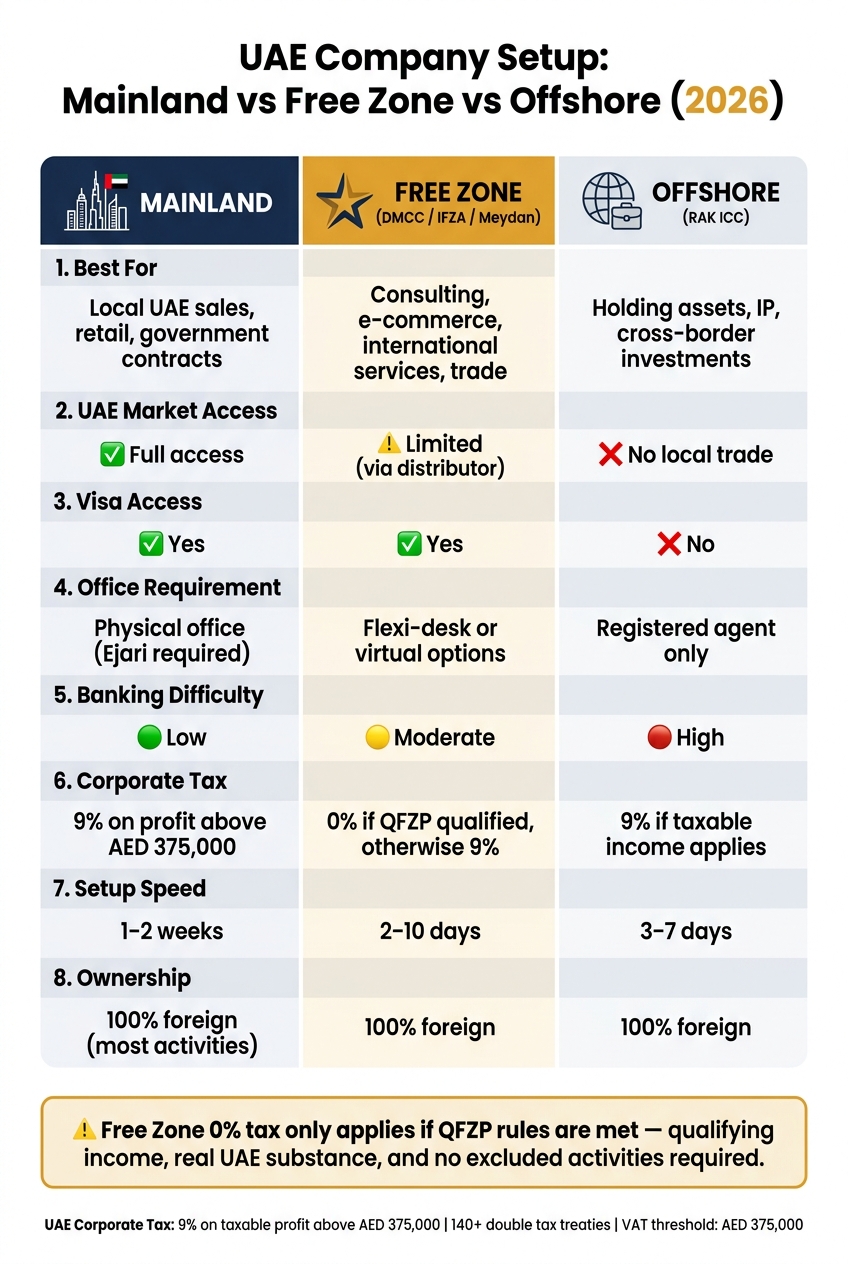
UAE Company Setup Comparison: Mainland vs Free Zone vs Offshore (2026)
Quick Comparison
| Setup | Best for | UAE market access | Visa access | Office need | Tax position |
|---|---|---|---|---|---|
| Dubai Mainland | Local UAE sales, retail, government work | Full | Yes | Physical office | 9% above AED 375,000 profit |
| DMCC | Trade, commodities, crypto, Dubai presence | Limited | Yes | Flexi-desk or office | 0% if QFZP, otherwise 9% |
| IFZA | Mixed activities, consulting, lean service firms | Limited | Yes | Flexi-desk options | 0% if QFZP, otherwise 9% |
| Meydan Free Zone | Solo founders, digital firms, lower-cost entry | Limited | Yes | Flexi-desk or virtual options | 0% if QFZP, otherwise 9% |
| RAK ICC | Holding assets, IP, share ownership | No local trade | No | Registered agent only | 9% if taxable income applies |
My main takeaway: don’t pick based on the lowest license fee. The wrong setup can cost more later through bank issues, tax problems, visa limits, or rules on what the company can and can’t do.
sbb-itb-39d39a6
Choose the right UAE company structure first
The cheapest license usually isn’t the right one. In the UAE, the smart move is to match the jurisdiction and legal form to your business model, tax position, visa needs, and banking plan. Start with a simple question: what does the company need to do day to day?
Mainland vs. free zone vs. offshore: what each structure allows
These three setups look similar on the surface, but they serve very different jobs.
Mainland companies are registered with Dubai’s mainland licensing authority. They can trade directly in the UAE domestic market, work with local customers, and bid for government contracts. They also need a physical office. Most mainland activities now allow 100% foreign ownership.
Free zone companies like DMCC, IFZA, and Meydan Free Zone also allow 100% foreign ownership and are often faster to set up. But there’s a catch: they generally can’t sell directly into the UAE mainland market unless they have the right mainland setup or work through a local distributor, depending on the activity. For the 0% corporate tax treatment as a Qualifying Free Zone Person (QFZP), the company must earn qualifying income, keep real substance in the UAE, and stay away from excluded activities. If it misses those tests, the standard 9% rate applies.
Offshore structures such as RAK ICC are built for holding assets, owning intellectual property, or holding cross-border investments. They cannot operate inside the UAE domestic market and do not give access to residency visas. In plain English, RAK ICC works as a holding vehicle, not an operating company.
| Feature | Dubai Mainland | DMCC | IFZA / Meydan Free Zone | RAK ICC |
|---|---|---|---|---|
| UAE Market Access | Full | Limited* | Limited* | No local trade |
| Permitted Activity | Trading, services, industrial | Trade, commodities | Consulting, e-commerce, services | Holding, IP, asset ownership |
| Visa Eligibility | Yes | Yes | Yes | No |
| Office Requirement | Physical (Ejari) | Physical or flexi-desk | Flexi-desk or virtual | Registered agent only |
| Banking Difficulty | Low | Moderate | Moderate | High |
| Tax Profile | 9% above AED 375,000 profit | 0% (if QFZP) or 9% | 0% (if QFZP) or 9% | 9% if taxable income exists |
| Setup Speed | 1 to 2 weeks | 2 to 4 weeks | 2 to 10 days | 3 to 7 days |
*Requires a local distributor or mainland setup to sell directly in the UAE mainland market.
Once you know the structure, the next step is picking the legal form and the exact license activity.
Which structure fits your business goal: trading, consulting, holding, or international operations
Dubai mainland is usually the cleanest fit when most of your revenue will come from UAE clients or government tenders. If you need to contract directly with local counterparties, mainland is often the easiest path.
DMCC works well when commodity trading is part of the plan or when a Dubai-based physical presence matters.
IFZA or Meydan Free Zone are often a good fit for lean businesses: solo consultants, e-commerce operators, and remote service providers that want a fast, lower-cost license with visa eligibility. Meydan Free Zone can be set up in as little as two days, and first-year costs are among the lowest in the UAE.
RAK ICC makes sense if the goal is to hold shares in other companies, own intellectual property, or structure international investments. It is not built for active commercial operations.
Ownership, tax, and substance rules to check before applying
After choosing the structure, check the rules that decide whether the setup will work in practice. A company can look fine on paper and still run into trouble with tax, substance, visas, or banking.
Ownership: Free zones and offshore structures allow 100% foreign ownership. Most mainland activities do too, following changes made in 2021.
Tax eligibility: The standard UAE corporate tax rate is 9% on taxable profits above AED 375,000. To qualify as a QFZP, the company must earn qualifying income, keep real UAE substance, and avoid excluded activities. If those tests are not met, the standard 9% rate applies.
Economic Substance Regulations (ESR): If the company carries out ESR-relevant activities like holding, finance, or IP, it must show that core income-generating activities take place inside the UAE. That usually means local management, staff, and actual premises. Missing the annual ESR notification can trigger fines starting at AED 50,000.
Banking and visas: A virtual office by itself usually won’t support corporate banking in 2026. Banks want a clear source-of-wealth story and proof of local management. And if UAE residency is part of the plan, check visa eligibility before filing anything. Offshore structures like RAK ICC do not support visas.
All UAE entities, including offshore companies, must register for Federal Corporate Tax and file annual returns, even if no tax is due.
Step-by-step process to register a UAE company in 2026
Once you’ve picked the right UAE setup, it’s time to move from planning to filing. In most cases, the order stays pretty similar across mainland, free zone, and offshore companies: choose the activity, pick the legal form, reserve the name, confirm the jurisdiction, prepare the documents, secure premises, get the license, and then handle tax registration.
Steps 1 to 4: pick the activity, legal form, name, and jurisdiction
Start with the licensed activity. This comes first because the activity drives the license type and tells you whether extra approvals are needed. Finance and healthcare are good examples. In those sectors, you usually need added regulator approval before the license can be issued.
Then choose the legal form. That could be an LLC, SPV, or branch, depending on the setup and the business activity. This choice matters because it affects ownership rules and tax treatment.
Next, reserve the trade name. The UAE doesn’t allow offensive or religious terms in company names. You’ll usually submit a shortlist of proposed names, and approval often takes 24 to 48 hours.
After that, confirm the jurisdiction – mainland, free zone, or offshore – based on how the business will operate.
Steps 5 to 8: submit documents, secure premises, receive the license, and register for tax
Once the activity, legal form, name, and jurisdiction are locked in, the filing stage starts. The main document set usually includes:
- Passport copies for shareholders and directors
- A UBO declaration for anyone holding 25% or more of the equity
- A business plan, where required
- Signed constitutional documents, such as the MOA or AOA
Then secure the premises. For mainland companies, that usually means a physical office with an Ejari-registered lease. Free zones may allow a flexi-desk or virtual office, depending on the authority and the number of visas needed. Offshore entities don’t need operating office space in the same way. They only need a registered agent address through an authorized corporate service provider.
Once the premises piece is done, submit the final license application.
After approval, eligible mainland and free zone companies receive an establishment card and can sponsor residency visas for investors and employees. Visa processing usually adds 2 to 4 weeks.
Tax registration comes after licensing. VAT registration is required once taxable revenue goes above AED 375,000. And even if a company qualifies for 0% tax as a Qualifying Free Zone Person, it still needs to complete FTA registration.
Typical 2026 timelines and first-year cost ranges
The filing process itself is often fairly quick. The slower parts are usually banking and visas. Free zone and offshore incorporation tend to move faster, while bank account opening and residency visa processing often take the most time.
Costs depend on the jurisdiction. In general, mainland is usually the most expensive option, free zones tend to fall in the middle, and offshore is often the lowest-cost route.
How the main UAE options compare in practice
Once you know the setup types, the next step is to compare the main UAE options by market access, cost, and banking friction. Each one lines up with a different goal: selling inside the UAE, running a lean service business, or holding assets.
Dubai mainland: best for UAE market access and local operations
If you need to sell straight to UAE customers, bid on government contracts, or run a retail location, mainland is usually the best fit. A Dubai mainland company is registered through the Department of Economy and Tourism (DET) and gives you direct access to the local market without using a distributor.
The tradeoff is cost. Fixed costs are higher because you must have an Ejari-registered office.
DMCC, IFZA, and Meydan Free Zone: speed, cost, and business fit
These three free zones cover most founder and small business use cases, but they don’t do the same job.
DMCC is a well-known free zone, especially for commodities, crypto, and international trade. It costs more and usually takes longer to set up, but banks and counterparties know it well.
IFZA sits in the middle. It lets you combine different business activities under one license, which helps if your company doesn’t fit neatly into a single box. Setup is faster than DMCC and usually costs less.
Meydan Free Zone is geared toward speed and lower overhead. It works well for digital businesses, consultants, and founders who don’t need much physical space. The application process is mostly digital, and setup is the fastest of the three.
| Feature | DMCC | IFZA | Meydan |
|---|---|---|---|
| Best For | Commodities, crypto, global trade | Flexible activity combinations | Budget-conscious, digital setups |
| Reputation | High / Tier 1 | Moderate / Flexible | High / Digital-first |
| Office Requirement | Physical office or flexi-desk | Flexi-desk options | Flexi-desk or virtual options |
| Setup Timeline | 10 to 15 days | 3 to 7 days | 2 to 5 days |
| Visa Options | Multiple | Multiple | Multiple |
RAK ICC offshore: where it fits and where it does not
RAK ICC is mainly for holding assets, not for day-to-day local operations. It can hold shares, intellectual property, or other assets, but it cannot do local UAE trading or sponsor residency visas.
This is where many people get tripped up. On paper, offshore can look simple. In practice, banking is often the sticking point.
UAE banks apply closer scrutiny to offshore entities because they can look like shell structures without clear economic substance. That usually means a tougher onboarding process and more requests for source-of-wealth documents.
| Feature | RAK ICC (Offshore) | Dubai Mainland | Free Zone (e.g., DMCC) |
|---|---|---|---|
| Local UAE Trade | Prohibited | Full access | Limited (via distributor) |
| UAE Residency Visa | No | Yes | Yes |
| Physical Office | Not required | Mandatory (Ejari) | Required (flexi-desk allowed) |
| Ownership | 100% foreign | 100% foreign (most activities) | 100% foreign |
| Banking Friction | High | Standard | Standard |
| Primary Use Case | Holding assets, IP, global shares | Local operations, retail, government contracts | International services, trade |
Before you file anything, check banking and visa eligibility. Those two points often decide whether a structure works in the real world, not just on a comparison chart.
Banking, visas, compliance, and next steps
Opening a corporate bank account and getting a UAE residency visa
Once you pick mainland, free zone, or offshore, banking and visas become the next big hurdle. They shape how fast your company can start operating. Your setup affects your bank application, your visa route, and how much admin work you’ll deal with later.
Banking is often the toughest part. UAE banks want to see a clear business purpose, real substance, and cash flow that makes sense. Before you contact a bank, get your paperwork in order: at least six months of personal or company bank statements, a source-of-wealth explanation, and a business plan that shows how money will move through the business. In many cases, banks also want proof that you have a real base in the UAE.
Visa quota usually depends on your office package. Some lower-cost free zone licenses don’t include any visa quota at all. Company formation can often be done remotely, but the visa process is different. Medical tests and biometric enrollment require you to be in the UAE in person.
Ongoing compliance and common setup mistakes to avoid
Getting the license is only the start. After that, the job is keeping the company active and compliant.
Stay on top of corporate tax, VAT, and annual filings from day one. Don’t wait until money starts coming in. Missing TRN registration can lead to penalties. You also need to keep the UBO register updated, hold records for seven years, and renew the license, establishment card, and lease every year. If the company carries out a Relevant Activity under the Economic Substance Regulations, you’ll also need to file annual notifications and reports. Missed filings can bring fines starting at AED 50,000.
A few mistakes come up again and again:
- Choosing the wrong activity or structure. For example, using a passive holding vehicle like an SPV for active trading or service work can draw regulatory action.
- Underestimating banking KYC. If your source-of-wealth story is weak, or the supporting documents don’t line up, delays and rejections are common.
- Ignoring regular reporting. Banks may ask for audited financial statements during annual reviews. If you can’t provide them, the account may be suspended.
Conclusion: how to pick the right UAE company in 2026
Start with the business goal, not the cheapest license. That’s usually where people go wrong. Mainland companies make the most sense if you need direct access to the UAE market. Free zones are often a better match for international service businesses and lean setups. Offshore companies are mostly for holding or investment structures, and banks tend to review them more closely than other options.
Once the structure is clear, plan for more than just the license fee. Bank account setup, visa processing, yearly renewals, accounting, and corporate tax registration all add to first-year costs.
If the business purpose is clear, the company has substance, the UBO details are in order, and the cash flow matches the story, you cut down a lot of the setup friction in 2026.
FAQs
Which UAE setup is best for my business?
The best UAE setup comes down to your goals, your tax position, and whether you need to sell inside the local UAE market.
- Mainland: best if you want full access to the UAE market. This setup is subject to 9% corporate tax.
- Free zone: a good fit for international trade, consulting, or holding assets. It allows 100% foreign ownership and may offer 0% corporate tax if you qualify.
- Offshore: best for international asset protection or holding activities only. It cannot trade in the UAE or sponsor visas.
Can I open a bank account with a virtual office?
Yes, but it is not guaranteed. You need to prepare with care.
Banks may flag companies that use only a virtual address as possible shell entities, and that can slow down or stall the application. To improve your chances, share a clear company background and a solid business reason for being in the UAE.
Do I need corporate tax and VAT registration?
Yes. They’re two separate UAE requirements, and they serve different purposes.
Corporate tax registration generally applies to every UAE legal entity, including mainland, free zone, and offshore companies. That applies regardless of revenue or whether the business may later qualify for an exemption.
VAT registration works differently because it depends on revenue:
- It’s mandatory once annual taxable supplies and imports go above AED 375,000.
- It’s voluntary when annual taxable supplies and imports are between AED 187,500 and AED 375,000.