
If you need to sell straight into the UAE, hire beyond a small visa quota, or bid for public work, I’d choose mainland. If most of my income comes from outside the UAE and I want lower setup costs, I’d look at a free zone first.
Here’s the short answer:
- Mainland gives me direct UAE market access
- Free zone can give me 0% corporate tax on qualifying income
- Mainland corporate tax is 9% on taxable profits above AED 375,000
- VAT is 5% in both setups once the threshold is met
- Free zones often start with 1 to 3 visas
- Mainland usually needs a physical office lease and Ejari
- Free zone goods can move with 0% customs duty while they stay in the zone or go abroad, but duties apply when goods enter the mainland
In plain English: I’d pick free zone for export-led trade, solo consulting, or online work with overseas clients. I’d pick mainland if local UAE sales are part of the plan from day one.
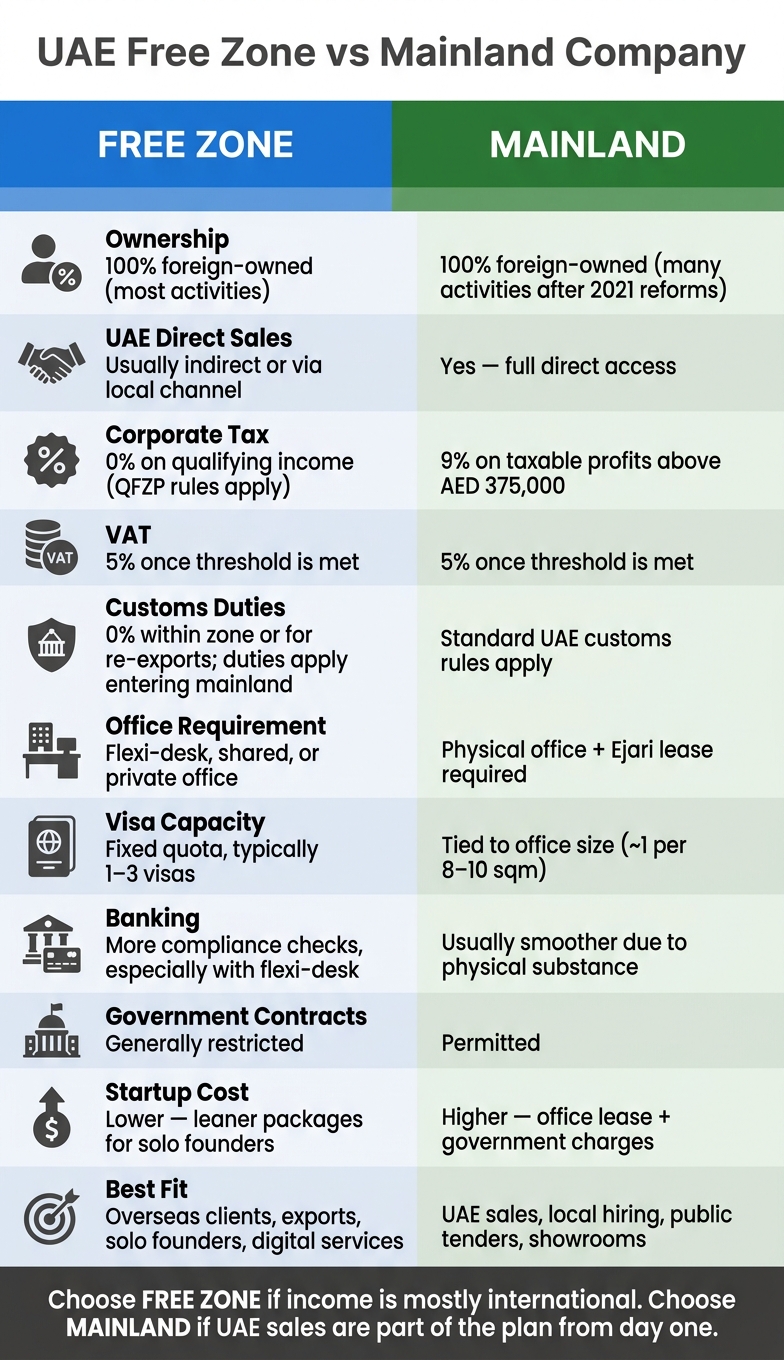
UAE Free Zone vs Mainland Company: Side-by-Side Comparison
Quick Comparison
| Criteria | Free Zone | Mainland |
|---|---|---|
| Ownership | Often 100% foreign-owned | 100% foreign-owned for many activities |
| UAE direct sales | Usually no, unless using a local channel or extra setup | Yes |
| Corporate tax | 0% on qualifying income if QFZP rules are met | 9% above AED 375,000 taxable profit |
| VAT | 5% if registered | 5% if registered |
| Customs | 0% on imports/re-exports within the zone or abroad | Normal UAE customs rules |
| Office | Flexi-desk, shared office, or private office | Physical office usually required |
| Visas | Often fixed package, about 1 to 3 | Linked to office size |
| Banking | More checks in many cases | Often smoother |
| Government work | Often restricted | Allowed |
| Best fit | Overseas clients, exports, solo founders | UAE sales, local hiring, public tenders |
My take: this choice is less about company type and more about where the money will come from, how many people I plan to hire, and whether I need direct access to the UAE market.
sbb-itb-39d39a6
Free zone vs mainland: a side-by-side overview
A mainland company follows one licensing system. A free zone company follows another. A mainland company gets its license from the UAE emirate authority. A free zone company gets its license from its own free zone authority. That split drives most of the day-to-day differences.
Once you know which setup fits your market, the next step is simple: look at how each one shapes tax, customs, and sales inside the UAE.
Here’s the side-by-side view:
| Feature | Free Zone Company | Mainland Company |
|---|---|---|
| Direct UAE Sales | Usually indirect or through an approved local channel | Yes |
| Government Contracts | Generally restricted | Permitted |
| Office Requirement | Flexible (flexi-desk or physical) | Physical office lease required |
What a UAE free zone company is
A free zone company is set up under a specific Free Zone Authority. It’s mainly built for international trade and services. In many cases, it allows 100% foreign ownership, but direct sales into the UAE mainland are generally restricted. Each free zone comes with its own focus, fee setup, and rulebook.
What a UAE mainland company is
A mainland company is licensed at the emirate level. It gives you full access to the UAE market: local consumers, companies across the country, and government contracts. It can trade across the UAE and usually needs a physical office lease.
That makes it a better fit when your business depends on direct client relationships inside the UAE, or when bidding on government contracts is part of the plan.
Ownership rules and activity approvals
Both setups now allow 100% foreign ownership for many business activities after the 2021 mainland reforms. On the mainland side, though, eligibility still depends on the exact licensed activity. Some regulated sectors may still need a UAE national to act as a local service agent or partner.
So before you decide, check whether your activity qualifies for 100% mainland ownership. If it doesn’t, a free zone can be the simpler route, especially if you don’t need direct UAE sales. That one detail can make a big difference when your activity needs local market access or a regulated license.
Tax, customs, and selling inside the UAE
Corporate tax and VAT: how each structure is treated
Once ownership is sorted out, tax and customs often end up making the decision.
The biggest split is corporate tax. Mainland companies pay 9% corporate tax on taxable profits above AED 375,000. Free zone companies can pay 0% on qualifying income, but that only applies if they meet the rules for Qualifying Free Zone Person (QFZP) status.
So the core trade-off is pretty simple: Do you want the free zone tax upside, or the mainland’s easier access to customers inside the UAE?
That 0% rate isn’t automatic. A free zone company can lose it if it doesn’t have enough substance, earns non-qualifying income, or fails to register for corporate tax.
VAT works the same way in both setups. A 5% VAT rate applies to most goods and services once the registration threshold is met.
| Tax Feature | Mainland Company | Free Zone Company |
|---|---|---|
| Corporate Tax | 9% on taxable profits above AED 375,000 | 0% on qualifying income (QFZP rules apply) |
| VAT | 5% once the registration threshold is met | 5% once the registration threshold is met |
Customs duties and access to the local market
Free zone companies pay 0% customs duties on imports and re-exports when goods stay inside the zone or are shipped abroad. If your business depends on global trade or re-export activity, that can trim costs in a meaningful way.
But once those goods move into the UAE mainland, normal import procedures kick in and customs duties apply. In plain English, the customs perk ends at the free zone gate.
Mainland companies don’t face that same issue when trading across the UAE.
When direct UAE sales change the decision
This is where things often shift.
Free zone companies are usually limited to trading inside their zone or outside the UAE. If they want to sell to mainland customers, they usually need a UAE-registered distributor, a local branch, or a separate mainland-registered entity.
A mainland company avoids those extra steps. It can sell across the UAE directly, without putting a third party in the middle. If local sales are a big part of how you plan to make money, that simpler setup matters.
Next, compare the office, visa, banking, and setup requirements that shape day-to-day operations.
Office requirements, visas, banking, and setup costs
Workspace options and how they affect visa capacity
The office rule is one of the clearest day-to-day differences between these two setups. Mainland companies need a physical office and a formal lease agreement, known as an Ejari, registered with the local land department. Visa capacity usually depends on office size, with about one visa for every 8 to 10 square meters of leased space.
Free zones give you more room to choose. Many offer flexi-desk packages, shared offices, or private offices. These setups often come with a set visa quota, usually one to three visas, no matter the office size. If you’re planning to build a local team over time, mainland can give you more headroom since a larger office can support more visas.
Opening a bank account: what to expect
Office setup matters for banking too, because banks look closely at business substance.
For both setups, opening a bank account is often tougher than getting the license itself. Mainland companies usually have an edge because the required physical office helps show a real business presence. Free zone companies that rely on flexi-desks can face more compliance checks and longer wait times.
Before you speak with a bank, put together a Source of Wealth file with six months of bank statements. Banks also pay close attention to whether your license matches your activity. For example, if your license says "consultancy" but your transactions look like "trading", that can lead to a rejection. A UAE-resident director or clear proof of local management activity can also help.
Startup and annual renewal costs compared
Once the office and banking side makes sense, cost usually becomes the next big filter.
Free zones are often the lower-cost option at the start. A basic package that includes a license, flexi-desk, and one or two visas can cost less in year one than a mainland setup. Mainland companies usually cost more upfront because they need a physical office lease and come with added government charges.
| Cost Factor | Free Zone Company | Mainland Company |
|---|---|---|
| Office Requirement | Flexi-desk, shared office, or physical office | Mandatory physical office with Ejari |
| Visa Capacity | Fixed package quota, often 1 to 3 visas | Tied to office size |
| Banking Practicality | More scrutiny, especially with a flexi-desk | Usually smoother because of physical substance |
| Startup Cost | Often leaner for solo founders | Higher upfront because of office and government charges |
| Annual Renewal | Often lower for small teams | Typically higher, but may be worth it if you need local market access |
Free zones usually cost less to start. Mainland setups usually mean less friction later if you want local hiring, UAE sales, or an easier banking path. Those trade-offs tend to fit three common business models, which the next section breaks down.
Which structure fits your business model
Now that the setup differences are clear, the next step is simple: match the company structure to how you make money.
Best fit: international consultants and solo operators
If you run the business on your own and most of your clients are outside the UAE, a free zone setup is usually the cleaner option. For solo operators, the main question isn’t the type of work you do. It’s where your revenue comes from.
If your income stays mostly international, free zone often makes more sense. If you need to sell straight into the UAE mainland, that changes the picture.
Best fit: e-commerce, trading, and international + UAE sales
The same logic applies to online stores. It’s not the business type that decides the better setup. It’s where your customers are.
Use a free zone structure for export-only e-commerce. Go with mainland if UAE orders make up a material share of your revenue.
Best fit: local UAE client-facing work and expansion
A mainland company is the right move if you need to sign contracts directly with UAE businesses, open a physical showroom, or bid for government projects.
Here’s a quick filter:
| Your situation | Better fit |
|---|---|
| Clients are outside the UAE, low overhead needed | Free zone |
| Selling goods or services directly to UAE consumers | Mainland |
| E-commerce with international customers only | Free zone |
| E-commerce with UAE mainland customers | Mainland |
| Government contracts, showrooms, or local hiring at scale | Mainland |
| Solo founder, consulting, or digital services | Free zone |
FAQs
Can I switch from a free zone to mainland later?
Yes. You can move from a free zone company to a mainland company, but it’s not a simple switch.
Because each setup follows a different legal framework, the move usually involves a formal restructure. Your business also needs to meet mainland rules, including having a physical office in the city to satisfy Department of Economic Development requirements and economic substance standards.
Which setup is better for getting a UAE bank account?
Both mainland and free zone companies are usually a better fit for UAE banking than offshore entities. The main reason is simple: banks tend to see them as having stronger economic substance.
Mainland companies often give banks the clearest compliance trail. They require a physical office and support business activity inside the UAE, which makes the setup easier for banks to review.
Free zone companies are also widely accepted, as long as they can show real business activity and local management.
What happens if a free zone company starts selling in the UAE?
A free zone company usually can’t sell straight into the UAE mainland on its own. If it wants to reach local customers, it will often need to work through a licensed UAE distributor.
If your business plans to make regular mainland sales or sell directly to customers there, a mainland company is usually the better setup. Trying to sell on the mainland without the right approval or business structure can lead to regulatory action.