
If I want the short answer: setting up a Cyprus company in 2026 usually takes 4 to 10 weeks, costs about $1,000 to $5,000+ to form, and works best when I line up structure, tax, UBO filing, banking, and local substance from day one.
Cyprus can still work well for trading, consulting, SaaS, holding, and IP businesses. The main draw is a 15% corporate tax rate, possible IP tax treatment down to about 3% for qualifying income, and, for some founders, 0% tax on dividends under the Non-Dom rules. But there’s a catch: paper-only setups are under more pressure now. In 2026, I need a physical office, local management activity, and, in many cases, local staff or contractors to back up the tax position.
Here’s the plain-English version:
- I start by choosing the right entity, usually a Private Ltd
- I reserve the company name
- I prepare and file the incorporation forms
- I get the Tax Identification Code
- I register for VAT if needed
- I file the UBO details
- I open a business bank account
- I set up bookkeeping, audit, and annual filings
A few numbers matter right away:
- 4 to 10 weeks is a common full setup timeline
- 5 to 15 business days is a common incorporation window after filing
- 2 to 6 weeks is a common bank account timeline
- VAT registration usually becomes required at €15,600 in taxable turnover
- 19% is the standard Cyprus VAT rate
The biggest mistakes are simple ones:
- Using a structure that doesn’t match what the business does
- Treating a virtual office like enough substance
- Sending weak KYC or KYB documents to the bank
- Missing UBO updates
- Mixing personal and company money
- Forgetting U.S. reporting like FBAR and FATCA if I’m a U.S. founder
If I want the shortest path, I should build the file in the right order: structure, name, company documents, tax and UBO filings, then banking and accounting. That cuts delays and lowers tax and banking problems later.
This guide breaks down that path in simple steps.
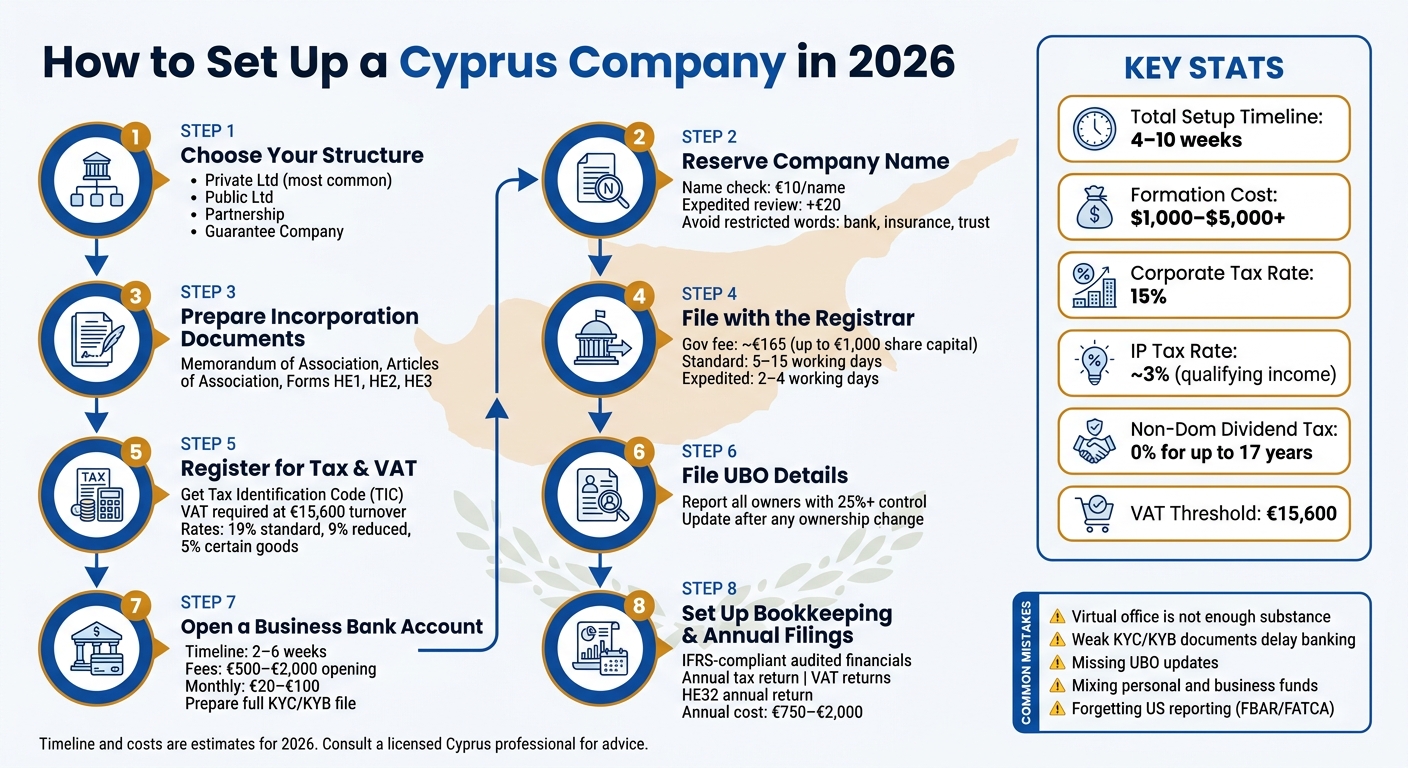
How to Set Up a Company in Cyprus in 2026: Step-by-Step Guide
1. Choose the right Cyprus business structure for your goal
Start with the entity type. That one decision affects liability, tax exposure, banking, and compliance. It also shapes every document you’ll need after that.
Private Ltd, Public Ltd, guarantee company, and partnership
For most international trading, consulting, SaaS, and holding companies, the Private Ltd is the usual starting point. It limits liability to the value of the shares, which makes it a practical fit for many founders.
The Public Ltd (Plc) is built for companies that plan to offer shares to the public or list on a stock exchange. It comes with higher minimum capital rules and more involved governance, so it’s rarely the best first move for a new founder.
A guarantee company does not have share capital. It is mostly used for non-profits or trade bodies.
Partnerships in Cyprus can be general or limited. They do show up in professional services and some restructurings, but they are not the usual first pick for international operating companies.
| Structure | Liability | Capital | Typical use case |
|---|---|---|---|
| Private Ltd | Limited to shares | Low and flexible | Trading, SaaS, consulting, holding |
| Public Ltd (Plc) | Limited to shares | Higher/statutory minimum | Public capital raising, listing |
| Partnership | Unlimited for general partners; limited for limited partners | None | Professional services and specific restructurings |
| Guarantee company | Limited by guarantee | None | Non-profits, trade bodies, specific asset holding |
With the entity type set, the next move is a compliant name reservation.
Matching the structure to your activity: trading, consulting, holding, or asset ownership
If you’re running a trading business, consultancy, SaaS company, or another active business, the Private Ltd is usually the best fit. It keeps liability ring-fenced and works well with Cyprus’s corporate tax system.
For holding and asset ownership, a Private Ltd can also work well, including as the operating company.
There’s one point you can’t gloss over in 2026: your structure has to match real substance. Companies must show real economic substance, including a physical office, local management, and local employees or contractors. If the company is in practice managed from another country, that country may still claim taxing rights. A PO box and virtual support are not enough to meet substance tests.
That applies no matter which entity type you choose. So this isn’t just a paperwork issue. It should shape the setup from day one.
Once the structure is fixed, move to the name search and the incorporation documents.
sbb-itb-39d39a6
2. Reserve the company name and prepare the incorporation documents
After you choose the entity, the next step is to reserve the company name and get the filing set ready.
Name search, approval rules, and restricted words
Run a name search with the Cyprus Registrar of Companies before drafting anything. That simple step can save time. If the proposed name is too close to an existing company name, the Registrar can reject it.
A name check costs €10 per name. If you want an expedited review, add €20.
Some words face extra scrutiny. Names that include bank, insurance, or trust need prior approval from the relevant regulator.
If the name is cleared, reserve it before moving ahead with the incorporation papers.
Memorandum, Articles, HE1, HE2, and HE3: what each document must contain
After the name is approved, prepare the five core filing documents:
| Document | What it covers | Who signs it |
|---|---|---|
| Memorandum of Association | Company name, business objects, share capital | Shareholders (subscribers) |
| Articles of Association | Internal governance rules | Shareholders (subscribers) |
| Form HE1 | Statutory declaration of compliance | Cyprus-licensed lawyer |
| Form HE2 | Physical registered office address in Cyprus | Director or secretary |
| Form HE3 | Details of first directors and secretary | Director or secretary |
Once these forms are ready, you can complete the incorporation filing.
The full incorporation set must be filed in Greek. It also helps to have passport copies, proof of address, and certified translations ready for the UBO filing. That way, you’re not scrambling for documents later.
Director, shareholder, secretary, and registered office requirements
The minimum setup is simple: at least one director, one shareholder, and one secretary.
Directors and shareholders can be either individuals or corporate entities. Directors do not need to be Cyprus residents.
The registered office must be a physical address in Cyprus. PO boxes are not accepted. You also need to report any person who owns or controls more than 25% of the company.
After the documents are signed, file the package with the Registrar, then move on to the tax, VAT, and UBO registrations.
3. File for incorporation and complete tax, VAT, and UBO registrations
Registrar filing steps, government fees, and processing times
Once your documents are signed, send the full incorporation packet to the Registrar.
The government filing fee depends on the company setup:
- For a company with share capital up to €1,000, the fee is about €165
- For companies without share capital, the fee is about €235
- If you want faster handling, you can add an expedited surcharge of about €100
Standard processing usually takes 5 to 15 working days after the Registrar accepts a complete filing. If you pay for expedited handling, the timeline usually drops to about 2 to 4 working days.
When the filing is approved, you receive four official documents:
- Certificate of Incorporation
- Registered Office Certificate
- Director and Secretary Certificate
- Shareholder Certificate
As soon as incorporation is approved, move straight into tax, VAT, and UBO registration. That handoff matters. A company may be formed on paper, but it still needs its tax and registry setup in place before it can run day-to-day without friction.
Tax Identification Code, VAT registration, and UBO filing
After incorporation, get a corporate Tax Identification Code (TIC) from the Cyprus Tax Department. You’ll need it for tax filings and official correspondence.
VAT registration becomes mandatory once taxable turnover reaches €15,600 in a 12-month period, or when you expect to pass that mark within the next 30 days. Cross-border services need close attention too, since they can trigger VAT duties even when the local turnover threshold hasn’t been met.
Cyprus VAT rates are:
- 19% standard
- 9% reduced
- 5% for certain goods and services
You can also register voluntarily below the threshold if you want to reclaim input VAT from day one. For some companies, that’s the smarter move. If you’re paying VAT on setup costs, software, rent, or outside services, early registration can help from the start.
File UBO details in the central register and update them after any ownership change.
After these registry filings, line up the company’s tax position with what the business is actually doing and where it is managed. That’s the part people sometimes gloss over, and it can come back to bite later.
Corporate tax, non-dom planning, and substance requirements in 2026
Cyprus taxes resident companies at 15% on net profits. Holding and IP companies may qualify for specific exemptions or lower effective rates.
If the founders are also Cyprus tax residents, they may be able to pair the company with the Cyprus Non-Dom regime. That can potentially mean 0% personal tax on dividends for 17 years.
Tax residency turns on where management and control happen in practice. Put simply, it’s not just about where the company is registered. It comes down to where decisions are made and where the business is run. To back up Cyprus residency, keep a real office, local decision-making, and local staff or contractors doing actual business work.
With the company formed and the core registrations done, the next step is opening the bank account and setting up day-to-day accounting.
4. Open a bank account and set up accounting and reporting
What banks require and how to prepare your file
Getting your Certificate of Incorporation is a big step. But it doesn’t mean the company is ready to trade. Without a bank account, a Cyprus company isn’t operational.
This is also where many founders run into their first serious delay. In most cases, the issue isn’t the bank itself. It’s the compliance file.
Cyprus banks work under strict EU Know Your Customer (KYC) and Know Your Business (KYB) rules. That means each director and UBO will usually need:
- A valid passport
- Proof of residential address dated within the last 3 months, such as a utility bill or bank statement
- The full incorporation package, including the Certificate of Incorporation, constitutional documents, and HE1–HE3 forms
Banks also want to understand what the company actually does. So you should be ready to provide a written summary of your business activities, your expected transaction profile, a business plan, sample contracts or invoices, and your website URL.
On top of that, source-of-funds and source-of-wealth documents are part of the process too. This usually means bank statements, prior-year tax returns, or audited financials. And banks now expect Cyprus substance. In plain English, they want to see a real office, local management activity, and staff or contractors who support the business.
Plan for the process to take 2 to 6 weeks, depending on how complex your structure is. Bank account opening fees usually fall between €500 and €2,000, with monthly maintenance fees of €20 to €100 and annual fees of €200 to €1,000. Some banks, especially those serving family offices or high-net-worth structures, may ask for a minimum deposit of €50,000 to €100,000. Some will want one in-person meeting. Others allow remote onboarding through a secure portal or video call.
From that point, the focus shifts to accounting records and annual filings.
Bookkeeping, IFRS financial statements, audit requirements, and annual filings
Once the bank account is open, the company moves into recurring compliance. Cyprus companies must keep proper accounting records, including invoices, contracts, and bank statements, and those records must be kept for 7 years.
Annual financial statements must follow EU-adopted IFRS and must be audited. It makes sense to budget for accounting support from the start.
Here are the main annual filing duties:
| Obligation | Requirement | Frequency |
|---|---|---|
| Financial Statements | IFRS-compliant, independently audited | Annual |
| Corporate Tax Return | Annual filing | Annual |
| VAT Reporting | Periodic returns to the Tax Department | Periodic |
| Annual Return (HE32) | Filed with the Registrar | Annual |
| UBO Registry Update | Any ownership changes reported | Annual or upon change |
| Bank KYC/KYB refresh | Updated identity and activity documents | Annual or upon change |
Annual compliance costs, including accounting, registered agent fees, and government renewals, usually range from €750 to €2,000 per year. One mistake can cause trouble fast: mixing personal and business funds. That can trigger a bank review or even a freeze, so keep those accounts fully separate from day one.
5. Costs, common mistakes, and a final setup checklist
What it actually costs and how long it takes to set up a Cyprus company
Once incorporation, tax, VAT, UBO, and banking are mapped out, the last questions are usually simple: How much will this cost? And how long will it take?
Here’s the rough cost range:
| Cost Category | Estimated Cost (EUR) | Estimated Cost (USD) | Frequency |
|---|---|---|---|
| Company Formation | €900 – €4,600 | $1,000 – $5,000+ | One-time |
| Bank Account Opening | €500 – €2,000 | $550 – $2,200 | One-time |
| Annual compliance costs | €450 – €1,850 | $500 – $2,000 | Annual |
| Ongoing bank fees | €220 – €1,100 | $240 – $1,200 | Annual |
Name approval and incorporation are usually the first time-sensitive steps. Tax, VAT, and UBO registrations can often move at the same time. Banking is often the slowest part left in the process.
Common mistakes that delay incorporation or create tax risk
The biggest cost overruns usually don’t come from government fees. They come from weak paperwork or poor substance planning.
If you pick a company structure that doesn’t fit your actual activity, you can run into tax residency, management, substance, and VAT issues later. And while a PO box or virtual office may look like an easy shortcut, it can hurt bank onboarding and weaken the company’s tax position.
A few other problems show up again and again:
- Incomplete KYC/KYB files
- Failing to update UBO information after ownership changes
- Misreading the VAT registration threshold
- Mixing personal and business funds
Each of these can slow onboarding, lead to account reviews, or create compliance risk.
Conclusion: The shortest compliant path to a Cyprus company in 2026
Here is the shortest practical checklist:
- Choose a structure that matches your activity and where the company will be managed from.
- Reserve the company name and prepare the Memorandum and Articles of Association.
- File incorporation, TIC, VAT if applicable, UBO, and substance documents in parallel.
- Prepare a full KYC/KYB package before approaching the bank.
- Set up IFRS-compliant bookkeeping early and track annual filings, tax filings, UBO updates, and bank KYC/KYB refreshes.
Build compliance into the first filing package. Fixing gaps later slows approval. A complete file from the start is the fastest route to approval and banking.
FAQs
Do I need to visit Cyprus to set up the company?
Generally, no. In most cases, you can set up a Cyprus company remotely through a licensed local service provider or registered agent. They handle the incorporation filings and the main compliance steps on your behalf.
The part that can change is the corporate bank account. Some banks in Cyprus allow remote opening, but many still ask for at least one in-person meeting. That tends to happen more often if the business has a higher-risk profile.
Can I use a Cyprus company if I live in another country?
Yes. You can own and use a Cyprus company while living in another country. Cyprus is often used for international business, trading, and holding setups.
That said, a Cyprus company on paper is only part of the picture. You also need to think about economic substance, tax residency, home-country reporting, and banking. And there’s a practical point many people miss: some banks may ask for at least one in-person meeting in Cyprus.
What type of business works best in Cyprus?
Cyprus is a strong fit for holding companies, trading, shipping, investment structures, and professional services. It tends to suit entrepreneurs and investors who want an EU-aligned legal setup for wealth preservation and cross-border business.
It is also well known for holding structures above foreign entities, along with intellectual property management, international investments, family offices, and trust structures.
Related Blog Posts
- Zero-Tax Countries for Business Owners: The Complete Jurisdiction Guide
- Lowest Corporate Tax Rates by Country: 2026 Comparison for Online Businesses
- 9 Best Jurisdictions for Company Incorporation: Costs, Tax Rates, and Compliance
- Best Countries for Startups: Where to Build, Incorporate, and Scale Tax-Efficiently