
Want to save on taxes for your online business? Here’s a quick guide to five countries offering low corporate tax rates in 2026, along with practical benefits for digital entrepreneurs.
- United Arab Emirates (UAE): 0% tax on profits up to $102,000; 9% above that. Free Zones offer 0% on qualifying income but require local offices and staff.
- Singapore: Effective tax rates as low as 4% for startups, thanks to exemptions. Strong financial ecosystem but requires a local director.
- Ireland: 12.5% tax on trading income with R&D tax credits up to 30%. EU market access but higher capital gains tax (33%).
- Cayman Islands: 0% corporate tax, no capital gains taxes, but strict compliance and banking challenges.
- Malta: Effective tax rate of 5% with refund systems. Offers EU access but requires upfront payment of 35%.
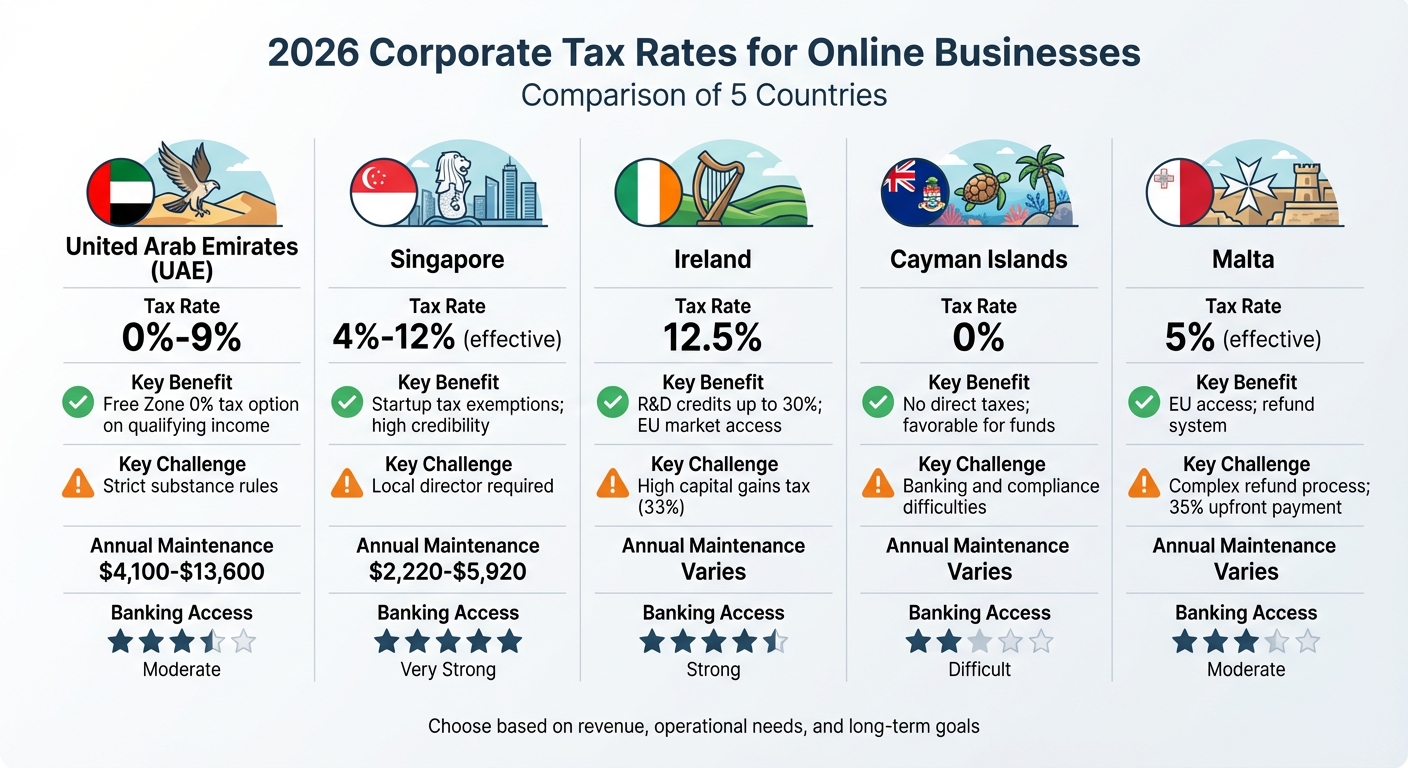
Quick Comparison
| Country | Tax Rate | Key Benefit | Key Challenge |
|---|---|---|---|
| UAE | 0%-9% | Free Zone 0% tax option | Strict substance rules |
| Singapore | 4%-12% (effective) | Startup tax exemptions | Local director required |
| Ireland | 12.5% | R&D credits, EU access | High capital gains tax |
| Cayman Islands | 0% | No direct taxes | Banking and compliance |
| Malta | 5% (effective) | EU access, refund system | Complex refund process |
Each jurisdiction has pros and cons. Choose based on your revenue, operational needs, and long-term goals.
1. United Arab Emirates (UAE)
Corporate Tax Rate
The UAE uses a tiered corporate tax system designed to benefit smaller online businesses. Profits up to AED 375,000 (about $102,000) are taxed at 0%, while profits exceeding this amount are taxed at 9%. For instance, if an online business earns $200,000 annually in profit, its corporate tax would be approximately $8,820.
Freelancers and sole proprietors classified as "Natural Persons" are only subject to corporate tax if their annual turnover surpasses AED 1 million (around $272,000). Additionally, businesses earning less than AED 3 million can apply for Small Business Relief to maintain a 0% tax rate until December 31, 2026. Free Zone entities can also enjoy a 0% tax rate on Qualifying Income, provided they meet certain economic substance requirements – such as employing staff locally, maintaining offices, and ensuring key decisions are made within the UAE. However, any income that doesn’t qualify is taxed at the standard 9% rate.
These tax policies, paired with a straightforward business setup process, make the UAE an attractive destination for online ventures.
Ease of Business Registration
Starting a business in the UAE is relatively quick and efficient. Free Zones, in particular, offer some of the fastest options for online businesses. These zones allow for 100% foreign ownership and have simplified incorporation processes. However, businesses operating in Free Zones must use a local agent to access the mainland market directly.
The Federal Tax Authority oversees all tax-related processes through the EmaraTax online portal. Registering on this platform typically takes 40–60 minutes if all documents are prepared, and approval is usually granted within 20 business days.
"Setting up a company in the UAE… is not simply about opening a company and benefiting from zero taxes, but about understanding how the company, residency, international taxation, and compliance requirements interact." – Orience International
Once a business is established, staying compliant with tax regulations is essential.
Compliance Requirements
After incorporation, meeting compliance deadlines is critical to maintaining the UAE’s tax benefits. All businesses must register for corporate tax through the EmaraTax portal within three months of incorporation, even if they don’t owe any tax. Late registration results in a fixed penalty of AED 10,000. Additionally, businesses are required to file tax returns and make payments within nine months of the end of their financial year.
Accounting records must be kept for seven years, with noncompliance leading to fines of AED 10,000 for first offenses and AED 20,000 for repeat violations. Late tax payments incur a 14% annual penalty, calculated monthly.
Digital Infrastructure
The UAE’s advanced digital infrastructure supports seamless online business operations, including hosting and caching services. The EmaraTax portal manages all federal tax processes electronically. It accommodates international entrepreneurs by accepting global phone numbers and email verification. The system is designed to detect inconsistencies and late filings automatically. However, failing to submit documents in Arabic results in a fine of AED 5,000.
sbb-itb-39d39a6
2. Singapore
Corporate Tax Rate
Singapore imposes a flat 17% corporate tax on income earned or remitted to the country. For the Year of Assessment 2026, businesses benefit from a 40% Corporate Income Tax Rebate, capped at $30,000. Additionally, active companies employing at least one local worker in 2025 qualify for a minimum rebate cash grant of $1,500.
New online businesses can take advantage of the Start-Up Tax Exemption (SUTE), which allows a 75% exemption on the first $100,000 of profits and a 50% exemption on the next $100,000 during their first three years of operation. These incentives can reduce the effective tax rate on initial profits to approximately 4.25%.
| Exemption Scheme | Chargeable Income Tier | Exemption Rate | Max Exemption per YA |
|---|---|---|---|
| Start-Up Tax Exemption | First $100,000 | 75% | $125,000 (Total) |
| (First 3 YAs) | Next $100,000 | 50% | |
| Partial Tax Exemption | First $10,000 | 75% | $102,500 (Total) |
| (After 3 YAs) | Next $190,000 | 50% |
Foreign-sourced income is not taxed unless it is remitted to Singapore. The Enterprise Innovation Scheme (EIS) further supports businesses with enhanced tax deductions of up to 400% for qualifying R&D activities and intellectual property registration.
Beyond offering competitive tax policies, Singapore simplifies the process of starting and running a business.
Ease of Business Registration
Launching an online business in Singapore is fast and entirely digital. The Accounting and Corporate Regulatory Authority (ACRA) processes registrations through its BizFile+ portal, typically within 1–3 business days. Foreigners can fully own a Singapore-based company, with the minimum paid-up capital requirement set at just $1.
"Singapore remains the world’s top destination for setting up a business, driven by political stability, a territorial tax system, and unmatched access to ASEAN’s 680-million-strong consumer market."
– Terra Advisory Services
However, foreign owners must appoint at least one director who resides in Singapore. Many opt for professional nominee director services, which cost between $1,500 and $4,500 annually. Overall, first-year setup costs range from $3,315 to $9,515. In December 2025, Singapore recorded 6,233 new business registrations – a 43.5% increase compared to the previous year.
Compliance Requirements
Singaporean companies must file their Estimated Chargeable Income (ECI) within three months of the fiscal year-end. Final tax returns are due by November 30 for paper filings or December 15 for electronic submissions. Filing for corporate taxes and withholding tax is fully digital. Businesses with an annual taxable turnover exceeding $1 million must register for the 9% Goods and Services Tax (GST).
Starting in April 2026, stricter anti-money laundering (AML) rules and mandatory nominee disclosure requirements will take effect under the Corporate and Accounting Laws (Amendment) Bill. Companies are also required to appoint a corporate secretary and maintain a registered address, which adds annual costs of $500 to $1,200. Moreover, Singapore has over 100 tax treaties to help businesses avoid double taxation.
This compliance framework strengthens Singapore’s reputation as a reliable and tax-efficient base for digital businesses.
Digital Infrastructure
Singapore’s digital-first approach integrates key government services through platforms like CorpPass and MyTax Portal. The GoBusiness portal streamlines tasks such as license applications and regulatory compliance. Digital banks like Aspire, Airwallex, and ANEXT support entrepreneurs with instant remote account opening, boasting approval rates above 90% for legitimate businesses. This makes it easy for online ventures to get up and running without needing a physical presence.
With a strong financial ecosystem, seamless banking integration, and robust intellectual property protection, Singapore is well-suited for digital operations. However, businesses with energy-intensive processes should account for the carbon tax of $25 per tonne in 2026, applicable to industrial facilities and large-scale digital operations.
3. Ireland
Ireland stands out as a strong contender for online businesses, following the analysis of the UAE and Singapore. The country runs a two-tier corporate tax system, with a 12.5% tax rate on trading income from active business operations and a 25% rate on non-trading income, such as investments or rental earnings. For large multinational corporations pulling in annual revenues over €750 million ($820 million), the OECD Pillar Two global minimum tax enforces a 15% effective tax rate.
Beyond these rates, Ireland offers enticing incentives for tech-focused companies. Businesses engaged in R&D can claim a 30% tax credit on eligible spending, effectively allowing for a total deduction of 42.5%. Moreover, profits from qualifying intellectual property assets and patents are taxed at just 10%. Startups entering new trades before the end of 2026 can enjoy a three-year corporate tax holiday, eliminating tax liabilities during their early growth stages. On top of that, trading losses can be carried forward indefinitely to offset future profits.
Ease of Business Registration
Ireland simplifies the process of starting an online business. Entrepreneurs can complete registration digitally through the Companies Registration Office (CRO) and Revenue platforms. Foreign business owners can fully own Irish companies, with the Private Company Limited by Shares (LTD) being the most popular structure for small and medium-sized enterprises. Better yet, there’s no minimum capital requirement, making it an appealing option for startups operating on a tight budget.
However, there are a few logistical requirements. Companies must appoint at least one director residing in the European Economic Area (EEA) and maintain a physical registered office address in Ireland. To qualify for tax treaty protections and avoid being flagged as a shell company, businesses need to meet "substance" requirements, such as having a local office or directors.
Compliance Requirements
Irish companies benefit from an extensive network of tax treaties designed to prevent double taxation. Tax filing is streamlined via Revenue’s online portal, but businesses must maintain detailed documentation of R&D activities to claim the 30% credit. This is especially critical for software-based projects. Additionally, a 33% capital gains tax applies when selling business assets or investments.
Digital Infrastructure
Ireland’s advanced digital infrastructure complements its appealing tax policies and business-friendly environment. The country serves as the EMEA headquarters for major global tech giants, including Apple, Google, Meta, Microsoft, and AWS, positioning it as a key European hub for technology companies. With 82 data centers and 14 international subsea telecommunications cables – four of which directly connect to North America – Ireland is a powerhouse in global connectivity.
The digital sector significantly contributes to Ireland’s economy, adding roughly $50 billion annually and accounting for 13% of its GDP. AI adoption has surged among Irish companies, leaping from 49% in 2024 to an impressive 91% in 2025. The government has also invested $3.3 billion under the National Broadband Plan to expand Fiber-to-the-Home (FTTP) and Gigabit broadband services. Ireland’s Very High Capacity Network (VHCN) and fiber coverage exceed EU averages, ensuring reliable, high-speed connectivity for businesses operating remotely. By 2030, the country aims to digitize 90% of its public services, further solidifying its commitment to a digital-first approach.
"The Irish digital infrastructure ecosystem contributes approximately €228 billion to the Irish economy, representing nearly 60% of Ireland’s service exports."
– Digital Infrastructure Ireland
4. Cayman Islands
The Cayman Islands stands out with its 0% general corporate income tax rate, creating a tax-neutral environment for businesses. There are no taxes on capital gains, dividends, interest, royalties, or payroll. However, multinational enterprises with annual revenues exceeding €750 million ($820 million) are subject to the OECD Pillar Two global minimum tax, which enforces a 15% effective tax rate starting in late 2025.
For online businesses, the territory offers Tax Exemption Certificates, which guarantee no corporate or income taxes for 20 to 50 years. This long-term certainty is especially appealing to digital entrepreneurs planning for sustained growth. The Cayman Islands has attracted substantial foreign investment, with $28.1 billion recorded in 2023, and it manages nearly half of the global hedge fund industry’s assets. Like the UAE and Singapore, it balances low taxes with efficient registration processes and high compliance standards.
Ease of Business Registration
Starting a business in the Cayman Islands is quick and straightforward. Standard company incorporations are processed within 1–3 business days, and an express option completes the process in just one day. Foreign entrepreneurs can fully own "Exempted Companies", a popular structure for businesses not trading locally. There are no residency requirements for directors or shareholders, making it ideal for remote operations.
A licensed local corporate service provider is required to act as your registered office and ensure legal compliance. Annual government fees depend on the authorized share capital. For capital up to KYD 42,000 ($50,400), the fee is KYD 925 ($1,110), while capital exceeding KYD 1.64 million ($1.97 million) incurs a fee of KYD 2,793 ($3,352). The Cayman Islands Dollar is fixed to the USD at a rate of 1 KYD = 1.20 USD.
Compliance Requirements
Once registered, Cayman companies must meet rigorous compliance standards, similar to other low-tax jurisdictions. Annual returns must be filed, and financial records kept for at least five years. A key requirement for online businesses is the Economic Substance regulation. Companies engaged in "relevant activities" such as intellectual property holding, fund management, banking, or insurance must demonstrate a physical presence through local staff and operational expenses. For businesses managing intellectual property, this means proving that the IP is actively developed and managed within the Cayman Islands.
"Even in a tax-free environment, Cayman companies must meet strict reporting and transparency standards to maintain global credibility."
– Wise Business
Non-compliance with Economic Substance Returns results in a penalty of CI$5,000, with an additional CI$500 charged daily until rectified. The jurisdiction has also embraced global standards like the Common Reporting Standard (CRS) and FATCA, moving toward greater transparency and away from the anonymity traditionally associated with offshore jurisdictions. Anti-Money Laundering (AML) measures require companies to verify beneficial owners and maintain detailed transaction records.
Digital Infrastructure
Beyond its tax benefits, the Cayman Islands offers a robust digital infrastructure that supports modern businesses. High-speed internet and state-of-the-art office facilities make it a strong choice for remote-first companies. Operating under English Common Law, the legal framework ensures reliable contract enforcement and intellectual property protection. The jurisdiction is also adopting digital registries, e-certificates, and single-window filings to simplify administrative tasks. This advanced financial and legal ecosystem has made the Cayman Islands an attractive destination for Web3, fintech, and venture capital-backed startups seeking credibility with institutional investors and banks.
5. Malta
Malta stands out with its distinctive tax approach. While the standard corporate tax rate is 35%, the country employs a full imputation system that allows shareholders to claim significant tax refunds. These refunds can reach up to 6/7ths of the tax paid by the company, effectively reducing the tax rate to as low as 5%.
In late 2025, Malta introduced the "Final Income Tax Without Imputation" (FITWI) regime. This system offers a flat 15% tax rate with no refunds or credits. Companies opting for FITWI must commit to it for a minimum of five consecutive years. This framework aligns with the OECD’s Pillar Two global minimum tax, providing businesses with a simpler, predictable alternative to the refund-based system.
"Malta operates a unique full imputation system that can significantly reduce the effective tax rate for shareholders through refunds of up to 6/7ths of the tax paid, bringing the effective rate down to as low as 5%."
– Wise Business
As a member of the EU, Malta provides seamless access to the European Single Market and operates using the euro. The country has also signed double taxation avoidance agreements with 81 nations and territories as of 2026. With a projected GDP growth of 4.0% in 2026, Malta offers a stable economic backdrop. Its VAT rate, set at 18%, is among the lowest five in the European Union.
Ease of Business Registration
Malta makes business registration straightforward, particularly through its online BAROS portal. The incorporation process usually takes 2 to 5 working days once all required documents are ready. The country allows 100% foreign ownership and full profit repatriation, making it an attractive choice for international online businesses. Opting for electronic submission through BAROS also reduces registration fees from €245 ($268) to €100 ($109).
The Private Limited Company (Ltd) is the most common structure for online businesses. Establishing one requires a minimum share capital of €1,165 ($1,275), with at least 20% (€233 or $255) paid up during registration. Companies need at least one director and a company secretary, though neither role requires residency in Malta. A physical registered office address within Malta is mandatory.
"The island of Malta has been ranked as one of the easiest places to do business in the European Union due to efficient online company registration facilitated by the Malta Business Registry (MBR)."
– One IBC
After incorporation, businesses must obtain a Tax Identification Number (TIN) and register for VAT if their annual turnover exceeds €35,000 ($38,300). This process typically takes an additional 1 to 2 weeks. English, being one of Malta’s official languages, simplifies the legal and business documentation process, making it easier for international entrepreneurs to navigate.
Compliance Requirements
Malta enforces strict compliance standards to maintain its reputation within the EU and globally. Companies must file annual tax returns within nine months of their financial year-end. Provisional tax payments are due on April 30, August 31, and December 21 each year. Annual accounts need approval within 10 months of the financial year-end, and most companies must prepare audited financial statements.
To qualify for EU tax benefits, businesses must demonstrate economic substance in Malta. This includes maintaining a physical presence, local decision-making capabilities, and operational expenditures within the country. The EU’s Anti-Tax Avoidance Directives (ATAD I and II) emphasize the need for genuine substance, making compliance crucial for retaining tax advantages.
Annual maintenance costs, including accounting and tax filing services, generally fall between €1,000 and €5,000 ($1,095 to $5,475). Registered office and agent services range from €500 to €3,000 ($547 to $3,285) per year, while annual return filing fees vary between €100 and €1,400 ($109 to $1,532), depending on the authorized share capital.
Digital Infrastructure
Malta offers a strong digital infrastructure that supports modern online businesses. Known for its reliable high-speed internet, the country is well-equipped for bandwidth-heavy industries like gaming and e-commerce. Digital industries now account for over 20% of Malta’s economy.
"Malta has never missed an opportunity in being a pioneer of the digital sector, and this is evident through the local ecosystem, including a robust digital infrastructure."
– Robert Abela, Prime Minister
The government has allocated €67.6 million ($74 million) – 26% of its Recovery and Resilience Plan – toward digital transformation. Malta is rolling out 5G connectivity and integrating smart technologies like IoT and AI into urban planning and resource management. Startups benefit from this environment, as the country positions itself as a testing ground for innovative digital solutions before scaling internationally.
Malta’s high population density attracts private investment in telecommunications. Additionally, the government is executing a five-year strategy to digitize all public services, creating an even more favorable environment for online businesses.
Advantages and Disadvantages
Finding the right balance between tax savings and operational efficiency is essential. A 0% tax rate might sound appealing, but if banking is unreliable or compliance costs eat into profits, the benefits quickly diminish. As Statrys points out:
"A rock-bottom tax rate is pointless if clients, suppliers, payment providers, or banks see your company as high-risk".
Here’s a closer look at the pros and cons of different jurisdictions:
The UAE and Singapore stand out for their credibility and access to banking. Singapore offers an effective tax rate of 4% to 12% for startups, coupled with a strong financial system. However, it requires a local director, and annual maintenance costs range from US$2,220 to US$5,920. The UAE provides a 0% tax rate on qualifying Free Zone income, but stricter substance requirements push fees to AED 15,000–50,000 (about US$4,100–13,600). Ireland offers access to the EU market and a 25% R&D tax credit, though its capital gains tax can reach 33%.
Traditional offshore hubs like the Cayman Islands, despite their 0% tax rate, come with significant drawbacks. Banking can be challenging, and the jurisdiction’s reputation may deter potential partners. Similarly, Malta’s tax refund system requires businesses to pay 35% upfront before reclaiming 6/7ths, which can strain cash flow.
Here’s a quick comparison of the key factors:
| Country | Tax Rate | Banking Access | Annual Maintenance | Key Advantage | Key Disadvantage |
|---|---|---|---|---|---|
| UAE | 0% – 9% | Moderate | ~US$4,100 – US$13,600 | 0% personal tax; 10-year Golden Visa | Rising substance requirements; strict KYC |
| Singapore | 4% – 12% (effective) | Very Strong | ~US$2,220 – US$5,920 | High credibility; robust banking system | Local director mandatory; higher operational costs |
| Ireland | 12.5% | Strong | Data varies | EU market access; R&D incentives | 33% capital gains tax; EEA director needed |
| Cayman Islands | 0% | Difficult | Data varies | No direct taxes; favorable for funds | Banking challenges; limited treaty network |
| Malta | 5% (effective) | Moderate | Data varies | EU membership; strong for gaming and fintech | Complex refund process; high published rate |
For businesses earning less than US$50,000 annually, the administrative costs might outweigh any tax savings. This underscores the importance of looking beyond the headline tax rate. As Madeira Corporate Services aptly asks:
"Where is low tax still defensible five years from now?".
Conclusion
Selecting the right jurisdiction in 2026 is about more than just finding the lowest tax rate – it’s about choosing a structure that supports growth while meeting regulatory demands. As Madeira Corporate Services aptly states:
"The decisive question is no longer ‘Where is tax lowest?’ but: ‘Where is low tax still defensible five years from now?’"
Our analysis of the UAE, Singapore, Ireland, Cayman Islands, and Malta highlights the balance between low tax benefits and operational support. For founders reinvesting heavily, the UAE offers a 0% tax rate on qualifying Free Zone income, though stricter substance rules mean annual costs range from AED 15,000 to 50,000 (around $4,100–$13,600). Singapore, with an effective tax rate of 4% to 12% for startups, provides the legal framework that venture capitalists and investors look for, despite higher maintenance fees of $2,220 to $5,920 annually. Ireland’s EU access and 25% R&D tax credit, Malta’s refund system reducing effective rates to 5%, and the Cayman Islands’ 0% tax environment (for businesses meeting substance requirements) all offer distinct advantages.
The rise of digital-first governance adds efficiency and ensures compliance, but it also brings increased scrutiny. Tax authorities now share data on over 171 million financial accounts worth nearly EUR 13 trillion. Any chosen structure must be robust enough to handle this level of global transparency.
Consider this: a 10% tax difference on $500,000 in profit means $50,000 more for reinvestment. However, for businesses earning under $50,000 annually, administrative costs could outweigh any tax savings.
Ultimately, your jurisdiction should align with your revenue stage, operational needs, and long-term goals – not just the current tax rate. The right choice ensures your tax strategy supports sustainable growth, compliance, and operational efficiency for years to come.
FAQs
Do I need a local office or staff to qualify for the lowest tax rate?
No, having a local office or staff is generally not mandatory. However, you do need to meet substance requirements, which include showing real economic activity, maintaining a physical presence, and involving local decision-makers. These measures are crucial to avoid being labeled as a shell company and to stay compliant with anti-avoidance regulations.
Will banks and payment processors treat my company as high-risk in low-tax countries?
Banks and payment processors often label companies in low-tax countries as high-risk. But it’s not just about tax rates. Factors like compliance, substance, and regulatory standards play a big role. Many jurisdictions have tightened substance requirements, such as mandating local operations or hiring employees. Falling short of these standards can result in higher fees, more scrutiny, or even restrictions. Staying compliant is crucial to avoid being flagged as high-risk and to keep financial processes running smoothly.
How do OECD Pillar Two rules affect a “0% corporate tax” setup?
The OECD Pillar Two rules establish a global minimum effective corporate tax rate of 15%. What does that mean in practice? Even if a multinational company operates in a jurisdiction with a 0% corporate tax rate, it doesn’t necessarily escape taxation. If their effective tax rate dips below 15%, they could be required to pay a top-up tax to meet the global minimum. This effectively limits the tax advantages of operating in zero-tax regions for large multinational enterprises.
