
If I had to cut it down to one line: Portugal, Greece, UAE, Panama, Costa Rica, and Paraguay are the main names to compare in 2026, but they fit very different goals.
If you want the short answer, here it is:
- Portugal: EU residency with a low stay rule and a path toward citizenship
- Greece: lower-entry EU option with no minimum stay
- UAE: tax-friendly setup with 0% personal income tax and no stay rule
- Panama: territorial tax system and a U.S.-dollar economy
- Costa Rica: family-focused option with foreign income generally not taxed locally
- Paraguay: low-cost backup idea, but 2026 rules need extra checking
What matters most is not the country name. It’s the mix of:
- minimum investment or income
- days you must spend there
- processing time
- tax rules
- citizenship programs
One point many Americans miss: a second residency does not end U.S. tax filing. The IRS still taxes worldwide income, so even a country with territorial tax or 0% personal income tax does not remove FATCA, CRS, or U.S. filing rules.
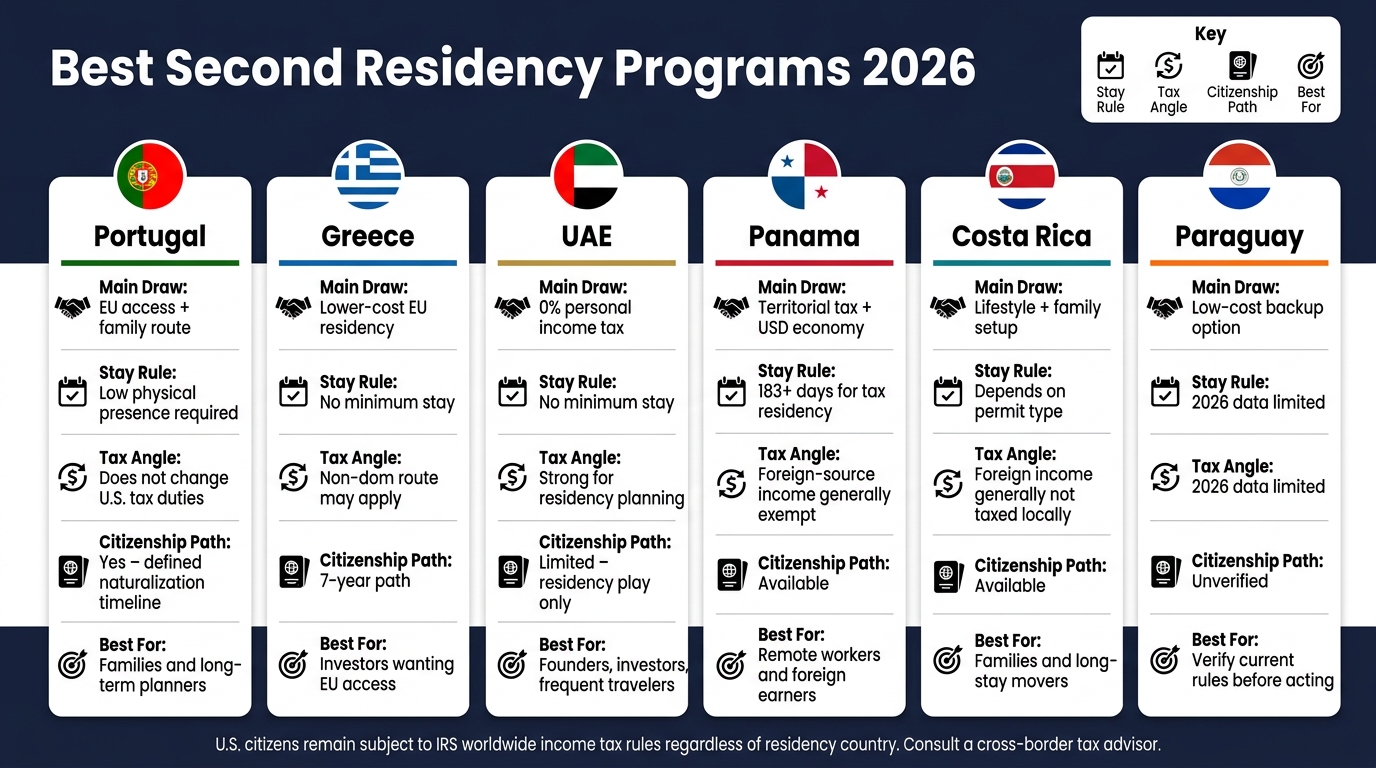
Best Second Residency Programs 2026: Side-by-Side Comparison
Quick Comparison
| Program | Main draw | Stay rule | Tax angle | Best fit |
|---|---|---|---|---|
| Portugal | EU access + family route | Low physical presence | Does not change U.S. tax duties | Families and long-term planners |
| Greece | Lower-cost EU residency | No minimum stay | Non-dom route may apply for some | Investors who want EU access |
| UAE | 0% personal income tax | No minimum stay | Strong for residency planning, not citizenship | Founders, investors, frequent travelers |
| Panama | Territorial tax + USD | Tax residency often tied to 183+ days | Foreign-source income usually outside local tax | Remote workers and foreign earners |
| Costa Rica | Lifestyle + family setup | Rule depends on permit type | Foreign income generally not taxed locally | Families and long-stay movers |
| Paraguay | Low-cost backup interest | 2026 data limited | 2026 data limited | People willing to verify rules first |
So if I were sorting these fast, I’d say:
- Pick Portugal for EU access and a known long-term route.
- Pick Greece if you want EU residency with less pressure to live there.
- Pick UAE if tax and mobility come first.
- Pick Panama if you earn abroad and want a territorial setup.
- Pick Costa Rica if family life matters more than pure tax math.
- Treat Paraguay as a case that needs current rule checks before acting.
That’s the core picture in 2026.
sbb-itb-39d39a6
1. Portugal Golden Visa
Portugal is still one of the top second residency choices in 2026, especially for people who want EU access, family inclusion, and a long-term path to residency.
What draws many applicants in? Two things stand out: the low physical presence requirement and a respected route to permanent residency and, later, citizenship. That combination makes Portugal a strong pick for families and investors who want a solid EU base, not just the fastest or cheapest residency option.
Put simply, this program tends to suit people who care about stability and access more than bargain pricing. The main issue to weigh is simple: do the investment cost and residency rules fit your mobility goals?
Tax treatment: For U.S. applicants seeking EU citizenship, Portugal can help with residency planning, but it does not change IRS worldwide-tax rules.
2. Greece Golden Visa
Greece offers one of the most accessible Golden Visa programs in the EU. That makes it a strong pick for investors who want European residency without the higher entry cost seen in many similar programs.
The program grants residency to non-EU nationals who meet the minimum investment threshold. In practice, real estate is still the most common route.
Here are the key details for 2026:
- Greece requires no minimum stay to keep residency status. That works well for investors and families who divide their time between countries.
- The program covers the main applicant and dependents, including a spouse and children. So it can work well for families too.
- Processing times have improved in recent years. Even so, applicants should still expect some administrative delays based on application volume and how complete the documents are.
Tax treatment is where people need to slow down and look closely. Greece does not automatically change U.S. tax duties. American applicants are still subject to IRS worldwide-income rules no matter where they hold residency. Greece does offer a non-dom tax regime for qualifying foreign-income earners, but any tax plan should be reviewed with a cross-border CPA who knows FATCA and CRS before you rely on it.
For readers who care most about EU access, low physical presence rules, and family coverage, Greece goes head-to-head with Portugal at a lower investment floor. The tradeoff is pretty clear: the path to citizenship is less established than Portugal’s more defined naturalization timeline.
The next option shifts away from EU access and toward faster, business-friendly residency in the UAE.
3. UAE Golden Visa
If your focus moves away from EU access and more toward tax efficiency and mobility, the UAE starts to look like a better match. The UAE Golden Visa pairs 0% personal income tax with no minimum stay requirement. For entrepreneurs and investors who want room to move and plan taxes with fewer limits, that setup is hard to ignore.
The property route calls for a minimum purchase of AED 2,000,000 in qualifying real estate, and that includes financed purchases. Applications are filed through ICP or the Dubai Land Department, and initial approval often comes through in 7 to 30 days.
One of the biggest draws is simple: you don’t need to spend any minimum number of days in the country to keep the residency valid. For people who travel often or split time across countries, that cuts out a common headache.
The tradeoff is pretty clear. The UAE works well as a residency option, but it has limited citizenship upside. In plain English, this is a residency play, not a naturalization path.
If you’re after a lower-cost route with a more territorial tax base, the next section turns to Panama.
4. Panama Residency Programs
Panama’s big draw is its territorial tax system. In plain English, Panama generally taxes only income earned inside Panama. For people who earn abroad, that can make life a lot simpler than dealing with places that tax global income or come with EU residency rules.
There’s another practical upside too: Panama uses the U.S. dollar and has a mature banking sector, which makes day-to-day money management easier for many international earners. Put together, Panama tends to work well for people who move around, want a territorial tax base, like the convenience of the U.S. dollar, and want a backup residence that’s fairly straightforward to use.
The two main paths to know are the Friendly Nations program and the Qualified Investor residency option. Friendly Nations is usually the faster and simpler route. Qualified Investor is the route for people bringing in more capital.
For tax residency, the general rule is spending more than 183 days per year in Panama. In practice, that status is usually backed up with records that show your day count, plus a local lease or property and DGI registration.
One point that’s easy to underestimate: Panamanian banks tend to run strict KYC, FATCA, and CRS checks. It’s smart to get your paperwork lined up before you apply, especially:
- source-of-funds records
- contracts
- tax filings
If Panama looks close to what you want, Costa Rica is usually the next lower-cost option worth putting side by side with it.
5. Costa Rica Investor and Rentista Residency
If Panama stands out for territorial taxation, Costa Rica offers a similar setup with more of a family-and-lifestyle feel. In 2026, the country’s Investor and Rentista options still look attractive, so it’s worth looking at the residency paths themselves a bit more closely.
Income earned outside Costa Rica is generally not taxed, which can help U.S. applicants with foreign-source income. Independent workers can also deduct 25% of gross income without receipts, which makes filing simpler. That said, there’s a tradeoff: expect tighter compliance rules and higher social security costs.
Where Costa Rica often pulls ahead is everyday life. It’s not just about tax treatment. The Investor and Rentista routes can work well for spouses and dependents, which matters if you’re planning a move as a household instead of as a solo applicant. Costa Rica’s healthcare system is also a big draw for families.
Costa Rica tends to suit applicants who want tax flexibility, room for family members, and a practical base for the long haul. For people who want a residency path with even less friction, Paraguay is the next country to compare.
6. Paraguay Permanent Residency
Verified 2026 data on moving to Paraguay is limited. Because of that, it can’t be ranked for investment, stay rules, processing time, citizenship, or tax treatment.
So for the next section, the comparison covers only the programs with verifiable 2026 data.
Pros and Cons by Program
This table lines up the six programs by the trade-offs that tend to matter most day to day: tax, mobility, family fit, and long-term residency value. If you want the short version, this is the fastest way to sort them by what matters in practice.
| Program | Biggest Advantages | Main Trade-Offs | Best For | Key Risks |
|---|---|---|---|---|
| Portugal Golden Visa | Strong infrastructure and family-friendly base cities | Tightening residency rules; major cities are expensive | Families and investors seeking EU access and a long-term residency path | Costs in Lisbon and Porto have risen sharply; look beyond the capital |
| Greece Golden Visa | 7-year citizenship path and tax incentives for qualifying residents | Documentation-heavy; minimum income requirement of €3,500/month | Lifestyle-first residents seeking a Mediterranean base and a clear citizenship timeline | Often requires a Greek bank account and extensive paperwork |
| UAE Golden Visa | 9% corporate tax in 2026; no minimum stay requirement | Limited citizenship upside; primarily a residency play | Business owners and entrepreneurs who need tax-efficient residency with full mobility | TRCs help support tax residency claims and reduce double-tax risk |
| Panama Residency | Territorial tax system: foreign-source income is generally exempt; USD economy | Strict banking KYC and FATCA/CRS compliance | Entrepreneurs and digital nomads with foreign income | Wrongly sourcing income or staying over 183 days can create local tax exposure |
| Costa Rica Residency | High quality of life and a slower pace; family-friendly with strong healthcare | Tighter compliance rules and higher social security costs | Families and remote workers seeking tax flexibility and a practical long-term base | Best suited to applicants who can meet income thresholds and manage compliance requirements |
| Paraguay Permanent Residency | Verified 2026 data is limited | Not rankable on cost, stay rules, processing, or tax | Readers who want a low-cost backup option | Treat as unverified until current rules are confirmed |
The core trade-off is pretty simple: less tax friction often means more compliance work.
Conclusion
There’s no one-size-fits-all program here. The right pick depends on cost, physical presence, tax treatment, and long-term mobility.
Portugal is a good match for people who want a steady EU base and a clear path to permanent residency. Greece fits applicants who care most about lifestyle and want a Mediterranean base with a route to citizenship. The UAE stands out for business owners who want residency with a tax and residency solutions. Panama can make sense for entrepreneurs and remote workers earning foreign income. Costa Rica appeals to people focused on quality of life and territorial taxation. Paraguay is better treated as a fallback, and only after you confirm the current rules.
Before you move forward, map out where your income comes from and check your 12-month day count against any physical-presence rules.
Residency only works when it fits into the bigger picture. Your choice should line up with your tax structure, asset protection plan, and long-term citizenship goals before you apply. A cross-border tax advisor can help you avoid exit tax exposure, income misclassification, and compliance gaps.
FAQs
Which residency is best for U.S. citizens?
There’s no single best residency for all U.S. citizens. The right pick comes down to your goals, the way you want to live, your tax setup, and how much you’re ready to invest.
If your main focus is tax planning, Panama and Paraguay often rise to the top. If you care more about lifestyle and access to the EU, Portugal is a strong choice. And if you want a zero-tax setting paired with solid business infrastructure, the UAE stands out.
One big catch: U.S. citizens still owe U.S. tax on worldwide income. So even if a country looks great on paper, cross-border tax advice isn’t optional. It’s a smart move before you make anything official.
How do I choose between residency and tax residency?
Residency is your legal right to live in a country. Tax residency decides where you owe taxes. Those two things can line up, but they don’t have to. You might have residency in one country and tax residency somewhere else.
The right choice depends on what you want.
- Pick residency if your main goal is to live, work, or retire in a country.
- Focus on tax residency if you’re thinking about your fiscal home, tax treaties, and possible relief from double taxation.
A lot of people try to line up both, since that can make life simpler.
Which program offers the easiest citizenship path?
For people who move across borders, Portugal offers a direct path to naturalization after five years of residency. Its Golden Visa program is well known for offering a dependable route to citizenship within that period.
By contrast, Panama usually asks for five years of permanent residency before someone can apply for citizenship, although that wait can drop to three years for some nationalities. Paraguay allows naturalization after three years of permanent residency.