
If I had to boil it down fast: Mexico is my best overall pick for 2026, Panama is my tax-and-residency pick, Uruguay is my stability pick, Costa Rica is my lifestyle pick, Colombia is my low-cost city pick, and Paraguay is my tax-first pick.
If you’re thinking about moving to Latin America, these are the six countries I’d focus on. The big factors are simple:
- Monthly cost: from about $1,500 to $3,500
- Safety: varies a lot by country and city
- Residency and taxes: some places tax only local income
- Healthcare and internet: strong in some hubs, weaker in others
Here’s the short take:
- Mexico: best mix of price, access to the U.S., and easy day-to-day living
- Panama: best for retirees and people who want a U.S. dollar setup
- Costa Rica: best for families, green space, and public healthcare access
- Uruguay: best for stable rules and a more settled feel
- Colombia: best for city life on a lower budget
- Paraguay: best for low taxes, but with more trade-offs in daily life
Quick Comparison
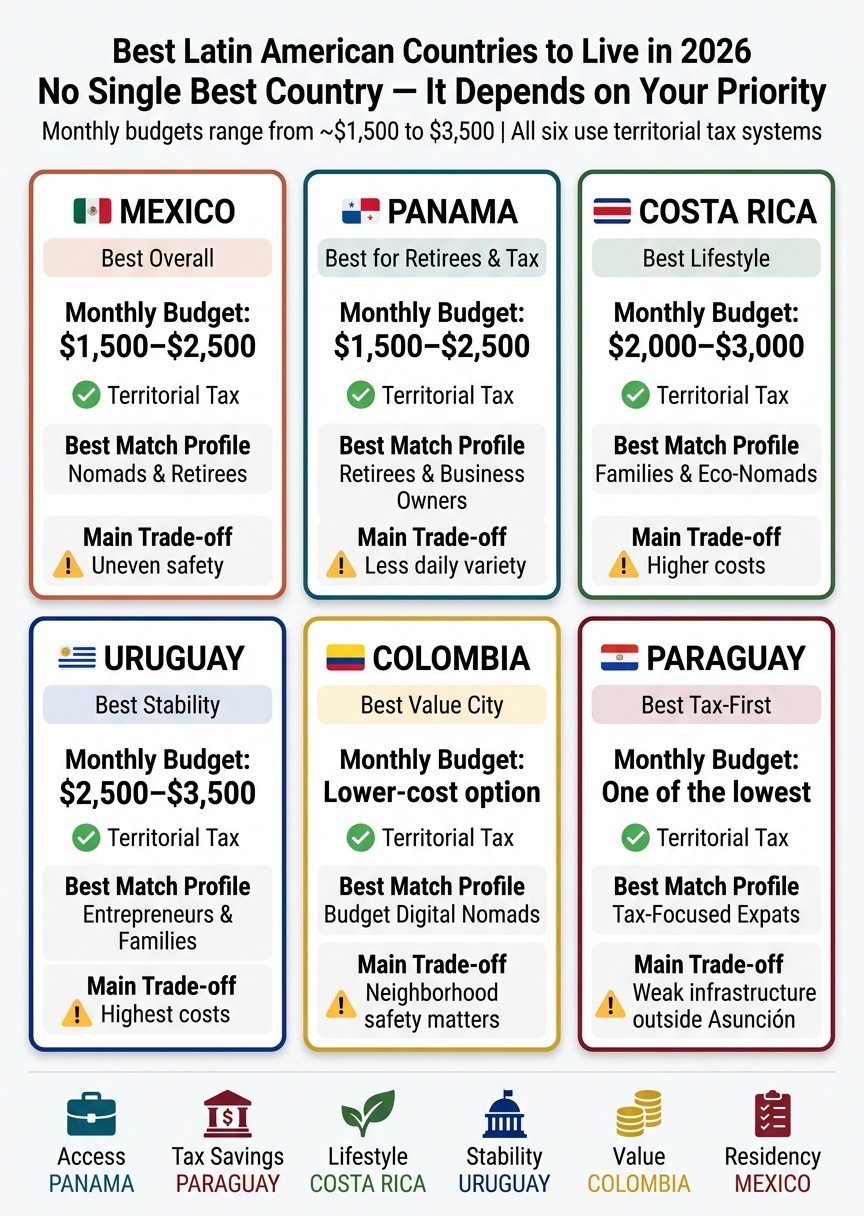
| Country | Typical monthly budget | Best fit | Main trade-off |
|---|---|---|---|
| Mexico | $1,500–$2,500 | Nomads, retirees | Safety depends a lot on area |
| Panama | $1,500–$2,500 | Retirees, business owners | Less day-to-day variety |
| Costa Rica | $2,000–$3,000 | Families, nature-first movers | Higher prices |
| Uruguay | $2,500–$3,500 | Families, professionals | Highest costs on this list |
| Colombia | Lower-cost city option | Nomads, startup-minded movers | Neighborhood choice matters a lot |
| Paraguay | One of the lowest | Tax-focused expats | Weaker healthcare and infrastructure outside Asunción |
What stands out to me is how different the trade-offs are. There’s no single “best” country for everyone. If you want to stay close to the U.S., I’d lean Mexico. If you care most about tax treatment, I’d look at Panama or Paraguay. If you want calmer politics and steadier rules, I’d put Uruguay near the top.
And before making any move, I’d double-check visa rules, tax residency rules, and healthcare access for your exact case, since those can change from one year to the next.
sbb-itb-39d39a6
1. Mexico
Mexico is often the simplest Latin American base for Americans. Flights are short, and the time-zone gap is usually small, which makes work and family calls a lot easier.
Cost of Living
In Mexico City, Playa del Carmen, or Oaxaca, a comfortable lifestyle usually runs about $1,500 to $2,500 per month. If you want a place that costs less and feels less crowded, Puebla is a strong option. It also has a growing nomad scene.
"Their money has more value here. Properties are cheaper, and they can live a better life." – Milly Arceo, Consultant, Legally in Mexico
Safety and Stability
Safety depends a lot on the area. In major expat neighborhoods, it’s smarter to use Uber or other app-based rides instead of hailing street taxis.
Residency and Taxes
Mexico has simple entry rules and clear residency paths. For many people, that removes a lot of friction at the start.
Foreign-source income is usually not taxed unless you become a tax resident. Property taxes are low, and Mexico does not have an inheritance tax. That said, you need to track your days in the country so you don’t drift into tax residency by accident.
Healthcare and Infrastructure
For faster service and newer facilities, most people use private healthcare. IMSS is still an option for eligible residents.
In Mexico City and other big hubs, internet is strong and coworking spaces are easy to find.
Next, Panama shifts the focus from access to infrastructure and residency structure.
2. Panama
Panama is a strong pick for U.S. readers who want to budget in U.S. dollars, stay close to the United States, follow a clear residency route, and use a territorial tax system.
Cost of Living
A comfortable life in Panama usually costs about $1,500 to $2,500 per month. That puts it in roughly the same range as Mexico and below Costa Rica.
Safety and Stability
Panama’s main edge in 2026 is consistency. Its residency rules have stayed stable, which makes long-term planning a lot easier.
Residency and Taxes
Panama’s Pensionado visa is one of the easier residency options in the region. You need a lifetime pension of at least $1,000 per month, plus $250 per month for each dependent. It also gives you permanent residency and discounts on healthcare, dining, utilities, and travel.
Panama taxes only Panama-sourced income. Foreign income, including pensions and remote work for foreign clients, is generally exempt. That’s a big draw for people who want a simpler setup on the tax side. Even so, opening a local account can still mean strict KYC and FATCA/CRS checks.
Healthcare and Infrastructure
Private healthcare in Panama is excellent and costs less than similar care in the U.S.. The country also has modern infrastructure and a well-established expat base, which makes day-to-day life easier for retirees and remote workers.
If those points line up with what you want, Costa Rica is the next country to look at for readers who put more weight on lifestyle and healthcare.
3. Costa Rica
Costa Rica costs more than Mexico or Panama, but that higher price comes with a different kind of appeal. It leans hard into a nature-first lifestyle, tropical weather, and universal healthcare. For readers who want a peaceful base with more green space and less chaos, Costa Rica often lands near the top of the list.
Cost of Living
A comfortable life in Costa Rica usually costs $2,000 to $3,000 per month. Part of that higher monthly spend comes from strong demand among expats who are drawn to the lifestyle.
If you’re trying to spend less, it helps to look past the main expat hubs. In many cases, you can find places with a similar day-to-day feel at a lower price point.
Safety and Stability
Costa Rica has a calm, low-key feel that many long-term residents like. It’s a good match for people who want a stable, nature-focused home base without the noise and pace of bigger urban areas.
Residency and Taxes
Costa Rica has two residency paths that stand out here. The pensioner visa is meant for retirees with steady pension income, while the Digital Nomad visa is geared toward remote workers.
On taxes, Costa Rica uses a territorial system. That means foreign-sourced income is not taxed, including pensions, offshore business profits, and investments.
Healthcare and Infrastructure
Residents can use Caja, Costa Rica’s universal public healthcare system, for public care, and many also pair it with private insurance to get faster access to specialists. That setup makes Costa Rica a strong pick for readers who care more about access and quality than getting the lowest monthly cost.
The country is also putting money into high-speed internet and weather-resistant infrastructure. For remote workers, that can make daily life a lot smoother, especially if they want a slower pace and greener surroundings.
Uruguay offers a very different profile: less tropical, more structured, and better suited to readers who prioritize stability over lifestyle.
4. Uruguay
Uruguay is the quieter, more structured pick on this list. It has a strong name for political stability and rules that don’t change on a whim. It stands out for predictability, not low cost. If you’d rather pay more and deal with fewer surprises, Uruguay is the clearest match.
Cost of Living
A comfortable lifestyle in Uruguay usually costs $2,500 to $3,500 per month, which puts it near the high end of this comparison. You’re paying for stronger institutions, better infrastructure, and a steadier policy climate than much of the region.
Safety and Stability
Uruguay’s biggest edge is stability. In 2026, it remains a low-risk destination with steady policies. While Mexico is cracking down on "perpetual tourists" and Costa Rica has added stricter income verification, Uruguay has kept its rules consistent and welcoming.
That kind of predictability matters. If you’re planning a long-term move, not just testing the waters for a few months, stable rules can make day-to-day life much easier.
Residency and Taxes
Uruguay’s residency process follows standard procedures and avoids the tighter income checks that are now more common in other parts of the region. Its territorial tax system also works in favor of many expats.
In plain English, foreign-sourced income is generally not taxed locally. That often includes:
- Pensions
- Offshore business income
- Remote work for foreign clients
Healthcare and Infrastructure
Healthcare is solid for the region, with both public and private options open to residents. Montevideo also offers strong internet connectivity and a growing entrepreneurial community. That makes it a practical base for remote workers and professionals who want urban infrastructure without the nonstop pace of bigger regional capitals.
Colombia shifts the focus from stability to value and energy.
5. Colombia
If Uruguay is the stability pick, Colombia is the lower-cost urban option. Colombia is the value play. You get lower day-to-day costs, solid city infrastructure, and a digital nomad opportunities in Latin America that are easy to understand. For 2026, it sits between Panama’s structure and Costa Rica’s lifestyle, with both energy and affordability in the mix.
Cost of Living
Colombia tends to cost less than many nearby countries, but it still gives you what most long-stay remote workers want: modern coworking spaces, dependable high-speed internet, and a growing international crowd.
Safety and Stability
Safety depends a lot on the neighborhood. In cities, use registered transport and keep valuables out of sight.
Medellín is still the main expat hub, with strong internet and a busy startup scene.
Residency and Taxes
Colombia’s digital nomad visa calls for proof of $12,240 in annual foreign-sourced income – about $1,020 per month – and allows stays of 6 to 24 months. In 2026, Colombia uses digital tracking to watch length of stay and possible tax duties. Bring clear income records and contract documents.
Healthcare and Infrastructure
Colombia’s larger hubs have the setup long-stay residents usually need: high-speed internet, access to international airports, and a solid nomad presence. That puts Colombia in a useful middle spot between lower costs and city convenience.
Paraguay goes in a different direction: easier residency and simpler tax exposure.
6. Paraguay
After Colombia’s value angle, Paraguay leans even harder into low costs and tax savings. The trade-off is pretty clear: you spend less, but you also get weaker infrastructure and a smaller expat scene.
Cost of Living
Paraguay is one of the most affordable countries in Latin America. Daily expenses are lower than in Mexico or Panama, which makes it a solid base for people who want their money to go further.
Safety and Stability
Paraguay ranked 73rd on the 2024 Global Peace Index and is considered the 5th safest country in South America. That said, petty theft is still common in urban areas like Asunción. It helps to stay in safer neighborhoods such as Villa Morra, Carmelitas, and Recoleta.
Some places are best skipped. Border cities like Ciudad del Este and Pedro Juan Caballero are worth avoiding due to smuggling and illicit trade.
Residency and Taxes
For expats, Paraguay’s biggest draw is tax treatment. The country uses a territorial tax system, which means foreign-sourced income, including offshore business profits, dividends, and investments, is taxed at 0%.
Residency is still within reach, but the process changed in October 2022. Paraguay shifted from fast-track permanent residency to a two-step path. Applicants now need two years of temporary residency before they can apply for permanent status. You also need to show financial solvency, such as employment income, a pension, or investment returns.
"While the process has become stricter, Paraguay remains one of the most accessible countries for obtaining legal residency in South America." – Bobby Casey, Managing Director, GWP
Healthcare and Infrastructure
Public healthcare is limited and overcrowded, so private insurance is the practical option. Coverage usually costs $50 to $150 per month. Doctor visits run about $20 to $50, and emergency room visits usually fall between $50 and $100.
Top private hospitals in Asunción include:
Outside the capital, daily life can get harder. Roads may be poorly maintained, rural areas can have power outages, and public transportation is unreliable. Spanish is also a must outside higher-level business environments. For many readers, that’s the core trade-off: lower taxes and lower costs versus an easier day-to-day setup.
Pros and Cons of Each Country
Each country fits a different kind of life. This section helps you line up each option with what you care about most, then compare that with the final picks below.
Mexico makes the most sense if you want flexibility and easy access to the U.S. The downside is pretty clear: safety varies a lot by region, and enforcement against long-term tourist visa stays is tighter in 2026.
Panama works well for retirees who want a simple setup built around the U.S. dollar. The trade-off is that day-to-day life can feel a bit less varied than in Mexico.
Costa Rica fits people who put lifestyle ahead of cost. It’s a strong pick if you want nature and comfort more than speed.
Uruguay is the steadiest option of the group, but you pay for that. Costs run higher, and the expat scene is smaller.
Colombia is a good fit for urban nomads watching their budget. Here, picking the right neighborhood matters more than it does in the other countries, and tighter digital tax tracking is a real issue in 2026.
Paraguay stands out for taxes. Foreign-earned income is tax-free under its territorial system. The catch is weaker infrastructure outside Asunción, and that’s the price many people feel day to day.
The table below turns those trade-offs into a quick side-by-side guide.
| Country | Biggest Advantages | Main Drawbacks | Best Match Profile |
|---|---|---|---|
| Mexico | Flexibility, U.S.-adjacent base | Uneven safety, stricter visa enforcement | Nomads and retirees |
| Panama | Dollar economy, retiree discounts | Less variety in daily life | Retirees and stability-seekers |
| Costa Rica | Eco-lifestyle, high quality of life | Higher costs, slower bureaucracy | Families and eco-conscious nomads |
| Uruguay | Political stability, modern infrastructure | High costs, smaller expat scene | Entrepreneurs and families |
| Colombia | Strong value, vibrant city energy | Neighborhood safety, digital tax tracking | Budget-conscious digital nomads |
| Paraguay | Tax-free foreign income, low overhead | Weak infrastructure outside Asunción | Tax-focused entrepreneurs |
Next, the final picks rank each country by priority.
Final Picks: Best Latin American Country by Priority
Here’s the short version.
Each country comes out on top for a different reason.
Mexico is the best overall pick for 2026 because it offers the best mix of digital nomad visas, cost, and flexibility.
Panama is the clearest residency-and-tax play. It’s a strong fit for retirees and professionals who want a simpler setup.
Uruguay works best for people who put stability first, especially families.
Costa Rica stands out most on lifestyle.
Colombia is the best value pick.
Paraguay is the tax-first option. It fits tax-focused expats who are willing to give up some infrastructure in exchange for lower costs.
Verify current immigration and tax rules before moving.
FAQs
Which country is best for digital nomads in 2026?
Panama is the best overall pick for digital nomads in 2026. It pairs a territorial tax system – where foreign-sourced income is generally exempt if you qualify as a tax resident – with clear residency rules and the convenience of U.S. dollar banking.
It’s a strong fit for remote professionals and entrepreneurs who serve clients outside Panama and want predictable tax treatment with a stable base in Latin America.
How do tax residency rules affect expats in Latin America?
Tax residency rules decide whether expats owe local taxes. And here’s the part that trips people up: tax residency is often separate from legal residency.
So even if you have permission to live in a country, that doesn’t automatically mean you’re treated as a tax resident there. The reverse can also happen.
In places like Panama, Paraguay, and Costa Rica, territorial tax systems generally tax only locally earned income, not foreign-source income. That’s a big deal for people who earn money from abroad.
In many cases, qualifying means spending more than 183 days a year in the country. But day count isn’t the whole story. Some countries also look at where your economic center of interest is or where your family center of interest is.
That’s why paperwork matters. Proper documentation and a Tax Identification Number are both important if you want your status handled the right way.
What should I check before moving to one of these countries?
Before you move, take care of the legal, financial, and personal basics with care. Start by pulling together your key documents early. Get them apostilled and translated, then check residency rules, investment minimums, and tax duties.
You’ll also want to confirm how healthcare works, what emergency services are available, and what kind of insurance you may need. Keep close track of your physical presence, save clean records of travel and income, and spend some time learning local customs and the language if needed.
A little prep here can save you a major headache later.
