
If I had to sum up Uruguay in one line, I’d say this: you move there for stability, not for cheap living.
If you’re a U.S. expat looking at Uruguay, the main points are simple:
- Foreign-sourced income is generally not taxed
- New tax residents may get a 0% rate on foreign investment income for up to 11 years
- Monthly living costs often start around $1,500 to $2,200 for one person in Montevideo
- Families often need $4,000 to $6,000+
- Montevideo fits full-time life better
- Punta del Este costs more and works better as a beach base
- Healthcare, banking, and property rules are steady by regional standards
- Spanish matters for normal daily life
So if you want a calm, orderly base with clear rules, Uruguay can make sense. If your top goal is stretching every dollar, it may not.
Quick Comparison
| Topic | What I’d keep in mind |
|---|---|
| Taxes | Uruguay usually taxes local income, not foreign-sourced income |
| Tax break | New residents may get 0% on foreign investment income for up to 11 years |
| Single budget | About $1,500–$2,200/month in Montevideo |
| Couple budget | About $2,500–$3,500/month |
| Family budget | About $4,000–$6,000+/month |
| Best city for full-time living | Montevideo |
| Best city for beach lifestyle | Punta del Este |
| Housing | Foreigners can buy property without limits |
| Healthcare | Best private care is mainly in Montevideo and Punta del Este |
| Main downside | Higher costs, slow paperwork, and a small job market |
What I like about Uruguay is that the pitch is simple: you pay more than in many parts of Latin America, but you often get a calmer day-to-day life in return. That’s the tradeoff.
sbb-itb-39d39a6
Residency, legal rights, and taxes for foreigners
Main residency pathways and how they work in practice
Uruguay’s residency process matters because it sets the point when you may become a tax resident and shapes how your income is taxed. For most expats, that’s the first practical hurdle. If you’re planning a move, you need to understand both residency and tax residency before you relocate, especially if you want to use Uruguay’s territorial tax rules. For retirees, remote founders, and mobile families, that can mean the difference between a smooth move and a costly mistake.
Property rights, contracts, and legal predictability
Uruguay offers strong legal certainty, with enforceable contracts and well-established property rights that hold up in practice. That matters most when you’re signing a lease, buying a home, or moving money into the country. In plain English: the rules are generally clear, and they tend to work the way they’re supposed to.
How Uruguay taxes residents and what expats should review before moving
Under Uruguay’s territorial tax rules, foreign-sourced income is generally not taxed. New tax residents can also get a 0% rate on foreign-sourced investment income for up to 11 years. That’s a big reason Uruguay stands out for people who want a simpler, more predictable base.
Before moving, review Uruguay’s residency-trigger rules and check whether you’d still have tax filing duties in your home country. A move can look simple on paper, but cross-border tax rules often have a sting in the tail.
Once the tax picture is clear, the next question is what everyday life actually costs in Montevideo and Punta del Este.
Cost of living, housing, and daily life in Montevideo and Punta del Este
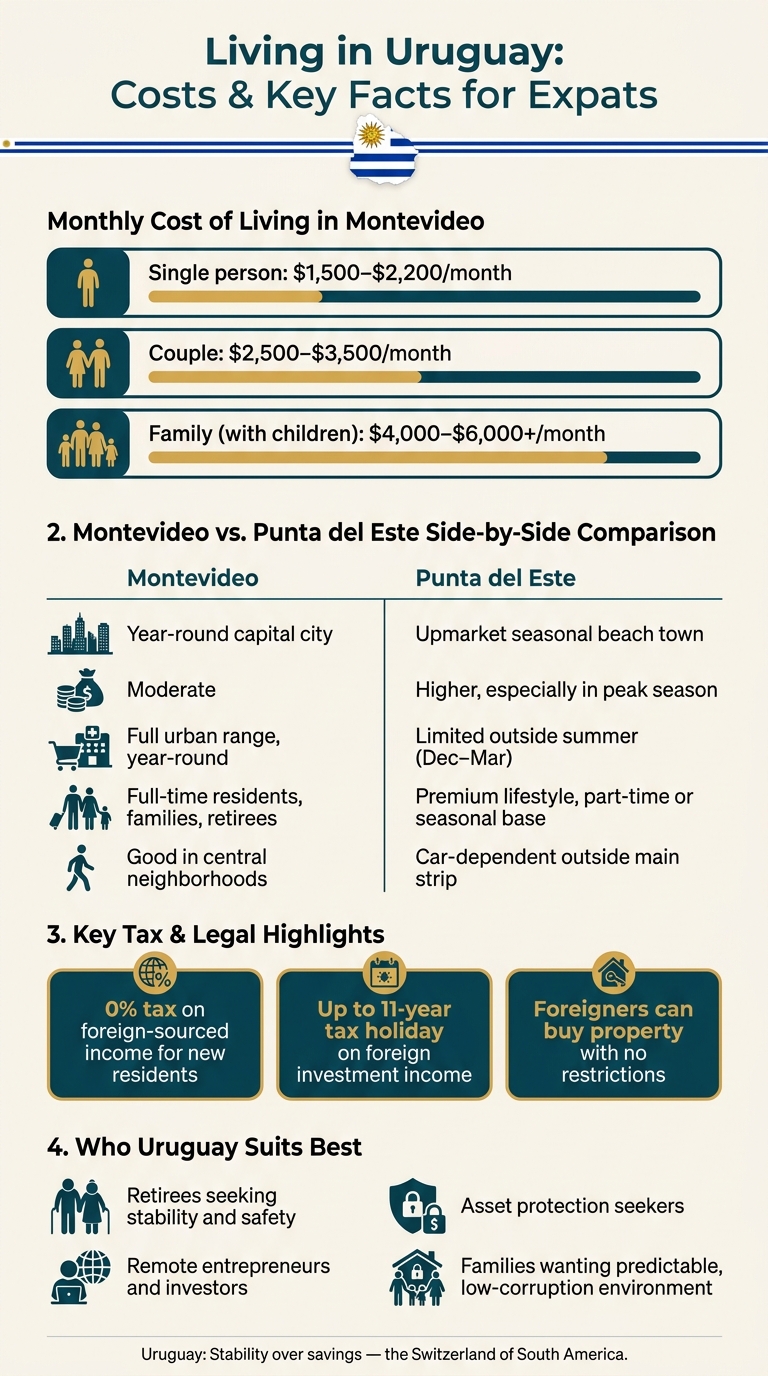
Typical monthly costs for singles, couples, and families
Once residency and taxes are sorted, the next thing most people want to know is simple: what does day-to-day life cost? Uruguay feels comfortable, organized, and city-friendly by regional standards. But it’s not a low-cost place by Latin American standards.
A single person living modestly in Montevideo will usually spend about $1,500–$2,200 per month on rent, food, transport, and utilities. Couples often fall into the $2,500–$3,500 range. Families with children, especially if private school and a larger apartment are part of the plan, often need $4,000–$6,000 or more.
Punta del Este is pricier across the board, and housing is where that gap tends to hit hardest.
Renting versus buying and what housing stock looks like
Housing quality can vary, but many expats say newer apartments and well-kept homes are solid by regional standards. In Montevideo, the rental market is broad. You can find older apartments with more character in areas like Pocitos and Punta Carretas, along with newer buildings that come with modern finishes.
Punta del Este works a bit differently. The market is more seasonal and more premium-priced. Inventory gets much tighter during the Southern Hemisphere summer, from December through March, then tends to loosen up during the rest of the year.
For expats thinking about renting for the long haul or buying a place as a steady base, Uruguay has one big plus: the rules are clear. Leases are enforceable. Property purchases follow set legal procedures. And foreign buyers can own property without restrictions.
That contrast stands out when you look at the two markets side by side. Montevideo runs as a year-round urban market. Punta del Este leans more seasonal and higher-end.
Montevideo vs. Punta del Este: which base fits your goals
These two cities meet very different expat needs, and the cost gap is part of that.
Montevideo is a busy capital that runs all year. It has the full set of urban services: hospitals, international schools, government offices, supermarkets, and public transport. Central neighborhoods are fairly walkable, and day-to-day costs are lower than in Punta del Este. For people living in Uruguay full time, it’s usually the more practical choice.
Punta del Este is more of an upmarket beach town with a strong seasonal rhythm. It draws a wealthier, more international crowd. Rents are higher. Restaurants cost more. The social scene is at its peak in summer. Outside high season, services thin out, and some businesses cut hours or close for part of the year. It tends to fit expats who want a premium coastal setup and can handle the higher spend, or people splitting time between Uruguay and another country.
| Factor | Montevideo | Punta del Este |
|---|---|---|
| Character | Busy, year-round capital city | Upmarket, seasonal beach town |
| Cost level | Moderate by Uruguayan standards | Higher, especially in peak season |
| Service access | Full urban range, year-round | More limited outside summer months |
| Best fit | Full-time residents, families, retirees | Premium lifestyle, part-time or seasonal base |
| Walkability | Good in central neighborhoods | Car-dependent outside the main strip |
Once housing and costs are clear, the next issue is whether the country’s healthcare, safety, and banking actually work smoothly for expats.
Healthcare, safety, banking, and quality of life
How healthcare works for expats
Uruguay offers strong private care, with the best private options centered in Montevideo and Punta del Este. If you want the broadest access to specialists, those are the places to look first. That tends to matter most for retirees and families who want care they can count on without a lot of guesswork.
Safety, social norms, and everyday comfort
That same stability carries into daily life. Expats often run into fewer surprises with paperwork, contracts, and public services. In plain terms, routine tasks usually come with less hassle. And that kind of predictability shapes how comfortable everyday life feels.
Banking access and Uruguay’s safe-harbor reputation
Uruguay’s banking reputation is one of the clearest reasons people compare it to Switzerland. Banks tend to be conservative and heavily focused on compliance. If you’re applying as a foreigner, expect to provide proof of income, source-of-funds documents, and residency paperwork. For expats who care a lot about financial stability, that mix helps explain the country’s appeal.
That setup fits some expats better than others.
Who Uruguay suits best and the main tradeoffs to weigh
Once the costs and logistics are clear, the next step is simple: does Uruguay fit the life you want?
Best-fit expat profiles
Uruguay tends to work best for expats who care more about stability, predictability, and capital protection than bargain-level living costs. In practical terms, that often means fewer unpleasant surprises with paperwork, public services, and long-range planning.
Retirees are often drawn to the calm pace, safety, and dependable services. Remote entrepreneurs and investors may like Uruguay’s territorial tax regime, which generally does not tax foreign income. People who want to protect assets often look at the country’s enforceable legal framework and stable institutions. Families and long-term residents also tend to like the orderly feel of daily life and the sense that rules are clear and usually stay that way.
Uruguay’s draw is not low prices. It’s stability, safety, and day-to-day reliability. If you want a steady base in a politically stable setting, Uruguay makes a strong case. If your main goal is making every dollar go as far as possible, it likely won’t be the right match.
Main drawbacks and decision points before relocating
Those upsides come with tradeoffs. Uruguay is a small country, so the job market is narrower and bureaucracy can move at a slow pace. And while you can get by in some circles without it, Spanish is a must for normal life, whether you’re dealing with a landlord or sorting out government paperwork.
| Advantage | Tradeoff |
|---|---|
| 0% tax on foreign-sourced income | Local income is taxed at standard rates |
| 10 to 11-year tax holiday for new residents | Slow bureaucracy and administrative pace |
| Strong institutional stability | Small economy with fewer job and business options |
| Strong private healthcare, but at a premium | Higher costs in top neighborhoods and resort areas |
| Clear legal protections for property and contracts | Spanish is needed for most daily interactions |
Conclusion: Uruguay as a residence and wealth-preservation base
That tradeoff is the whole idea. Uruguay doesn’t win on price. It wins on stability, legal predictability, and quality of life. For expats whose top goal is protecting capital, keeping a steady home base, or raising a family in a low-corruption setting, there’s a lot here to like.
If you want certainty more than cheap living, Uruguay should be near the top of your list.
FAQs
How hard is it to get residency in Uruguay?
Getting residency in Uruguay is often seen as fairly straightforward for foreigners who want a stable place to live. The country has clear legal paths and a predictable system for setting up legal status.
That said, you still need to follow the required government steps. Even so, Uruguay’s institutional stability and relatively transparent administration can make the process feel more reliable and easier to handle.
Will I still owe U.S. taxes if I move to Uruguay?
Yes. The United States uses citizenship-based taxation. That means U.S. citizens and permanent residents generally need to file a tax return with the IRS every year, no matter where they live or where their income comes from.
Uruguay’s territorial tax system doesn’t cancel out your U.S. federal tax duties. In plain English: even if Uruguay taxes only certain income tied to Uruguay, the IRS still expects you to file.
That said, filing doesn’t always mean you’ll owe the same tax twice. A tax professional can help you figure out whether tools like the Foreign Earned Income Exclusion or the Foreign Tax Credit can lower double taxation.
Is Uruguay a good fit for full-time family life?
Yes. Uruguay is a strong choice for full-time family life. The country offers political and legal stability, a high level of safety, and a strong quality of life.
For families, that matters day to day. It means a more predictable place to live, plan, and settle for the long haul.
There’s also modern private healthcare, which adds peace of mind for parents thinking beyond the short term. And the lifestyle options are broad enough to fit different kinds of families. Some may prefer Montevideo for its urban feel, schools, and city conveniences. Others may lean toward Punta del Este for a more exclusive setting and a different pace of life.
Either way, Uruguay gives families a secure and predictable environment for long-term residency.
