
The short answer: don’t wait until there’s a problem. I’d set up a backup residency before banking limits, tax issues, or travel rules start closing doors.
Here’s the core of it:
- I’d first decide what the residency is for: mobility, family access, banking, tax planning, or a full move
- Then I’d match that goal to the right path: income-based, investment, business, digital nomad visas, or ancestry
- After that, I’d filter countries by cost, time in country, family rules, and tax risk
- Then I’d build the document file early, because apostilles, police checks, and translations often take 90 days to 12 months in harder cases
A few numbers stand out:
- Portugal D7: from about €920/month in income
- Costa Rica Pensionado: $1,000/month pension
- Costa Rica Rentista: $2,500/month income or $60,000 deposit
- Paraguay: about $4,500 deposit or $1,500/month income
- Panama Pensionado: $1,000/month pension, plus dependent add-ons
- Spain Digital Nomad: about €2,646 to €2,850/month
- Italy Digital Nomad: about €2,065/month
What I take from this article is simple: a Plan B residency is not citizenship, and it’s not a panic move. It’s a legal way to enter, stay, renew, and often bring family with you. That alone can buy time and options.
Quick Comparison
| Path | Best for | Main tradeoff | Time in country | Long-term direction |
|---|---|---|---|---|
| Income-based residency | Retirees or passive-income earners | Must show steady income | Low to medium, depends on country | Can lead to long-term residence |
| Residency by investment | People with more capital | Higher upfront cost | Often low | Often leads to permanent residence later |
| Business/entrepreneur visa | Founders and operators | More filings and local setup | Medium | Depends on local rules |
| Digital nomad visa | Remote workers | Often more short-term | Often higher | Usually renewable, not always permanent |
| Ancestry route | People with family ties | Paperwork can be hard | Varies | In some cases, direct path to citizenship |
If I were using this guide, I’d treat it as a filter: pick the job the residency must do, cut the paths that don’t fit, shortlist countries, then start paperwork early.
sbb-itb-39d39a6
Define what you need your Plan B residency to do
Before you compare countries, get clear on the job your residency needs to do.
A good Plan B should lower the specific risk you’re trying to guard against, whether that’s banking access, tax exposure, mobility, or family continuity. And here’s the catch: not every program handles all four equally well. That gives you a simple filter before you start weighing countries, visas, and investment minimums.
Rank your non-negotiables before comparing countries
Start by writing down the situations you want protection from. Then rank each one as a must-have, nice-to-have, or optional.
The most common filters include:
- How fast you need approval
- Whether your spouse and children can be included
- How many days per year you can realistically spend in the country
- Whether you need work rights
- Whether the permit is likely to trigger local tax residency
Tax exposure needs extra care. Many countries use day-count rules or a center-of-vital-interests test to decide tax residency. So if a residency requires long stays, it can pull you into local tax obligations by accident.
For U.S. citizens, that doesn’t change worldwide U.S. tax liability. But it can still affect your full tax picture, banking, and reporting.
Travel flexibility matters too. A useful Plan B residency should let you re-enter with confidence and, ideally, stay active with very little time on the ground. Some programs ask for only a short visit every year or two. Others are built more like full relocation permits and come with heavier presence rules.
Those are very different tools. The right fit depends on what you want:
- A backup base
- A semi-permanent home
- A full move
It also helps to separate temporary, renewable, and permanent residence.
Temporary status gives you stay rights for a limited period. Renewable status can be extended if you keep meeting the rules. Permanent residence is more durable, which makes it better suited to a long-term backup plan.
Match the right residency path to your assets, family, and business
A practical way to narrow your options is to match the residency type to your finances, income source, and timing.
A remote business owner usually needs low physical presence rules, work rights for foreign or remote income, and broad mobility. In many cases, a digital nomad visa or entrepreneur visa is the best fit. It depends on whether you want a lighter backup option or a path toward a more established local foothold.
A retiree with passive income usually needs proof of steady income, access to healthcare, and stable renewal terms. That often points to income-based or retirement-style programs built around foreign pensions, dividends, or investment income.
An investor with substantial capital can look at residency-by-investment programs. These are often the fastest route to a durable backup option and may lead to permanent residence or citizenship over time. For this profile, the big questions are simple: how much capital you want to commit, whether the investment has an exit path, and how fast the program can turn into stronger long-term status.
| Profile | Best-fit residency type | Typical approval timeline |
|---|---|---|
| Remote business owner | Digital nomad or entrepreneur visa | Fast, often within a few months |
| Retiree with passive income | Income-based or retirement visa | Usually a few months |
| Investor with capital | Residency by investment | Often 3 to 12+ months |
If you only qualify for a temporary or renewable permit right now, that doesn’t mean you’re stuck. You can use it as a bridge to permanent residence later. With that profile in place, you can start comparing the main residency paths.
The main residency paths and how they compare
Once your priorities are clear, the next move is picking the residency path that matches the amount of capital, time, and physical presence you can actually put in. For most Plan B cases, four routes do the heavy lifting: residency by investment, entrepreneur or business visas, digital nomad visas, and ancestry-based residency.
Each one comes with its own price tag, paperwork burden, and long-term upside. The key isn’t choosing the option that sounds best on paper. It’s choosing the one that fits your actual limits.
Residency by investment and entrepreneur visas
Residency by investment (RBI) is the most capital-heavy path, but it’s also one of the easiest to maintain. In most cases, you make a qualifying investment and meet only limited in-country presence rules.
For a contingency plan, that mix matters. You get a durable legal status without turning your life upside down, plus a clear route toward permanent residence or citizenship over time.
Entrepreneur and business visas sit in the middle. They usually cost less up front than RBI programs, but they ask more from you after approval. In most cases, you’ll need to:
- Form a local company
- Open a local bank account
- Keep up with filings and contributions
These routes make sense if you want a real business base in the country. But they do come with active compliance and more hands-on involvement.
Digital nomad visas and ancestry-based options
Digital nomad visas are often the fastest and cheapest way in for remote workers. They work best when your income isn’t tied to one place and your goal is flexibility, not a long-lasting fallback.
That’s the trade-off: you get easier entry, but usually with higher presence requirements and a shorter time horizon than investment or ancestry routes.
Ancestry-based residency can be the lowest-cost long-term option if you have qualifying family ties. The hard part is usually not the application itself. It’s proving the line of descent with authenticated records.
| Path | Best for | Cost profile | Time in country | Long-term outcome |
|---|---|---|---|---|
| Residency by investment | Hands-off backup plan | High capital | Low | Strong path to permanent residence or citizenship |
| Entrepreneur/business visa | Business foothold | Lower up front, higher compliance | Moderate | Depends on the program |
| Digital nomad visa | Remote workers | Income-test based | High | Usually temporary |
| Ancestry-based | Eligible lineage | Low legal/document fees | Varies | Can lead directly to citizenship |
Use this comparison to rule out paths that don’t match your budget, timeline, or travel pattern before you start comparing countries.
How to choose a country that fits your contingency plan
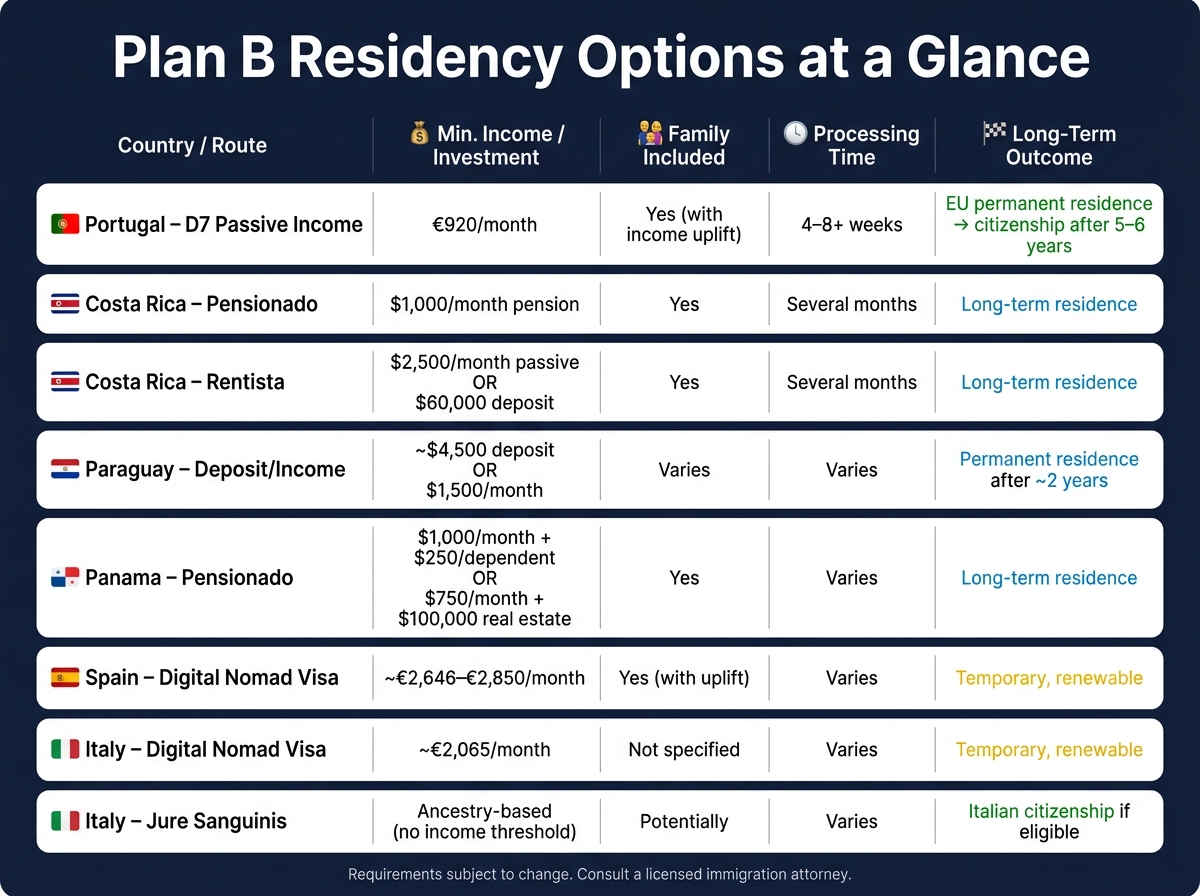
Start with your non-negotiables. That cuts the list down fast.
The goal is simple: focus on countries where you can meet the financial threshold, handle the stay rules, and live with the timeline. A visa that looks good on paper can still be a bad fit if the income bar is out of reach or the renewal rules don’t work for your life.
Countries where income or deposits can qualify you
If you want passive income now and a path to staying in the EU later, Portugal’s D7 visa is a common fit for retirees and passive-income earners. Consular processing usually takes 4 to 8 weeks, and the first residence card is valid for 2 years. From there, you can work toward permanent residence and EU citizenship after 5 to 6 years of legal residence.
If your income comes from a pension or passive sources, Costa Rica gives you two routes. The Pensionado route requires a guaranteed lifetime pension from a recognized source. The Rentista route works if you can show documented passive investment income or make a lump-sum deposit that can support dependents.
If you want a lower-cost backup residency, Paraguay stands out because the financial bar is low. A $4,500 bank deposit or about $1,500 a month in passive income will often meet the solvency requirement. Temporary residence usually lasts about 2 years, and permanent residency may be available between months 21 and 24.
Higher-commitment routes with durable long-term options
If you have foreign-source income and want a fairly simple tax setup, Panama’s Pensionado visa may fit. It requires a guaranteed lifetime pension plus extra amounts for each dependent, or a lower pension paired with a qualifying real estate investment. That can work well for remote workers and business owners earning income from outside Panama.
If you work online, Spain’s Digital Nomad Visa is aimed at freelancers and remote workers whose income comes mainly from non-Spanish clients. The income requirement also goes up if you bring dependents.
Italy’s Digital Nomad Visa is also built for remote workers, but it adds one more hurdle: you need proof of at least 6 months of experience in the same field, plus a degree or a similar professional background.
For people with Italian ancestry, jure sanguinis is in a different category. It isn’t an income-based route like the others above. If you qualify, it can skip the usual income thresholds and lead straight to Italian citizenship. Recent legal changes added deadlines and residency conditions, which is why legal guidance matters here.
Use the table below as a first-pass filter, not a final pick.
| Country | Route | Min. Income / Investment | Family Included | Processing Time | Long-Term Outcome |
|---|---|---|---|---|---|
| Portugal | D7 passive income | €920/month | Yes, with income uplift | 4 to 8+ weeks | EU permanent residence, citizenship after 5 to 6 years |
| Costa Rica | Pensionado | $1,000/month pension | Yes | Several months | Long-term residence |
| Costa Rica | Rentista | $2,500/month passive income or $60,000 deposit | Yes | Several months | Long-term residence |
| Paraguay | Deposit/income | ~$4,500 deposit or $1,500/month | Varies | Varies | Permanent residence after ~2 years |
| Panama | Pensionado | $1,000/month + $250/dependent, or $750/month + $100,000 real estate | Yes | Varies | Long-term residence |
| Spain | Digital Nomad | ~€2,646 to €2,850/month | Yes, with uplift | Varies | Temporary residence, renewable |
| Italy | Digital Nomad | ~€2,065/month | Not specified | Varies | Temporary residence, renewable |
| Italy | Jure Sanguinis | Ancestry-based | Potentially | Varies | Italian citizenship if eligible |
How to prepare your application and timeline before pressure hits
Once you’ve chosen a path and country, start building your file before any deadline gets tight. For a simple case, plan on about 90 days. For more involved cases, expect 6 to 12 months, especially if you’re dealing with multiple entities, dependents, or an investment-based program. That file is what keeps a backup residency usable when things get tense.
Build your document file before it becomes urgent
Start with the documents that most programs ask for no matter where you apply:
- A valid U.S. passport with at least 6 to 12 months left before expiration
- An FBI Identity History Summary or similar criminal background check
- Bank statements for the last 6 to 12 months
- Your last 2 to 3 years of tax returns
- Proof of health insurance with international coverage
- Proof of address or accommodation
- Civil records like birth and marriage certificates for you and any dependents
Two things slow down most applications: apostilles and certified translations. Apostilles for FBI checks and civil records can take anywhere from same-day to 8 weeks. And some consulates want the original document, apostille, and translation submitted together. That’s where people lose time.
The timing rules are also tight. Police checks often need to be less than 90 days to 6 months old. Bank statements usually need to show the last 3 to 6 months. Insurance has to stay active through your arrival date. A simple tracking spreadsheet can save you a lot of trouble. Include the document type, issue date, validity window, and whether the apostille and translation are done. It’s a lot easier than rebuilding the whole file when you’re under stress.
If you’re applying through an investment-based program, you’ll also need a source-of-funds package. That usually includes tax returns, account statements, property records, business documents, and a short asset-origin memo. This matters most when capital, business ownership, or cross-border accounts are part of the case.
Final checklist: file, arrive, renew, and keep the option active
Once the file is ready, the process gets much simpler. At that point, you’re down to filing, first entry, and renewal tracking. First, confirm that you still qualify for your chosen path. Then refresh any time-sensitive documents and submit the application.
After approval, enter the country within the required window, collect your residence card, and track renewals and upgrade milestones 6 to 12 months ahead.
For more involved cases, line up residency timing with tax, entity, and asset-protection planning before you file.
FAQs
How do I pick the right Plan B residency?
Pick the right Plan B residency by tying it to your main goal: mobility, tax planning, family relocation, business growth, or personal security.
That sounds simple, but this is where many people get stuck. A country can look great on paper, then fall apart once you look at taxes, time on the ground, or whether your spouse and kids can come with you.
A good comparison should focus on a few practical points:
- Costs and investment requirements
- Tax structure and double-taxation rules
- Physical presence rules
- Healthcare, infrastructure, and banking
- Processing time, family eligibility, and whether the option works with your company setup
You’ll also want to decide early on whether you want temporary residency or a path to citizenship.
If your main aim is travel flexibility, look closely at what the residency can lead to over time. If tax is the main issue, don’t stop at headline tax rates. Check local tax residency tests, foreign income treatment, exit tax rules, and whether the country has a tax treaty with the places where you earn or hold assets. That’s where the small print can hit hard.
For families, day-to-day life matters just as much as legal status. Good schools, solid hospitals, safe neighborhoods, reliable flights, and decent banking can make the difference between a paper plan and a life you can live with. A cheap permit in the wrong place can turn into a headache fast.
Business owners need to go one layer deeper. Some residencies work fine for individuals but clash with how a company is run. You may need to look at corporate tax exposure, management and control rules, substance requirements, and whether moving yourself could drag your business into a new tax net. In plain English: where you live can affect where your company is seen as operating.
And then there’s the time factor. Some programs move in a few months. Others take much longer and ask for renewals, document updates, in-person visits, or a longer stay before permanent status becomes possible. If you need a backup plan NOW, that timing matters.
The best Plan B residency isn’t the one with the loudest marketing. It’s the one that matches how you live, how you earn, and what kind of future you want to build.
Will a second residency make me a tax resident?
Not automatically.
A residence permit gives you the legal right to live in a country. But tax residency is a separate issue. It usually depends on your personal ties to that country, such as:
- how many days you spend there
- where your permanent home is
- where your center of vital interests lies
You can also be a tax resident in more than one country at the same time.
If you are a U.S. citizen, you still remain subject to worldwide taxation no matter where you live.
What documents should I prepare first?
Start with your core identity documents: a valid passport with at least six months left, your original birth certificate, and any marriage or divorce records.
You should also get a criminal background check from your home country and make sure it’s properly certified or apostilled. If you can, start the notarization and apostille process before you leave your home country. It can save time and make the application process much smoother.
