
A visa alone does not change your tax home. If I want low-tax residency to hold up, I need to do three things at the same time: reduce ties to my old country, meet the new country’s tax tests, and keep records that match my day-to-day life.
Here’s the short version:
- Tax residency is separate from immigration status
- Many countries use a 183-day test, but days alone are often not enough
- Tax treaties often settle dual-residency fights through tests like permanent home, center of interests, habitual abode, and nationality
- A Tax Residency Certificate (TRC) is often the paper I need to support treaty claims and show where I am taxed
- Low-tax countries such as the UAE, Paraguay, Panama, and Georgia each ask for different proof
- Common failure points include weak records, paper-only moves, and business control still sitting in the old country
If I had to boil it down even more, it would look like this:
- Leave cleanly: cut day-count and tax ties in the old country
- Enter cleanly: get the right permit and meet local tax rules
- Live cleanly: keep leases, bank records, registration papers, and travel logs
- Document it: apply for a TRC for the tax year when I qualify
Quick Comparison
| Country | Tax system | Main route | Usual presence rule | Main proof |
|---|---|---|---|---|
| UAE | No personal income tax | Investor, business, or best digital nomad visas | 183 days, or 90 days with home + local work/business | Lease, bank statements, Emirates ID |
| Paraguay | Territorial | Residency route | Documented local presence | Local ID, address proof, bank activity |
| Panama | Territorial | Friendly Nations Visa or investor route | Documented local presence | Local ID, address proof, bank activity |
| Georgia | Territorial | Residence permit or HNWI route | 183 days, with an HNWI exception | Tax ID, lease, bank account, address registration |
A few facts stand out. The 183-day rule is still the baseline in many places. The UAE may allow a 90-day path in some cases. Georgia can issue a tax residency certificate in as little as one business day for some applicants, but the certificate is tied to a single tax year and must be renewed.
So the core point is simple: low-tax residency works only when the facts, filings, and paper trail all line up.
sbb-itb-39d39a6
Understand the tax rules before you move
Before you move, map out the residency rules in both countries. One move can lead to tax claims in two places, and that can get messy fast.
The main tests: days, vital interests, habitual abode, and domicile
The 183-day rule is often the first thing people check. But that’s only the starting point. Many countries also look at your ties, so day counts on their own won’t tell the full story.
A lot of tax systems also look at your center of vital interests. That means where your strongest personal and financial ties sit. Some countries, including Georgia, look at strong economic ties too, not just how many days you spend there. Habitual abode is another common test. And some residency documents use domicile language when describing your tax home.
That’s why your move needs to be planned around these tests from day one.
Once you know which tests apply, the next step is figuring out how treaty rules deal with a conflict.
How treaties and dual residency conflicts are resolved
If two countries can both claim you as a tax resident, treaty tie-breakers are used to decide which residency wins. Double Taxation Avoidance Agreements (DTAAs) follow OECD model standards and apply tie-breakers in this order: permanent home, center of vital interests, habitual abode, and nationality.
To claim treaty benefits, you’ll usually need a Tax Residency Certificate (TRC), sometimes called a Tax Domicile Certificate. This document helps prove your tax home to foreign tax authorities and lets you claim treaty relief.
What U.S. taxpayers still need to watch
U.S.-connected taxpayers still need proof that the new tax home is real. They may also still have U.S. filing duties.
With the rules clear, the next step is building the residency record that proves them.
Step by step: How to establish tax residency in a low-tax country
Once you know the rules, it’s time to put them into action. There are three concrete steps that move you from your current tax setup to a residency position you can defend in a new country.
Step 1: Break or reduce your current tax residency exposure
Start by cutting down your tax ties to your current country. This is especially critical for digital nomad taxes where residency rules can be complex. Day count matters a lot here. Many countries treat the number of days you spend there as a residency trigger, so you need to track every entry and exit with care. Keep a detailed log, because tax authorities often check those records against passport and ID data.
You’ll also want to move your home, banking, and economic ties to the new country. For business owners, this part is a big deal. If your company is still being run from your old country, tax authorities may still treat it as managed there.
Use the TRC to back up exit-tax filings and treaty claims.
After you’ve reduced those old ties, the focus shifts to meeting the rules in the new country.
Step 2: Secure the right permit and meet local residency conditions
Your permit helps you make the move, but local tax rules are what decide if you count as a tax resident.
The main paths usually include:
- Investment-based residence
- Entrepreneur or startup visas
- Digital nomad routes
Each option has its own income, asset, or activity rules. Apply through official government portals when possible. That tends to make the process smoother and gives you a clear digital paper trail.
Once the permit is set, the next job is to build records that show your life has in fact moved.
Step 3: Build proof through presence, registration, and daily life
A permit and a day count alone won’t carry the whole case. Substance matters. During an audit, what often protects you is the pattern of life you’ve built around your new residency.
Register locally as soon as the host country requires it. Get a physical lease agreement, and keep records over time, such as housing documents, bank statements, and immigration records. The goal is simple: show that your life has actually moved, not just on paper, but in day-to-day life.
Once the move is real in practice and in your records, apply for a Tax Residency Certificate to show your status to banks and tax authorities.
The exact proof changes from one jurisdiction to another, which is why the next step is picking the country that matches your facts.
Compare low-tax residency options: UAE, Paraguay, Panama, and Georgia
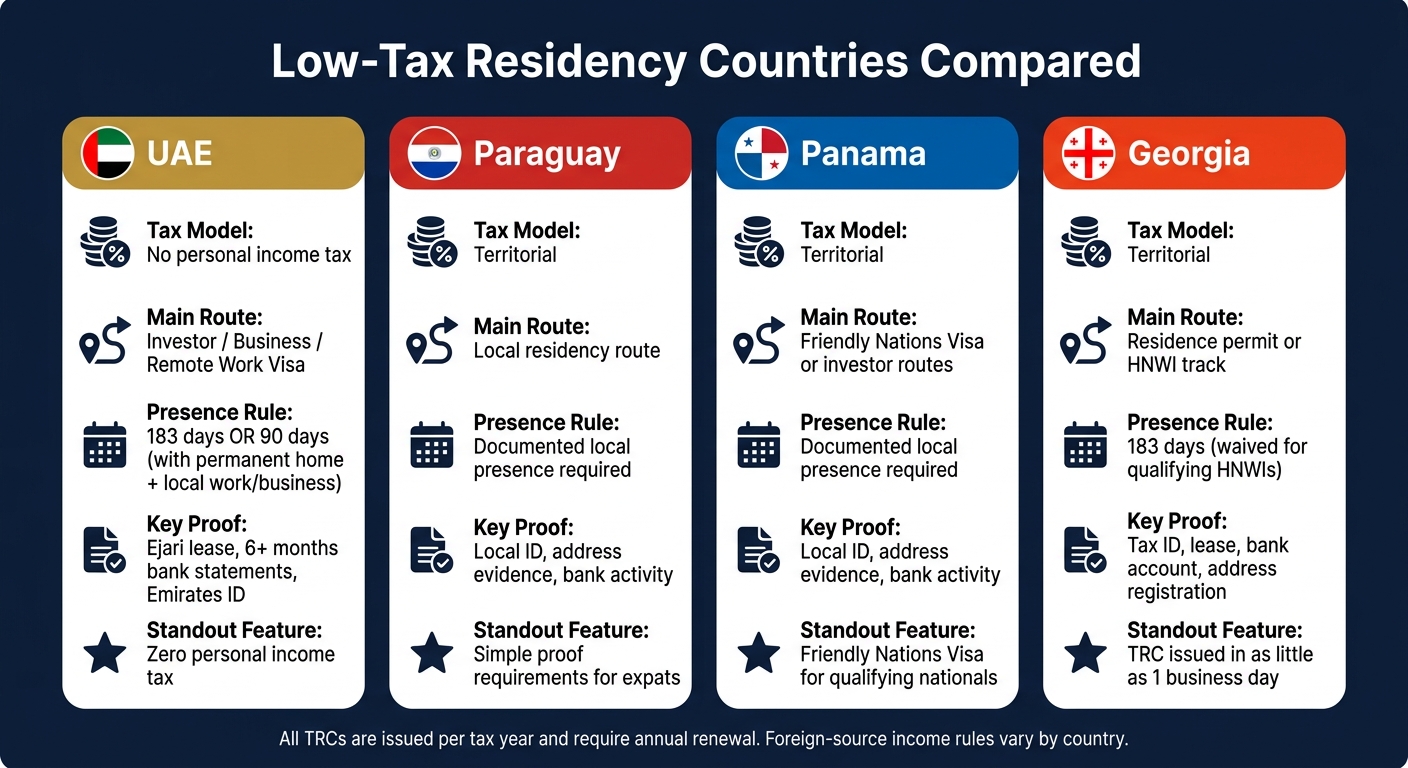
The best low-tax residency option comes down to three things: how many days you can spend there, how much local proof you can show, and how much paperwork you’re willing to deal with.
These four choices don’t work the same way. Some are easier if your income comes from abroad. Others work better if you can show a lease, bank activity, or business ties. The table below helps line that up with the path that’s easiest to follow without cutting corners.
| Country | Tax Model | Main Route | Presence Rule | Key Proof |
|---|---|---|---|---|
| UAE | No personal income tax | Investor, business, or remote work visa | 183 days; or 90 days with permanent home and local work or business | Lease (Ejari), 6+ months of bank statements, Emirates ID |
| Paraguay | Territorial | Local residency route | Documented presence required | Local ID, address evidence, bank activity |
| Panama | Territorial | Friendly Nations Visa or investor routes | Documented presence required | Local ID, address evidence, bank activity |
| Georgia | Territorial | Residence permit or HNWI track | 183 days; waived for qualifying HNWIs | Tax ID, lease, bank account, address registration |
UAE: No personal income tax, but strict proof requirements
The UAE has no personal income tax, which is the big draw. But the paperwork standard is tighter than many people expect.
The UAE generally requires 183 days, or 90 days with a permanent UAE home and local work or business. And if you want a TRC, you need to back up your case with solid records: a lease, six months of bank statements, and a valid Emirates ID.
That’s the trade-off. The tax side is simple. The proof side is not.
If you want a route with less document pressure, the territorial systems below may be easier to handle.
Paraguay and Panama: Territorial tax systems with residency options for investors and expats
Paraguay and Panama both use territorial taxation. That makes them a natural fit for people whose income is mostly foreign-source.
Panama adds the Friendly Nations Visa for qualifying nationals, which gives some applicants a more direct path. Paraguay tends to suit expats who can show real local presence through basic records like ID, address evidence, and bank activity.
Neither option is just about getting a permit on paper. You still need to show that your move is real and documented.
Georgia: Clear tax residency rules with appeal for entrepreneurs
Georgia also uses a territorial system, so most foreign-source passive income is exempt. At the same time, local dividends and interest are taxed at a flat 5%.
For most people, the standard route means 183 days in the country. To support that, you’ll usually need a Georgian tax ID, address registration, a lease, and a local bank account. If you like clear rules and a paper trail you can point to, Georgia is pretty straightforward.
There’s also another route for qualifying HNWIs. They can bypass the 183-day rule if they meet the asset, income, and local investment thresholds.
One more thing sets Georgia apart: it offers an expedited approval process that can issue a tax residency certificate in as little as one business day. Like the UAE, though, that certificate applies to a specific tax year and needs annual renewal.
Avoid mistakes and get the right support
Common red flags that can defeat your new residency
A strong residency plan can still fall apart if your facts and documents don’t match.
Getting a visa does not make you a tax resident. And foreign tax authorities are now pushing back harder on low-tax claims. Dual residency often shows up when your old country still sees your vital interests or habitual abode as local, while the new country sees only paper residency.
Business activity is another big tripwire. Say your company is registered in a low-tax country, but you’re making decisions, signing contracts, or running day-to-day operations from a high-tax country. In that case, tax authorities may decide the company’s place of effective management is in that high-tax location and tax it there.
That’s where a lot of people get burned. A virtual office or flexi-desk might look fine on paper, but it usually won’t fix the issue. Authorities want proof of actual local management and control.
Weak, mismatched, or expired records are also common reasons for rejection.
How Global Wealth Protection can help structure the move
Most of these problems can be avoided with coordinated planning.
Tax, immigration, and corporate structure decisions are tied together. Change one piece, and the others can shift with it. Global Wealth Protection helps coordinate tax, immigration, corporate, and asset-protection planning so the move works both in practice and on paper.
Conclusion: The safest path to low-tax residency
Once the structure is set up, the next job is keeping your records clean.
Low-tax residency works only when the facts, filings, and daily life all line up. The safest path is the one you can prove from day one.
FAQs
How do I prove my move is real?
Show clear proof of physical presence and economic ties in your new country. The strongest document is a Tax Residency Certificate (TRC) from the local tax authority.
It also helps to keep a clean paper trail that shows you were actually there and living your day-to-day life there. That can include:
- Daily location records
- Passport stamps
- Boarding passes
- Lease agreements or utility bills
- Local bank activity
- Local registration records
- Tax ID documents
If you own a business, show local substance and that effective management happens there. In plain English, that means the business should have a real footprint in the country, and key decisions should be made there – not just on paper.
Can I still be taxed in my old country?
Yes. You may still owe tax to your former country after you move. For U.S. citizens, this matters a lot because the United States taxes worldwide income no matter where you live.
So even if you become a tax resident in another country, your filing duties back home may not disappear. In many cases, you need to formally sever tax ties to avoid accidental dual residency. And when a tax treaty applies, tie-breaker rules may help sort out which country treats you as a resident for tax purposes.
Which low-tax country is easiest to qualify for?
It depends on your situation, but the UAE is often seen as one of the easier options because the process is efficient and the entry bar is fairly low. In some cases, you may qualify with as little as 90 days of physical presence if you also keep a permanent home and local business or job ties.
Panama and Georgia are popular too, though they may ask for more specific economic or investment ties. In practice, the easiest option is usually the one that fits your income sources and your ability to meet residency tests like 90 or 183 days.
