
If I had to cut this down to one line: the best country depends on what I want most – lower tax, stronger banking, EU living, lower costs, or easy online company admin.
Here’s the short answer:
- UAE: best if I want 0% personal income tax and can show local substance
- Singapore: best if I want strong banks, legal order, and Asia access
- Portugal: best if I want EU residency and lifestyle
- Panama: best if I want territorial tax and U.S.-friendly time zones
- Estonia: best if I want an EU company I can run online
One thing matters more than most founders think: where I incorporate, where I live, and where I become tax resident are not always the same. That gap can create tax problems fast, especially for U.S. citizens, who still face U.S. tax filing on worldwide income.
So when I look at these five countries, I’m not asking, “Which one is best?” I’m asking:
- Where can I live without tax surprises?
- Where can I bank without months of friction?
- Where does my company setup match how I make money?
- What trade-off am I willing to accept?
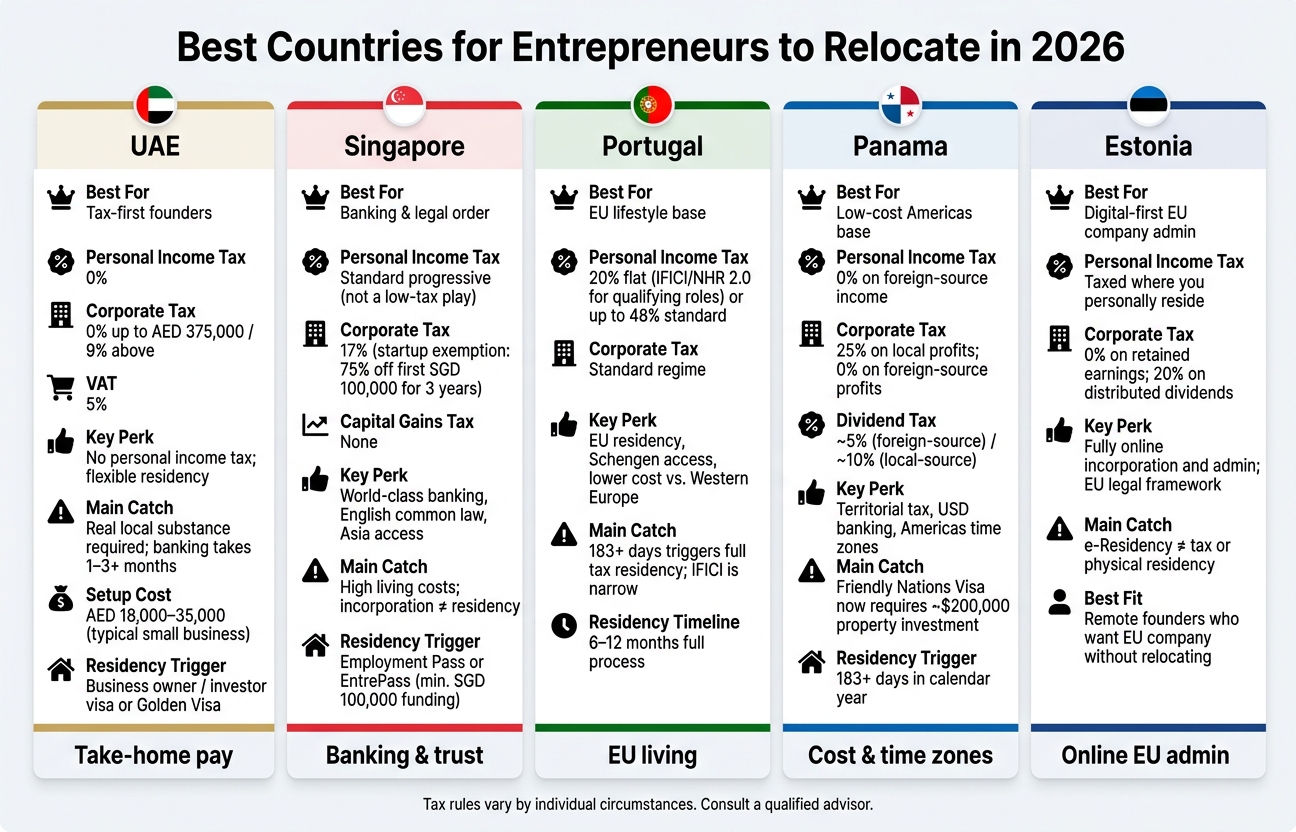
Quick Comparison
| Country | Best for | Personal tax angle | Main catch |
|---|---|---|---|
| UAE | Tax-first founders | 0% personal income tax | Needs local substance; banking can take 1 to 3 months+ |
| Singapore | Banking and legal order | Not a low-tax personal move for most people | High living costs; no residency from incorporation alone |
| Portugal | EU living base | 20% IFICI only for some people; standard rates can reach 48% | Spending 183+ days can trigger tax residency (often tracked via Common Reporting Standards) |
| Panama | Lower-cost base in the Americas | Foreign-source income is often taxed at 0% locally | Residency now needs stronger ties, often $200,000 in property |
| Estonia | Online EU company setup | Personal tax depends on where I live | e-Residency is not residency |
My shortlist is simple:
- I’d pick UAE for take-home pay
- I’d pick Singapore for banking and legal order
- I’d pick Portugal for living in Europe
- I’d pick Panama for cost and time-zone fit
- I’d pick Estonia for low-friction EU company admin
The main point is simple: the right move is the one that fits my tax and residency solutions, business model, and daily life at the same time.
sbb-itb-39d39a6
1. UAE
The UAE is often the strongest tax-first relocation pick for founders who want no personal income tax, residency tied to business ownership, and a well-developed free-zone system.
Tax environment
For individuals, the tax side is simple and attractive. Personal income, dividends, bank interest, and capital gains are generally untaxed, and individuals do not file personal tax returns.
That said, tax is only one piece of the puzzle. The bigger call for most founders is choosing between a free zone setup and a mainland company based on how the business will operate.
On the company side, the UAE brought in federal corporate tax in 2023. The standard rate is 0% on taxable business income up to AED 375,000 and 9% above that amount. Free zone companies may still get 0% on qualifying income, but only if they meet the required conditions.
The UAE also applies 5% VAT to most goods and services, which can make daily living and operating costs higher than in many other low-tax places.
Company setup
Free zones are usually a good fit for cross-border consulting, tech, media, trading, and holding structures. Mainland companies make more sense for businesses that need direct access to the UAE market, local staff, or government clients.
Setup costs can swing a lot depending on the zone and license. Basic zero-visa packages may start at about AED 5,500 to AED 12,000. A more typical small business setup with visas and a shared office often lands in the AED 18,000 to AED 35,000 range. Premium or regulated structures can hit AED 80,000+.
Residency path
Most founders go through business owner visas, investor visas, or the Golden Visa. The Golden Visa can provide 5- or 10-year residency. For entrepreneur applicants, this route usually calls for a UAE-registered company generating at least AED 1,000,000 in annual revenue in an accredited sector. Investor routes often require at least AED 2,000,000 in qualifying capital or deposits.
One big reason founders like the UAE is that residency can be linked to ownership and business activity rather than employment. That works well for location-independent operators.
Still, this isn’t a paper-only game anymore. Documentation checks are tighter now, so founders should be ready to show real presence in the UAE and real business activity. In practice, UAE residency tends to work best for people who can spend time there and keep that paper trail in order.
Banking and legal stability
Banking in the UAE is strong, but it can be slow and picky. Opening a corporate account often means handing over detailed business documents, proof of activity, licensing records, and proof of an office lease or shared office. A Dubai Chamber and UAE Ministry of Economy study found that 65% of SMEs struggle to open bank accounts, and onboarding can take one to three months or more.
Banks tend to look even harder at:
- New entities
- Holding structures
- Crypto-adjacent businesses
- Companies with complex cross-border flows
Minimum balance requirements often range from AED 25,000 to AED 100,000, and many banks want at least one signatory with a UAE residency visa and Emirates ID.
Compliance is manageable, but it tends to favor founders with clean documents and actual operating activity.
On the legal side, the UAE is business-friendly and deeply connected, with modern infrastructure and established dispute-resolution systems. But there’s a catch: rules can differ by emirate, free zone, and license type. So while the system is solid, it isn’t always simple.
The UAE tends to suit consultants, agency owners, e-commerce operators, digital founders, holding companies, and regional distributors. The main trade-off is cost. Housing, private healthcare, and international schools can get expensive.
For founders who want a more conservative regulatory setup and stronger financial infrastructure, Singapore is the next benchmark.
2. Singapore
If the UAE is the tax-first pick, Singapore is the institution-first one. It leans harder into rules, legal clarity, and banking depth. For founders aiming at Asia, that can be a much better fit. The catch? Living costs are high, and the immigration path is strict. Singapore is expensive, orderly, and built for founders who care more about efficiency than low overhead.
Tax environment
Singapore’s corporate tax rate is 17%, but new companies can cut early-year tax through startup exemptions. If a company qualifies, it may get a 75% exemption on the first SGD 100,000 of chargeable income and a 50% exemption on the next SGD 100,000 for its first three years. That can push early-year taxes down into the single digits.
Singapore also uses a territorial tax system, which means foreign-sourced income is generally not taxed unless it is brought into Singapore. There is also no capital gains tax.
For U.S. founders, there’s one big wrinkle: the U.S. taxes citizens on worldwide income no matter where they live. So even if Singapore’s effective rate is low, you may still run into GILTI or Subpart F on the U.S. side. That’s why it makes sense to model both systems together before making the move.
Company setup
Setting up a private limited company (Pte Ltd) is fast and fairly simple. In many cases, it takes only a few days. Foreign founders can own 100% of a Pte Ltd, but the company must have at least one local resident director. The minimum paid-up capital is just SGD 1.
In practice, many foreign founders use nominee-director and registered-address packages, which usually cost about SGD 1,000 to SGD 3,000+ per year.
This is also where Singapore shows its style. It’s not a place you set up and then ignore. Ongoing duties include annual returns, tax filings, bookkeeping, and audited financial statements once you cross certain revenue thresholds.
Residency path
Starting a company does not give you residency. If you want to move there yourself, you’ll need a separate work pass.
The main paths are:
- Employment Pass, for founders who meet salary and role requirements
- EntrePass, aimed at venture-backed or innovative startups
For EntrePass, founders usually need to show meaningful funding, such as at least SGD 100,000 raised in a recognized funding round, or participation in an accredited accelerator.
For high-net-worth founders, the Global Investor Programme (GIP) offers a route to permanent residency. Options include investing SGD 10 million into a qualifying business or SGD 25 million into an approved fund. Put simply, Singapore tends to favor founders who are high-skill, high-earning, or building high-growth companies.
Banking and legal stability
Singapore’s banks are one of its biggest draws. They offer multi-currency accounts, trade finance, and private banking, but onboarding is strict. Expect deep checks on ownership, source of funds, source of wealth, and in-person verification.
That means founders should show up prepared. Think contracts, client records, and proof of real business activity. Without that, delays or rejections are much more likely.
On the legal side, Singapore stands out for its English common-law system, strong IP protection, and the SIAC arbitration framework. That mix is a strong match for tech companies and IP-heavy businesses.
Portugal shifts the trade-off toward EU access and a lower cost of living.
3. Portugal
If Singapore is the institution-first pick, Portugal is the Europe-first one. It gives founders an easier day-to-day setup, access to the EU, and a gentler landing if the goal is to live in Europe while keeping the company elsewhere.
Portugal stands out for EU residency, solid lifestyle appeal, and a lower-friction entry point than many other European countries. It tends to fit best when your business is based somewhere else, but you want an EU home base for living and travel. Housing is still cheaper than in many Western European countries, although Lisbon and Porto have become more expensive.
Tax environment
Portugal’s old Non-Habitual Resident (NHR) regime is no longer open to new applicants. The replacement is IFICI (NHR 2.0). It offers a 20% flat tax rate on qualifying Portuguese-source income for up to 10 years.
That said, IFICI is much narrower than the old system. It is aimed at founders and workers in scientific research, technology, innovation, higher education, and some export-focused roles. It does not include the broad foreign-income exemptions that made the original NHR so popular with retirees and passive investors.
If a founder doesn’t qualify for IFICI, Portugal’s standard income tax rules apply. Those rates are progressive and can go up to 48%, with a possible solidarity surtax on top. And once you become a Portuguese tax resident, Portugal taxes your worldwide income.
Company setup
For most foreign founders, the usual company form is a sociedade por quotas (Lda), which is similar to an LLC. Before incorporation, each shareholder and director needs a Portuguese tax number (NIF). For non-EU founders, that often means using a fiscal representative or turning on tax notifications through the Portuguese tax portal.
The fastest path is Empresa na Hora, a government one-stop service that lets founders set up a company in a single visit if they use a pre-approved company name and standard articles. Government fees are roughly €220 to €360, depending on whether you use pre-approved bylaws or custom ones.
If you need custom documents or a more complex setup, things can take longer. In those cases, a few weeks is normal. One international advisory firm says its average timeline for full incorporation and banking setup is 11 weeks.
Residency path
Portugal gives foreign founders a few ways in.
The D7 visa can work well for remote founders who pay themselves from a foreign company, as long as they can show stable passive or business income above the minimum threshold. There is also a digital nomad visa for remote founders with steady foreign income well above the Portuguese minimum wage.
Founders working in innovation and certified R&D may also qualify for visa routes that can support IFICI access and the 20% rate.
For non-EU applicants, consulate processing often takes 60 to 90 days. From getting a NIF and setting up the company to receiving a residency card, the full path usually takes around 6 to 12 months.
One number matters a lot here: spending more than 183 days in Portugal during any 12-month period triggers tax residency. So if you want the lifestyle but not the tax hit, you need to track your days with care.
Banking and legal stability
Portugal’s banking system is steady and plugged into the EU financial network. Everyday banking works well. SEPA payments, online banking, and multi-currency features are standard at major banks.
The main headache is onboarding. Foreign founders should expect strict AML checks for both personal and business accounts. Corporate accounts can also slow down incorporation, since share capital usually has to be deposited first. For U.S. founders, FATCA paperwork can add more back-and-forth and more time.
EU membership also gives founders a clear legal framework and Schengen mobility.
For founders who want tax planning without EU residency, Panama is the next comparison.
4. Panama
Panama is a solid pick for founders who work with foreign clients and want territorial taxation, USD banking, lower living costs, and time zones that line up well with North and South America.
Tax environment
Panama uses a territorial tax system. That means only Panama-source income is taxed locally. Foreign-sourced income is generally taxed at 0% for both individuals and companies. Local corporate profits are taxed at a flat 25%.
There’s also no national wealth, inheritance, or gift tax. Dividends from foreign-source profits are generally taxed at around 5%, while dividends from Panama-source profits are usually taxed at 10%.
In 2026, substance rules matter more than many founders expect. The treatment of foreign passive income depends on things like real staff, management, decision-making in Panama, and clear documentation. Put simply, booking foreign profits in Panama without real activity on the ground is getting more scrutiny. So the company structure you choose – and whether you can show actual presence in the country – matters more than it would in a pure tax haven.
For U.S. citizens, there’s an extra layer to keep in mind: Panama’s territorial system does not remove U.S. tax filing duties. Americans still owe U.S. tax on worldwide income.
Company setup
Most foreign founders use a Panamanian corporation (Sociedad Anónima) or an international business company (IBC). These are commonly used for international trade, consulting, and holding setups. In most cases, founders work with a local law firm or corporate service provider to prepare the articles of incorporation, appoint a resident registered agent, and file with the Public Registry. If the company will operate inside Panama, it also needs an Operation Notice (Aviso de Operación) and tax registration.
Getting a company off the ground is fairly simple. The harder parts tend to be tax payment and contract enforcement. One example puts the full setup timeline, including banking, at about 9 to 11 weeks and around $10,770.
Residency path
For many entrepreneurs, including Americans, the Friendly Nations Visa (FNV) is the main route. Under the current framework, approved applicants first get two years of temporary residency. During that period, they need to show a real economic tie to Panama. That usually means either employment with a Panamanian company or a real estate investment of at least $200,000. After that, they can apply for permanent residency.
The economic-ties route also calls for at least $1,000 per month and tighter paperwork. Other routes exist, but they usually require more capital.
Tax residency is generally triggered by spending more than 183 days in Panama during a calendar year, whether those days are continuous or cumulative.
Once residency is mapped out, the next hurdle is often banking.
Banking and legal stability
Panama uses the U.S. dollar, which helps cut currency risk for American founders and makes day-to-day operations simpler. That said, opening a bank account can feel like a slog. Banks usually ask for notarized IDs, proof of address, a detailed business description, and proof of where the funds come from.
Panama exited the FATF grey list in October 2023. Even so, banks still tend to favor applicants who can show a local footprint – things like local clients, payroll, or real estate. Founders with no Panamanian presence often deal with more friction than those who can point to real ties in the country. Working with a well-known local law firm and attending meetings in person can help the process go more smoothly.
On the legal side, Law 54 of 1998 gives foreign investors who meet the law’s terms a guarantee of legal, tax, municipal, customs, and labor regime stability for up to 10 years. It also gives foreign and local investors equal treatment under the law.
Estonia takes a different path: digital-first company formation inside the EU, with less tax flexibility but less red tape.
5. Estonia
After Panama’s territorial-tax model, Estonia is the digital-EU option: cleaner admin, less lifestyle pull. It fits founders who want a remote EU company, not a full relocation package. In plain English, Estonia is stronger for setting up and running a business than for moving your whole life.
Tax environment
Estonia stands out because of how it taxes company profits. An Estonian OÜ (private limited company) pays 0% corporate tax on retained earnings. Tax only kicks in when profits are paid out as dividends, and at that point, a 20% rate applies. For founders, that means you can keep money inside the business and reinvest it without an immediate tax bill.
One point matters a lot here: e-Residency is not tax residency. Your tax residency depends on where you actually live.
Company setup
The big draw is speed. You can incorporate fully online through Estonia’s digital government portal. Day-to-day admin works much the same way too, including filings, reporting, and signatures.
If you like clean systems and fewer moving parts, this setup makes life easier. That’s a big part of Estonia’s appeal.
Residency path
e-Residency gives you access to run a company. It does not give you the right to live in Estonia. If you want to move there in person, you’ll need a separate residency route.
Banking and legal stability
Banking access is available, but you’ll need clean paperwork. KYC checks are strict, and approval depends on showing real business activity, a clear source of funds, and full CRS and FATCA compliance.
As an EU member state, Estonia offers a stable legal framework. That makes it a practical base for founders serving EU clients, especially if they want an EU presence without a lot of admin drag.
Tallinn is one of the more affordable EU capitals, with lower housing and living costs than Lisbon, Singapore, or Dubai. That said, founders who use Estonia only as a business base won’t get much from that day to day. So the best fit here is pretty clear: Estonia works best for founders who want an EU operating base with minimal admin.
Pros and cons by founder type
No single country is the best choice for every founder. It comes down to what you want most: a lower personal tax bill, a bank account that won’t become a headache, a simple online setup, a base in the EU, or lower costs in the Americas.
The country profiles show a pretty clear split. Your best option changes based on whether tax, banking, EU access, or admin ease matters most.
| Use Case | Best Fit | Personal Tax | Corporate Tax | Main Trade-off |
|---|---|---|---|---|
| Lowest personal tax burden | UAE | 0% | 9% above AED 375,000 | Real substance is required; free-zone 0% status depends on qualifying income and the de minimis rule. |
| Strongest banking | Singapore | Not a tax-minimization play. | Standard corporate tax regime | Higher operating costs; resident-director requirement adds complexity. |
| Easiest digital administration | Estonia | Taxed where you are personally tax resident. | Tax follows company tax residency or a permanent establishment | e-Residency doesn’t equal tax residency; banking still requires clean paperwork. |
| Best EU lifestyle base | Portugal | 20% IFICI rate on qualifying Portuguese-source income | Standard regime | Residency rules are tightening, and living there can create broader tax residency exposure. |
| Best low-cost base in the Americas | Panama | Foreign-source income is generally exempt | Foreign-source income is generally exempt | The Friendly Nations route now requires meaningful ties such as a $200,000 property purchase, and banking KYC is demanding. |
The table gives you the short version. Here’s how that plays out for different founder types.
UAE makes sense for founders who want zero personal income tax and can back that up with real local substance. This tends to work well for consultants, agency owners, and founders running international service businesses. The upside is obvious. The catch is that you can’t just rent a license and call it a day.
Singapore is a better fit for founders who care more about legal clarity and deep banking access than shaving tax down to the floor. It stands out for scalable service companies, fintech-adjacent setups, and founders who need banking relationships that can stand up to scrutiny. You’ll pay more to operate there, and the resident-director rule adds another moving part.
Estonia suits remote founders who want simple EU admin, not a personal relocation package. If you like digital filings, online signatures, and a government portal that doesn’t feel stuck in 2009, Estonia is a strong option for remote-first company management. Just don’t mix up e-Residency with tax residency. They are not the same thing.
Portugal works best for founders who want an EU lifestyle base and are fine dealing with more tax planning. For some people, that trade is worth it. If your goal is to live well inside the EU, Portugal stays in the conversation, but it’s not the simple low-tax play some founders hope for.
Panama fits cost-conscious founders with foreign-source income and real local ties. That last part matters more now. The $200,000 property requirement means this is no longer a low-commitment route. Banking KYC can also be tough, so the setup needs to be clean from day one.
At this point, the shortlist usually gets much shorter. A founder chasing tax alone may lean one way, while a founder who needs stable banking or EU access may land somewhere else.
Conclusion
There’s no single “best” country here. The right pick comes down to what matters most to you: tax, banking, residency, or day-to-day life.
Here’s the short version.
| Priority | Best Fit | Why |
|---|---|---|
| Maximum take-home income and mobility | UAE | No personal income tax; low corporate tax; flexible residency. |
| Banking depth and institutional trust | Singapore | Stable institutions and top-tier banking. |
| EU lifestyle and residence rights | Portugal | Schengen access and long-term residence pathways. |
| Lower-cost base in the Americas | Panama | Territorial tax and lower living costs. |
| Digital-first EU business base | Estonia | Digital company management and tax on distributed profits. |
That table is a good starting point, but it doesn’t tell the whole story. Each country works well only in the right setup.
The trade-offs are pretty clear. The UAE needs substance. Singapore is more expensive. Portugal is stricter on residency. Panama asks for stronger banking proof. And Estonia works best as a business base, not as a personal residence option.
Residency results also vary a lot by country. Portugal and Panama can lead to permanent residence and, later, citizenship. The UAE and Singapore usually depend on renewable visas tied to business activity. Estonia is different again: if you want to live there, you’ll need a separate immigration route.
A practical way to decide is to rank your top three priorities:
- tax efficiency
- EU access
- banking strength
- cost of living
- digital simplicity
Then line those up with where your clients, partners, and actual life will be. From there, match the country to your business model, client base, and residency goals, and cut the list down to one or two options.
FAQs
How do I choose where to live and where to incorporate?
These are separate decisions, but they’re closely linked. Where you incorporate should match the day-to-day needs of your business, like banking access, target markets, and how easy it is to get the company set up.
Where you live shapes your tax residency and your lifestyle. And those aren’t small details. Tax residency is not the same as a residence permit, and company taxes can also depend on where management decisions are made. So both choices should line up with your business model and your personal tax goals.
Which country is best for a U.S. entrepreneur?
There’s no one-size-fits-all answer for a U.S. entrepreneur. The best country depends on how your business makes money, where your customers are, and the kind of life you want to build.
If most of your clients are in the U.S., keeping a U.S. LLC can still make a lot of sense. In many cases, it’s a clean and efficient setup, especially if your sales, banking, and day-to-day work are still tied to the U.S.
For relocation, a few places tend to stand out for different reasons:
- The UAE offers 0% personal income tax
- Panama uses the U.S. dollar and has territorial taxation
- Singapore is known for stability and low corporate tax rates
Each option solves a different problem. Some people care most about taxes. Others want easier banking, a smoother place to live, or a setup that fits their long-term plans.
What proof of substance do I usually need?
You’ll usually need proof that your business is actually run and managed in the jurisdiction you chose.
That proof often includes:
- A local office lease
- Records that show local management activity
- Proof of day-to-day business operations
It also helps to keep clear business records on hand, such as contracts, invoices, and proof of local employees or contractors.
If you’re dealing with banks or tax authorities, keep these records separate from your personal accounts. Also, update your identity and compliance records every year.
