
The short answer: 183 days can trigger tax residency, but it does not automatically settle your tax home. I’d treat it as a warning line, not a final rule.
Here’s what matters most if you spend time in more than one country:
- 183 days is often a tax residency test
- Tax residency and tax home are not the same thing
- Many countries count partial trips, arrival days, and departure days
- The U.S. uses a 3-year formula, not a flat 183-day test
- Treaties may look at your home, family, work, and where your life is centered
- Low day counts do not always keep you out of a tax system
- Good records can make or break your position
In plain English: you can spend under 183 days in a country and still face tax issues if your ties there are strong. And you can cross 183 days without that being the only fact that matters.
A few numbers stand out:
- In the U.S., the substantial presence test uses a 3-year weighted count
- You need at least 31 days in the current year for that U.S. test
- As of 09/02/2026, qualifying Americans abroad may exclude up to $130,000 of earned income with Form 2555, if they meet the rules
I’d sum it up like this: day count starts the tax question; your home, family, business activity, and treaty position help finish it. If you travel often, work remotely, or run a company across borders, that difference can affect filing duties, tax bills, and what proof you need to keep.
What the 183-day rule is and what it actually decides
In many countries, spending 183 days there during the year can make you a tax resident. That status is often the starting point for figuring out where your tax home is treated as being.
This is where people get tripped up. The days usually don’t have to be consecutive, and many countries count both arrival and departure days. So the same travel pattern can lead to one tax result in one country and a different result somewhere else.
How different countries use the 183-day threshold
A lot of countries use the 183-day threshold as a plain single-year test. The U.S. does it differently.
It uses a weighted three-year substantial presence test. Current-year days count in full, days from the first prior year count as one-third, and days from the second prior year count as one-sixth. You also need at least 31 days in the current year.
Here’s a simple example: if you spend 120 days in the U.S. in each of three years, your weighted total is 180 days. That means you still fall short of the threshold.
For founders, that’s a big deal. Frequent U.S. trips can turn into U.S. tax residency even if that was never the plan. And that still doesn’t settle everything, because residency is only one part of the tax-home question.
Tax residency versus tax home: what the difference means for you
Tax residency and tax home are connected, but they are not the same test.
Tax residency is a legal status under a country’s domestic tax law. It decides whether you’re taxed as a resident or a nonresident for the year. Residents are often taxed on worldwide income, while nonresidents are usually taxed only on income sourced in that country.
Under U.S. rules, your tax home is usually your main place of business. If you don’t have one, it’s your main place of abode.
A practical example makes this easier to see. Say a software founder from Germany spends enough time in the U.S. over three years to meet the substantial presence test. That makes her a U.S. tax resident. But she still runs her main company and most revenue-producing operations from Berlin, and she goes to the U.S. only for investor meetings and conferences.
In that case, for U.S. travel-expense purposes, her tax home may still be Berlin. That can change how deductions work and how the foreign earned income exclusion is handled.
sbb-itb-39d39a6
Why day-counting alone does not settle your tax home
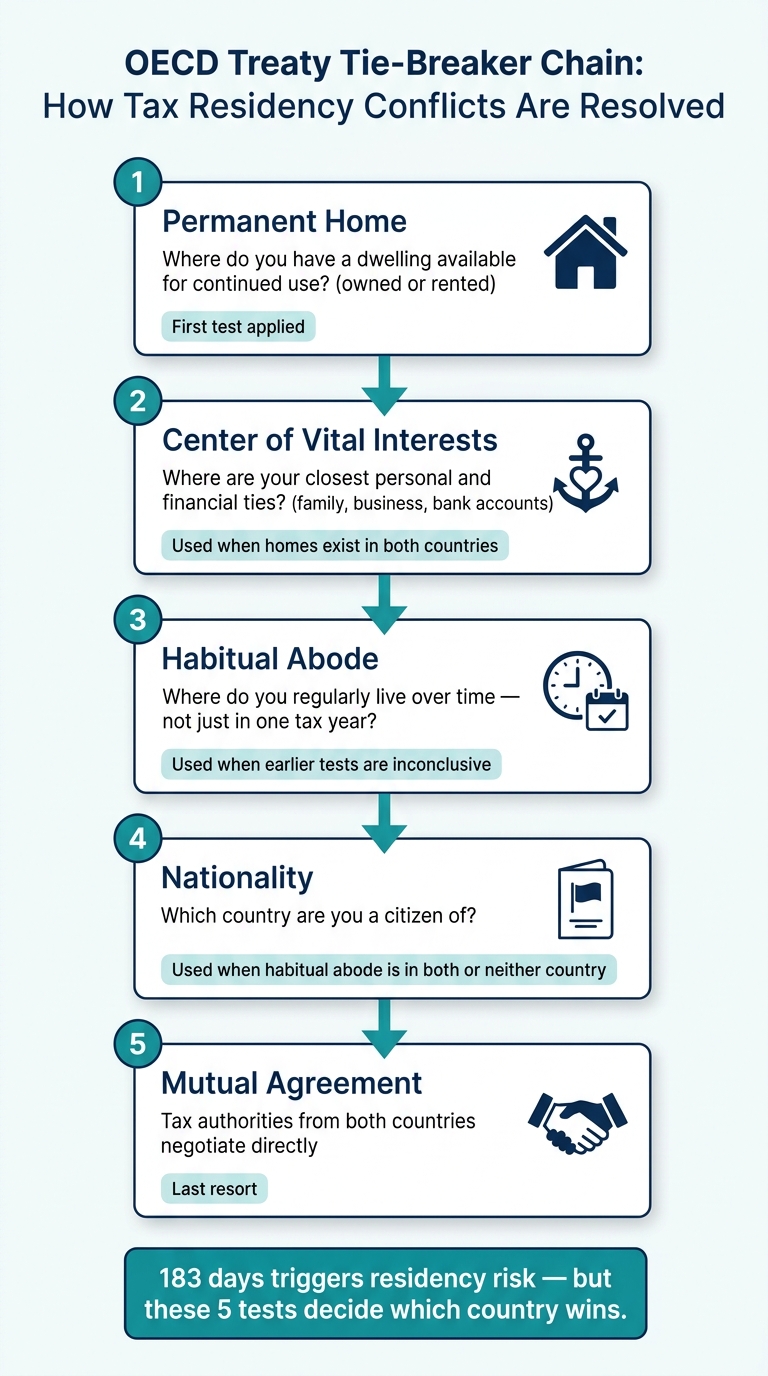
When day counts create a residency conflict, tax treaties step in to decide which country gets the final say. The 183-day rule is a starting point, not the whole answer. In practice, tax authorities also look at where you have a permanent home, where your personal and financial life is centered, and where you usually live.
Permanent home, center of vital interests, and habitual abode explained
These three ideas come up again and again in treaty analysis, and each one gets at something a simple day count misses.
A permanent home is a place that is set up and available for your continued use, whether you own it or rent it. For example, a 12-month lease with your belongings still there can count as a permanent home even if you spend a lot of time on the road. When tax homes clash, this is often the first thing authorities examine.
The center of vital interests looks at where your personal and financial life is most concentrated. Authorities weigh things like where your family lives, where you run your business, and where your bank accounts and other ties sit. Say a family has children enrolled in school in Canada, keeps its main home there, and has most of its day-to-day life there. In that case, its center of vital interests will likely be in Canada, even if one parent spends long stretches working in another country. This test often becomes the key one when a person has permanent homes in both places.
Habitual abode focuses on where you live on a regular basis over time, not just what happened in one tax year. Picture a cross-border executive who spends three weeks each month in one country and one week in another for several years. That person will likely be seen as having their habitual abode in the first country, even if, in one given year, they spend a bit less than 183 days there.
How tax treaties resolve dual-residency conflicts
If two countries both treat the same person as a tax resident under their own domestic rules, a tax treaty may assign residence to just one of them. Many modern treaties follow the OECD Model Tax Convention. They apply a tie-breaker chain in this order: permanent home, center of vital interests, habitual abode, nationality, and then mutual agreement.
This kind of treaty relief turns on facts and paperwork. A U.S. citizen who spends 200 days in another country may still be treated as a U.S. tax resident under a treaty tie-breaker if they keep a house in the U.S., their spouse and children live there, and they continue managing a U.S.-based business. So yes, physical presence matters. But it doesn’t always win.
| Tie-breaker test | What it looks at | When it applies |
|---|---|---|
| Permanent home | Where you have a dwelling available for your continued use | First test in the sequence |
| Center of vital interests | Where your closest personal and financial ties are concentrated | Used when you have homes in both countries |
| Habitual abode | Where you spend your regular life most often | Used when the earlier tests do not settle the case |
| Nationality | Which country you are a citizen of | Used when habitual abode is in both countries or neither |
| Mutual agreement | Tax authorities work it out directly | Last resort when the tests are still unclear |
These tie-breaker rules matter most for people whose lives move back and forth across borders on a regular basis.
Cross-border situations that commonly trigger residency risk
This is where things get tricky. On paper, your travel may look normal. In practice, it can still create tax residency exposure.
Split-year travel and repeated cross-border stays
Split-year trips and frequent returns are often counted together under a rolling 12-month test. In plain English, many jurisdictions don’t just look at one long stay. They add up all the days you spent in the country across any rolling 12-month period.
That means separate trips can still end up in the same residency count. A few weeks here, a month there, then another short return later in the year may not feel like much. But once those days are aggregated, your tax home exposure can move a lot further than you planned.
Digital nomads, expats, and founders running companies remotely
Low day counts don’t always keep you out of a tax system. Your business ties can still pull you in.
Tax authorities may also look at:
- Economic ties
- Family ties
- Local business activity
All of that can affect where your tax home is viewed to be.
A legal home is not always a tax home. That’s a big point. The place where a company is managed and controlled can create a separate tax residency risk from the place where it was incorporated.
Say a founder hires local staff, serves local clients, or keeps an office abroad. That can create permanent establishment risk even if the founder’s own day count stays below 183. Put simply, where you run the business can matter just as much as where you sleep.
How the rule works in the US and UAE
The same travel pattern can lead to very different tax outcomes depending on the jurisdiction.
| Jurisdiction | Practical takeaway |
|---|---|
| U.S. | U.S. citizens cannot exit U.S. tax exposure by day count alone. |
| UAE | The UAE has no personal income tax and residency usually depends on visa, business, or investment status. |
Once you know which rules apply, the next step is proving where you were and where your tax home sits.
How to check your exposure and protect your position
Once you know the residency rules, the next step is proving where your tax home is. Tax authorities can check travel through entry and exit records, so don’t rely on memory alone. Keep your own log, and back it up with records that show your day count, your home, and where your life is actually based.
Records to keep if you need to prove your day count and tax home
A travel log helps, but it won’t do the whole job. You also need records that show where you lived and worked in practice. Hold onto:
- Accommodation records: leases, deeds, or hotel invoices that show where you stayed
- Work records: notarized work contracts, client correspondence, and records showing where remote work days were logged
- Financial and tax records: bank statements, local registrations, proof of income, and required insurance
- Corporate records: registrations, board minutes, and management records
Use these records before you extend a stay or book a return trip.
A pre-travel review to run before you approach 183 days
Before you get close to 183 days, run a quick exposure check. Start by adding up your days in that country. Then check whether that country uses a hybrid residency test that also looks at property ownership, family ties, or local business activity. After that, see whether a treaty changes the outcome.
Here’s the plain-English version: if a tax authority questioned your position today, could you show a lease, local registrations, and proof of income that back up your claimed tax home? If the answer is no, fix that gap before you travel again.
As of 2026, qualifying Americans abroad can exclude up to $130,000 of earned income from federal taxes through the Foreign Earned Income Exclusion using Form 2555. But that break still depends on meeting either the bona fide residence test or the physical presence test. So yes, your paperwork matters.
Conclusion: treat day counts as an early warning, not the full answer
Treat the 183-day rule as an early warning, not the full answer. Day counts matter, but they only start the analysis.
FAQs
Does 183 days automatically make me a tax resident?
No. 183 days is a common benchmark, but it does not automatically make you a tax resident in every case. And if you stay fewer than 183 days, that does not mean you’re in the clear either.
In many countries, tax authorities use the 183-day rule as a starting point. But they may also look at things like your permanent home, your center of vital interests, where your family lives, and your property and business ties.
Some places follow different tests altogether. The U.S., for example, uses the Substantial Presence Test.
What is the difference between tax residency and tax home?
Tax residency shapes your overall tax duty in a country. In most cases, it depends on where you live, where you work, and where your personal or financial ties sit. It helps determine which country has the right to tax your worldwide income.
A tax home is your main place of work or business. For U.S. citizens, having a tax home in a foreign country may be required to claim certain tax breaks, including the Foreign Earned Income Exclusion.
What records should I keep to prove my tax position?
Keep a clear day-count record for each tax year. That means saving travel logs, passport stamps, flight records, hotel receipts, lease agreements, transport receipts, and credit card statements that show where you were.
You should also keep proof of your ties and where you live. This can include utility bills, a driver’s license or state ID, voter registration, property tax filings, bank statements, and any related tax returns or treaty paperwork.
