
If I were sizing up Cyprus in 2026, I’d look at three things first: tax residency, permit type, and city cost. Cyprus can work well for a U.S. expat because foreign dividends and interest may face 0% SDC for up to 17 years under non-dom rules, the 60-day tax residency route is now easier to use, and living costs can range from about $1,650 to $3,850 per month for one person depending on the city.
Here’s the short version:
- Tax: Cyprus tax residency can start under the 183-day rule or the 60-day rule.
- Non-dom: Many new arrivals can get 0% SDC on dividends and passive interest, though GESY still applies.
- U.S. filing: I still have to file with the IRS, including Form 1040, and often FBAR and Form 8938.
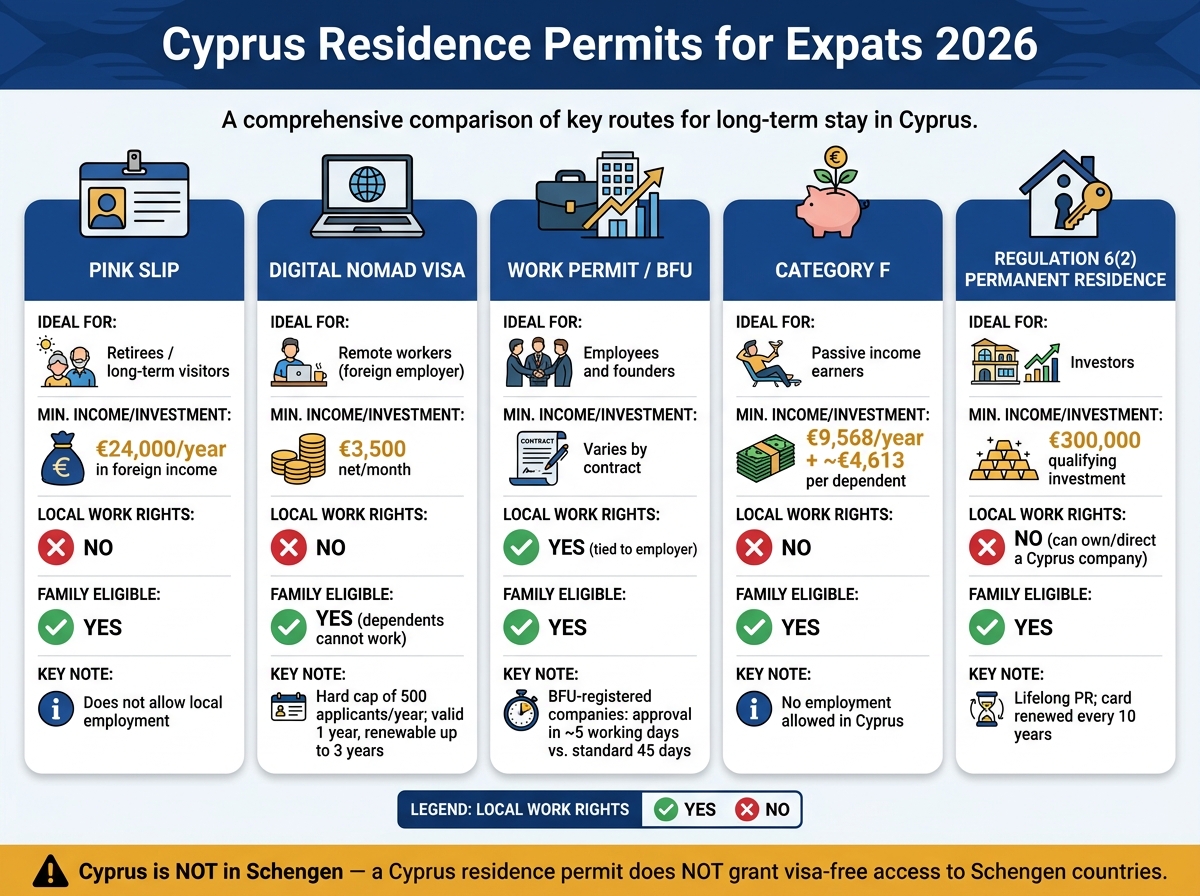
- Permits: Main routes include the Pink Slip, Digital Nomad Visa, work permit/BFU, Category F, and Regulation 6(2) permanent residence.
- Housing: A one-year registered lease can matter for both immigration and tax residency.
- Costs: Limassol is the priciest; Larnaca and Paphos are usually lower-cost.
- Lifestyle: English is common, crime is low, summers are hot, and a car is often useful.
- Travel note: Cyprus is not in Schengen, so a Cyprus permit does not give Schengen access.
Quick comparison
| Topic | What I’d check first | 2026 takeaway |
|---|---|---|
| Tax residency | 183-day vs. 60-day rule | The 60-day route is now simpler for mobile expats |
| Non-dom tax | Dividend and interest treatment | 0% SDC may apply for up to 17 years |
| U.S. taxes | IRS filing after the move | U.S. citizens still file on worldwide income |
| Permit route | Work, remote income, or passive income | The right visa depends on how I earn and whether I need local work rights |
| Cost of living | City choice | Limassol costs more; Paphos/Larnaca usually cost less |
| Property setup | Lease or purchase | A stamped, registered 12-month lease often matters |
| Daily life | Healthcare, transport, safety | Low crime, good internet, hot summers, and left-side driving |
If I were planning a move, I’d treat Cyprus as a place where the math can look good only if the paperwork matches the story: days on the island, housing, permit status, and U.S. reporting all need to line up.
sbb-itb-39d39a6
Cyprus taxes for expats: residency rules, non-dom status, and US reporting
For expats, Cyprus tax residency is where the plan either holds up or starts to wobble.
The 183-day rule and the 60-day rule explained
Under the 183-day rule, you become a Cyprus tax resident if you spend more than 183 days in Cyprus during a calendar year. Arrival days count. Departure days do not.
For founders and executives who move around a lot, the 60-day rule is often the better fit. To use it, you must meet all four conditions in the same calendar year:
- Spend at least 60 days in Cyprus
- Not spend more than 183 days in any one other country
- Keep a permanent home in Cyprus through owned property or a one-year registered lease
- Have Cyprus employment, a business, or a company directorship
A 2026 update removed the need to show that you are not tax resident somewhere else, which makes the 60-day route easier for mobile professionals.
Paperwork matters here more than people think. Keep boarding passes, passport stamps, and a travel log made at the time you travel. If your residency status is ever questioned, that record can save you a major headache.
Once you know which test you can meet, the next issue is simple: does non-dom status cut your tax bill?
How non-dom status can cut tax on dividends and interest
You will usually qualify for non-dom status if Cyprus is not your original domicile and you have not been tax resident there for 17 of the last 20 years.
Non-dom status means you do not pay the Special Defence Contribution, or SDC, on worldwide dividends and passive interest for 17 years. That can make a big difference.
Domiciled residents pay 5% SDC on dividends and 17% on interest. Non-doms pay 0% SDC on both. That said, GESY still applies.
Here’s how the main income types are taxed based on status:
| Income Type | Non-Resident | Cyprus resident, domiciled | Cyprus resident, non-dom |
|---|---|---|---|
| Dividends | 0% SDC | 5% SDC + 2.65% GESY | 0% SDC + 2.65% GESY |
| Interest | 0% SDC | 17% SDC + 2.65% GESY | 0% SDC + 2.65% GESY |
| Employment income | Cyprus-source only | Progressive (0–35%) | Progressive (0–35%)* |
| Securities gains | 0% | 0% | 0% |
| GESY annual cap | N/A | €4,770/year | €4,770/year |
*New residents with qualifying employment income above €55,000 may receive a 50% exemption.
Cyprus does not charge capital gains tax on securities. Gains from crypto-asset disposals are taxed at a flat 8%. Rental income is now taxed only under standard income tax rules.
After the first 17-year non-dom period ends, people can extend the SDC exemption for two back-to-back five-year periods by paying a lump sum of €250,000 per 5-year period.
Those tax savings look great on paper. But they only work if your permit, housing setup, and travel pattern match the tax position you are claiming.
What US citizens must still file after moving to Cyprus
Moving to Cyprus does not end US filing duties. US citizens still need to file Form 1040, FBAR, and Form 8938 when the filing thresholds are met.
"A US citizen, for instance, still faces global filing obligations regardless of where they sit; the Cyprus tax residency position helps with non-US-source income but does nothing about IRS reach." – C. Savva & Associates
The Foreign Earned Income Exclusion and the Foreign Tax Credit are the main ways to deal with double taxation. GESY may play into the Foreign Tax Credit analysis, but that answer depends on the facts of your case.
Starting in 2026, Cyprus residents ages 25 to 70 must file an annual tax return, even if they have zero income.
It helps to line this up early with a US-qualified tax advisor, especially if you need to document your exit and treaty position. With residency sorted, the next step is picking the residence permit that lets you live in Cyprus lawfully.
Residency and immigration routes: how to legally live in Cyprus in 2026
Getting your tax setup right is only half the job. If your immigration status is weak, the whole plan can fall apart.
Cyprus gives non-EU expats a few main permit routes, and each one fits a different type of person. Some are built for retirees. Some fit remote workers. Others are meant for founders, employees, or investors.
Main residence permit options for non-EU expats
The best permit depends on where your income comes from, whether you need local work rights, and who is moving with you.
The Pink Slip allows non-EU nationals to stay in Cyprus for more than 90 days, but it does not allow local employment. It generally requires about €24,000 per year in foreign income and a Cyprus bank account.
The Digital Nomad Visa is aimed at people who work remotely for employers outside Cyprus. To qualify, you need a minimum net monthly income of €3,500. There is also a hard cap of 500 applicants per year. The permit is issued for one year and can be renewed up to a total of three years.
If you are a founder or employee in a tech, shipping, or pharmaceutical company, the BFU route can move things along much faster for qualifying businesses. Standard processing is usually 45 days, while BFU-registered companies may get approvals in as little as 5 working days.
Category F is aimed at people living on passive income who do not plan to work in Cyprus. The income threshold is about €9,568 per year for a single applicant, plus around €4,613 for each dependent.
Regulation 6(2) permanent residence is the route many investors look at. It requires a minimum property purchase or other qualifying investment of €300,000 and gives lifelong permanent residency, though the card itself must be renewed every 10 years. Holders cannot take local employment, but they can own and direct a Cyprus company.
One point trips people up all the time: Cyprus is not in Schengen. So a Cyprus residence permit does not give visa-free access to Schengen countries.
Documents, processing times, and filing steps
No matter which route you choose, the base paperwork looks pretty similar. In most cases, you will need:
- A full passport copy
- Proof of Cyprus address, such as a title deed or stamped rental agreement
- Utility bills
- Private health insurance
- Proof of income or available funds
The small admin details matter more than they seem. A rental agreement must run for at least one year, be registered with the Land Registry, and have stamp duty paid for it to count as a valid permanent home for both residency and tax purposes. Miss one of those steps and the lease may not do the job you expected.
There is also a timing issue. Apostilled documents, police clearances, and medical certificates all come with expiry windows. If you file too early, or if the case drags on, some of those papers can expire during processing.
Opening a local bank account usually takes four to six weeks if you do not already have a banking history in Cyprus. Non-EU applicants also need to provide a bank guarantee of about €5,000 to €8,000, depending on the permit type. This is not just a basic deposit. It is a formal guarantee tied to repatriation costs. It is smart to budget for that from the start.
Another point worth stressing: many permit categories must be filed before arrival or from outside Cyprus. So do not assume you can fly in first and sort the status out later.
A one-year registered lease can support both your residence application and Cyprus tax residency under the 60-day rule.
Choosing the right permit route for families, founders, and remote workers
In practice, most people are deciding based on three things:
- Do you need local work rights?
- How fast do you need the permit?
- Are you staying for a short period or putting down roots?
If you work remotely for a foreign employer and earn at least €3,500 per month, the Digital Nomad Visa is usually the most direct option. If you are joining or building a BFU-registered company, the work permit route gives you employment rights and the fastest processing on the table. If you live on pensions or other passive income, Category F or the Pink Slip will usually be the better fit, depending on your income level. And if you want a long-term base in Cyprus without local employment, Regulation 6(2) is often the route investors focus on.
| Route | Ideal Applicant | Min. Income / Investment | Local Work Rights | Family Eligible |
|---|---|---|---|---|
| Pink Slip | Retirees / long-term visitors | About €24,000/year in foreign income | No | Yes |
| Digital Nomad Visa | Remote workers (foreign employer) | €3,500 net/month | No | Yes (no work) |
| Work Permit / BFU | Employees / founders | Varies by contract | Yes (tied to employer) | Yes |
| Category F | Passive income earners | ~€9,568/year, plus ~€4,613 per dependent | No | Yes |
| Regulation 6(2) PR | Investors | €300,000 investment | No (can own company) | Yes |
Once your permit route is clear, the next step is figuring out what everyday life in Cyprus will actually cost.
Cost of living, housing, healthcare, and daily life in 2026
Once residency is in place, the next thing most people want to know is simple: what does everyday life cost? In Cyprus, the answer depends a lot on where you live, what kind of home you rent, and whether you stick with public healthcare or also pay for private cover.
Monthly budget estimates by lifestyle and household size
A single expat should plan for about $1,650 to $3,850 per month, based on city and lifestyle. That range includes rent, utilities, groceries, and basic leisure. Larnaca and Paphos are usually on the lower end, while Limassol is the most expensive city because it’s the island’s main business center. A family of four typically spends about $3,357 per month before rent.
One cost that catches many new arrivals off guard is electricity. Monthly bills for a standard apartment are usually around $110 to $220, and they climb in summer when air conditioning runs hard. Water is about $24 per month, and fiber internet with speeds of 100 to 200 Mbps usually costs $22 to $33 per month.
Renting and buying property: costs and process for non-EU buyers
Here are the 2026 city-center rent estimates for one-bedroom and two-bedroom apartments, along with a typical monthly budget for a single expat:
| City | 1-BR Apartment | 2-BR Apartment | Total Monthly Budget (Single) |
|---|---|---|---|
| Limassol | ~$1,045 (€950) | ~$1,339 (€1,217) | $2,750 to $3,850 |
| Nicosia | ~$660 (€600) | ~$963 (€875) | $2,200 to $3,080 |
| Larnaca | ~$633 (€575) | ~$812 (€738) | $1,650 to $2,420 |
| Paphos | ~$453 (€412) | ~$688 (€625) | $1,980 to $2,750 |
The gap between cities is pretty clear. Limassol asks the most, while Larnaca and Paphos give you more breathing room. That matters if you’re trying to keep monthly costs under control without giving up coastal living.
Apartment prices in coastal cities rose by 13.9% going into 2026, pushed by expat and investor demand. For buyers, residential property averages about €2,500 to €2,800 per square meter. If you’re a non-EU buyer, you’ll need a Council of Ministers permit to purchase property.
There are also taxes to factor in. On resale property, transfer tax applies on a sliding scale:
- 3% up to €85,000
- 5% up to €170,000
- 8% above that
New builds come with 19% VAT, though a reduced 5% rate may apply for a first home purchase on properties priced under €475,000.
If you’re renting for residency purposes, use a one-year registered lease. Short-term rentals don’t count.
Healthcare, safety, and day-to-day practicalities
GESY is Cyprus’s public healthcare system. People who pay into it make income-based contributions, and GP visits come with a low co-pay. In practice, many residents use GESY for routine care and keep private insurance for faster access to specialists. By mid-2023, about 933,000 people, or 75% of the population, were registered in GESY.
| Feature | GESY (Public System) | Private Insurance |
|---|---|---|
| Eligibility | Citizens, EU workers, permanent residents | All residents, subject to premium |
| Cost | 2.65% of income for employees; 4% for self-employed | $220 to $660/year for a basic policy |
| GP visit | Around $7 co-pay | Often covered or reimbursed |
| Specialist wait times | Can be long for non-urgent cases | Generally very short |
On safety, Cyprus does well. It ranks as the 13th safest country in the world, with a homicide rate of 0.8 per 100,000 people. For many expats, that shows up in everyday life in small ways: walking around at night feels normal in many areas, and the pace is calmer than in many larger countries.
Getting around is another thing to think through early. Driving is on the left, and outside city centers, having a car is often the practical choice because intercity bus links are limited. Non-EU driver’s licenses usually need to be exchanged for a Cypriot license after six months of residency.
The weather is one of Cyprus’s biggest selling points. The island gets about 300 to 340 days of sunshine a year, with summer highs around 90 to 99°F (32 to 37°C) and mild winters averaging 61 to 64°F (16 to 18°C). In summer, sea temperatures are about 80 to 82°F (27 to 28°C), which helps explain why the coast is such a draw.
Day-to-day life is also fairly easy for English-speaking newcomers. Median fixed broadband speeds are about 165 Mbps, 5G is available in all major cities, and homes use UK-style Type G power sockets, so U.S. residents will need adapters. English is widely spoken across the island and is standard in business and legal settings.
Costs, transport, and access to services can change a lot from one city to another, so the next step is picking the place that fits your budget and routine.
Where to live in Cyprus and how to decide if it fits your goals
Nicosia vs. Limassol vs. Larnaca vs. Paphos: a city-by-city comparison
Once you’ve mapped out costs and day-to-day life, the last big call is where to live. And this part matters more than people think. Each city works for a different kind of life, so the best pick depends on your work, family setup, and travel needs.
Limassol is Cyprus’s main business center. It’s the top fit for founders and high earners, especially if you work in fintech, gaming, or tech. It also has the island’s strongest coworking setup to support that scene.
Nicosia makes sense for people in finance, law, or government who want lower rent and a central business base. The downside is simple: it’s inland. That means no beach access, and summers tend to feel hotter than in the coastal cities.
Larnaca is the practical choice for people who travel a lot. It’s closest to Cyprus’s main international airport, and it has the lowest rent among the coastal cities.
Paphos is the most laid-back option of the four. It also has the lowest housing costs, which makes it a strong match for retirees and families.
| City | Cost | Best Fit | Beach Access | Airport Access | Trade-off |
|---|---|---|---|---|---|
| Limassol | Highest | Tech founders, high earners | Excellent | Good | Highest rents on the island |
| Nicosia | Moderate | Finance, law, startups | None (inland) | Moderate | No coast; very hot summers |
| Larnaca | Moderate-Low | Remote workers, frequent flyers | Good | Best | Smaller business community |
| Paphos | Lowest | Retirees, families, slow-paced expats | Excellent | Moderate | Limited career networking |
For families, international school fees across the island range from $5,000 to $15,000 per child per year. The strongest school options are mostly in Limassol and Paphos.
The best city isn’t just the one that looks good on paper. It’s the one that fits how you’ll live every day, and the setup behind that life.
Aligning a Cyprus move with tax planning and asset protection
If you’re a founder or investor, your city choice can shape more than your commute. It can also affect tax residence, company substance, and banking.
Cyprus uses an English common-law base, which helps with companies, contracts, and cross-border estate planning. The non-dom regime can offer 0% tax on foreign dividends and interest for 17 years. But that only works well if your residency status lines up with your company setup, banking, and estate plan.
For business owners, substance is a big deal. A Cyprus company needs real management and control on the island. In plain English, that usually means:
- Board meetings held in Cyprus
- A resident director
- A physical office
Without that, foreign tax authorities may challenge the setup. If you’re a mobile professional using the 60-day route, you also need a permanent home in Cyprus and a local directorship.
The practical point is straightforward: your city choice, tax residence, company substance, and residency paperwork need to line up before you move.
Conclusion: key pros, limits, and next steps before you relocate
Cyprus in 2026 is a strong option when your permit path, tax residency status, and city choice match your actual situation. Before relocating, check the current immigration rules with the relevant authorities. It also helps to get the core residency pieces in place early: a permanent home in Cyprus, health insurance, and a current travel log with boarding passes to support your residency position if a foreign tax office asks questions.
FAQs
Can I qualify for the 60-day rule if I still spend time in other countries?
Yes. You can still qualify if you spend at least 60 days in Cyprus and no more than 183 days in any other single country during the same tax year.
There are a few other conditions too. You must keep a permanent home in Cyprus and have business activity, employment, or a directorship there.
Which Cyprus permit is best if I work remotely for a U.S. company?
The Digital Nomad Visa is usually the best option for non-EU nationals who work remotely for a U.S. company while living in Cyprus.
To qualify, you need net monthly income of at least €3,500. That amount goes up if you’re bringing family members. The visa is valid for one year and can be renewed for up to two more years.
There’s one big limit: it does not let you work for a company in Cyprus. And if you stay in Cyprus for more than 183 days in a year, you become a Cyprus tax resident.
How much should I budget to live comfortably in Cyprus in 2026?
A comfortable monthly budget in Cyprus in 2026 comes down to two things: where you live and how you live.
For a single person, a practical monthly range is $1,300–$2,400. For a family of four, a good working budget is about €3,100 per month, not including rent.
The biggest expense is usually rent. And the gap between cities can be pretty big. For a one-bedroom apartment in the city center, you’re generally looking at:
- Larnaca: €450–€750
- Nicosia: €550–€900
- Limassol: €800–€1,200
After rent, the next main costs are utilities, groceries, and casual dining. That’s why two people with the same income can end up with very different monthly budgets. Someone living simply in Larnaca will likely spend far less than someone renting in central Limassol and eating out often.
