
Miss the 330-day rule by just 1 day, and you can lose access to up to $132,900 of foreign earned income exclusion for 2026. That’s the whole game: count your days the IRS way, pick the right 12-month window, and keep proof before you file Form 2555.
Here’s the short version:
- You need 330 full days outside the United States in any 12-month period
- A full day means midnight to midnight in a foreign country
- Any U.S. presence during a day means that day does not count
- You also need a foreign tax home and foreign earned income
- If your 12-month window crosses tax years, your exclusion may be prorated
- A safe target is 340 to 350 foreign days to leave room for mistakes or travel delays
This test is about where I was, not what I intended. It does not depend on ties, plans, or long-term residency. It is a strict day-count rule.
A few common traps can cause problems fast:
- U.S. layovers
- Partial travel days
- Time over international waters
- Days in U.S. territories
- Picking the wrong rolling 12-month period
- Weak records
If I want to pass this test, I need to do three things well: count only valid days, choose the best 12-month stretch, and keep records that match my timeline.
| Key rule | What it means |
|---|---|
| 330 full days | At least 330 qualifying days abroad in one consecutive 12-month period |
| Full day | 12:00 a.m. to 11:59 p.m. in a foreign country |
| U.S. presence | Even a short stop in the U.S. can knock out that day |
| Best window | I can use a rolling 12-month period, not just Jan. 1–Dec. 31 |
| Proof | Travel log, passport stamps, boarding passes, and other records should line up |
Below, I break down the rules in plain English so I can check my days, avoid bad assumptions, and file with fewer surprises.
What the FEIE physical presence test requires
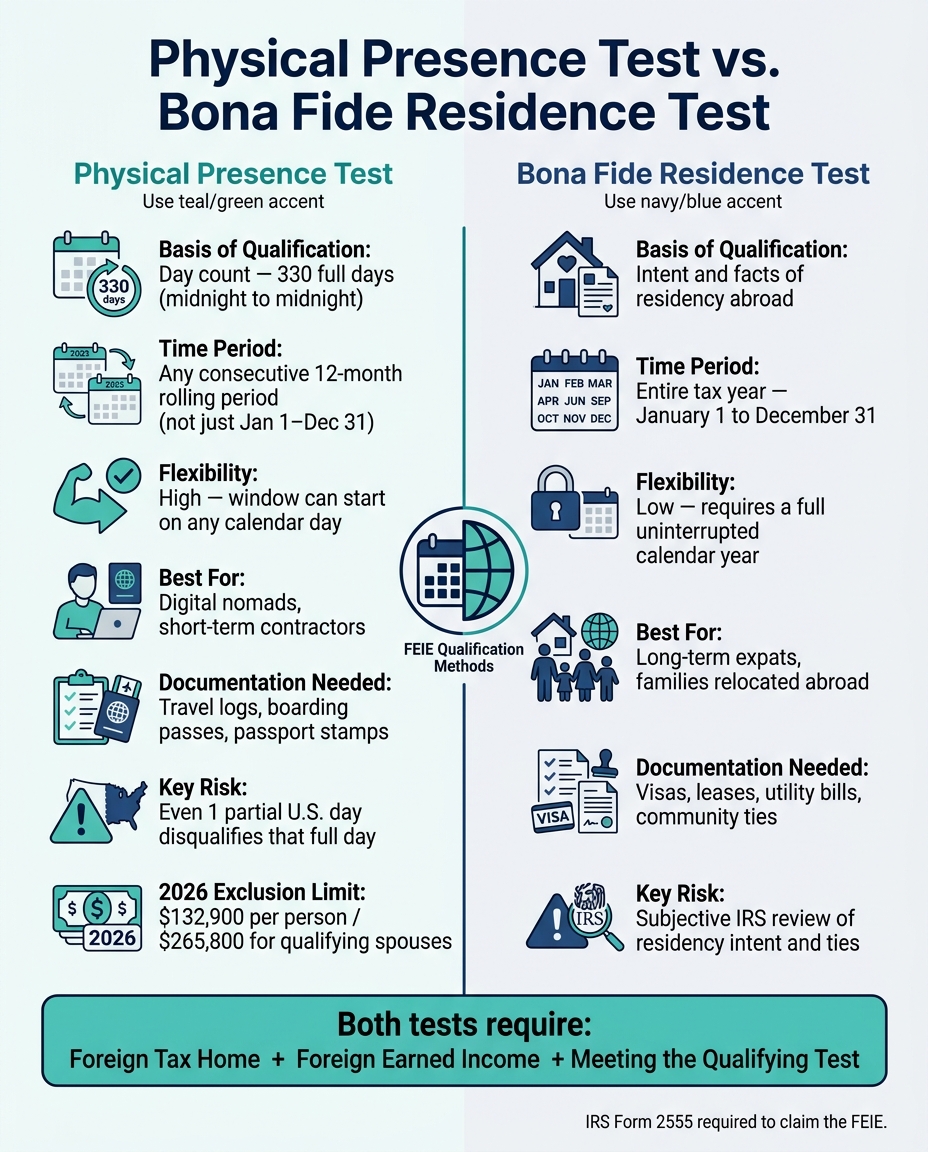
To claim the FEIE under the physical presence test, you need three things: a foreign tax home, foreign earned income – such as wages, salaries, professional fees, or self-employment income from services performed abroad – and at least 330 full days in one or more foreign countries during any 12-month stretch.
That last part gets most of the attention, but the day count by itself doesn’t do the whole job. You still need the tax home and income pieces too. Even so, the day-count rules are where things usually get tricky.
What the 330 full days rule actually means
A full day means midnight to midnight in a foreign country. So if you’re in the U.S. for even part of that day, that day does not count.
The 330 days also don’t have to be back-to-back. You can build them across several trips and across more than one country, as long as every counted day falls inside the same 12-month window.
That’s why the next step is simple in theory but easy to mess up in practice: figuring out which days count and which ones don’t.
What this test does and does not prove
The physical presence test is a day-count test. It does not look at your intent, your local ties, or how settled you are abroad. As Chris Conway, CPA, puts it:
"The physical presence test is purely quantitative. It requires you to be physically present in a foreign country or countries for at least 330 full days during any consecutive 12-month period."
The bona fide residence test works differently. It looks at residency facts and intent, not just your travel calendar. Here’s where the two tests split:
| Feature | Physical Presence Test | Bona Fide Residence Test |
|---|---|---|
| Basis of qualification | Day count (330 full days) | Intent and facts of residency |
| Time period | Any consecutive 12-month period | Entire tax year (Jan 1 to Dec 31) |
| Flexibility | High; can start on any day | Low; requires a full calendar year |
| Best for | Digital nomads, short-term contractors | Long-term expats, families moved abroad |
| Documentation | Travel logs, boarding passes, passport stamps | Visas, leases, utility bills, community ties |
Getting those days right is the next part.
sbb-itb-39d39a6
How to count qualifying foreign days correctly
Before you pick your 12-month window, make sure you’re counting travel days the way the IRS does. This part trips people up all the time.
Days that count toward the 330-day requirement
A day counts only if it’s a full 24-hour period spent entirely in foreign countries. That means the day has to run from midnight to midnight outside the United States.
Travel days can count too, but only when the trip stays fully outside the U.S. For example, flying from France to Germany counts if you’re traveling only between foreign countries and the day falls inside your chosen 12-month window. You can also combine time from different foreign countries to get to 330 days.
Days that do not count, including U.S. travel and partial days
If a day includes any U.S. presence, it doesn’t count. The same goes for days spent in U.S. territories like Puerto Rico, Guam, or the U.S. Virgin Islands, days on international waters, and any day in Antarctica.
"A ‘full day’ for IRS purposes is a period of 24 consecutive hours beginning at midnight. If you are in transit… any day where you are physically on or over international waters – or present in the U.S. for even a portion of the day – typically does not count." – Sam Faulkner, CPA, Get Balanced CPA
In plain English: even a brief U.S. layover can knock out that day. It doesn’t matter if you were there for just a few hours. If you touched the U.S. at any point during that day, that day is out.
Day-count table for common travel scenarios
| Travel Scenario | Counts? | Reason |
|---|---|---|
| Full day spent in Spain | Yes | 100% presence in a foreign country |
| Travel from France to Germany (no U.S. stop) | Yes | The trip stays entirely outside the United States |
| Any day with U.S. presence, even briefly | No | Any U.S. presence disqualifies the full day |
| U.S. layover under 24 hours | No | Physical presence in the United States at any point during the day |
| Day on a vessel in international waters | No | International waters are not a foreign country |
| Full day in Puerto Rico or Guam | No | U.S. territories do not qualify as foreign countries |
| A day in Antarctica | No | Antarctica is not under foreign government jurisdiction |
| Crossing the International Date Line | Varies | Use the local date at your location |
A smart buffer helps here. Aim for 340 to 350 foreign days so a flight delay, surprise stop, or simple counting mistake doesn’t put your 330-day test at risk.
Once you know which days count, compare 12-month windows to find the one that gets you to 330 fastest.
How to choose the best 12-month period to qualify
Now that you know which days count, the next job is simple: pick the 12-month window that gets you to 330 full foreign days as fast as possible. The physical presence test uses a rolling 12-month window, not the calendar year.
That detail matters more than most people think. You’re not stuck with January through December. You can choose the 12-month span that gives you the best shot at qualifying.
How to test different 12-month windows
Start with one date. Then count only the full foreign days in the next 12 months and see whether you hit 330. If you come up short, shift the window forward or backward and test again.
Why bother with small changes? Because a few travel days can make or break the result. If you move the start date by a week, or even a few days, you may push a cluster of U.S. trips outside the period. That can be enough to get you over the line.
This is why it helps to test overlapping windows instead of locking yourself into the first one that seems close.
How overlapping periods can improve FEIE eligibility
If you’ve been abroad for a long stretch, you can test more than one 12-month period. And you can use a different qualifying window for different tax years.
For example, your 2025 return might use a March-to-March window, while your 2026 return uses an April-to-April window to pull in more qualifying days under the higher 2026 exclusion limit.
There’s one catch: if your chosen window crosses two tax years, the exclusion is prorated based on the number of qualifying days that fall inside each tax year.
Comparison table for alternative 12-month windows
The examples below show how the same travel pattern can pass or fail depending on the window you choose.
| Start Date | End Date | Foreign Days | U.S. Days | Qualifies? |
|---|---|---|---|---|
| Jan 1, 2026 | Dec 31, 2026 | 325 | 40 | No |
| Feb 10, 2026 | Feb 9, 2027 | 332 | 33 | Yes |
| May 1, 2025 | Apr 30, 2026 | 340 | 25 | Yes |
| Oct 1, 2025 | Sep 30, 2026 | 335 | 30 | Yes |
The first row fails because it does not reach 330 full foreign days. In the second row, shifting the start date to February 10 pushes enough U.S. days out of the period to clear the test. Same person, same trips, different window.
Once you choose the best period, build a travel log that shows each counted day before you file Form 2555.
How to track, document, and verify your physical presence before claiming the FEIE
Once you’ve picked your 12-month window, the next job is proof. This is where many people slip up. Counting days is one thing. Showing the IRS exactly where you were on those days is another.
The IRS wants records that show both location and timing. So don’t rely on a rough calendar or your memory from six months ago.
How to build a travel log that holds up under IRS scrutiny
The biggest rule is simple: record your travel as it happens, not months later. A log rebuilt from memory right before filing carries much less weight with the IRS than one kept in real time.
For each entry, log:
- the date
- the location
- arrival and departure time
- the day type: Full Foreign Day, U.S. Day, Partial Travel Day, or Non-Qualifying Day
Your log also needs backup. Passport stamps help, but they are often incomplete. Some countries use electronic entry systems, and that can leave you with no physical stamp at all. That’s why it helps to stack records together.
Good supporting records include boarding passes, hotel receipts, foreign lease agreements, and bank or credit card statements that show local purchases. One record may have gaps. A set of matching records tells a much stronger story.
Store everything in a secure digital folder by tax year. Keep records for at least three years; six is safer.
How to run a pre-filing FEIE self-check
Before you file, go through this four-point review:
| Step | What to Verify | Disqualifying Factor |
|---|---|---|
| Day Count | Confirm your log totals 330 full foreign days | Transit days over international waters do not count. |
| 12-Month Window | Confirm the chosen window supports the return year | The window does not contain 330 qualifying foreign days. |
| Tax Home | Confirm your tax home is in a foreign country | Maintaining your primary abode in the U.S. |
| Income Type | Confirm the income is earned income from personal services | Passive income like dividends, interest, or rent doesn’t qualify. |
If you haven’t yet reached 330 days by the regular filing deadline, you can file Form 2350 to ask for an extension until you meet the rule.
Documentation strength table for audit readiness
Not all records carry the same weight. Think of it like building a case: the more your records line up, the better.
| Evidence Type | Strengths | Limitations |
|---|---|---|
| Passport Stamps | Primary evidence; highly credible to the IRS | Electronic immigration gates in many countries produce no physical stamp. |
| Boarding Passes | Proves exact flight times and helps identify partial U.S. days | Only proves the flight occurred, not the duration of your stay. |
| Foreign Leases / Hotel Receipts | Strong proof of physical presence in a specific foreign location | Doesn’t account for short trips away from your primary foreign address. |
| Bank / Credit Card Statements | Shows a geographic trail of local activity | May not reflect daily movements. |
| Employer Letters | Confirms overseas assignment and work location | Less useful for self-employed individuals or digital nomads seeking tax and residency solutions. |
| Real-Time Travel Log | Strongest when kept in real time | Weak if reconstructed after the fact rather than maintained as events occur. |
Use your log and supporting records to check eligibility before filing Form 2555.
Conclusion: Key steps to pass the physical presence test
After you count your days and check your windows, do a few final checks. Passing the physical presence test comes down to one main rule: 330 full 24-hour days in a foreign country (midnight to midnight) during one consecutive 12-month period.
Use the best rolling 12-month window, not just January 1 through December 31. It’s smart to test several rolling windows before you file.
One extra day in the United States can knock out the whole period. That line matters because the 2026 FEIE limit is $132,900 per person, or $265,800 for qualifying spouses.
Give yourself a cushion of 340 to 350 foreign days. Build that cushion into your travel plan before you travel.
With accurate day counts, the right 12-month window, and solid records, you can confirm that you qualify before filing Form 2555.
FAQs
What if I reach 330 days after the tax filing deadline?
If you haven’t reached the 330-day mark by the usual tax filing deadline, you can ask for more time with Form 2350. That gives you extra time to file until you’ve spent enough qualifying days abroad to meet the physical presence test.
Once you meet the test, you can file and claim the Foreign Earned Income Exclusion. If you already filed your return, you may still be able to claim it by submitting an amended return.
Can I switch to a different 12-month window for a later tax year?
Yes. You can pick a different 12-month window for each tax year to get the most from your exclusion.
The 330-day requirement does not need to line up with the calendar year. You can use any consecutive 12-month period that best matches your travel and income for the tax year you’re filing.
That period can be:
- different from the one used in another tax year
- overlapping with a prior period
- completely separate in a later year
What records should I keep if my passport wasn’t stamped?
If your passport wasn’t stamped, keep other records that show you were outside the United States. A detailed travel log can help a lot here. Write down where you were each day and keep it up to date.
Back that up with documents like boarding passes, flight confirmations, travel itineraries, lease agreements, hotel receipts, work logs, and foreign bank or credit card statements that show purchases in your host country.
