
_For 2026, I can exclude up to _$132,900_ of qualifying foreign earned income from U.S. federal income tax if I meet the FEIE rules._* If my spouse also qualifies, we may exclude up to $265,800 combined. But this tax break only applies to earned income from work done outside the United States.
Here’s the short version:
- 2026 FEIE limit: $132,900 per qualifying person
- Who may claim it: U.S. taxpayers with a foreign tax home who meet either:
- the bona fide residence test, or
- the physical presence test
- Physical presence rule: at least 330 full days abroad in a 12-month period
- What counts: wages, salary, bonuses, fees, and self-employment income for work performed in a foreign country
- What does not count: dividends, capital gains, rent, pensions, Social Security, and pay for work done while in the U.S.
- How to claim it: file Form 2555 with Form 1040
- Big catch: the FEIE does not remove 15.3% self-employment tax
A few points matter more than most people think. Where I physically work controls whether income can qualify. If I work from the U.S., that income does not qualify, even if a foreign company pays me. And if I miss the day-count test by even one day, I may lose the exclusion for that period.
The bottom line: the 2026 FEIE can lower my U.S. income tax, but only if my tax home, travel days, and records all line up with IRS rules.
Who Qualifies for the FEIE in 2026
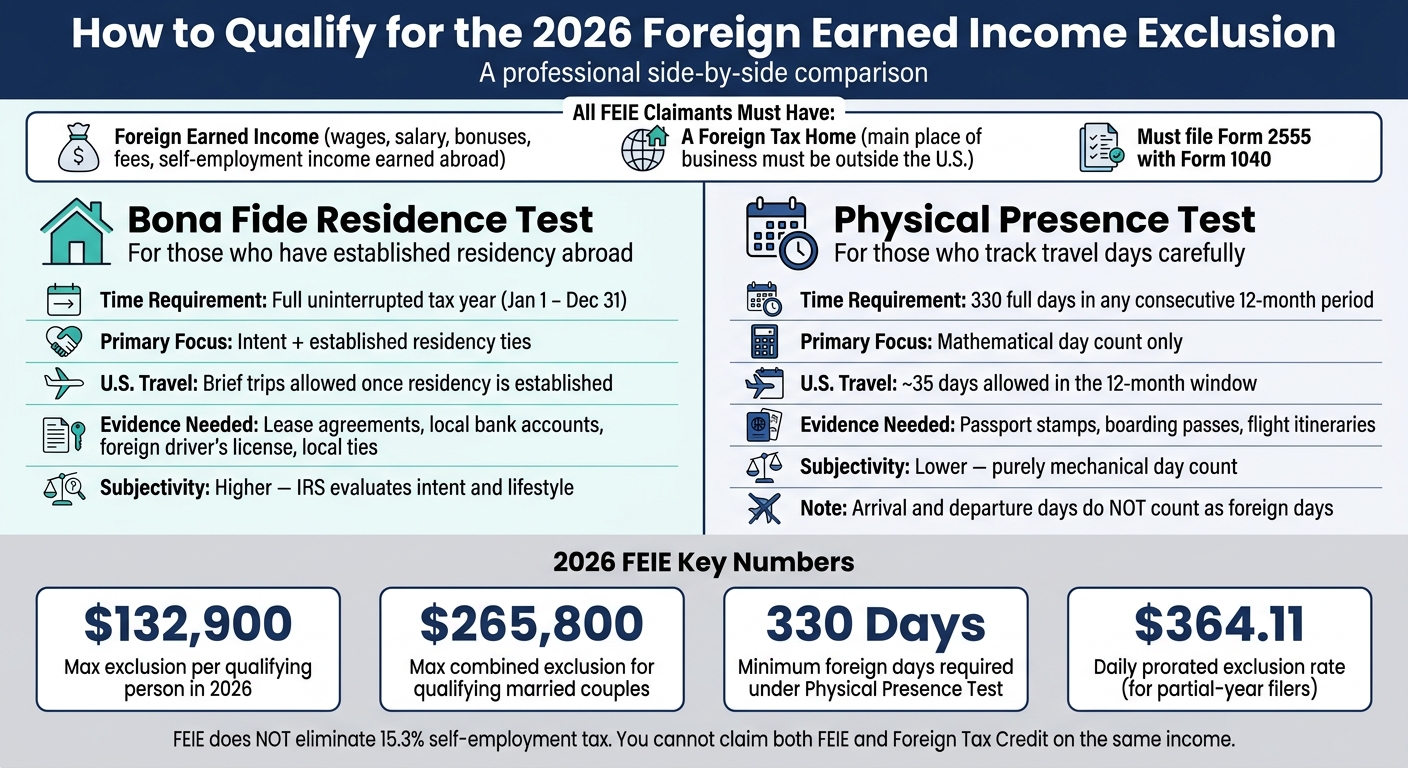
FEIE 2026: Bona Fide Residence vs. Physical Presence Test Explained
The 2026 exclusion amount matters only if you pass the FEIE rules. To claim the FEIE in 2026, you need foreign earned income, a foreign tax home, and you must meet either the Bona Fide Residence Test or the Physical Presence Test.
Foreign Earned Income and the Foreign Tax Home Requirement
Foreign earned income means pay for services you physically perform in a foreign country. That includes wages, salaries, bonuses, commissions, professional fees, and self-employment income. The location of your employer doesn’t control this. What counts is where you did the work.
Your tax home is usually your main place of business or employment. If your personal and economic ties are still centered in the United States, the IRS may view your abode as U.S.-based. If that happens, you may not have a foreign tax home at all.
Bona Fide Residence Test: Living Abroad for a Full Tax Year
This test looks at whether you actually built residency in another country, not just how many days you spent there. You must be a bona fide resident of a foreign country for an uninterrupted period that includes one full tax year, from January 1 through December 31.
The IRS looks at things like your intent, whether you set up a permanent home, and how strong your local ties are. That can include a lease, local bank accounts, or a foreign driver’s license.
Brief trips back to the United States are allowed after bona fide residence is in place. Since this test turns in part on intent, it’s more subjective than the Physical Presence Test.
Physical Presence Test: 330 Full Days in a 12-Month Period
This test is much more mechanical. You must be physically present in a foreign country for at least 330 full days during any consecutive 12-month period. A full day means a 24-hour stretch from midnight to midnight, and arrival and departure days usually don’t count as foreign days.
The 12-month period does not need to line up with the calendar year, which gives you some room to choose a rolling window that fits your travel pattern. In practice, that usually leaves you with about 35 days in the United States during that window, and days you miss still count against you. For those working while traveling, understanding digital nomad taxes is essential to staying compliant.
| Feature | Bona Fide Residence Test | Physical Presence Test |
|---|---|---|
| Primary Focus | Intent and established residency ties | Mathematical day count (330 full days) |
| Time Requirement | Full tax year (January 1 through December 31) | Any consecutive 12-month period |
| U.S. Travel | Brief trips allowed once residency is established | Limited to about 35 days in the United States during the window |
Once you meet these tests, the next step is figuring out which income the FEIE can exclude.
What Income the FEIE Covers and What It Does Not
Even if you qualify for the FEIE, not all income makes the cut. The rule is pretty direct: only income from work you perform while you are physically in a foreign country can be excluded.
So the key issue isn’t just who pays you. It’s where you were when you did the work.
Income That Typically Qualifies for the FEIE
Income from personal services usually qualifies if you earned it while working abroad. That includes wages, salaries, bonuses, commissions, professional fees, and self-employment income.
Here’s the big catch: if you do the work while physically in the United States, that income is treated as U.S.-sourced. It does not qualify for the FEIE, even if the company paying you is based overseas.
Income That Does Not Qualify for the FEIE
The FEIE does not apply to passive income. That means interest, dividends, capital gains, rent, pensions, annuities, and Social Security are all outside the exclusion. U.S. government pay is also excluded from FEIE treatment.
If you own an S-corp, there’s another line to watch. Only W-2 wages can qualify. Distributions cannot.
How the $132,900 Cap Applies When Income Exceeds the Limit
The FEIE has a hard cap. For 2026, that cap is $132,900. If your qualifying foreign earned income goes above that amount, the extra income stays taxable.
For example, if you earn $175,000 in qualifying foreign wages in 2026, only $132,900 can be excluded. The remaining amount is still taxable.
There’s one more wrinkle here: the stacking rule. Even though excluded income isn’t taxed directly, it still counts when the IRS figures out your tax bracket. In plain English, that can push your other income into a higher tax rate.
sbb-itb-39d39a6
How the FEIE Works in Practice for 2026 Filers
The examples below show how the FEIE works after you meet the tax home and residency tests.
Example 1: U.S. Employee Living Abroad for the Full Year
Say a U.S. employee works abroad for the full year. If she meets the Bona Fide Residence Test, she can exclude up to $132,900 of foreign earned income from U.S. federal income tax.
That said, not all income gets this treatment. Any U.S. dividend income she receives is not excluded. And the stacking rule still applies, which means the excluded income is still counted when figuring the tax rate on her other taxable income.
If her spouse also qualifies, the spouse can claim the same exclusion separately.
Example 2: Digital Nomad with U.S. and Foreign Workdays
Things change when work is split between the United States and abroad.
Consider Marcus, a software developer who earned $180,000 in 2026 while traveling through Southeast Asia. By tracking enough foreign days and filing Form 2555 within a qualifying 12-month period, Marcus excluded part of his income. But only the income tied to foreign workdays qualified.
For 2026, the daily prorated exclusion rate is about $364.11 ($132,900 divided by 365 days). So if you’re abroad for only part of the year, your exclusion is prorated based on the number of qualifying days.
Form 2555, the Stacking Rule, and Self-Employment Tax
To claim either result, the taxpayer must file Form 2555.
You must claim the FEIE on Form 2555 and file it with your Form 1040 each year. If you revoke the election, you generally can’t elect it again for five years unless the IRS gives consent.
One more thing: the FEIE does not remove self-employment tax.
Common FEIE Mistakes to Avoid and Key Takeaways
Meeting the basic FEIE tests doesn’t always mean you’re in the clear. A filing slip-up can shrink the exclusion or wipe it out entirely.
Errors That Lead to Denied or Reduced Exclusions
The IRS often rejects FEIE claims when your tax home or abode still looks like it’s in the U.S. That comes up a lot when a spouse, children, and your main personal and economic ties stay in the U.S.
Day-count errors are another common problem. Miss the 330-day mark by even one day, and you can lose the exclusion for that period. That’s a brutal rule, but it’s how the test works.
There’s also a double-dipping rule to watch. You can’t claim the FEIE and the Foreign Tax Credit on the same income. And if you revoke an FEIE election, you usually can’t claim it again for five years unless the IRS says yes.
Records to Keep When Filing a 2026 FEIE Claim
The fix is pretty straightforward: keep records that show where you lived and where you worked.
| Record Category | Specific Documents to Retain |
|---|---|
| Travel | Passport stamps, boarding passes, flight itineraries, credit card statements |
| Residency | Lease agreements, utility bills, local ID cards, local driver’s licenses |
| Income | W-2s, 1099s, invoices, payroll slips, records of days worked inside vs. outside the U.S. |
It also helps to update your day-count records all year long instead of trying to rebuild everything at tax time.
Conclusion: Is the FEIE the Right Move for You in 2026?
For 2026, the FEIE exclusion is $132,900 per qualifying taxpayer. That can cut your U.S. federal income tax, but it isn’t always the best play.
If the country where you live taxes income at a higher rate than the U.S., the Foreign Tax Credit may fit better. And if the FEIE wipes out all of your earned income, you may lose the option to contribute to an IRA for that year.
For 2026, the FEIE works only if your eligibility, your records, and Form 2555 all match up.
FAQs
Can I use the FEIE if I work remotely while visiting the U.S.?
Generally, no. The FEIE only applies to income you earn for services performed while you are physically in a foreign country. So if you do work while you’re in the United States, that income doesn’t qualify.
Time in the U.S. can also hurt your eligibility under the physical presence test. Those days count against the 330 full days you need to meet that rule. And if your tax home or abode stays in the U.S., you may not qualify for the FEIE at all.
Should I claim the FEIE or the Foreign Tax Credit?
It depends. You can’t use the FEIE and Foreign Tax Credit on the same income.
The FEIE can exclude up to $132,900 of qualifying foreign earned income in 2026, but it can limit other tax breaks. The Foreign Tax Credit gives you a dollar-for-dollar credit for foreign taxes paid, can apply to both earned and passive income, and is often the better pick in high-tax countries. Because FEIE revocation rules are restrictive, careful planning matters.
What if I fail the 330-day test by one day?
If you miss the 330-day requirement by even one day, you do not pass the Physical Presence Test.
It’s a strict math-based rule. So being short by just 24 hours can knock out your entire exclusion for that period.
That means you may not qualify for the Foreign Earned Income Exclusion under this test, which can lead to an unexpected tax bill. You may still qualify under the Bona Fide Residence Test.
