
When managing offshore assets or running global businesses, understanding data privacy laws is as crucial as tax compliance. These laws protect sensitive information like trust documents and financial records while ensuring compliance with global standards like FATCA and CRS. Here’s a quick breakdown of key points:
- Global Shift: By 2026, 79% of nations will have data protection laws, reflecting the growing importance of financial data security.
- Offshore Jurisdictions: Locations like the Cayman Islands, Nevis, Cook Islands, Seychelles, and Belize offer tailored privacy frameworks that balance confidentiality with global compliance.
- Key Examples:
- Cayman Islands: GDPR-aligned laws with strict breach notification rules.
- Nevis: Strong barriers against foreign judgments and tight confidentiality for trusts.
- Cook Islands: Criminalizes unauthorized disclosures and rejects foreign court orders.
- Seychelles: Evolving transparency measures while maintaining zero tax on foreign income.
- Belize: Combines GDPR-style protections with fast asset security.
Why It Matters: Offshore data privacy laws shield assets from legal risks through offshore asset protection while adhering to international transparency. Striking the right balance ensures long-term security and compliance.
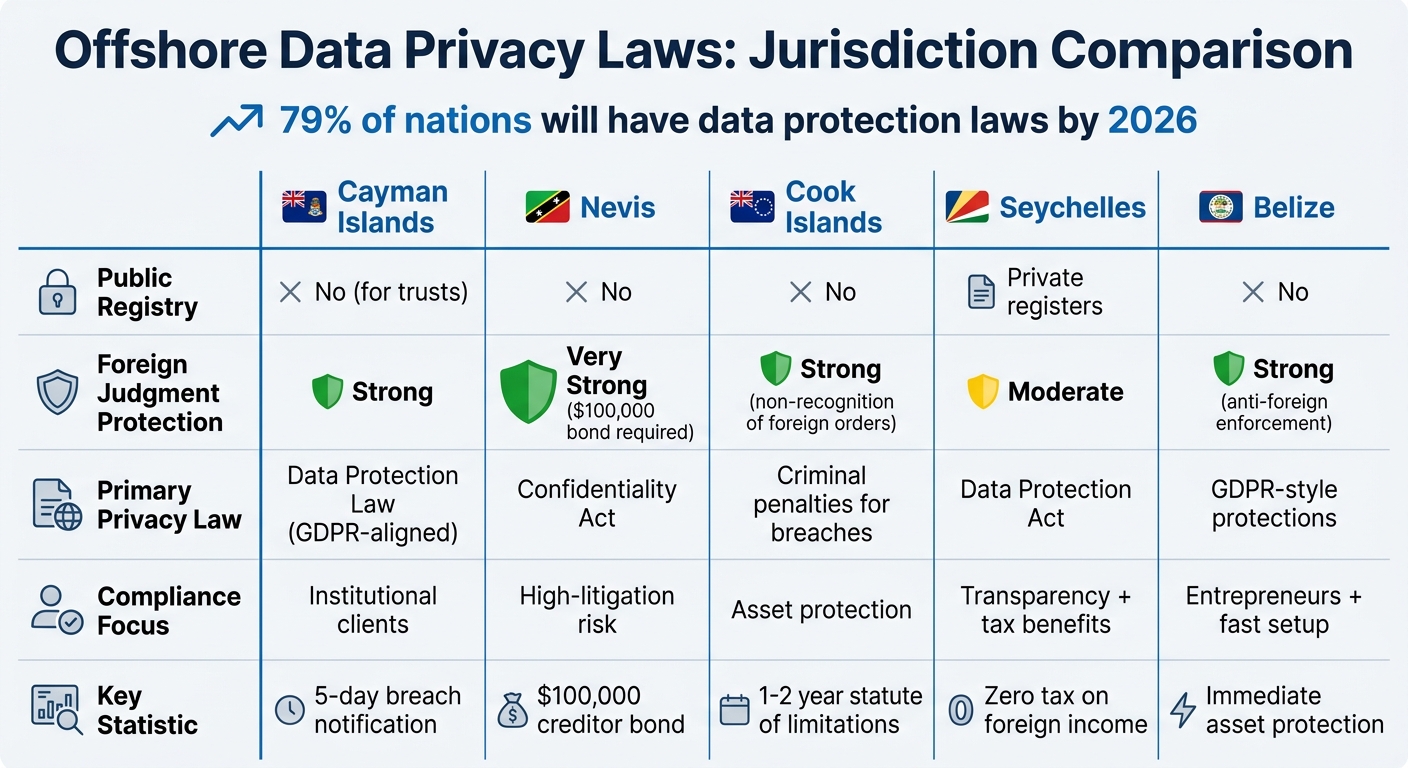
Quick Comparison:
| Jurisdiction | Public Registry | Foreign Judgment Protection | Privacy Strength | Compliance Focus |
|---|---|---|---|---|
| Cayman Islands | No (for trusts) | Strong | Data Protection Law (GDPR-like) | Institutional clients |
| Nevis | No | Very strong | Confidentiality Act | High-litigation risk |
| Cook Islands | No | Strong | Criminal penalties for breaches | Asset protection |
| Seychelles | Private registers | Moderate | Data Protection Act | Transparency + tax benefits |
| Belize | No | Strong | GDPR-style protections | Entrepreneurs + fast setup |
These frameworks cater to different needs, from high-risk asset protection to compliance with global standards. Offshore privacy laws are evolving, and staying informed is key to safeguarding your financial footprint.
Cayman Islands: Confidentiality and Data Privacy Framework
The Cayman Islands has established itself as a leader in data privacy within the Caribbean, offering a well-structured legal framework designed to protect personal information. This system is anchored by the Data Protection Law (DPL), which took effect on September 30, 2019, and the Confidential Information Disclosure Act (CIDA) of 2016. Together, these laws provide layered protections, incorporating elements of trust law to address specific needs. Bedell Cristin has described this framework as "the most comprehensive data protection regime in the region".
The DPL requires data controllers to adhere to eight key principles, including fair processing, purpose limitation, data minimization, accuracy, and storage limitation. Additionally, organizations must implement suitable technical and organizational safeguards to protect personal data. If a data breach occurs, companies are obligated to inform both the Office of the Ombudsman and affected individuals within five working days.
One unique aspect of the DPL is its treatment of trust-related data. Personal data tied to trusts established under the Trusts Act is exempt from certain provisions, such as the standard right of access and notification requirements. This exemption balances two competing interests: beneficiaries’ rights to information about their interests and the need to protect trustees’ discretionary decision-making, including sensitive documents like letters of wishes.
The CIDA of 2016 complements the DPL by addressing confidentiality violations as civil, rather than criminal, matters. This allows affected parties to seek damages in cases of privacy breaches. Under CIDA, confidential information includes any data related to property where a duty of confidence exists, provided the information is not already public. Disclosure is tightly controlled and allowed only under specific circumstances, such as with consent, a court order, a request from Cayman Police, or when required by law.
sbb-itb-39d39a6
Nevis: Strong Confidentiality Protections
Nevis stands out for its impressive privacy protections, thanks to two cornerstone laws: the Nevis Business Corporation Ordinance (NBCO) of 1984 and the Nevis International Exempt Trust Ordinance (NIETO). Together, these laws ensure multiple layers of confidentiality, keeping beneficial ownership details out of public records and limiting access for foreign authorities.
The NBCO offers companies significant privacy advantages. Businesses registered under this ordinance are not required to disclose shareholders, directors, or officers, nor must they file annual reports. Additionally, they are exempt from Nevisian taxes. According to Hanver Trust Company, companies conducting legitimate business under the NBCO enjoy full protection under Nevis’s Confidentiality Act. Any unauthorized disclosure of information is treated as a civil offense, with penalties that include damages.
The NIETO provides similar privacy for trusts. Key details – such as the names of settlors and beneficiaries – remain entirely confidential. When registering a trust, only minimal information is required: the trust’s name, the registered office address, and the trustee’s name. The Nevis Financial Services Regulatory Commission affirms:
"All non-criminal judicial proceedings relating to the international trust shall be heard in private and that no details may be published without leave of the court".
While anti-money laundering (AML) and counter-financing of terrorism (CFT) regulations require Registered Agents to maintain accurate records of beneficial owners (including settlors, trustees, and beneficiaries), this data remains securely private, balancing compliance with client confidentiality.
Nevis further enhances these protections with strict legal barriers against foreign judicial interference. The island does not recognize foreign judgments. Creditors looking to challenge a trust must start fresh legal proceedings in Nevis courts, post a $100,000 bond, and meet a high evidentiary standard – clear and convincing proof of fraudulent disposition. This criminal-law standard is far stricter than typical civil litigation requirements. Additionally, fraudulent transfer claims are subject to a short statute of limitations of just 1–2 years from the date of asset transfer. On top of these safeguards, Nevis trusts are entirely tax-exempt on all income derived from foreign sources.
These robust confidentiality measures and legal protections make Nevis a prime jurisdiction for structuring offshore trusts for asset protection.
Cook Islands: Data Privacy and Foreign Judgment Protection
The Cook Islands stands out when it comes to offshore data privacy laws, thanks to its robust legal framework designed to protect sensitive asset information. The International Trusts Act (ITA), originally enacted in 1984 and updated in 2004, is at the core of this protection. Under Section 23 of the ITA, it’s a criminal offense to disclose any information about the creation or affairs of an international trust to anyone not authorized to receive it. This strict rule discourages unauthorized disclosures in a serious way.
One key feature of the Cook Islands’ approach is the absence of a public trust registry. This ensures complete anonymity for those involved. Blake Harris, Founding Attorney at Blake Harris Law, explains the significance of this:
"Trust documents in the Cook Islands are not filed publicly, ensuring utmost discretion. The settlor’s identity can be kept private, adding another layer of confidentiality".
Additionally, any court proceedings involving international trusts are conducted privately, which means financial details remain out of public view.
The Cook Islands also offers unique protection against foreign judgments. Section 13D of the ITA explicitly prevents local courts from recognizing or enforcing foreign judgments if they conflict with the ITA. For example, a U.S. court order has no authority in the Cook Islands. Creditors must start fresh legal proceedings within the jurisdiction, which can be both costly and challenging. This legal hurdle, combined with strict privacy rules, creates a powerful shield for asset protection.
Creditors face further obstacles when pursuing claims. They must prove beyond a reasonable doubt that a transfer was fraudulent, and claims must be filed within one to two years. If a transfer occurred two or more years after the creditor’s claim arose, the law assumes there was no fraudulent intent – a presumption that cannot be overturned.
The 2004 amendments to the ITA reinforced these protections, making it even harder to disclose offshore trust details unless explicitly ordered by a court. While the Cook Islands complies with international tax reporting standards like FATCA and CRS, it maintains a strong commitment to safeguarding trust data. This balance between global compliance and confidentiality highlights the jurisdiction’s effectiveness in protecting sensitive financial information.
Seychelles: Compliance with the Data Protection Act
The Seychelles operates under the Data Protection Act (Act 9 of 2003), which lays out the rules for managing personal data in this well-known offshore hub. While the country has traditionally been seen as a classic offshore destination – offering zero tax on foreign income and minimal reporting obligations – recent reforms have introduced the requirement for offshore companies to maintain accounting records. This shift signals a move toward greater transparency.
These adjustments are part of a global trend where data protection laws are adapting to keep up with technological advancements and the increasing overlap with cybersecurity. This rapid pace of regulatory change presents challenges for offshore businesses. As DLA Piper notes, "Data protection and privacy laws continue to evolve at pace, reflecting responses to technological change, increasing data‑driven business models and heightened expectations around accountability and enforcement". For businesses operating in Seychelles, staying ahead of jurisdiction-specific reforms is crucial.
Seychelles now occupies a unique position among offshore jurisdictions. Like the British Virgin Islands, Panama, and the Cayman Islands, it offers tax benefits while steadily introducing stricter record-keeping requirements. However, unlike low-tax jurisdictions such as Hong Kong and Singapore – where formal tax returns and audits are mandatory – Seychelles retains its no-tax policy while embracing new measures for transparency. For businesses and investors focused on asset protection, this combination of zero tax and evolving compliance standards presents both opportunities and challenges.
Belize: Trusts and Data Protection Safeguards
Belize offers a unique blend of asset protection and privacy laws. The Trusts Act serves as a robust barrier against foreign court orders, while the Data Protection Act (Act No. 45 of 2021) introduces GDPR-style protections for personal and financial data. Together, these laws create a strong framework for safeguarding assets and sensitive information.
The Trusts Act stands out for three main reasons:
- It blocks the enforcement of foreign judgments against Belizean trusts, forcing creditors to pursue claims within Belize.
- Asset protection kicks in immediately once the trust is funded.
- It shortens the statute of limitations for fraudulent transfer claims.
As Blake Harris, Founding Attorney at Blake Harris Law, explains:
"Belize has established a reputation for providing robust privacy protections alongside cost-effective trust structures."
On the privacy side, the Data Protection Act classifies financial records as "sensitive personal data." It enforces strict security measures, requires breach notifications within 72 hours, and allows individuals to access, correct, or delete their data. Non-compliance can result in fines of up to $10,000 USD for false statements. Additionally, Belize does not maintain a public trust registry, keeping settlor and beneficiary identities confidential.
Small businesses gain an added advantage: those with annual revenues under $1.5 million USD are generally exempt from the Data Protection Act unless operating in sensitive areas like healthcare or credit reporting. This setup makes Belize particularly appealing to entrepreneurs handling bank accounts, securities, or cryptocurrency, offering fast asset protection with minimal administrative hurdles.
Comparison of Data Privacy Features Across Jurisdictions
This section breaks down the key privacy and protection features across various offshore jurisdictions, highlighting how each one balances privacy, asset security, and regulatory requirements.
The Cayman Islands stands out with its Data Protection Act, which aligns with global standards like GDPR. This makes it a go-to choice for institutional clients who prioritize strict compliance measures.
In contrast, Nevis and the Cook Islands emphasize robust defenses against foreign judgments. Nevis requires creditors to post a hefty US$100,000 bond before taking legal action against a trust. Meanwhile, the Cook Islands enforces a short one-to-two-year statute of limitations on fraudulent transfer claims and demands a "beyond a reasonable doubt" standard of proof – an unusually high bar for civil cases. Both jurisdictions also take privacy seriously, going as far as criminalizing unauthorized disclosure of trust information.
Blake Harris highlights the Cook Islands’ approach:
"The Cook Islands International Trusts Act… helped make the Cook Islands one of the offshore jurisdictions with the strongest privacy laws… by banning people from disclosing information about offshore trusts unless a court ordered it."
The table below provides a clear comparison of these features across jurisdictions:
| Jurisdiction | Primary Law | Public Registry | Foreign Judgment Protection | Max Penalty | Ideal For |
|---|---|---|---|---|---|
| Cayman Islands | Data Protection Act | No (for trusts) | Strong (STAR regime) | US$305,000 fine; 5 years imprisonment | Institutional compliance and fund managers |
| Nevis | International Exempt Trust Ordinance | No | Very strong (US$100,000 bond required) | Rigorous sanctions | High-litigation risk scenarios |
| Cook Islands | International Trusts Act | No | Strong (non-recognition of foreign orders) | Criminal penalties for unauthorized disclosure | Asset protection with strict confidentiality |
| Seychelles | Data Protection Act | Private registers | Moderate to high | Not specified | Balanced privacy and compliance |
| Belize | Data Protection Act (2021) | No | Strong (anti-foreign enforcement) | Not specified | Cost-effective privacy with fast asset protection |
Each jurisdiction offers tailored solutions depending on your needs. For instance, Belize provides GDPR-style protections at a lower cost, while the Cook Islands and Nevis focus on unparalleled asset protection and privacy. The Cayman Islands, on the other hand, is ideal for those requiring compliance with international standards.
Liechtenstein and Switzerland: European Offshore Privacy Standards
Liechtenstein and Switzerland have carved out reputations for their stringent offshore privacy standards, achieved through distinct legal frameworks that balance strong data protection with confidential asset management. These approaches reflect a broader European trend of combining regulatory oversight with privacy safeguards in offshore financial activities.
In Liechtenstein, the Persons and Companies Act (PGR) creates clear distinctions between operational businesses and wealth-holding entities. For instance, private-benefit foundations under Article 552 § 20 are not required to register publicly if they avoid commercial activities. Instead, they only need to notify the Office of Justice about their establishment. Similarly, trust settlors have the choice of public registration or submitting a certified extract of the trust deed, which confirms the trust’s existence without disclosing its internal structure. As a result, details like foundation deeds and beneficiary information remain protected from public access.
Marco Felder and Thomas Stern of BPBergt & Partner AG summarize this approach well:
"Liechtenstein therefore combines formal control through filing obligations with a high level of discretion vis-à-vis the general public."
This unique combination of mandatory filings and private disclosures makes Liechtenstein stand out. Switzerland, on the other hand, employs a dual framework to uphold confidentiality alongside data protection.
Switzerland’s system is anchored by the Federal Act on Data Protection (FADP) and strict banking secrecy laws under Article 47 of the Banking Act. The FADP enforces principles like transparency, purpose limitation, and proportionality in data handling, applying to all activities within Swiss jurisdiction. Complementing this, banking secrecy laws impose severe penalties for unauthorized disclosures of client information, with fines reaching up to CHF 250,000 (approximately US $277,500). Meanwhile, Liechtenstein’s penalties for GDPR violations can soar as high as CHF 22 million (around US $24.4 million) or 4% of global turnover.
Liechtenstein also bolsters privacy through its Register of Beneficial Owners (VwbP), which remains accessible only to domestic authorities and foreign entities under specific international agreements. This system exemplifies what Felder and Stern describe as "justified transparency", ensuring regulatory compliance while safeguarding individual privacy.
Emerging Trends and Global Compliance Challenges
Offshore jurisdictions are stepping up their game in data privacy to align with international standards. Bermuda’s Personal Information Protection Act (PIPA) officially took effect on January 1, 2025, introducing a detailed regulatory framework that impacts all organizations – whether individuals, entities, or public authorities – that handle personal information. The penalties under PIPA are steep: fines can go up to $250,000 for organizations and $25,000 for individuals, with the latter also facing up to two years of imprisonment.
This shift marks a major regulatory milestone for Bermuda, transitioning from common law privacy protections to a statutory model that aligns with both the EU’s GDPR and the UK’s Data Protection Act. Roger James of Ogletree Deakins highlights the broader implications of this change:
"The implementation of PIPA will allow Bermuda to apply for ‘adequacy’ status from the European Union (EU)… an important step for Bermuda to place it on an even playing field with competitor jurisdictions".
Achieving adequacy status would facilitate the free flow of personal data between EU member states and Bermuda, removing the need for additional, often expensive, safeguards. This adjustment reflects a broader global push toward balancing robust data protection with international transparency, setting the stage for new compliance challenges in offshore data privacy practices.
Balancing Confidentiality and Transparency
The Common Reporting Standard (CRS) and other international disclosure requirements have created a tension between the traditional confidentiality offered by offshore jurisdictions and the transparency now demanded globally. PIPA addresses this by requiring organizations to establish a valid "condition of use" for personal data, which includes compliance with international regulatory and disclosure obligations.
A key requirement under PIPA is the appointment of a mandatory privacy officer tasked with ensuring compliance and serving as the liaison with the Bermuda Privacy Commissioner. Notably, the Privacy Commissioner has been granted enforcement powers to issue orders directly, bypassing the need for Supreme Court litigation.
To strengthen compliance efforts, offshore entities are encouraged to form privacy committees that include Board and Executive members. Gretchen Tucker of BeesMont Law Limited underscores this point:
"Compliance is necessary to improve resilience and ensure operational continuity in the face of the current and future threat landscape".
Organizations are also advised to conduct tabletop exercises – simulated scenarios of cybersecurity incidents – to ensure they can meet breach notification deadlines.
Accountability and Personal Liability
A growing focus on accountability is reshaping the regulatory landscape. Under PIPA, corporate officers can be held personally liable if an offense occurs with their consent, involvement, or negligence. This mirrors similar provisions in other jurisdictions, such as the British Virgin Islands and Cayman Islands, where fines can reach $500,000 and $305,000, respectively, alongside potential imprisonment. Bermuda’s approach signals a clear move toward holding individuals responsible for corporate compliance failures.
These developments highlight a pivotal shift: offshore jurisdictions are recalibrating their traditional privacy strengths to meet the transparency demands of modern global compliance standards.
Conclusion
Data privacy laws in offshore jurisdictions play a key role in protecting assets for both businesses and individuals. These laws act as a safeguard, controlling who can access details about your financial assets and trusts.
As discussed earlier, the legal frameworks in places like the Cook Islands and Nevis have made significant strides. These jurisdictions now offer a combination of strict data privacy and firewall legislation that helps shield assets from foreign court orders. For example, Nevis requires creditors to post a hefty $100,000 bond before they can even initiate legal proceedings. Similarly, in the Cook Islands, claims related to fraudulent transfers must be filed within a tight window of 1 to 2 years.
However, strong privacy measures alone aren’t enough. Without adhering to global standards, such as FATCA and CRS, even the best privacy laws can backfire, leaving individuals exposed to severe penalties. These fines can erode the very asset protection you’re aiming to secure.
Jurisdictions that align with global frameworks like the EU’s GDPR strike the right balance. They offer confidentiality while maintaining international credibility, ensuring that legitimate asset protection doesn’t cross into illegal territory. This dual focus helps preserve the integrity and longevity of offshore structures.
FAQs
How do offshore privacy laws work with FATCA and CRS reporting?
Offshore privacy laws are deeply connected to international reporting standards such as FATCA (Foreign Account Tax Compliance Act) and CRS (Common Reporting Standard). These initiatives are designed to tackle tax evasion by requiring financial institutions to share details about account holders with relevant authorities.
Although some jurisdictions have bolstered their data protection laws, the global push for transparency has reshaped the traditional concept of offshore confidentiality. Privacy laws in these regions are increasingly aligned with compliance mandates, prioritizing transparency over secrecy. The exact level of privacy offered varies depending on a jurisdiction’s legal framework and how it balances individual privacy rights with international reporting obligations.
Which jurisdiction is best if I’m worried about foreign court judgments?
The Cayman Islands are often seen as a premier jurisdiction for individuals and entities wary of foreign court judgments. Their strong legal system and rigorous enforcement standards make it difficult for foreign judgments to be recognized or enforced without satisfying strict legal requirements.
What should my business do to meet breach notification deadlines offshore?
To comply with offshore breach notification deadlines, it’s crucial to familiarize yourself with the data protection laws specific to your jurisdiction. Many regulations mandate reporting breaches within a tight window – usually between 24 and 72 hours.
To stay prepared, create a detailed incident response plan. This plan should outline clear steps for detecting, assessing, and reporting breaches. Regular staff training is essential to ensure everyone knows their role in the process. Additionally, keep a close eye on your data systems and maintain accurate, up-to-date records.
By prioritizing compliance, you can reduce the risk of penalties and safeguard your business’s reputation.
