
If I wanted the short answer, it would be this: the UAE is the clearest 0% local income tax option, while Panama, Costa Rica, Georgia, and Paraguay work more on foreign-source income rules. Bermuda still has 0% tax, but access is now a problem.
Here’s what I’d check first before picking any of them:
- How the country taxes income: 0% income tax, territorial tax, or a visa-based exemption
- When tax residency starts: often 183 days, but the UAE can be less in some cases
- Whether remote work done in-country becomes local income
- What admin comes with the setup: visas, tax IDs, monthly filings, health insurance, or local advisors
- Whether I’m a U.S. citizen or green card holder: I still file with the IRS, and the 2026 FEIE is $132,900
The main takeaway is simple: “No local tax” does not always mean “pay nothing.” In some places, I can pay 0%. In others, I can get low tax only if my clients stay foreign, my day count stays inside the rules, and my paperwork is clean.
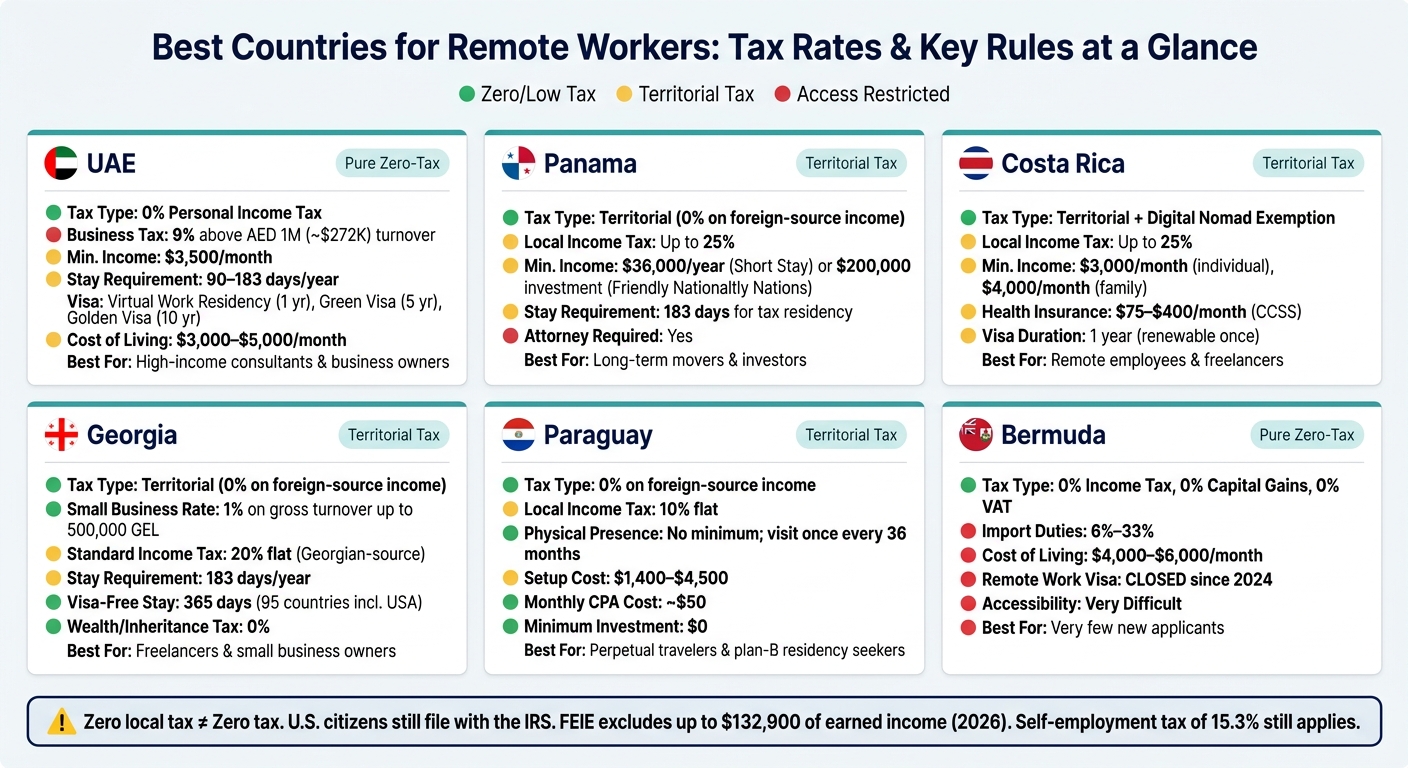
Quick Comparison
| Country | Main tax angle | Main catch | Best fit |
|---|---|---|---|
| UAE | 0% personal income tax | Business tax can apply above AED 1 million turnover | Higher-income solo workers and owners |
| Panama | Territorial tax | Work for Panama clients can become taxable | Long-term movers and investors |
| Costa Rica | Foreign remote income exemption under digital nomad rules | Local income can be taxed up to 25% | Remote employees and freelancers |
| Georgia | Territorial system or 1% small business regime | Work done from Georgia can trigger tax | Freelancers and solo businesses |
| Paraguay | 0% on foreign-source income | Monthly filings still apply | Low-stay travelers |
| Bermuda | 0% income tax | Remote work visa closed; high living costs | Few new applicants |
If I were comparing these places fast, I’d split them into two groups: pure zero-tax countries like the UAE and Bermuda, and territorial-tax countries like Panama, Costa Rica, Georgia, and Paraguay. That one difference shapes almost everything else.
sbb-itb-39d39a6
1. United Arab Emirates
The UAE is the clearest zero-local-income-tax option for remote workers who can meet the residency rules. There is no federal or Emirate-level personal income tax on salaries, dividends, capital gains, or investment income. So for a remote worker, salary or freelance income can stay untaxed at the local level.
The main entry points are the Dubai Virtual Working Programme and the federal Virtual Work Residency. The federal visa usually costs about $100 to $300, while Dubai’s program costs about $600, including Emirates ID and medical testing. In most cases, you need to earn at least $3,500 per month and have a valid one-year employment contract.
One point trips people up: tax-free status depends on being treated as a resident, not just holding a visa. To get a UAE Tax Residency Certificate, you generally need at least 90 days of physical presence per year if you have strong local ties, or 183 days under the standard rule. Miss that day count, and you may not qualify for the certificate.
The bigger tax issue is usually not personal income tax. It’s whether your work starts to look like a business for tax purposes. The main risk is the 9% business tax, which can apply to self-employed people running a business if annual turnover goes above AED 1 million (about $272,000). Personal investment income and real estate income do not count toward that figure. You also need health insurance for residency.
If you’re a U.S. citizen, the story doesn’t stop in Dubai or Abu Dhabi. You still need to file U.S. tax returns, and the FEIE can exclude up to $132,900 of earned income for 2026.
The UAE also has other long-stay options. The Green Visa is a 5-year route for self-employed people and skilled employees. The Golden Visa is a 10-year renewable route for investors and highly skilled professionals.
Here are the main UAE pathways at a glance:
| Pathway | Duration | Min. Monthly Income |
|---|---|---|
| Virtual Work Residency / Dubai Virtual Working Programme | 1 year (renewable) | $3,500 |
| Green Visa | 5 years | AED 15,000/month |
| Golden Visa | 10 years (renewable) | Investment-based |
2. Panama
Panama is a strong fit for remote workers who want territorial taxation, foreign-source income treatment, and a route to long-term residency. In many cases, income from foreign clients is treated as foreign-source, which means it isn’t taxed locally.
There are two main paths here: the Short Stay Visa for Remote Workers and the Friendly Nations Visa. The short-stay option works better for temporary time in the country. The Friendly Nations route makes more sense if you want to stay longer and work toward residency.
The big issue is income sourcing. If you do work in Panama for a local client or Panama-based entity, that income can be treated as Panama-source and taxed at rates of up to 25%. So the line is pretty clear: if the client is local, the tax picture can change fast.
That’s why your paperwork matters just as much as your visa. You’ll want records that show your income is foreign-source. Without that paper trail, things can get messy. And if the work is physically performed for a Panama-based client, the tax upside can vanish.
A tax residency certificate usually calls for at least 183 days per year in Panama. Also, residency applications have to be filed through a licensed local attorney.
| Feature | Short Stay Visa | Friendly Nations Visa |
|---|---|---|
| Min. Income/Investment | $36,000/year | $200,000 investment |
| Duration | 9 months (renewable once) | 2 years (temp), then permanent |
| Dependents | Not permitted | Permitted |
| Path to Permanent Residency | No | Yes |
| Attorney Required | Yes | Yes |
If you want a different residency setup, Costa Rica is the next country to compare.
3. Costa Rica
Costa Rica uses a territorial tax system. That means foreign-source income is usually exempt. On top of that, the Digital Nomad Law gives eligible remote workers a clear exemption for income earned abroad.
To qualify for the visa, you need a minimum monthly income of $3,000 for individuals or $4,000 for families. There’s also the Rentista route, which asks for $2,500 per month for two years and can lead to permanent residency after three years. If you go the Rentista route, you also need to join the CCSS health system. That usually costs $75 to $400 per month, based on your declared income.
| Feature | Digital Nomad Visa (Law 10,008) | Rentista Residency |
|---|---|---|
| Min. Monthly Income | $3,000 ($4,000 for families) | $2,500 |
| Duration | 1 year, renewable for 1 more | 2 years, renewable |
| Path to PR | No | Yes, after 3 years |
| Application Fee | About $250 | About $250 |
The big catch is local-source income. If you earn money from Costa Rican clients or take a local job, you can trigger income tax at progressive rates up to 25%. There’s another wrinkle too: foreign entities may become taxable if passive income does not meet Costa Rica’s substance rules. Digital Nomad visa holders avoid that substance test and do not need to set up a local company.
Georgia comes with a different tradeoff: less paperwork, but a more nuanced tax-residency test.
4. Georgia
Georgia is simpler than Panama on the paperwork side. But the tax side has one big catch: it depends on where the work happens.
Georgia follows a territorial tax system. In plain English, foreign-source income is generally not taxed. But if you’re doing the work from Georgia, that income can be treated as Georgian-source income and taxed at a flat 20%. So this setup tends to work best for remote workers who are paid by foreign clients, not Georgian ones.
A lot of remote workers go with Small Business Status as an Individual Entrepreneur. Under that setup, you pay 1% on gross turnover up to 500,000 GEL and 3% above that. That’s a big reason Georgia keeps showing up on digital nomad shortlists.
Tax residency usually starts after 183 days in any 12-month period. There’s also a lot of room before you even need to sort out a permit: citizens of about 95 countries, including the U.S., can stay in Georgia visa-free for 365 days.
If you want to stay longer, Georgia offers an IT Residence Permit. To qualify, you need at least $25,000 in annual income and two or more years of IT experience. The permit can be renewed for up to 12 years. There’s also a path for high-net-worth applicants that doesn’t require meeting the 183-day test, though it still requires at least 25,000 GEL in Georgian-source income.
One more detail worth noting: Georgia has no wealth, inheritance, or gift taxes, and self-employed people pay no social security contributions.
| Feature | Details |
|---|---|
| Tax Residency Trigger | 183 days in any 12-month period |
| Visa-Free Stay | 365 days for citizens of about 95 countries, including the U.S. |
| Small Business Tax Rate | 1% on gross turnover up to 500,000 GEL |
| Revenue Above Threshold | 3% |
| Standard Income Tax | 20% flat rate on Georgian-source income |
| Wealth / Inheritance / Gift Tax | 0% |
5. Paraguay
Paraguay is worth a close look if you want an even lighter residency setup than Georgia. In this group, it has one of the lowest maintenance burdens: there’s no minimum stay to keep residency, and permanent residents only need to visit once every 36 months.
Under Law 6380/2019, Paraguay taxes only income produced inside Paraguay. That means foreign-source remote income is taxed at 0%. If the income is treated as Paraguay-source work, it’s taxed at a 10% flat rate and may also trigger 10% VAT.
A setup many people use is an EAS. It passes income through to the owner and does not change the tax treatment of foreign-source income. But low tax doesn’t mean no admin. You still need a Tax ID (RUC) and must file monthly VAT declarations, even when you’re reporting zero local income.
The usual costs are fairly modest:
- A local CPA often costs about $50 per month
- Initial residency setup, including temporary residency, Cedula, and RUC, usually runs from $1,400 to $4,500
- No minimum investment is required
| Feature | Details |
|---|---|
| Foreign Income Tax | 0% |
| Local Income Tax | 10% flat |
| Physical Presence | No minimum stay; permanent residents need one visit every 36 months |
| Minimum Investment | $0 |
| Path to Permanent Residency | 2 years on Temporary Residency |
| Wealth / Inheritance / Gift Tax | 0% |
The big issue here is source of income. If your work is seen as performed in Paraguay, that income moves into the 10% tax base. So the setup only works cleanly if your income stays foreign-source.
In plain English: keep your RUC active, file the monthly VAT returns, and stay away from local clients if you want to keep foreign-source treatment intact.
Bermuda is the opposite model: no personal income tax, but much higher residency and cost barriers.
6. Bermuda
Bermuda is simple on taxes: 0% personal income tax, 0% capital gains tax, and 0% VAT, with no wealth or inheritance tax. That puts it in a very different bucket from Panama, Costa Rica, Georgia, and Paraguay. Those places lean on territorial tax rules. Bermuda doesn’t. It just has zero local tax.
That sounds great on paper. In practice, getting in is the hard part.
The main issue is access. The Work From Bermuda Certificate closed in 2024, and long-term residency is now much harder to get because it depends on tougher immigration paths. So yes, the tax setup is attractive, but that only matters if you can actually stay there.
Then there’s the cost. Bermuda is expensive, plain and simple. A single person will often spend $4,000 to $6,000 per month. The government also brings in money through land tax, which is based on assessed rental value, plus import duties of 6% to 33% on most goods. So while income tax is zero, daily life can still hit your wallet hard.
| Feature | Details |
|---|---|
| Personal Income Tax | 0% |
| Capital Gains Tax | 0% |
| VAT | 0% |
| Import Duties | 6%–33% on most goods |
| Monthly Cost of Living | $4,000–$6,000 (single person) |
| Remote Work Visa | Work From Bermuda Certificate closed since 2024 |
| Visa Accessibility | Difficult |
One more thing: U.S. citizens still owe the IRS no matter where they live.
So Bermuda offers a clean zero-tax setup locally, but the tradeoff is clear: hard access and a high monthly cost.
Pros, cons, and red flags by country
Several countries on this list can offer a real path to zero or near-zero local tax on foreign income. But the fine print matters. A lot.
The table below lays out the tradeoffs that tend to make or break the decision.
| Country | Biggest Advantage | Biggest Drawback | Best-Fit Worker | Key Watch-Out |
|---|---|---|---|---|
| UAE | 0% personal income tax; strong infrastructure | High cost of living ($3,000–$5,000/mo) | High-income consultants and business owners | 9% corporate tax can apply once business turnover exceeds AED 1 million (~$272,000) |
| Panama | U.S. dollars and a territorial tax system | $200,000 investment now required for the Friendly Nations Visa | Investors and long-term settlers | Work done in Panama can become Panama-source income |
| Costa Rica | Digital nomad visa holders have a statutory income tax exemption | Mandatory CCSS health system enrollment ($75–$400/month) | Solo freelancers and digital nomads | Passive-income exemptions can fail without substance |
| Georgia | 1% tax rate for small businesses earning up to about $185,000 | 183-day stay is often needed to establish tax residency | Freelancers and small business owners | If small business status is lost, the flat tax rate can jump to 20% |
| Paraguay | No minimum stay requirement; visit once every three years | Limited flight connections and banking infrastructure | Perpetual travelers and "plan B" residency seekers | Maintain an active RUC and file monthly declarations to build a legitimate residency record |
| Bermuda | 0% personal income tax | Work From Bermuda certificate program closed in 2024 | None for new applicants | Cost of living runs roughly $4,000–$6,000/month |
On paper, these setups can look simple: move there, pay little or no local tax, done. In practice, it doesn’t work that way. Residency rules, income sourcing rules, and filing duties decide whether the tax deal holds up once you’re living and working there.
That’s why the “best” country depends less on headline tax rates and more on how you earn, where your clients are, how long you stay, and how much admin you can handle. For one person, UAE may make sense despite the cost. For another, Paraguay may work better because of the light physical presence rules. And for someone doing client work on the ground, Panama or Costa Rica may need a much closer look.
Which country fits which remote worker
These six countries don’t suit the same kind of person. Each one lines up with a different income setup, tax comfort level, and length of stay. So the best pick depends on how you earn, how long you plan to stay, and how much tax friction you’re willing to deal with.
| Persona | Best Fit | Why |
|---|---|---|
| U.S.-based freelancer | Georgia | 1% gross turnover under Small Business Status |
| Online business owner | UAE | 0% personal income tax; no tax on capital gains or inheritance |
| Remote employee with a foreign employer | Costa Rica | Foreign-source remote work is exempt under the Digital Nomad Law |
| Perpetual traveler | Paraguay | No minimum stay; one visit every three years keeps permanent residency active |
That said, a country only “fits” if the residency rules and source-of-income rules work in your favor. Before making a move, check these four things:
- Income source. In territorial systems, work physically done in-country can be treated as locally sourced, even if your client is abroad. Costa Rica’s statutory exemption under Law 10,008 is the cleanest way around that risk.
- Residency trigger. Most countries use a 183-day threshold. The UAE can establish tax residency in as few as 90 days for certain visa holders.
- Permanent establishment risk. If you run a foreign company, permanent establishment rules can make your company taxable in the country where you’re living.
- U.S. filing duties. U.S. tax duties don’t stop when you leave. The FEIE excludes only a portion of earned income, self-employment tax still applies at 15.3%, and FBAR/FATCA filings apply for foreign accounts. In zero-tax countries, the Foreign Tax Credit rarely helps because there’s no local tax to offset.
Zero local income tax does not mean zero tax.
FAQs
Does remote work done in-country count as local income?
It depends on the country’s tax laws.
In territorial tax systems like Panama, Costa Rica, and Paraguay, only income generated inside the country is taxed.
That sounds simple, but there’s a catch. A remote salary from a foreign employer is often treated as foreign-sourced, which can make it tax-exempt. At the same time, tax authorities may argue that if you’re physically doing the work while in the country, that income is locally sourced.
Income from local clients or from running a local business is generally taxable.
Which option is best for U.S. citizens?
For U.S. citizens, the best option on this shortlist is usually Panama.
Why? Panama uses a territorial tax system, which means foreign-earned remote-work income is generally not taxed there. That can make a big difference if you work online for clients or a company outside Panama. On top of that, the country offers an accessible remote-work residency path, which makes the move more doable for many Americans.
That said, one big rule does not go away: you still have to file U.S. tax returns. The U.S. taxes worldwide income no matter where you live, so moving abroad doesn’t end your filing duties. In many cases, Americans abroad use the Foreign Earned Income Exclusion (FEIE) to cut their U.S. federal tax bill.
What paperwork matters most before moving?
The most important paperwork usually falls into two buckets: making a clean break from your current home and getting ready for legal entry into your new country.
Start by formally cutting local ties. That can mean canceling voter registration, surrendering your driver’s license, ending a lease or selling property, and closing or updating local bank accounts. The goal is simple: leave a clear paper trail that shows you’ve moved on.
Then turn to entry documents. In many cases, that means gathering items like apostilled birth certificates, apostilled background checks, and a valid passport. If you wait too long on this part, things can get messy fast, so it helps to get those records lined up early.
