
If I plan to live in Thailand on a DTV in 2026, I focus on two numbers first: 180 days and January 1, 2024. The visa can let me stay long-term, but if I spend 180+ days in Thailand in one calendar year, I become a Thai tax resident. After that, foreign income earned on or after 1/1/2024 and brought into Thailand can be taxed at rates from 0% to 35%.
Here’s the short version:
- Thailand Digital Nomad Visa (DTV) validity: 5 years, multiple entry
- Stay per entry: up to 180 days
- Extension: one extra 180 days for THB 1,900 (about $55)
- Visa fee: about $275 to $400
- Savings proof: at least THB 500,000 (about $14,500)
- Tax trigger: 180 days in Thailand in the same calendar year
- Main tax point: foreign income is usually a Thai tax issue when I remit it into Thailand
- Allowed work: remote work for foreign employers or clients
- Not allowed on DTV: work for Thai employers or Thai clients
This means the DTV solves the immigration side, not the tax side. If I want to use Thailand as a long-stay base, I need to track my days, separate old savings from new income, and keep records for every transfer into Thailand.
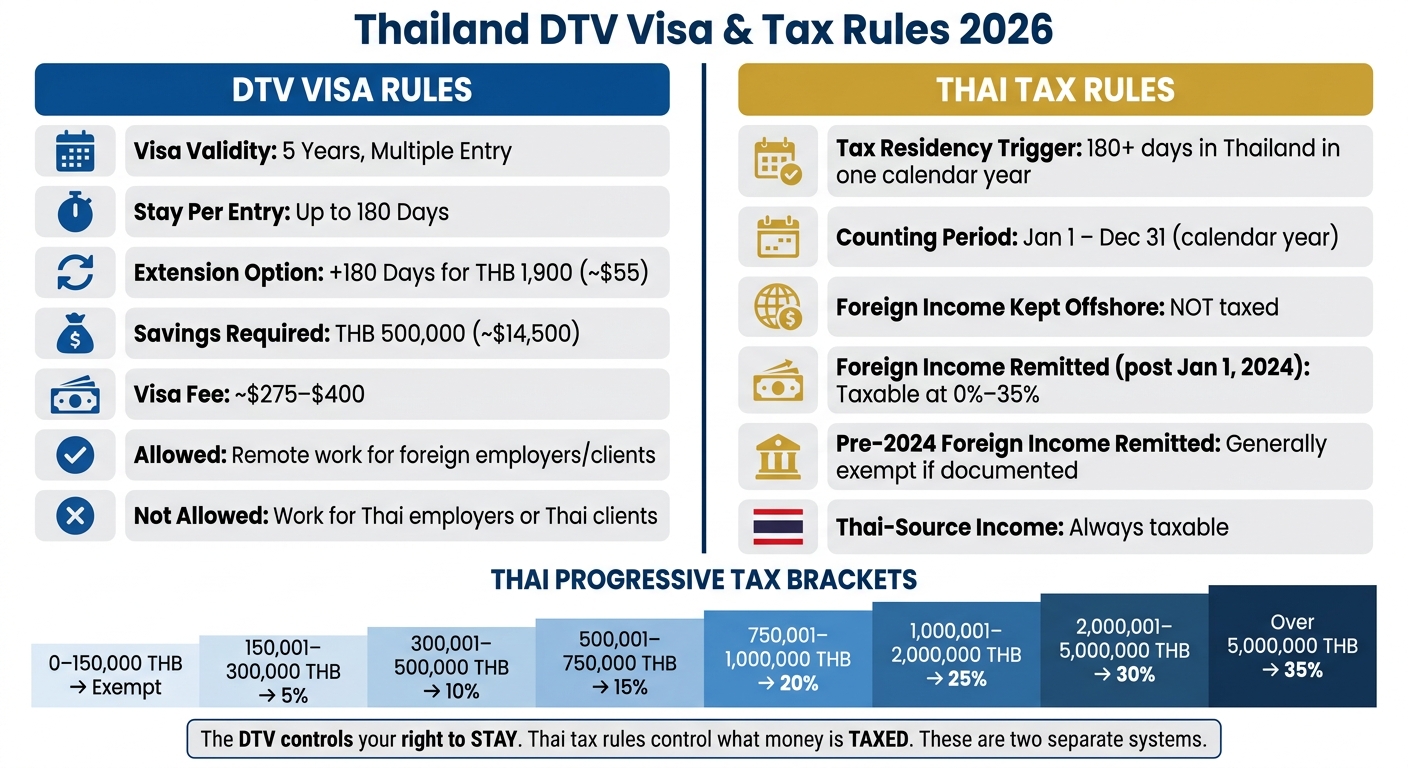
Quick comparison
| Topic | Main rule in 2026 |
|---|---|
| Visa length | 5 years |
| Stay length per entry | 180 days |
| Extra stay option | +180 days extension |
| Tax residency test | 180+ days in a calendar year |
| Foreign income kept offshore | Not taxed |
| Foreign income remitted to Thailand after becoming resident | Can be taxed |
| Pre-2024 foreign income remitted later | Usually not taxed if documented |
| Thai-source income | Taxable |
So before I move, I’d treat the DTV and Thai tax as two separate systems: one controls my right to stay, and the other controls what money may be taxed.
sbb-itb-39d39a6
DTV visa basics: who qualifies, what it allows, and how long you can stay
The Destination Thailand Visa is a five-year, multiple-entry visa for remote workers and approved Soft Power participants. Soft Power activities include Muay Thai training, Thai culinary programs, medical treatments, and cultural programs. The minimum age for a primary applicant is 20, and there’s no upper age limit.
Who can apply and what documents you need
Every applicant needs:
- A passport with at least 6 months of validity left
- A passport photo that meets ICAO standards
- Proof of current residence
- Bank statements showing at least 500,000 THB (about $14,500) in accessible savings
In 2026, embassies usually ask for 3 to 6 months of bank history, not just a current balance screenshot. So if you’re planning to apply, it helps to keep those funds in the account for a few months before you submit.
What you need beyond that depends on your category:
| Category | Key Documents |
|---|---|
| Remote Workers | Employment contract or offer letter from a foreign company, recent pay stubs |
| Freelancers | Client contracts, invoices, portfolio, platform profiles (e.g., Upwork, LinkedIn), business registration if self-employed |
| Soft Power | Enrollment letter from a certified Thai institution, course outline (6+ months), payment receipt |
| Dependents | Marriage or birth certificate (legalized/apostilled), primary applicant’s DTV copy |
Legal spouses and unmarried children under 20 can qualify as dependents. Each dependent pays a separate visa fee. Unmarried partners don’t qualify, so they need to apply on their own.
Once the documents are sorted, the next thing to pin down is what this visa lets you do day to day.
What you can and cannot do on a DTV
"The DTV is strictly for foreign-source remote work. If you want to work for a Thai employer, you need a Non-B work visa instead." – Issa Compass
The rule is pretty simple: you can work remotely for foreign companies or international clients, but you can’t work for Thai employers, take Thai clients, or do work that would usually need a Thai work permit.
Visa validity, extensions, re-entry, and planning your stay
This is where people often get tripped up: five-year validity does not mean five years in Thailand without leaving.
Each entry gives you 180 days. You can then apply for one 180-day extension at a local Thai Immigration Office for 1,900 THB (about $55). That brings one continuous stay to about 360 days. After that, you need to leave Thailand, then re-enter to begin a new 180-day period.
That timing matters for more than travel planning. Thai tax residency is based on how many days you spend in Thailand, not on how long the visa stays valid.
Thai tax residency: when DTV holders become taxable
Once you hit 180 days in Thailand, the main issue becomes tax residency, not your visa. That’s the key point. A DTV does not give you a special tax carveout. Thai tax rules look at how many days you were physically in Thailand during the year, not the visa sticker in your passport.
The 180-day rule and how calendar-year counting works
Thailand counts tax residency by calendar year, from Jan. 1 through Dec. 31. The 180-day test is based on your total physical presence during that period, and those days add up across all trips you take in the same year. So if you enter and leave multiple times, Thailand still counts the combined total.
Resident vs. non-resident tax treatment
If you stay under 180 days, Thailand taxes only Thai-source income. If you stay 180 days or more, the rules get broader: Thailand can also tax foreign income remitted into Thailand, as long as that income was earned on or after Jan. 1, 2024.
There’s one line that matters a lot here. Foreign income earned before Jan. 1, 2024, is outside this rule, even if you bring that money into Thailand later.
| Tax Situation | Thai Tax Resident (180+ Days) | Non-Resident (Under 180 Days) |
|---|---|---|
| Thai-source income | Taxable | Taxable |
| Foreign income left offshore | Not taxed | Not taxed |
| Foreign income remitted to Thailand | Taxable if earned on or after Jan. 1, 2024 | Generally exempt |
| Pre-2024 foreign income remitted | Not taxed | Not taxed |
This is why residency matters so much. It decides when foreign income can fall into the Thai tax system. The next step is figuring out which foreign income Thailand looks at once you remit it in 2026.
Thailand’s 2026 tax rules: foreign income, remittances, and common income types
How the 2026 remittance rule applies to foreign-source income
Once you pass the 180-day mark, the next issue is simple: what money becomes taxable in Thailand when it comes in.
Thailand taxes foreign-source income for tax residents when that income is remitted into Thailand. If the money stays offshore, it stays outside the Thai tax system until you bring it in.
In practice, remittance is broader than a standard wire transfer. It can include:
- Bank transfers into Thailand
- ATM withdrawals in Thailand
- Card spending in Thailand when the funds come from offshore accounts
Pre-2024 savings may still be exempt, but you need to prove where the money came from and when you earned it.
Remote salary, freelance income, dividends, and transfers into Thailand
This rule hits the income types most remote workers rely on.
If your salary is paid outside Thailand and you become a Thai tax resident, that salary becomes taxable when you remit it into Thailand. The same basic rule applies to freelance or consulting income, along with foreign dividends and interest.
Foreign capital gains are usually treated differently. The main carve-out is crypto gains.
Thai tax rates, filing obligations, and records to keep
Thailand uses a progressive personal income tax system. The first 150,000 THB of net taxable income is exempt. After that, rates move from 5% to 35%, with the top rate applying to income above 5,000,000 THB.
| Annual Net Taxable Income (THB) | Tax Rate |
|---|---|
| 0 – 150,000 | Exempt |
| 150,001 – 300,000 | 5% |
| 300,001 – 500,000 | 10% |
| 500,001 – 750,000 | 15% |
| 750,001 – 1,000,000 | 20% |
| 1,000,001 – 2,000,000 | 25% |
| 2,000,001 – 5,000,000 | 30% |
| Over 5,000,000 | 35% |
The table below sums up the main income types and their general 2026 treatment for Thai tax residents.
| Income Type | Thai Tax Resident (180+ Days) |
|---|---|
| Thai-source income | Taxable at progressive rates (5–35%) |
| Foreign remote salary (remitted) | Taxable |
| Foreign freelance income (remitted) | Taxable |
| Foreign dividends/interest (remitted) | Taxable |
| Foreign capital gains (remitted) | Generally 0% (except crypto) |
| Pre-2024 foreign income (remitted) | Exempt if documented |
| Foreign income kept offshore | Not taxed |
If you’re planning to stay in Thailand for the long haul and send money in on a regular basis, paperwork isn’t optional. It needs to be sorted out before that becomes your normal routine.
Thai tax residents file once a year for the Jan. 1–Dec. 31 tax year. Thailand also exchanges data under CRS, so keep a clean trail of:
- Day counts
- Transfer records
- Proof of source, including payroll records, invoices, dividend statements, and account traces that separate pre-2024 savings from post-2024 income
Those records, along with the right tax treatment for each income type, should be set up before you start using the DTV as a long-term base.
Using the DTV as a long-term base: steps to take before you relocate
When the DTV works well and when it creates tax exposure
The DTV tends to work best when your income remains foreign-sourced and your clients or employer are based outside Thailand. If you expect to spend more than 180 days in Thailand during a calendar year, get your banking setup and recordkeeping in place before you arrive. And one line is clear: Thai-client or Thai-employer work is not allowed on this visa.
Pre-move checklist: visas, banking, tax records, and entity structure
At a practical level, the job is simple: separate your income, track your days, and keep your transfer records clean.
- Confirm DTV eligibility and bank-history requirements. Check that your documents and account history meet the current embassy rules before you apply.
- Keep pre-residency savings and post-residency income in separate offshore accounts. That clean paper trail helps you show that transfers from earlier savings are capital, not taxable income.
- Audit your payroll and invoicing setup. If you’re on salary, make sure payroll runs through a non-Thai entity. If you’re freelance, keep your contracts limited to foreign clients.
- Arrange health insurance before arrival. The DTV doesn’t require it, but for a long stay, going without coverage is a gamble most people shouldn’t take.
With the visa, tax status, and money trail mapped out, the last piece is figuring out whether the DTV matches your long-term plan.
Conclusion: key decision points for living in Thailand on a DTV in 2026
The DTV is a practical long-stay visa, but it doesn’t change Thai tax residency or Thailand’s remittance rules. What matters most from there is simple: how many days you spend in Thailand and when your foreign money enters the country.
The two numbers that shape the whole decision are 180 and January 1, 2024. If you stay in Thailand for 180 days or more in a calendar year, you become a Thai tax resident. And if you remit foreign-source income into Thailand that was earned after January 1, 2024, that income can be taxed at progressive rates of up to 35%.
In plain English, the DTV tends to work best if you can:
- Live on savings earned before 2024
- Keep your funds offshore
- Accept Thai tax on remitted post-2024 foreign income
Before you move, line up your day count, remittance timing, and source-of-funds records together.
FAQs
Does time outside Thailand reset the 180-day tax clock?
No. Time spent outside Thailand does not reset the 180-day tax clock.
Thai tax residency is based on your total physical presence in Thailand within a single calendar year, from January 1 to December 31. If you leave the country, the count simply pauses while you’re away. When you come back, your days in Thailand start adding up again.
How can I prove a transfer came from pre-2024 savings?
Keep pre-2024 savings fully ring-fenced in a separate offshore account that has never received income earned on or after January 1, 2024.
Once those funds get mixed with later salary, dividends, or interest, things can get messy fast. The Thai Revenue Department may apply first-in, first-out treatment, which can make it harder to show what money came from where.
That’s why clean records matter. Keep clear offshore documentation and full bank statements that show the funds’ uninterrupted history and origin.
What if I accidentally earn income from a Thai client?
That can violate your DTV terms, which allow work only for foreign employers or clients. And yes, it can put your visa status at risk.
Income from Thai sources is taxable for Thai tax residents, no matter when you bring the money into Thailand. If payments run through a Thai bank account or a Thai entity, that can leave a clear paper trail for tax or immigration review.
Related Blog Posts
- Tax-Free Countries in Asia: Practical Options for Location-Independent Businesses
- Digital Nomad Visas: 49 Countries Where You Can Live and Work Legally in 2026
- Best Countries for Canadian Expats: Where to Move for Lower Taxes and Better Living
- What are the best digital nomad visas in 2026? (49+ countries)
