
If I had to sum it up in one line: MM2H can work well in 2026 if I want a long-stay base in Malaysia, can lock up cash, and understand that visa status and tax status are not the same thing.
Here’s the short version:
- MM2H is a long-term stay program, not a work visa, not permanent residency, and not citizenship.
- There are three main tiers: Silver, Gold, and Platinum.
- The upfront cash is high: from $150,000 to $1,000,000 in fixed deposits, plus a home purchase.
- If I’m under 50, I usually need 90 days a year in Malaysia under MM2H rules.
- If I spend 182 days or more in Malaysia, I may become a Malaysian tax resident.
- Foreign-sourced income can be tax-free in Malaysia through December 31, 2036, if the rules are met.
- Malaysian-sourced income is taxable, and where I do the work matters.
- U.S. citizens still pay attention to IRS rules, even if Malaysia does not tax the same income.
What matters most is simple: Can I handle the deposit, property purchase, stay rules, and tax recordkeeping without creating new problems? If yes, MM2H may fit. If not, the low living costs alone are not enough.
A few numbers stand out:
- A modest lifestyle in Kuala Lumpur is often around $1,000 to $1,500 per month
- Silver starts with a $150,000 deposit
- Gold starts with a $500,000 deposit
- Platinum starts with a $1,000,000 deposit
- Non-citizen property transfers may face 8% stamp duty from January 1, 2026
- Malaysian resident tax rates run from 0% to 30%
- Non-residents generally pay 30% on Malaysian-sourced income
My takeaway: MM2H is less about getting a visa and more about making the math work for my life, my travel pattern, and my tax setup.
MM2H in 2026: who it suits, how it works, and what approval gives you
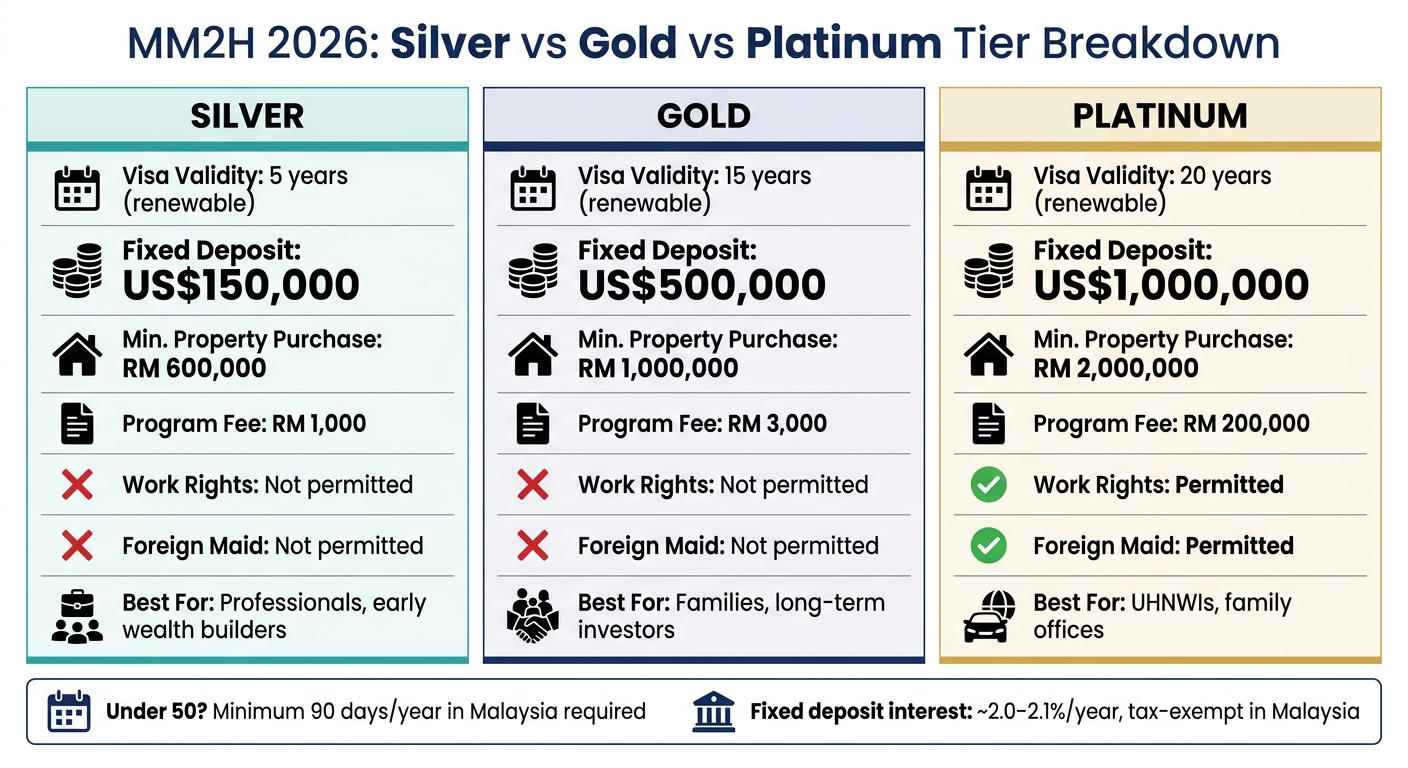
With the basic framework in place, the next step is simple: figure out who MM2H is for and what approval lets you do in practice.
Who MM2H is designed for in 2026
MM2H fits retirees, remote workers paid from abroad, offshore founders, and families that want a stable base in Southeast Asia.
Silver, Gold, and Platinum tiers: a side-by-side overview
The main MM2H tiers vary based on deposit size, property purchase rules, visa length, and work rights.
| Feature | Silver | Gold | Platinum |
|---|---|---|---|
| Visa validity | 5 years (renewable) | 15 years (renewable) | 20 years (renewable) |
| Fixed deposit | US$150,000 | US$500,000 | US$1,000,000 |
| Min. property purchase | RM 600,000 | RM 1,000,000 | RM 2,000,000 |
| Program fee | RM 1,000 | RM 3,000 | RM 200,000 |
| Work rights | No | No | Yes |
| Foreign maid permitted | No | No | Yes |
| Best fit | Professionals, early wealth builders | Families, long-term investors | UHNWIs, family offices |
These differences matter because they shape what life looks like after approval.
Silver makes sense for people who want to test Malaysia without putting in as much capital up front. Gold is often a better match for families, especially since a 15-year visa can line up with a full school journey. Platinum is aimed at ultra-high-net-worth individuals and family offices, and it’s the only tier that gives full work and business rights.
There is also a separate special economic zone / special financial zone tier for designated areas like Forest City. That option comes with a US$65,000 deposit, or US$32,000 for applicants age 50 and above, plus a 5- to 10-year visa.
What MM2H holders can and cannot do after approval
Approval gives you a multiple-entry visa tied to your tier’s validity period. Under the standard MM2H tiers, you must buy property within 12 months of visa endorsement. That property then comes with a 10-year sale restriction unless you move up to a higher-value home.
You can also do a lot of practical day-to-day things that matter once you’re settled. That includes opening local bank accounts, including Shariah-compliant options, enrolling children in international schools, and using private healthcare. After one year, you may withdraw up to 50% of the fixed deposit for approved costs like property, education, or medical care.
On the family side, the program is fairly broad. You can bring:
- A spouse
- Children under 21
- Unmarried, unemployed children ages 21 to 34
- Disabled children with no age limit
- Parents or parents-in-law
The line around work is where things get more strict. Silver and Gold are set up for nonworking residents. Platinum is the only tier meant for people who want active local involvement. If you hold Silver or Gold, you can’t work for Malaysian employers or actively own or run a Malaysian business, though remote work for non-Malaysian clients is allowed.
That means the fine print around eligibility, stay days, and financial rules does much of the heavy lifting.
sbb-itb-39d39a6
Eligibility, financial requirements, and stay rules that matter in practice
These are the rules that decide whether MM2H works as a practical base for your lifestyle, family setup, and tax plan.
Age, background checks, and financial entry requirements
Applicants must be at least 25 years old for the Silver, Gold, and Platinum tiers. You also need at least 18 months of passport validity and a police clearance from your home country for the security check. Immigration also runs background screening through MyIMMS.
The 2024 reforms changed the financial entry rules in a big way. The main tiers no longer use monthly offshore income or liquid-asset tests. Instead, the focus shifted to deposit and property rules. Fixed deposits must be placed with a licensed Malaysian bank. Applicants also need medical insurance with at least RM 80,000 in coverage, plus a medical fitness check.
As of April 2026, fixed deposit rates at major Malaysian banks are usually around 2.0% to 2.1% per year, and that interest is tax-exempt in Malaysia.
You also can’t apply on your own anymore. Direct applications are no longer allowed. You must use an agent licensed by Malaysia’s Ministry of Tourism, Arts and Culture, and fees often fall between RM 40,000 and RM 70,000.
Once you get through that entry screen, the next issue is simple but important: how many days you need to be in Malaysia, and whose days count.
Stay days, renewals, and dependent rules
If you are between 25 and 49, you must spend at least 90 cumulative days per year in Malaysia. The principal applicant and family members can pool their days to meet that total. That point matters in practice because many families plan their travel around the same residency calendar. Applicants aged 50 and above do not have a minimum stay rule.
Even when the pass is issued for 10, 15, or 20 years, renewal checks still take place every 5 years. It’s smart to start the renewal process 3 to 6 months before expiration so you don’t end up with a gap.
Dependents can include:
- A spouse
- Children under 21
- Qualifying adult children
- Disabled children
- Parents or parents-in-law
One small detail can turn into a headache later. If a dependent child over 21 takes local employment in Malaysia, they may lose dependent status, which can make renewal harder.
Those stay rules matter, but for many people the bigger issue is staying on the right side of the property and deposit rules.
Property purchase, deposit withdrawals, and compliance limits
Mainland MM2H applicants must buy approved property within 12 months, and state-level minimums can be higher than the program floor. In Kuala Lumpur and Penang, the foreign purchase threshold is often RM 1,000,000. So a Silver applicant may, in practice, need to buy above the program minimum of RM 600,000 in those markets. That’s the key point: the program minimum and the state minimum are separate rules, and both apply.
The rest of the deposit must remain in place for the full visa period. If the balance falls below the required amount, the visa can be canceled. Selling the property without moving into a higher-value home can also lead to visa cancellation.
For most applicants, this is not just paperwork. It’s part of the actual cost of keeping residency in place and making the numbers work for long-term tax planning.
How Malaysia taxes MM2H holders in 2026
MM2H affects where you can live, not your tax residency. For tax purposes, it matters mainly because it can change how many days you spend in Malaysia.
Tax residency: your MM2H pass does not decide your tax status
MM2H does not determine tax residency. In Malaysia, you’re generally treated as a tax resident if you spend 182 days or more in the country during a calendar year, and linked-year rules can still affect the result.
There’s a wrinkle here. Short trips of up to 14 days may still count toward your total days in Malaysia if they fall inside a linked period. That’s why travel logs matter more than many people expect. Once your residency status is settled, the next step is figuring out which income Malaysia can tax.
Foreign-sourced income: the main tax benefit, key conditions, and rule-change risk
For many MM2H holders, this is the big one.
Resident individuals can currently receive qualifying foreign-sourced income in Malaysia tax-free through Dec. 31, 2036, as long as that income was taxed in the country where it came from. Non-residents also do not pay Malaysian tax on foreign-sourced income, even if they remit it into Malaysia. This can include income such as foreign pensions, dividends, and rental income.
To support that position, keep records that show tax was paid at source. That can include:
- Tax returns
- Dividend vouchers
- Other supporting documents
U.S. citizens have one extra layer to deal with. The United States taxes its citizens on worldwide income, no matter where they live. So Malaysia’s foreign-sourced income exemption does not remove that U.S. filing and tax duty. The U.S.–Malaysia treaty from 1984 is also less helpful than some people assume because it includes a savings clause that limits how much most Americans can use it.
There’s also a planning point here for business owners. The resident-individual exemption runs through 2036, but relief for companies and LLPs ends sooner. If you earn through a foreign entity, that shorter timeline creates more rule-change risk.
That split matters most for retirees, remote workers, and founders who have income coming from more than one place.
Local income, capital gains, and common expat tax scenarios
Malaysia does tax Malaysian-sourced income. That includes salary, rental income, and business profits for both residents and non-residents.
If you’re a resident, Malaysia uses progressive tax rates from 0% to 30%. The top 30% rate applies only to income above RM 2,000,000 (about $449,000). Non-residents pay a flat 30% on Malaysian-sourced income and do not receive personal reliefs or deductions.
One point trips people up all the time: where the work is physically performed. If you do the work while sitting in Malaysia, that income can be treated as Malaysian-sourced, even if your employer is overseas and your pay lands in a foreign bank account.
For capital gains, the picture is simpler. Individuals generally pay no Malaysian tax on gains from listed shares.
| Income Source | Likely Malaysian Tax Treatment | Residency Sensitivity | Documentation Needed |
|---|---|---|---|
| U.S. Social Security / Pension | Usually exempt if foreign-sourced and taxed at source | High | U.S. tax return / 1099 |
| Remote work (foreign employer) | Exempt if duties are performed outside Malaysia; taxable if performed inside Malaysia | Critical | Employment contract, travel logs |
| Foreign dividends | Exempt for resident individuals until 2036 if taxed at source; not taxed in Malaysia for non-residents | Medium | Dividend vouchers, tax residency cert |
| Local rental income | Taxed at progressive rates for residents or 30% flat for non-residents | Low | Tenancy agreement, expense receipts |
| Sale of listed shares | 0% capital gains tax for individuals | None | Trade confirmations |
There’s one more item to watch. Starting with the 2025 Year of Assessment, a 2% dividend tax applies to individuals who receive more than RM 100,000 in annual dividends from Malaysian companies. Foreign-sourced dividends remain exempt.
Those are the rules that shape whether MM2H fits neatly into your tax setup – or turns into one more admin file you have to manage.
Is MM2H the right fit for your residency, tax, and asset protection plan?
Who benefits most from MM2H and why
Once you get past the rulebook, the bigger issue is simple: does MM2H match your money, your income setup, and the way you actually live and travel?
MM2H tends to work best for people who earn their income outside Malaysia and are comfortable with the program’s capital and stay requirements.
Retirees age 50 and up are usually the clearest fit. There’s no minimum stay rule for this group, living costs can be lower, and healthcare is broadly available.
For applicants under 50, the planning gets tighter. You need to manage the 90-day MM2H stay rule against Malaysia’s 182-day tax residency test. That slim gap between staying compliant with MM2H and becoming a Malaysian tax resident is where most of the planning sits.
Families can also be a good fit, especially when they want a steady base, access to schools, and a setup that works across generations. For business owners and founders who earn abroad, Platinum stands out because it is the only MM2H tier that allows local work and directorship rights.
Key trade-offs, red flags, and compliance checkpoints
The same parts of MM2H that make it useful can also create the biggest planning issues.
The biggest trade-offs are locked-up capital and limited work rights. The fixed deposit is not liquid, even though some withdrawals are allowed after 12 months for approved expenses. Property comes with its own friction too: a 10-year sale lock-in, plus an 8% stamp duty for non-citizens on property transfers starting Jan. 1, 2026.
Silver and Gold tier holders cannot work locally or serve as a director in a Malaysian company. Another point matters here: the program’s rules have changed fast before. MM2H was suspended in 2020 and then reworked in 2021, with financial thresholds going up by 300% to 500%.
| Point | Advantage | Trade-off | Who It Affects Most |
|---|---|---|---|
| Foreign income tax | 0% on qualifying FSI until Dec. 31, 2036 | Requires proof that the income was taxed in the country of origin | Retirees, remote workers |
| Fixed deposit | Earns tax-exempt bank-deposit interest | Capital is locked; currency risk still applies | All applicants |
| Property | Access to quality real estate | 10-year lock-in; 8% stamp duty for non-citizens from 2026 | Families, long-term residents |
| Work rights | Local work rights at Platinum | Prohibited at Silver/Gold tiers | Entrepreneurs, active professionals |
| Stay rules | No minimum for 50+ | 90 days per year required if under 50 | Younger applicants, frequent travelers |
| U.S. tax overlay | Malaysia’s FSI exemption can reduce local tax exposure | U.S. citizens remain subject to worldwide taxation and IRS reporting | U.S. citizens |
Conclusion: key questions to answer before you apply
Before moving ahead, it helps to pressure-test the plan from a few angles.
Can you leave capital tied up for years? The fixed deposit is not easy to access, and the property purchase adds another long-term tie.
Where does your income come from? If it is foreign-sourced and taxed in the country of origin, Malaysia’s exemption through 2036 may help in a meaningful way. If you expect to earn inside Malaysia, only Platinum gives you a legal path to do that.
How many days will you actually spend in Malaysia? If you are under 50, you need at least 90 cumulative days each year. If you spend 182 days or more, you may become a Malaysian tax resident.
Are you a U.S. citizen? If so, Malaysia’s foreign-income exemption does not replace your IRS duties. U.S. reporting rules like FBAR and FATCA can still apply to Malaysian accounts.
Is this built for how you want to live? The property lock-in, deposit setup, and visa renewal rules all point to a multi-year plan, not a short-term move. If you want maximum flexibility or a route to citizenship, MM2H does not give you that. It is a residency program, not a naturalization track.
If you’re looking at MM2H as one part of a cross-border plan, tailored advice before committing capital is often the smart move.
FAQs
Can MM2H lead to permanent residency or citizenship?
No. MM2H is a long-term social visit pass. It is not a route to permanent residency or citizenship.
Permanent residency is a separate status, and Malaysia grants it only in rare cases. In most situations, it is linked to marriage to a Malaysian, special employment sponsorship, or investments of $2,000,000+.
Citizenship is even harder to get. It usually calls for 10 to 12 years of residence, fluency in Malay, approval from the minister, and giving up your current nationality.
What happens if I miss the MM2H stay requirement?
For MM2H holders age 50 and older, there is no minimum stay requirement.
For those ages 25 to 49, the 90-day annual stay requirement is mandatory. Miss it, and the visa can be revoked.
Here’s the key detail: for applicants ages 25 to 49, the 90 days are cumulative. That means the principal applicant and dependents can meet the rule together. If one family member stays in Malaysia for 90 days, it counts for the whole group.
How do I prove my income is foreign-sourced and tax-exempt?
First, confirm your tax residency status.
If you spend fewer than 182 days a year in Malaysia, you’re treated as a non-resident. In that case, Malaysia does not tax foreign-sourced income, whether you earn it abroad or bring it into Malaysia.
If you stay 182+ days, remitted foreign-sourced income is generally taxable. That said, individual exemptions apply through December 31, 2036 if the income was taxed in the source country. Keep your foreign tax filings and receipts as proof.
Interest earned on the mandatory MM2H fixed deposit is tax-exempt.
Related Blog Posts
- 8 Countries That Don’t Tax Foreign Income: What Your CPA Isn’t Telling You
- Tax-Free Countries in Asia: Practical Options for Location-Independent Businesses
- 14 Easy Second Residency Programs: No Minimum Net Worth Required
- Best Countries to Retire Abroad: Options for Wealthy Americans Seeking Low Taxes
