
You can live in Georgia for up to 365 days without a visa, but that does not give you residency. If I planned to stay long term, work from Georgia, or build a local base, I’d look at a residence permit early.
Here’s the short version:
- U.S. citizens get 365 days visa-free
- Tax residency can start after 183 days
- From January 1, 2026, entry requires health and accident insurance with at least 30,000 GEL in coverage
- From March 1, 2026, work physically done in Georgia needs a Special Labour Activity Permit
- Main residency routes are work/self-employment, IT, property, investment, and family
- Property starts at $150,000
- The investment route starts at $300,000
- Permanent residence usually comes after 6 years, or 5 years on the $300,000 investment path
If I wanted the lowest-cost route, I’d look at Individual Entrepreneur status with the right tax setup. If I worked in IT and met the rules, I’d check the 3-year IT permit. If I wanted a longer permit with fewer renewals, I’d compare property vs. $300,000 investment.
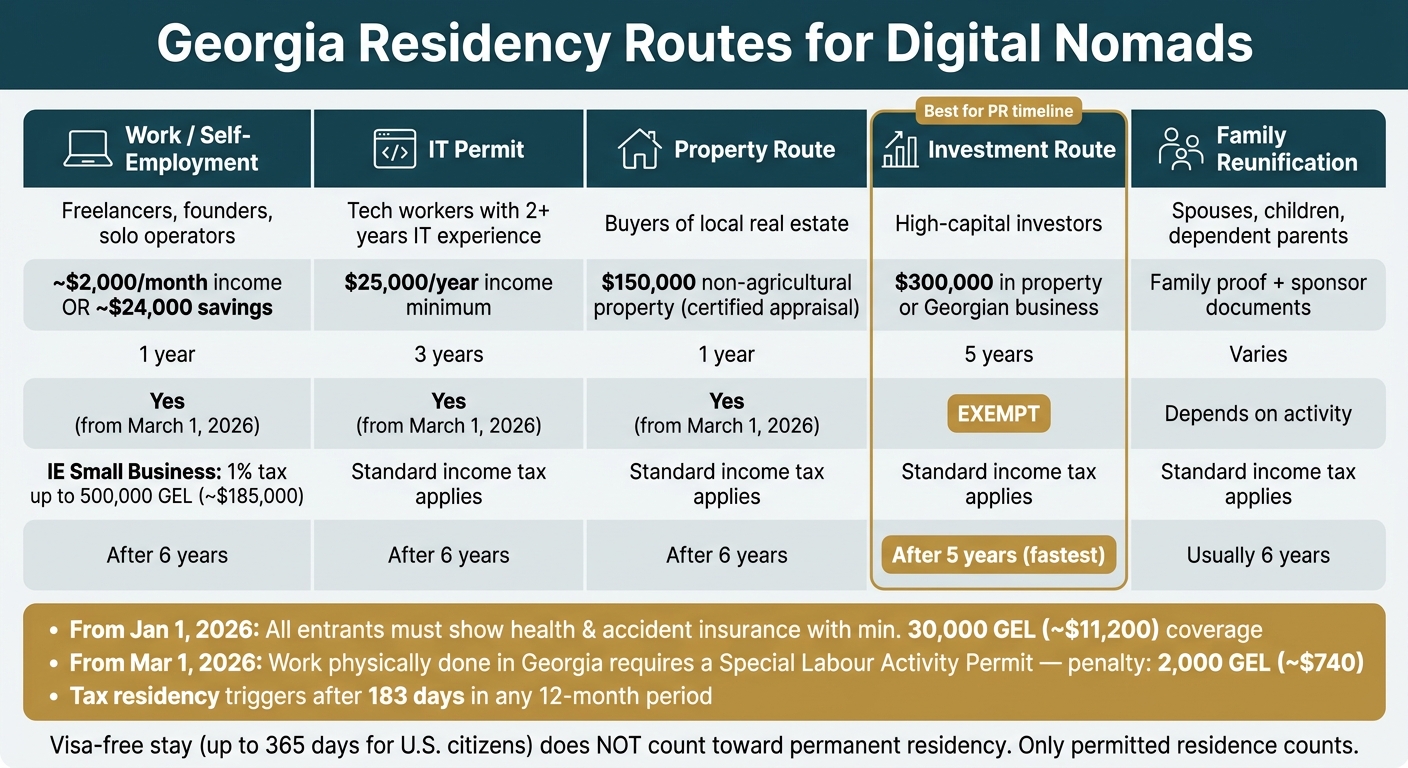
Quick comparison
| Route | Best for | Main cost or threshold | Permit term | Path to permanent residence |
|---|---|---|---|---|
| Work / self-employment | Freelancers, founders, solo operators | Income or savings proof | 1 year | 6 years |
| IT permit | Tech workers with experience | $25,000/year income + 2 years of IT experience | 3 years | 6 years |
| Property | Buyers of local real estate | $150,000 non-agricultural property | 1 year | 6 years |
| Investment | People putting in more capital | $300,000 in property or business | 5 years | 5 years |
| Family | Spouses, children, dependent parents | Family proof + sponsor docs | Varies | Usually 6 years |
Bottom line: if I only wanted a first-year test run, visa-free entry might be enough. If I planned to work locally, stay past a year, or count time toward permanent residence, I’d pick a permit route based on my income, assets, and timeline.
sbb-itb-39d39a6
Visa-free stay vs. residence permits: know the difference before you plan
Visa-free entry gives you time. A residence permit gives you legal status, a local ID card, and a route to permanent residence after six years of continuous legal residence. That gap matters. It decides whether Georgia is just a place to stay for a while or a legal base you can build from.
U.S. citizens can stay in Georgia for up to 365 consecutive days without a visa. Starting January 1, 2026, they must also show proof of health and accident insurance at entry, with minimum coverage of 30,000 GEL (about $11,200).
There’s also a tax angle here. Tax residency starts after 183 days in Georgia during any continuous 12-month period, even if you don’t have a residence permit. And income is usually sourced based on where the work is physically performed. So this isn’t just an immigration choice. It can affect your tax position too.
When visa-free entry is enough for your first year
For many people, the 365-day visa-free stay is enough to get started. You can use that time to settle in, buy property, open a bank account, register a company, and begin your residency application before the 365 days run out.
But there’s a line you shouldn’t miss: if you plan to do work that is physically performed in Georgia, visa-free entry by itself does not cover that. As of March 1, 2026, any foreigner doing work physically performed in Georgia needs a Special Labour Activity Permit, separate from any residence permit.
Skip that permit, and the penalty is 2,000 GEL (roughly $740) for both the individual and the employer. In plain English, a border run won’t fix this. It won’t solve the work-permit issue, and it won’t create residency.
When a residence permit becomes the better choice
A residence permit starts to make more sense once your plans go past testing the waters. The clearest signs are pretty simple:
- You need a local ID card, since banking is often harder without one
- You plan to stay longer than a single year
- You’ll be doing work physically performed in Georgia
- You want your time in Georgia to count toward the six-year permanent residency rule
The main routes for nomads are work or self-employment, business or investment, property, and family reunification. The next section breaks down which route fits your setup best.
Pick your residency route: work, business, property, or family
Georgia gives nomads four main ways to get residency: work/self-employment, business/investment, property, and family. The best fit depends on your income, what you own, and how long you plan to stay.
Work and self-employment permits for freelancers, consultants, and founders
A lot of nomads go with Individual Entrepreneur status and add Small Business Status. Why? Because eligible turnover is taxed at 1% up to 500,000 GEL (about $185,000) and 3% above that.
There’s one catch that trips people up: Small Business Status starts the month after approval. Any income you earn before that is taxed at 20%. So timing matters.
This route usually calls for about $2,000 per month in income or around $24,000 in savings.
If you work in tech, Georgia also has the IT Residence Permit, introduced in September 2025. It requires at least 2 years of IT experience and annual income of at least $25,000. In return, you get a 3-year residency card.
Not every freelancer can use Small Business Status, though. It does not apply to consulting, legal, medical, or financial services. If you work in those fields, you’re usually looking at the standard 20% personal income tax rate unless some other status fits your case.
Business and investment permits for company owners and property buyers
The property route sits in the middle on cost. As of March 1, 2026, you need non-agricultural real estate with a minimum market value of $150,000.
That number comes from a certified Georgian appraisal, not from the price written in your contract. The permit lasts 1 year and must be renewed each year. If you sell the property, the basis for the permit disappears.
If you want a longer permit term, the $300,000 investment route is the bigger play. It can be tied to real estate or a Georgian business, gives you a 5-year permit, and puts you on a direct track toward permanent residence. It’s also exempt from the Special Labour Activity Permit rule.
For the business version of this route, you also need to hit turnover targets over time:
- $50,000 in year 1
- $100,000 in year 2
- $120,000 in years 3–5
| Work / IE Route | IT Permit | Property Route ($150K) | Investment Route ($300K) | |
|---|---|---|---|---|
| Startup Cost | Low (IE registration roughly $7–$38) | Low | $150,000 minimum | $300,000 minimum |
| Permit Duration | 1 year | 3 years | 1 year | 5 years |
| Compliance Burden | Active income and permit compliance | Active IT income | Hold the asset | Turnover targets over time |
| Labour Permit Required | Yes | Yes | Yes | Exempt |
| Path to PR | After 6 years | After 6 years | After 6 years | After 5 years |
| Flexibility for Nomads | High | High | Moderate | Lower, but more stable |
If your main goal is the longest permit term and the most direct route to permanent residence, the $300,000 investment option is the steadiest pick.
Family reunification and the path to permanent residence
Family reunification is open to the spouse, minor child, or dependent parent of either a Georgian citizen or a foreigner who already has a valid Georgian residence permit.
The usual paperwork includes:
- Apostilled marriage or birth certificates
- The sponsor’s residence card
- Proof of enough funds
Foreign documents must be translated into Georgian and notarized before you file them.
For permanent residence, the general rule is 6 consecutive years of lawful temporary residence. The $300,000 investment route is the main exception, with eligibility after 5 years. Before applying for permanent residence, keep absences below 90 consecutive days.
Next: the documents, fees, processing times, and renewal deadlines for each route.
How to apply: documents, fees, timelines, and renewal rules
Once you know which path fits your case, the process is mostly about paperwork and timing.
Step-by-step application process inside Georgia
Most residence applications are handled through the Public Service Hall (also called the Justice House), with offices in Tbilisi, Batumi, and other major cities.
Here’s how it usually works:
- Confirm your legal basis – work, business, investment, or family reunification.
- Gather the required documents – passport, photos, insurance, financial statements, and proof of local address, such as a lease or owner consent.
- File at the Public Service Hall and give biometrics – submit your documents, choose standard or expedited processing, and provide your fingerprints and photo during the same visit.
- Pay the fee, track the case, and collect the card – if your application is approved, you’ll return to pick up your residence card.
Required documents by permit type
You’ll need a valid passport, two photos, insurance, and proof of local address. Then you add the papers tied to your route.
- Work or self-employment: Special Labour Activity Permit, which becomes mandatory on March 1, 2026, plus bank statements showing at least 1,300 GEL per month in income or a 15,500 GEL savings balance.
- IE or business-based permits: Registration documents and turnover certificates showing that you still meet the required threshold.
- Family reunification: Papers that prove the family relationship, such as apostilled marriage or birth certificates, plus the sponsor’s residence card.
State fees, processing times, and renewal deadlines
Processing speed changes the timeline. In most cases, decisions are issued within 10 to 30 days, based on the fee tier you choose.
| Item | Amount / Time | Approx. USD |
|---|---|---|
| Standard processing | About 30 days | – |
| Expedited processing | About 10 days | – |
| Application fee | 180 GEL to 600 GEL | ~$67 to ~$225 |
| General temporary residence permit fee | About 240 GEL | ~$90 |
For renewals, expect to submit the same core documents again, along with updated proof that you still meet the route’s income, savings, or turnover rules. In practice, many renewals get rejected for simple reasons: missing insurance, missing turnover records, or weak financial proof.
One point matters more than it may seem: do not let your visa-free stay expire while your application is pending.
At this point, the main call is simple: pick the route that lines up with your income, assets, and timing.
Conclusion: choosing the right Georgia residency path based on your income, structure, and timeline
Pick the Georgia path that lines up with how you make money, how long you plan to stay, and whether you want a short-term base or a longer legal setup. Start with the basic call: do you need a permit at all? A visa-free stay can work for a short test run. If you’re setting up a life or business for longer, a permit makes more sense.
If you do need a permit, the next step is simple. Match the route to where your income comes from: work, business, property, or family. For people earning active income, IE status can fit work that falls under Georgia’s small-business rules, while the IT permit fits eligible tech workers. If you qualify through a spouse, child, or parent, family reunification may be the better path. Property or investment routes make more sense if you want to use capital as your way in.
Once you’ve chosen a path, think past the application itself. Tax residency and renewal timing can change how smooth the whole setup feels. That means planning around Georgia’s 183-day tax residency rule and looking closely at where the work is actually done. The best route is the one that matches your income, the paperwork you’ll need to handle, and the length of time you expect to stay.
FAQs
Can I switch from visa-free stay to residency without leaving Georgia?
Yes. You can apply for a residence permit while staying in Georgia on a visa-free entry, and you do not need to leave the country to do it.
That said, visa-free stay and a residence permit are not the same thing. Visa-free entry lets you stay in Georgia for up to 365 days, but it does not give you residence status.
If you want a residence permit, such as a work permit or an Individual Entrepreneur permit, you can start and finish the application process in person at the Public Service Hall.
Which residency route is easiest for digital nomads?
For digital nomads, the most common long-term path is the Work Residence Permit. A lot of people get it by registering as an Individual Entrepreneur (IE).
Why does this route appeal to so many people? It puts your stay on a formal legal footing, and it may also let you use Georgia’s 1% small business tax rate.
One point trips people up: visa-free entry for up to 365 days is not the same as legal residency. You can stay, yes. But that doesn’t mean you have resident status.
Under the March 2026 rules, you generally need proof of income of about $2,000 per month or enough savings. You also need a formal work permit to qualify.
Does visa-free time count toward permanent residence?
No. Time spent in Georgia on a visa-free stay does not count toward the period needed for permanent residence.
That clock starts only after you get a formal temporary residence permit, such as through business registration, employment, or property ownership. Visa-free entry lets you stay in Georgia for up to 365 days, but it is legally separate from residence permit status.
