
Looking for a second residency without a hefty financial commitment? Here’s a quick guide to 14 programs that require no minimum net worth. These options prioritize steady income over large investments, making them accessible to retirees, those seeking the best digital nomad visas, and middle-class families. Highlights include:
- Paraguay: Temporary residency for just $350–$400 in fees, with no income or deposit requirements.
- Cambodia: A $300 business visa option or a $100,000 investment for a 10-year residency.
- Ecuador: Professional Visa starts at $482/month income, or $1,446 for other categories.
- Georgia: Invest $150,000 in real estate for a 1-year renewable residency.
- Guatemala: Permanent residency with $1,250/month income, skipping temporary status.
- Nicaragua: Pensionado visa starts at $1,000/month income or $30,000 investment.
- Panama: Friendly Nations Visa with a $200,000 real estate or bank deposit.
- Malaysia: MM2H program requires a $150,000 fixed deposit and property purchase.
- Montenegro: €150,000 real estate investment for 1-year renewable residency.
- Belize: QRP program with $2,000/month income, no work allowed in Belize.
- Costa Rica: Pensionado visa for $1,000/month income; tax-free foreign pensions.
- Mexico: Temporary residency with $4,400/month income or $74,000 savings.
- Uruguay: Permanent residency with $1,500/month income, no temporary phase.
- Colombia: Pensionado visa starts at $1,400/month income; investment options available.
These programs often come with tax advantages like territorial tax systems, low local taxes, and exemptions on foreign income. Choose a country based on your income, lifestyle, and residency goals. Whether you’re looking for a tropical escape, tax savings, or a backup plan, these options make it feasible without breaking the bank.
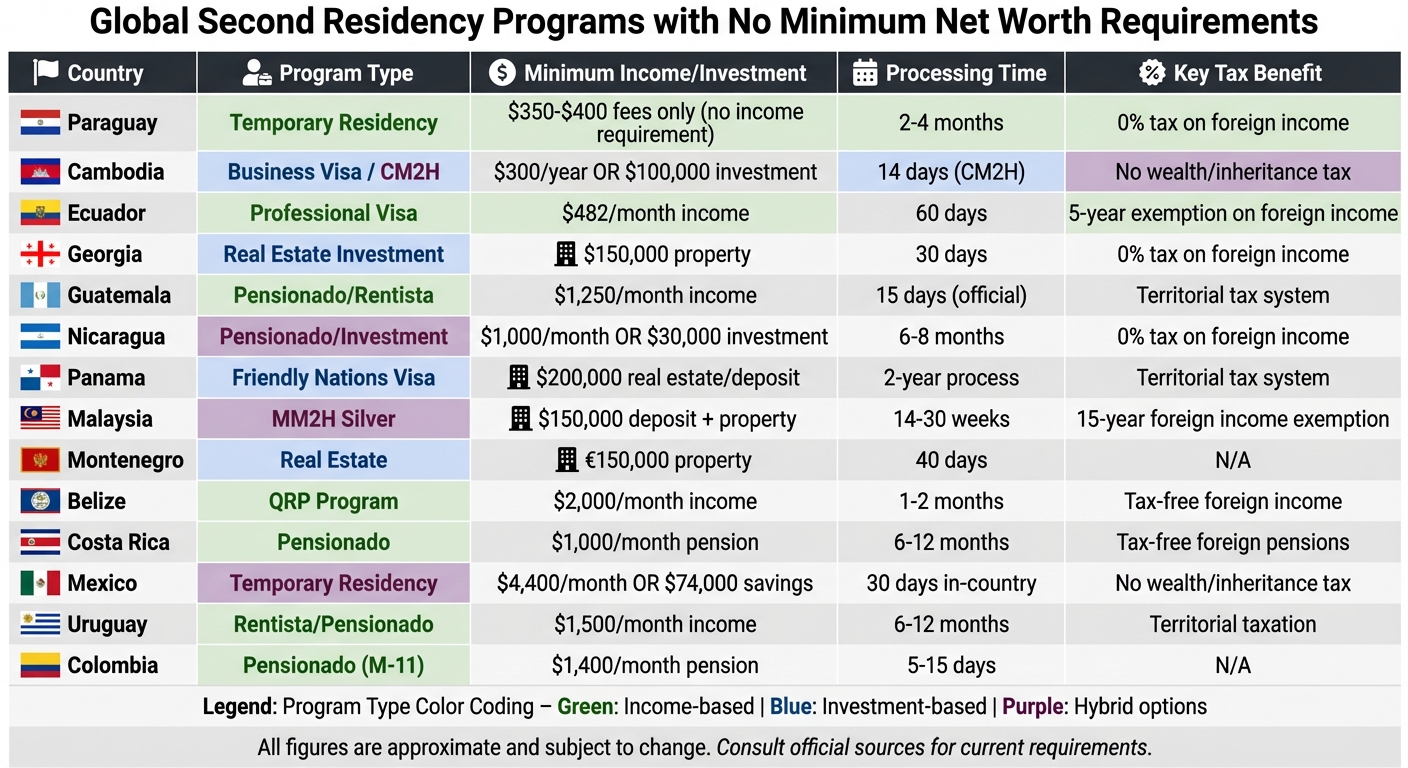
14 Second Residency Programs Comparison: Income Requirements and Investment Thresholds
1. Paraguay Residency Program
Moving to Paraguay offers one of the simplest residency options for Americans, thanks to Law No. 6984/2022. This law eliminated income, investment, and deposit requirements, allowing you to obtain temporary residency with no financial prerequisites. The only costs involved are government fees, which range from $350 to $400. This two-year temporary residency lets you live, work, and study in Paraguay while you determine if it suits your long-term plans. Here’s a closer look at the process.
To apply, you’ll need to visit Asunción in person and spend 5–7 business days completing paperwork at the Dirección General de Migraciones. Required documents include your passport, an apostilled birth certificate, and an apostilled police clearance certificate issued within the last six months. Once submitted, processing takes 2 to 4 months, and you’ll receive your Cédula (national ID) about 45 days later. This ID is essential for tasks like opening bank accounts or signing contracts.
After two years of temporary residency, you can apply for permanent residency by proving financial solvency. The easiest way is to make a bank deposit of around $5,000. Alternatively, if you have a guaranteed lifetime pension of approximately $1,300 per month, you can bypass temporary residency altogether and apply directly for permanent status through the Pensionado program.
What makes Paraguay especially appealing is its territorial tax system. Foreign-sourced income – such as dividends, rental income, or pensions – is completely exempt from Paraguayan income tax. Additionally, Paraguay has no wealth, inheritance, or gift taxes. As Paraguay Simply explains:
Income earned outside of Paraguay is tax-exempt (0%). This is not a loophole; it is the fundamental law.
For local income, tax rates are modest at just 8–10%, making Paraguay one of the most tax-friendly countries in Latin America.
Citizenship is an option after two years of temporary residency and three years of permanent residency. Permanent residents can even be absent for up to three consecutive years without losing their status. However, maintaining annual visits is recommended to strengthen ties and ensure eligibility for citizenship.
sbb-itb-39d39a6
2. Cambodia Residency Program
Cambodia offers a straightforward and affordable business visa option, costing less than $300 for a one-year renewable pass. This makes it one of many visas for digital nomads looking for low-cost residency. Unlike many other programs, this visa doesn’t require proof of financial standing or a specific net worth. The process is simple: arrive in Cambodia, get a visa on arrival, and then extend it to a business visa with local assistance within a few days. For those seeking a more structured long-term option, there’s the Cambodia My Second Home (CM2H) program.
Launched in July 2022, the CM2H program provides a 10-year residency for individuals willing to invest at least $100,000 in approved real estate. Beyond residency, this program comes with perks like one year of free medical coverage, VIP airport pickup, and membership in the Khmer Home Charity Association (KHCA). The KHCA supports members with tasks like opening bank accounts and registering companies. Applications are processed within 14 days, and the program has a limit of 10,000 visas.
Cambodia’s tax system adds to its appeal. Understanding tax residency begins after spending more than 182 days in the country within a 12-month period. Residents pay progressive income tax rates ranging from 0% to 20%. Non-residents are taxed at a flat 20% on Cambodian income. There are no wealth or inheritance taxes, and rental income is taxed at 10% for citizens and 14% for foreigners.
The CM2H program also offers a path to citizenship after five years of residency. For those looking for a faster route, there’s an expedited naturalization option. This requires either a $244,000 donation or a $305,000 investment in a Cambodian Development Council-approved project. The fast-track process takes three to six months, but applicants must show basic knowledge of the Khmer language, script, and history.
3. Ecuador Residency Program
Ecuador provides several residency options, all tied to the country’s 2026 Basic Salary Unit (SBU) of $482 per month. Among these, the Professional Visa stands out as the most affordable, requiring just $482 in monthly income – much lower than the $1,446 required for most other visa categories. To qualify, applicants need a bachelor’s degree registered with Ecuador’s SENESCYT authority. The registration process takes 30 to 90 days and costs about $500 if using third-party services.
Other popular residency options include:
- Pensionado Visa: Requires proof of a lifetime pension of at least $1,446 per month.
- Rentista Visa: Designed for those with stable passive income, such as rental payments or dividends.
- Investor Visa: Demands a one-time investment of $48,200 in real estate, a bank certificate of deposit, or company shares.
- Digital Nomad Visa: Requires $1,446 in monthly income and a remote work contract with a foreign employer.
For those adding dependents, an additional $250 per month in income is required per person. These options reflect Ecuador’s focus on accessible, income-based residency pathways tailored to different financial and professional situations.
"The Professional Visa doesn’t care where your money comes from, as long as you can document $482/month." – Chip Moreno, Founder, EcuaPass
To simplify the process, Ecuador now requires all residency applications to be submitted through its national E-Visa online platform – eliminating in-person submissions. Applications typically take 60 days to process but can take longer in some cases. Required documents include:
- A valid passport with at least six months of validity
- An apostilled criminal background check (valid for 180 days)
- An apostilled birth certificate
- Proof of health insurance
For U.S. citizens, starting the FBI background check early is crucial, as it can take 8 to 12 weeks to complete and obtain an apostille.
Fees include a $50 non-refundable application fee, $400 for visa issuance (reduced by 50% for applicants aged 65 or older), and approximately $15 for the cédula (national ID). After 21 months of temporary residency – during which you cannot spend more than 90 days abroad per year – you become eligible to apply for permanent residency. Citizenship is available after three years of permanent residency, making the total journey to an Ecuadorian passport about five years.
Ecuador also offers attractive financial perks. Under a 2024 tax regime, new residents are taxed only on Ecuador-sourced income for their first five years. The use of the U.S. dollar as the national currency eliminates exchange rate concerns. Seniors over 65 enjoy additional benefits like VAT refunds, 50% discounts on utility bills, and property tax exemptions. However, keep in mind the 5% Outbound Transfer Tax on funds sent abroad above certain exemption limits. These economic incentives, combined with the straightforward residency process, make Ecuador a practical choice for those seeking a second residency.
4. Georgia Residency Program
Georgia has recently updated its residency program, making some notable adjustments while still keeping the process relatively straightforward for foreign investors. Starting March 1, 2026, the minimum real estate investment required to qualify for residency increased from $100,000 to $150,000 – a 50% increase reflecting the country’s move toward stricter immigration policies. However, the program remains attainable since there are no additional net worth requirements beyond the investment itself, unlike other programs that impose such conditions.
The $150,000 Real Estate Route offers a 1-year renewable residency permit with no minimum stay requirements. To qualify, you must purchase non-agricultural property worth at least $150,000, have it registered at the Public Service Hall (a process that typically takes 1–4 days), and then submit your application. Notably, the permit is granted based on the property’s market value as determined by an accredited appraiser, rather than its purchase price. A professional appraisal, which starts at 49 GEL (around $18), is required. This route also extends residency rights to your spouse and minor children under the same investment.
For those seeking a more permanent solution, the $300,000 Investor Route is an attractive option. This route grants an immediate 5-year residency permit and allows investors to apply for permanent residency after five years, one year sooner than the $150,000 option. The investment can be made in either non-agricultural real estate or a Georgian business. However, the business option has additional requirements, including meeting specific annual turnover thresholds: $50,000 in the first year, $100,000 in the second, and $120,000 annually from the third to the fifth year. Like the $150,000 route, this option does not require physical presence in Georgia.
"Georgia offers one of the most accessible residency-by-investment programs in Europe – and possibly the world." – Levan Jojua
The application process is fairly affordable. Standard 30-day processing costs 300 GEL (about $110), while expedited 10-day processing costs 410 GEL (around $150). Property registration fees are 50 GEL ($20) for standard processing or 200 GEL ($80) for same-day service. Additionally, the residence card, which must be applied for within one month of permit approval, costs 50 GEL ($20). Failure to apply for the card within this timeframe will result in termination of the permit. All foreign documents, such as criminal background checks, need to be translated into Georgian by a certified translator and must include an apostille before submission.
Georgia’s tax system is another major advantage for investors. Tax residents enjoy a 0% tax rate on foreign-sourced income, and personal cryptocurrency gains are completely tax-exempt. Additionally, individual entrepreneurs with Small Business Status pay just 1% tax on gross turnover up to 500,000 GEL (roughly $185,000).
For those considering long-term residency, Georgian citizenship becomes an option after 10 years of continuous residence and demonstrating proficiency in the Georgian language. However, it’s important to note that Georgia generally does not allow dual citizenship. Applicants are usually required to renounce their original nationality unless granted an exception by presidential decree.
5. Guatemala Residency Program
Guatemala stands out with its income-based residency program, offering a direct path to permanent residency. Through the Residencia Permanente para Rentistas o Pensionados program, applicants can skip the temporary residency phase entirely. This makes it one of the most accessible options in Central America for those seeking immediate permanent residency.
The program has two primary options: the Pensionado route and the Rentista route. The Pensionado option caters to individuals receiving a consistent pension from a government, private organization, or international entity. Meanwhile, the Rentista category is for individuals with passive income from sources like foreign investments, real estate, or bank deposits outside Guatemala. Interestingly, despite being labeled a "retirement visa", there’s no age restriction – you just need to meet the income requirements.
To qualify, you must demonstrate a minimum monthly income of $1,250 from foreign sources, with an additional $300 required for each dependent, such as a spouse or children under 18. All foreign documents must be apostilled and translated into Spanish by a certified translator. Additionally, police clearance certificates are required from every country where you’ve lived in the past five years. While the official processing time is listed as 15 working days, delays can extend this to several weeks or months.
The program is relatively affordable. The Pensionado visa fee is $400, while standard permanent residency costs $700. Additionally, there’s an annual foreigner fee of $40. Since navigating the process involves multiple government offices, hiring a local immigration lawyer is advisable, with fees typically ranging from $500 to $1,500.
One of the most appealing aspects of Guatemala’s residency program is its territorial tax system. As Mikkel Thorup, Founder and CEO of Expat Money, explains:
Guatemala has a territorial tax system, so resident or not, you are taxed on any income that is sourced from within the country and you do not pay taxes on any income that comes from outside the country.
This means foreign income such as pensions, dividends, or rental earnings remains completely tax-free. Residents also enjoy additional perks, like a one-time exemption from VAT and customs duties on household goods. Plus, you can import one vehicle duty-free, as long as its value doesn’t exceed 25 times your declared monthly income – up to $31,250 for those meeting the $1,250 threshold.
After five years of continuous residency, you can apply for citizenship, which grants visa-free access to 148 countries.
6. Nicaragua Residency Program
Nicaragua provides an affordable and flexible residency option, making it an appealing choice for individuals seeking a new home base. The country offers one of the most budget-friendly investment-based residency programs globally, requiring a minimum investment of just $30,000. This investment must be directed toward real estate development, new business ventures, or government-approved agricultural or forestry projects. Additionally, the investment must generate economic benefits, such as hiring at least two Nicaraguan employees under formal contracts.
For those leaning toward an income-based route, Nicaragua offers two straightforward options. The Pensionado visa is available for individuals with a permanent monthly pension or retirement income of at least $1,000, while the Rentista visa requires proof of a stable monthly income from private sources (e.g., dividends, interest, or rental income) of at least $1,250. These thresholds increased in 2024, up from $600 and $750, respectively.
The application process typically takes 6 to 8 months and must be completed in Managua, as the program does not support online applications. Applicants need to provide apostilled birth certificates, police clearance documents (valid for only 90 days), and health certificates, all translated into Spanish by certified translators. The total cost for an individual applicant usually falls between $35,000 and $40,000, encompassing the $500 government fee, $200 per dependent, $215 in processing fees, and legal fees ranging from $1,000 to $5,000.
Nicaragua’s territorial tax system is another attractive feature. Personal income tax is 0% for earnings below 100,000 NIO (Nicaraguan Córdobas), and foreign-sourced income is entirely tax-free, regardless of the amount. There are no wealth taxes, inheritance taxes, or foreign asset reporting requirements. While the residency ID card (cédula) must be renewed every six months in person, there is no formal minimum stay requirement.
One critical point to consider: constitutional amendments set to take effect in 2026 will strip Nicaraguan nationality from citizens who acquire foreign citizenship, effectively ending dual citizenship for most individuals. However, the program does provide a two-year path to citizenship for those who maintain at least 180 days of presence in the country annually, offering a relatively quick route to citizenship.
7. Panama Friendly Nations Visa
Panama’s Friendly Nations Visa offers a simple residency route for citizens of over 50 countries, including the US, Canada, the UK, Australia, most EU nations, Japan, and South Korea. Since its launch in 2012, the program has brought in over 15,000 new residents, with US citizens making up 35% of applicants. Its popularity is bolstered by Panama’s dollar-based economy, territorial tax system, and stable political environment. Let’s break down the three qualification paths introduced in 2021.
In 2021, new regulations (Executive Decrees 197 and 226) outlined three ways to qualify for the visa. You can either invest $200,000 in titled Panamanian real estate, deposit $200,000 in a three-year fixed-term account at a licensed Panamanian bank, or secure a valid employment contract with a Panamanian company registered with the Ministry of Labor (MITRADEL) [30,33,36]. The process involves two stages: a two-year provisional permit, which transitions to permanent residency as long as you meet the criteria [30,33,36].
Costs include government fees of $1,050 per applicant ($250 to the National Treasury and $800 as a repatriation deposit). Legal fees vary from $1,500–$4,000 for the main applicant and $500–$2,000 per dependent [30,33,34]. Additional expenses, such as translations, apostilles, medical exams, and notary services, can range from $500–$1,500 [36,37]. With all required documents, the program boasts a 98% approval rate, according to the Panama National Police Immigration Division.
"The Friendly Nations Visa remains one of the most straightforward residency programs in Latin America. We see clients from all eligible countries, but the key is proper preparation and understanding the investment requirements upfront." – Austin Hess, COO of DoPanama
Panama’s territorial tax system is another draw. All foreign-sourced income, including pensions, dividends, and capital gains, is exempt from local taxes [30,31,35]. There’s no annual minimum stay requirement; you just need to visit Panama at least once every two years to retain your residency [30,31,37]. After five years of permanent residency, you can apply for Panamanian citizenship, gaining a passport with visa-free or visa-on-arrival access to over 140 countries [30,37]. To avoid delays, start obtaining apostilled criminal background checks and birth certificates 2 to 8 weeks before traveling.
8. Malaysia MM2H Program
Malaysia’s My Second Home (MM2H) program now operates under a four-tier system: Silver, Gold, Platinum, and Special Economic Zone (SEZ). As of May 2025, there were 57,608 active visa holders in the program. The Silver tier, which accounted for 78% of principal approvals in 2024, is the most popular choice. It requires a $150,000 fixed deposit and a minimum property purchase of RM600,000 (approximately $135,000). Notably, all applications must now go through a licensed Ministry of Tourism, Arts and Culture (MOTAC) agent, as self-submissions are no longer allowed. These updates aim to simplify the process while retaining the program’s benefits.
One of the key attractions of MM2H is its tax-friendly structure. Foreign-sourced income is tax-exempt for 15 years, and there are no taxes on capital gains, wealth, or inheritance. Additionally, the interest earned on your fixed deposit is tax-free. Applicants can also withdraw up to 50% of their fixed deposit after one year. Residency requirements vary by age: those under 50 must spend at least 90 days per year in Malaysia, while applicants aged 50 and above have no minimum stay requirement.
Application Process
The entire process typically takes 14 to 30 weeks. Here’s a breakdown of the steps:
- Initial Documentation: Start by obtaining police clearances (6–10 weeks) and preparing documents such as three months of bank statements, two years of tax returns, passport copies, and birth or marriage certificates.
- Application Submission: Your licensed agent submits the application to MOTAC, which reviews it over 4 to 12 weeks before issuing a Conditional Approval Letter (CAL).
- Final Steps: After receiving the CAL, you’ll have 4 to 8 weeks to open a Malaysian bank account, deposit the required funds, and complete a medical exam at a Malaysian clinic.
Costs and Requirements
The program’s fixed, non-refundable costs range from RM49,000 to RM60,000 ($11,000 to $13,500). These include:
- RM40,000 agent fee
- RM1,000 participation fee
- Medical insurance with a minimum coverage of RM100,000
Fixed deposit interest rates are competitive, typically between 4.5% and 5.2% annually. For property purchases, you must buy within 12 months of approval and hold the property for at least 10 years.
"The new requirement to buy property has put some potential candidates off… many high-net-worth individuals who may not want to buy real estate in Malaysia." – Anthony Liew Yong Huat, President, Malaysia My Second Home Consultants Association (MM2HCA)
Additional Tips
- Verify your agent’s license through the MOTAC official registry. Legitimate licenses follow the "MM2H" series format (e.g., MM2H810).
- Opening a bank account with HSBC or Maybank can speed up the fixed deposit process.
- For a more affordable option, the Sarawak-MM2H (S-MM2H) program requires a lower deposit of RM150,000 ($34,000) and only a 30-day annual stay. However, this option limits your residency to Sarawak state.
9. Montenegro Real Estate Residency
Montenegro has established a straightforward pathway to residency through real estate investment, with updated criteria introduced on January 17, 2026. This reform set a €150,000 minimum property investment requirement, replacing the previous policy that had no minimum threshold. The property’s value is based on the Tax Authority’s official assessment – not the listing or purchase price. Eligible properties include apartments, villas, cottages, commercial offices, and restaurants, as long as they are debt-free and you own at least 50%.
Residency permits under this program are valid for one year and can be renewed annually as long as you retain ownership of the property. The application process takes about 40 days, and applicants must deposit €3,650 (€10 per day) into a Montenegrin bank account to demonstrate financial stability. This amount can be withdrawn after 24 hours. It’s important to note that this permit does not grant work authorization – a separate work permit is necessary.
"Montenegro’s reform signals a calibrated shift from loosely structured residency incentives toward a more regulated model aligned with EU compliance standards." – International Investment
After five years of holding a temporary residency permit, you can apply for permanent residency. Citizenship becomes an option after 10 years of total residency. However, Montenegro does not allow dual citizenship for naturalization. For those purchasing properties on the secondary market, a 3% property transfer tax applies, while new constructions are subject to a 17% VAT. Immigration service fees are approximately €400, with an additional €350 per dependent.
Keep in mind, leaving Montenegro for more than 90 days will result in the permit being revoked. Additionally, all residents must register with the local police or tourist office within 24 hours of arriving in the country. For those who secured residency before the 2026 reform, the new €150,000 threshold does not apply for permit renewals, as they are grandfathered under the old rules.
10. Belize QRP Program
Belize offers a practical residency option through its Qualified Retired Persons (QRP) Program, designed for retirees and remote workers with steady foreign income. This program is open to individuals aged 45 or older who can demonstrate a foreign-source income of at least $2,000 per month or an annual deposit of $24,000 into a Belizean bank. It’s available to people of any nationality, including retirees, digital nomads, and remote business owners.
The application process is straightforward and typically takes 1 to 2 months. Applicants need to provide several documents, including birth and marriage certificates, police clearance, passport copies, proof of income, a medical certificate, passport photos, and a bank reference (dated within the last six months). Once approved, QRP holders are required to spend 30 consecutive days in Belize annually to maintain their status. While working for Belizean companies is not allowed, participants are free to work online or manage offshore businesses that serve international clients.
Belize’s territorial tax system is a major draw, as foreign-sourced income and capital gains are tax-free. There are also no inheritance or net worth taxes. The initial fees include $1,350 for the main applicant and $1,100 for dependents under 25, with a $50 annual renewal fee. Financial planning is simplified by the Belize Dollar’s fixed 2:1 exchange rate with the U.S. Dollar. Additionally, QRP members enjoy duty-free exemptions on household goods during their first year and can import one motor vehicle, ship, or aircraft duty-free every three years.
After one year of QRP residency, participants may qualify for permanent residency. However, becoming a tax resident requires spending more than 183 days per year in Belize, which is not a condition for maintaining QRP status. This program is a cost-effective and efficient option for those seeking a second residency in a tropical setting.
11. Costa Rica Pensionado Program
Costa Rica’s Pensionado Program stands out as one of the longest-running residency options in Latin America. The main requirement? A guaranteed lifetime pension of at least $1,000 per month. Qualifying pensions include U.S. Social Security, military benefits, government pensions (state or federal), and corporate pensions with lifetime payouts. However, retirement savings accounts like 401(k)s or IRAs don’t qualify unless converted into an annuity with fixed monthly payments. There’s no age restriction, making it an option for younger retirees with disability or military pensions. Here’s a breakdown of how the application process works.
The process takes about 6 to 12 months and requires several apostilled documents, including your passport, birth certificate, FBI background check, pension verification letter, and marriage certificate (if applicable). You’ll need to enter Costa Rica on a tourist visa and file your application with the Dirección General de Migración y Extranjería (DGME). Non-Spanish documents must be translated, which can cost $200 to $500. Government fees total approximately $565, broken down as a $250 application deposit, $200 change-of-status fee, and $100–$125 for the DIMEX residency card. Attorney fees typically range from $1,500 to $3,000, depending on the legal services required.
One of the program’s financial perks is that foreign-sourced pension income is entirely tax-free under Costa Rica’s territorial tax system. However, you must enroll in the CAJA public healthcare system, which comes with monthly premiums ranging from 7% to 11% of your declared income. For someone declaring the $1,000 minimum pension, this means paying about $70 to $150 per month. If both spouses have pensions, it’s smart to make the spouse with income closest to $1,000 the primary applicant to keep healthcare costs lower. While you cannot work for a Costa Rican employer, you are allowed to run your own business or earn income from overseas.
Another benefit? New residents can import household goods and one vehicle tax-free within six months of approval, saving anywhere from $10,000 to $30,000 in import duties, which are usually 50–80%. Additionally, there’s a 20% reduction in property transfer tax if you decide to purchase real estate. The program grants temporary residency for two years, which you can renew as long as you meet the income requirement and visit Costa Rica at least once per year. After three years of temporary residency, you’re eligible to apply for permanent residency. Citizenship is an option after five to seven years of legal residency, making this program a strong choice for those seeking a long-term, cost-effective residency solution.
12. Mexico Legal Residency Program
Mexico’s residency program is structured around an "economic solvency" model, making it a viable option for remote workers, retirees, and investors. The most common route is temporary residency, which requires proof of a monthly income of about $4,400 or maintaining savings of approximately $74,000 for 12 consecutive months. Accepted income sources include freelance work, rental income, investment dividends, or pensions. The process is relatively straightforward and involves two main steps: consular approval and border procedures.
To get started, schedule an appointment through the "MiConsulado" system at a Mexican consulate outside of Mexico. Requirements differ by consulate – some ask for 6 months of bank statements, while others require 12. Check with your chosen consulate for specifics. The consulate fee is $56, and upon approval, you’ll receive a visa sticker valid for 180 days with a single entry. When entering Mexico, ensure the border officer marks your entry as "Canje" (exchange); otherwise, you may need to restart the process. Once in Mexico, you have 30 days to visit a local INM (National Migration Institute) office to exchange your visa for a residency card. This step costs roughly 11,141 MXN (around $620).
Temporary residency is initially granted for one year, with the option to renew for up to three additional years. Afterward, you can transition to permanent residency.
For residents aged 18 and older, obtaining an RFC (tax ID) and activating the Buzón Tributario (SAT electronic mailbox) is mandatory to avoid fines ranging from 3,850 MXN to 11,540 MXN. The RFC is essential for everyday activities like opening bank accounts or buying vehicles.
Mexico taxes worldwide income at progressive rates from 1.92% to 35%, with the top rate applying to incomes over approximately $250,000. Spending more than 183 days in Mexico per year qualifies you as a tax resident. However, Mexico does not impose wealth, inheritance, estate, or gift taxes. If you plan to buy property within 31 miles of the coast or 62 miles of international borders, you’ll need a fideicomiso – a trust that costs $2,000 to $3,000 to establish, plus annual fees of $550 to $1,000.
After five years of legal residency, you can apply for naturalization. If married to a Mexican citizen, this timeline reduces to two years. The application fee for naturalization is 8,755 MXN.
13. Uruguay Rentista or Pensionado Visa
Uruguay offers one of the most straightforward residency programs in Latin America by granting permanent residency right away – no temporary status required. To qualify, you need to show a stable monthly income of about $1,500. The Pensionado route is for those with lifetime pensions (government or private), while the Rentista option applies to passive income sources like dividends, rental income, or investment returns. There’s no age restriction for either path, making it accessible to a wide range of applicants.
To apply, you must enter Uruguay as a tourist and file your application in person at the Dirección Nacional de Migración. A Uruguayan public notary (escribano) will need to certify your income, which costs between $300 and $800. Before meeting with the notary, you’ll need to open a local bank account and show three months of consistent income transfers. Government filing fees range from $80 to $100, and total application costs, excluding legal fees, are between $380 and $900. Legal fees, if needed, can exceed $3,000. While the processing time is 6 to 12 months, you’ll receive a temporary ID card within 1 to 10 days, allowing you to live and work in Uruguay during the wait.
"Uruguay is one of the few countries in Latin America… where residency is granted directly as permanent residency rather than requiring years of temporary status first." – Pascal Klein, GoResident
Once you’ve secured residency, there are notable tax benefits. Uruguay uses territorial taxation, meaning foreign-source income is generally not taxed. Starting January 1, 2026, new residents can choose between a 10-year exemption on foreign-source capital income (dividends and interest) or a permanent 7% flat tax. Additionally, there are no inheritance, estate, or gift taxes. The Pensionado visa also allows you to import household goods and one vehicle duty-free, though the vehicle cannot be sold for four years.
To maintain residency, you cannot be away from Uruguay for more than three consecutive years. Citizenship is possible if you spend at least 183 days per year in the country – married applicants can apply after three years, while singles need five years. Health cooperative memberships cost $70 to $250 per month, and you’ll need to provide police clearance certificates from every country you’ve lived in during the past five years. These certificates must be less than six months old and apostilled before your arrival.
14. Colombia Residency Program
Colombia’s residency program provides several pathways, with fees and thresholds updated annually based on the SMMLV (Salario Mínimo Mensual Legal Vigente). For 2026, the SMMLV is COP 1,750,905 – a 23% increase that has raised income and investment requirements accordingly. Among the options, the Pensionado (M-11) visa stands out as the most accessible, requiring a monthly pension of at least 3 SMMLV (around $1,400) with no age limits. Other options include the Rentista visa, which demands passive income of approximately 10 SMMLV ($4,600 per month), or the real estate investment route, requiring an investment of 350 SMMLV (about $163,000). For those looking to invest in a business, the threshold is 100 SMMLV (around $47,000).
The application process is entirely online through the Ministry of Foreign Affairs (Cancillería) portal. Applicants must pay a $55 non-refundable study fee, along with an issuance fee that ranges from $177 to $270, depending on the visa type. Required documents include:
- A valid passport
- A police clearance certificate covering the last three years
- A medical certificate confirming fitness
- A health insurance policy that explicitly includes a "repatriation of remains" clause (this is crucial to avoid rejection)
Once approved, applicants must register with Migración Colombia and obtain a Cédula de Extranjería (foreign ID card) within 15 days. This ID costs about $75.
Colombia taxes residents on their worldwide income, unlike countries with territorial tax systems. The progressive tax rates range from 0% to 39%, and tax residency is established after spending 183 days or more in any rolling 365-day period. Additionally, all residents must enroll in the public health system (EPS) and contribute approximately COP 87,500 monthly, even if they have private insurance. Most Migrant (M) visas can convert to permanent residency after five years, but note that any absence exceeding six consecutive months will result in visa cancellation.
Application costs, excluding legal fees, range from $307 to $400. Legal fees, if needed, typically fall between $500 and $1,500. Since thresholds are tied to the minimum wage and exchange rates can fluctuate, it’s wise to maintain a financial buffer above the minimum requirements. The Cancillería generally processes applications within 30 calendar days, with decisions often issued in 5 to 15 business days.
Conclusion
Getting a second residency doesn’t have to involve a massive fortune or complicated investments. The 14 programs highlighted here show that moving abroad can be a realistic option for retirees, remote workers, and anyone with passive income or savings. Take Paraguay’s low income requirement or Panama’s pensionado visa as examples – these programs focus on practical entry points rather than financial barriers.
Beyond being easy to access, these programs come with real perks. Many offer quick processing times (sometimes in under three months) and minimal physical presence requirements, giving you the freedom to live and travel as you please. On top of that, they often provide benefits like quality healthcare, potential tax breaks, and pathways to permanent residency.
When choosing a program, think about how it fits your income and lifestyle. For instance, retirees with a steady pension might find Panama, Costa Rica, or Colombia’s pensionado visas ideal. Remote workers could explore options in places like Georgia or Mexico. Understanding tax and residency solutions is crucial for this lifestyle. Don’t forget to factor in things like work rights, tax obligations, language barriers, and whether you plan to fully relocate or just establish residency.
"Long-term residency abroad is no longer reserved for the ultra-wealthy or corporate expatriates."
– Georgia, Writer, Trust Vista Consulting
To get started, pick two or three countries that align with your budget and lifestyle. Dive into the details of their residency requirements – documents like police clearances, medical certificates, and income proofs can take months to prepare and authenticate. If you can, spend some time in your chosen country on a tourist visa first. This lets you get a feel for the local infrastructure, cost of living, and overall vibe before making a commitment. With this step-by-step plan, securing a second residency becomes not just possible, but a smart move. It’s a chance to expand your horizons, enjoy greater mobility, and create a more secure future – all without draining your savings.
FAQs
Do these residencies lead to citizenship?
Residency programs like these usually don’t grant citizenship right away. That said, many countries offer routes to permanent residency or even citizenship after meeting certain conditions over time. It’s crucial to check the immigration policies and legal requirements of the country you’re considering to fully understand your options.
Will I owe taxes if I become a tax resident?
Whether you owe taxes as a tax resident depends on the specific tax rules of the country where you live and your financial circumstances. Generally, being a tax resident means you’ll need to follow that country’s tax laws, which often include paying income taxes. Since the requirements and obligations differ from one jurisdiction to another, it’s crucial to understand the particular regulations for the country you reside in.
Can I include my spouse and kids?
Yes, many second residency programs let you include your spouse and children in the application. However, the eligibility criteria and application process can differ depending on the program and country. Make sure to carefully review the specific requirements for the country you’re considering.
