
Yes – if you want a low-bar residency with light stay rules, Paraguay is one of the simplest options in South America. You can usually apply without a job offer, income proof, or a large investment at the temporary stage. In many cases, government fees are about $350, total costs land around $1,500 to $6,000, and approval often takes 60 to 90 days, with the ID card following later.
But here’s the catch: easy to start does not mean easy to finish well. If I were sizing up Paraguay, I’d focus on six things right away:
- Who can apply: most people can use the standard temporary route
- What documents matter: passport, apostilled birth certificate, and criminal record check
- How long it takes: often 4 to 8 months from prep to ID card
- What it costs: from under $1,000 DIY to $6,000 with full legal help
- How much time you must spend there: usually once a year for temporary residents and once every three years for permanent residents
- How tax works: Paraguay generally taxes local-source income at 10% and does not tax most foreign-source income locally
If you’re comparing Paraguay with Uruguay, Argentina, Brazil, and Chile, Paraguay stands out for its lower entry bar, lighter upkeep, and territorial tax system. Still, it’s not a magic fix. You may still need a RUC, accounting filings, and a tax residency certificate if you want your setup to hold up outside Paraguay.
Quick Comparison
| Country | Entry barrier | Foreign income tax | Stay rule | Typical setup cost |
|---|---|---|---|---|
| Paraguay | No income proof or big investment for temporary residency | Usually 0% locally on foreign-source income | Light | Lower end in the region |
| Uruguay | Higher proof of ties or funds | 0% for a set period, then 12% on some foreign income | Much heavier | $8,000 to $25,000 |
| Argentina | Must fit a visa category | Worldwide income, up to 35% | More tied to status path | $2,000 to $5,000 |
| Brazil | Usually work, family, or investment route | Worldwide income, up to 27.5% | More tied to category | $2,000 to $5,000 |
| Chile | Category-based process | 0% on foreign income for 3 years, then worldwide | More time and process | $2,500 to $6,000 |
For me, the short version is simple: Paraguay is one of the easiest places in the region to get residency on paper, but the long-term win depends on keeping the residency file, tax ID, and tax records in order.
sbb-itb-39d39a6
Paraguay residency: options, documents, costs, and timeline
Temporary residency: who qualifies and what you need to submit
Paraguay’s standard residency route is the temporary application, and for most foreigners, this is the path they take. The main issue isn’t qualifying on paper so much as getting the process right: knowing what to file, where to file it, and how long each step tends to take.
The standard route does not require a job offer, minimum income, or an upfront investment. You’ll need a passport with at least six months of validity left, an apostilled birth certificate showing both parents, and an apostilled criminal background check. For U.S. applicants, that means an FBI background check with a federal Hague Apostille. It’s smart to start at least three months before departure, since apostilles alone can take two to four weeks.
Document translation has to be handled only in Paraguay. The DNM in Asunción accepts translations only from certified public translators licensed in Paraguay. If your documents are in a language other than Spanish, English, French, or Portuguese, you’ll first need an intermediate translation into one of those four languages. After that, a Paraguayan translator can prepare the final Spanish version.
Once you’re in Paraguay, you must get the Certificate of Life and Residence from the local police and the Interpol clearance from the Asunción regional office before filing the DNM residency application.
Temporary residency is valid for two years. It gives you the right to live and work in Paraguay, apply for a Paraguayan national ID card (Cédula), and register for a Tax ID (RUC).
Moving from temporary to permanent residency
After you receive the temporary card, the next step is deciding whether to move to permanent residency or look at a direct investment route.
At the 21-month mark, you become eligible to apply for permanent status. This step adds a solvency check. You’ll need either a university degree, a recognized professional certification, or a refundable bank deposit of about $4,562. Permanent residency is issued for 10 years and can be renewed.
Paraguay also has direct permanent options for investors, but for most applicants, the standard temporary route is still the main route people use.
Timeline, fees, and physical presence rules
Here’s how the process usually looks in practice:
| Stage | Timeframe |
|---|---|
| Document preparation in the U.S. (apostilles, FBI check) | 3 to 6 weeks |
| In-country filings, local checks, translations | 1 to 2 weeks after arrival |
| DNM approval for temporary residency | 60 to 180 days (average 90 days) |
| Cédula issuance after approval | 30 to 60 additional days |
| Total realistic timeline | 4 to 8 months |
Government filing fees for temporary residency usually run $336 to $350, and the residency certificate adds about $27. If you later upgrade to permanent residency, filing fees are usually $500 to $700.
Your total out-of-pocket cost depends a lot on how much help you want:
- DIY route: about $980 to $2,050
- Local filing agent: $1,500 to $2,500 in fees, on top of government costs
- Full binational legal support: $3,500 to $6,000
If you keep an active RUC, monthly accounting usually costs $30 to $50.
There’s one more part people often miss: keeping the status active. Temporary residents generally need to visit once per year. Permanent residents need to visit once every three years. And residency status is not the same thing as tax residency. A Cédula on its own does not create tax residency. To get a Tax Residency Certificate, you need an active RUC and proof of economic substance in Paraguay.
Paraguay versus Uruguay, Argentina, Brazil, and Chile
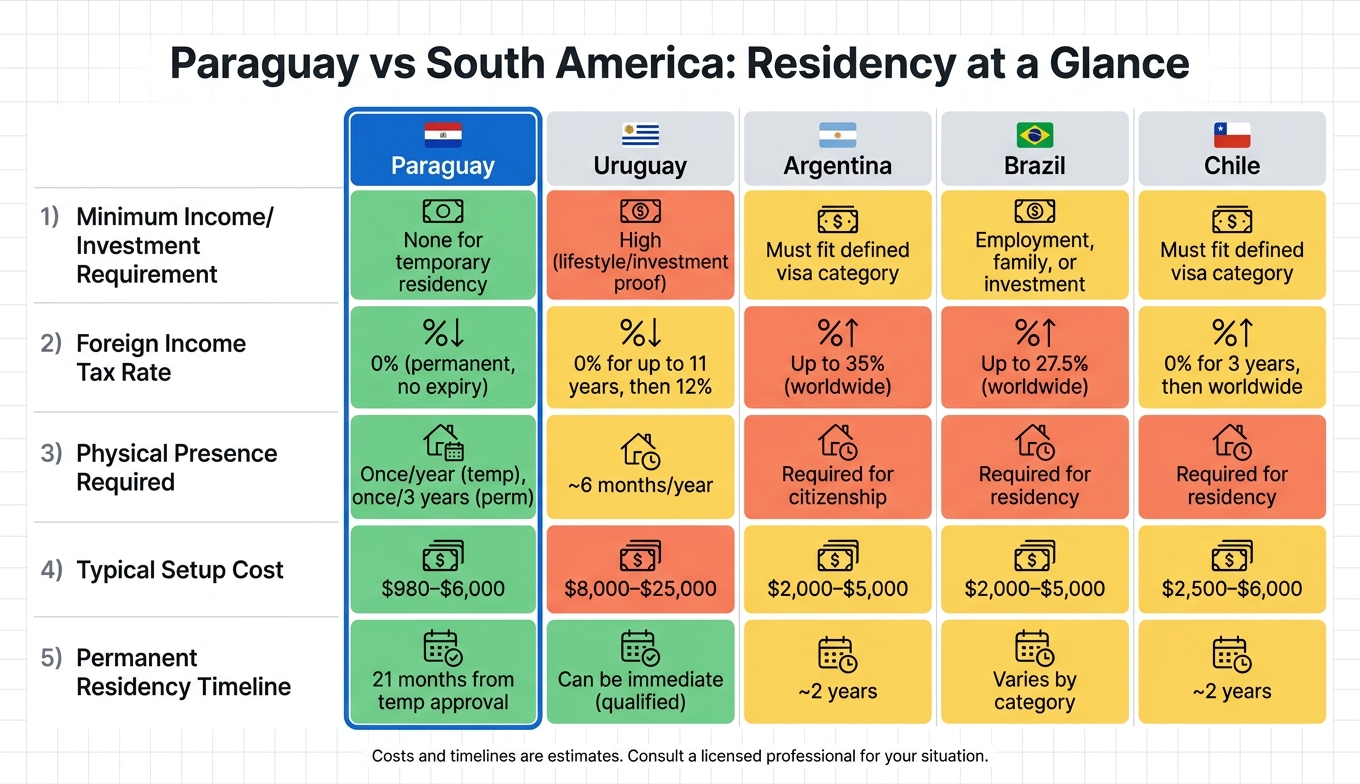
This comparison sticks to what most people care about first: entry rules, timing, cost, and taxes. The point isn’t to crown one country the winner. It’s to see which one is simpler to qualify for and keep over time.
Paraguay stands out in three places: lower entry barriers, lighter upkeep, and territorial taxation.
| Criteria | Paraguay | Uruguay | Argentina | Brazil | Chile |
|---|---|---|---|---|---|
| Minimum income or investment | None for temporary residency | High (lifestyle/investment proof) | Must fit a defined visa category | Employment, family ties, or investment | Must fit a defined visa category |
| Foreign income tax | 0% on foreign income (territorial, permanent) | 0% on foreign income for up to 11 years, then 12% applies | Worldwide income, up to 35% | Worldwide income, up to 27.5% | 0% on foreign income for 3 years, then worldwide |
| Physical presence | Not required during temporary residency | ~6 months/year | Required for citizenship | Required for residency | Required for residency |
| Permanent residency | Slower than some, faster than category-based routes | Can be immediate for qualified applicants | 2 years | Varies by category | 2 years |
| Typical setup cost | Lower than Uruguay; similar to Chile; above basic DIY filings elsewhere | $8,000 to $25,000 | $2,000 to $5,000 (est.) | $2,000 to $5,000 (est.) | $2,500 to $6,000 |
Paraguay versus Uruguay
Uruguay usually asks for stronger proof that your life is tied to the country. It also tends to expect more time spent there, with physical presence of about six months per year as the normal benchmark.
The tax angle matters too. Uruguay gives a tax holiday on foreign income, but it ends. After that, foreign-source interest and dividends face a 12% tax. Paraguay’s 0% rate on foreign-source income does not expire.
So if your goal is to keep in-country duties light, Paraguay is the simpler path.
Paraguay versus Argentina and Brazil
Argentina and Brazil both run on category-based residency systems. In plain English, you need to fit a box.
Brazil usually wants employment, family ties, or a qualifying investment. Argentina also uses a defined-category system, and applicants need to show income that fits that category.
Paraguay took a different turn. After Law No. 6,984/2022, the financial solvency rule for temporary residency was removed. That means the standard route no longer asks for proof of income or an up-front bank deposit.
There’s also a practical tax issue here. Argentina and Brazil can create more risk around taxes and exit matters if you leave without a clean fiscal break. That’s the kind of detail people often miss until it becomes a headache.
Paraguay versus Chile
Chile is still a workable option, but the process is more procedural and a bit less flexible than Paraguay.
The tax setup shows the difference fast. Chile gives new residents a three-year exemption on foreign income. After that, worldwide taxation applies. Paraguay’s territorial system keeps the 0% rate on foreign-source income without an end date.
For people who care more about flexibility than formal process, Paraguay stays the cleaner route.
That leaves one last question: who gets the most out of Paraguay’s lighter model, and where does it come up short?
Who Paraguay works for and where it falls short
The comparison above makes Paraguay look simpler on paper. But the part that matters is who can use that setup without creating tax problems later.
Good fit: digital nomads, retirees, and entrepreneurs
Paraguay tends to work best for people who want a low-friction residency path and want foreign-source income to stay outside the local tax net.
Remote workers and digital nomads may do well here, but one detail changes everything: where the work is done, and where the income is sourced. If you physically perform the work in Paraguay, that may trigger Paraguayan tax on local-source income. So the setup matters just as much as the residency card itself.
Retirees are often in a strong position, especially those living on foreign pensions or portfolio income. Those income streams are not taxed locally, and day-to-day costs are much lower than in the U.S. Private healthcare is also roughly 70% cheaper than U.S. rates.
Entrepreneurs can also find Paraguay appealing. Smaller businesses may use the IRE SIMPLE regime, which applies a 3% tax on gross revenue under about $270,000 per year.
Still, that simple setup has a few hard edges.
The limits of the ‘easy residency’ label
The process is easier than in many other countries, but "easy" does not mean "done." One of the most common mistakes is treating the national ID card, the Cédula, like the finish line.
It isn’t. The ID card is only one part of the process. To prove tax residency to foreign authorities, you need the full paper trail: migratory residence, the physical Cédula, a tax registration number (RUC), and a Tax Residency Certificate. Miss one of those pieces, and your home country may still treat you as taxable there.
Banking can trip people up too. Major banks often want both a Cédula and an active RUC, so showing up and expecting fast account opening is a common misstep.
There are also quality-of-life tradeoffs. Asunción has modern amenities, but outside the capital, some hubs can feel rougher, with heavier traffic, more noise, and strained infrastructure.
For U.S. citizens, there is one more layer to deal with. Paraguay residency does not change U.S. federal tax duties. And the Foreign Earned Income Exclusion only covers earned income, not passive income such as pensions or dividends.
Spanish is not required for approval, but life gets harder without it. Filings, banking, and any later citizenship process all tend to move more slowly.
How Paraguay residency fits into a broader international plan
If you’re using Paraguay as part of a bigger tax move, the paper trail matters more than the card. The card only works when it is backed by residency status, an RUC, and the right tax records.
A practical setup usually looks like this:
- Secure residency
- Register for an RUC
- Keep the RUC active with regular "nil" filings
- Maintain the records needed for a Tax Residency Certificate
Monthly accounting to keep that RUC active usually costs between $30 and $50.
Paraguay tends to work best when residency, tax residency, and exit planning from your home country all line up.
Conclusion: Is Paraguay the right residency choice for you?
Yes – Paraguay is one of the simplest residency paths in South America, but it suits people who can stay on top of the paperwork and tax follow-through. The low entry bar and light physical presence rules make it open to more applicants than many other countries in the region.
Its territorial tax system means foreign-source income stays outside local tax, which adds to the appeal. Naturalization is available after about three years.
That makes Paraguay a strong option for people who want simplicity, flexibility, and a practical backup base.
But that upside only matters if you keep the residency file clean. The main limit is compliance: residency works only when migratory residence, the Cédula, RUC registration, and tax records all stay in sync.
For Americans, that setup does not change U.S. filing rules. Paraguay can change where you live for residency purposes – not your U.S. worldwide tax duties.
FAQs
Can I get Paraguay residency without moving there full-time?
Yes – but not without going in person.
Paraguay’s residency process usually starts with temporary residency and then moves to permanent residency. To get it done, you must appear in Paraguay for an in-person appointment with Migraciones for biometrics and signing.
You don’t need to live there full-time. But during the 2-year temporary stage, you’ll generally need at least one visit to stay on track before applying for permanent residency.
What could delay or derail a Paraguay residency application?
The main reasons for delays are paperwork mistakes and admin slowdowns.
Foreign documents have to meet a strict set of rules. They must be issued within six months, include a Hague Apostille, and be translated into Spanish by an official translator registered with the Paraguayan Judiciary. If even one document is out of date or handled the wrong way, the whole application can stall.
Delays can also start outside Paraguay. In the U.S., FBI background checks and apostille processing can take time. On top of that, immigration backlogs can slow things down even more.
Some issues go beyond timing. Criminal convictions can lead to a denial. And if your economic substance or local ties look weak, it may be harder to move from temporary residency to permanent residency.
Do I need tax residency in Paraguay or just legal residency?
No. Legal residency and tax residency in Paraguay are two different statuses, and different government bodies deal with them.
Legal residency gives you the right to live, work, and do business in Paraguay. But on its own, it does not make you a tax resident.
To become a tax resident, you need a Tax Residency Certificate. That usually means getting a local Tax ID, showing proof of economic activity, and meeting the required presence or vital-interests test.
