
Many Americans are moving to Spain in 2026 for one simple reason: life often costs less and feels less stressful. I’d sum it up this way: lower housing costs, cheaper healthcare, safer day-to-day living, and visa paths that fit remote workers and retirees are doing most of the pull.
Here’s the short version:
- Cost of living is lower: Spain is about 36% cheaper overall than the U.S. on average, and rent is about 66% lower in many cases.
- Retirement income can stretch more: The average Social Security benefit is $2,071 per month in 2026, and in some Spanish cities that can cover much more of daily life than it can in many U.S. metros.
- Remote work fits well: Americans who earn from abroad may qualify for Spain’s Digital Nomad Visa, with a minimum income of about €2,850 per month.
- Retirees have a path too: The Non-Lucrative Visa is aimed at people living on passive income, with a minimum of about €2,400 per month.
- Healthcare costs are far lower: Private expat insurance can start at around €50 to €100 per month.
- City choice matters: Valencia and Alicante draw people who want lower costs, Madrid and Barcelona draw people who want business access, and Malaga draws retirees and remote workers.
- Taxes can change the picture: After 183 days in Spain, many Americans become Spanish tax residents, which can mean tax on worldwide income, extra filings, and possible wealth-tax issues depending on the region.
Quick Comparison
| Main reason | What Americans like about it |
|---|---|
| Lower costs | Rent, groceries, transit, and dining out are often much cheaper than in big U.S. cities |
| Better daily life | Walkable cities, slower pace, and lower violent crime |
| Healthcare | Lower monthly insurance costs and strong care access |
| Remote work | Legal stay options for people working for non-Spanish clients |
| Retirement fit | Monthly budgets can work better on Social Security, pensions, or investments |
| City options | Coastal, big-city, and mid-sized choices with different cost and tax tradeoffs |
| Tax planning | Some regions are much more favorable for wealth tax than others |
If I were putting it plainly, I’d say this: Spain makes the most sense for Americans who want lower monthly costs and a calmer lifestyle, but the move works best when visa rules and taxes are sorted out before leaving the U.S.
sbb-itb-39d39a6
The Main Reasons Americans Are Moving to Spain
Lower Cost of Living Compared to Major U.S. Cities
For a lot of Americans, the math is hard to ignore.
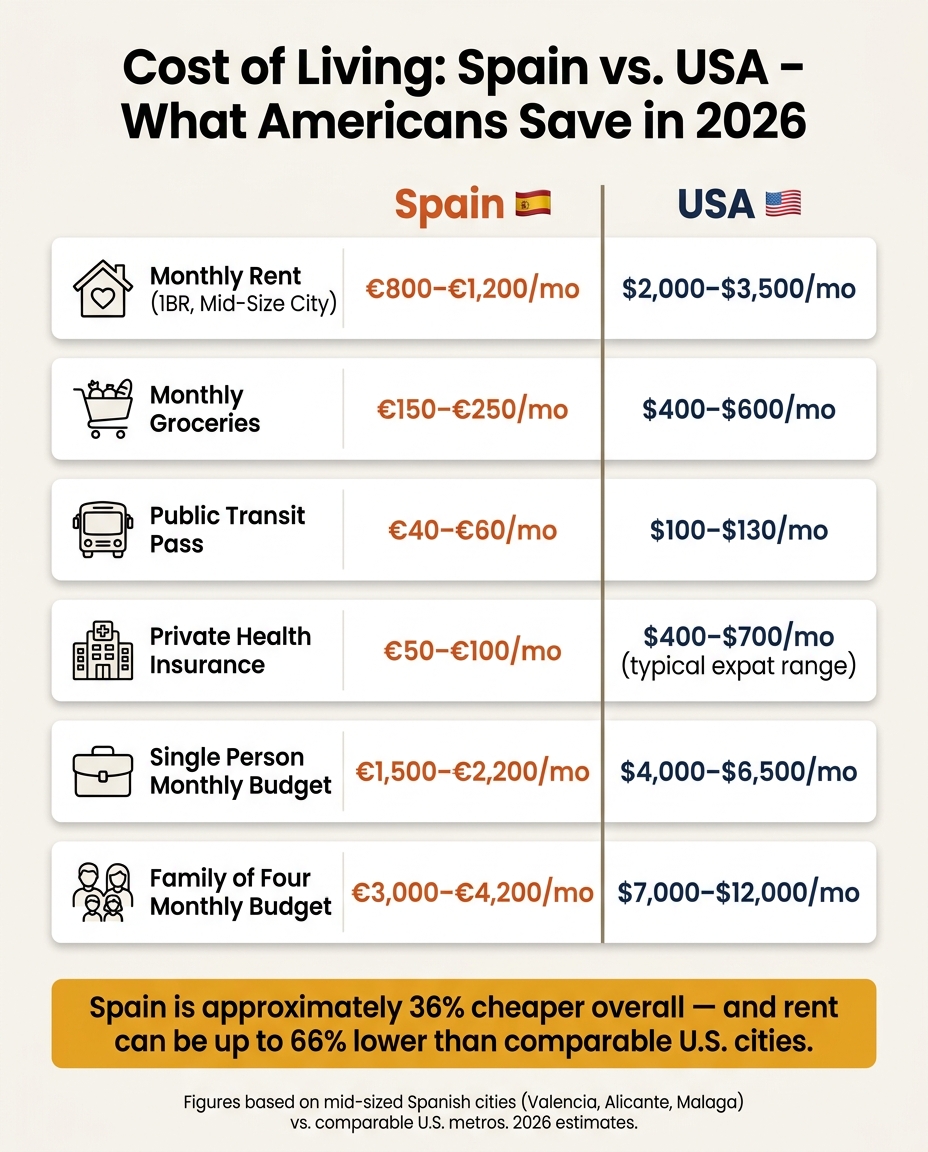
Living in Spain often costs about 20% to 45% less than living in a similar U.S. metro, and housing is the biggest reason for that gap. A one-bedroom apartment in central Madrid costs about €1,380 per month, while a similar place in New York City can run about $4,100. In mid-sized cities like Valencia, Malaga, or Alicante, that same one-bedroom usually falls between €800 and €1,200 per month.
And it’s not just rent. Day-to-day costs like groceries, public transit, and eating out also tend to be lower.
| Expense | Spain (Mid-Sized City) | U.S. (Comparable Metro) |
|---|---|---|
| Monthly Rent (1BR) | €800–€1,200 | $2,000–$3,500 |
| Monthly Groceries | €150–€250 | $400–$600 |
| Public Transit Pass | €40–€60 | $100–$130 |
A single person can often live on about €1,500 to €2,200 per month in a mid-sized Spanish city. A family of four can often make it work on €3,000 to €4,200 per month in those same places. That kind of spread can ease pressure on retirement income or leave more room for savings. It also helps explain why many Americans look past the biggest urban hubs and zero in on mid-sized Spanish cities.
These are typical ranges for mid-sized Spanish cities and comparable U.S. metros [3][4][5].
Lifestyle, Safety, and Healthcare
Spain also lines up well with the kind of daily life many people want. Cities are built for walking, so a lot of residents can get by without owning a car. Violent crime rates are low, and Spain tends to rank well on global safety indexes.
Healthcare is another big draw. Private insurance for expats can start at around €50 to €100 per month, which is far below what many Americans are used to paying for similar coverage in the U.S. If you apply through the Non-Lucrative Visa route, you must carry private insurance with no copays.
Remote Work and Retirement Fit
Spain makes sense for two groups in particular: people earning income from abroad and people living on passive income.
For remote workers, the setup can be especially appealing. They can keep earning a U.S. salary while paying Spanish living costs. Spain’s Digital Nomad Visa requires a minimum monthly income of about €2,850 and lets remote professionals live and work in the country legally. Some who qualify may also reduce their Spanish tax burden under a special regime.
For retirees, the draw is a little different. Spain offers more predictable monthly costs, solid healthcare, and weather that supports an active lifestyle through the year. U.S. Social Security benefits are taxed only in the U.S. under Article 21 of the bilateral tax treaty. That matters. It makes Spain a strong option for retirees who rely on those payments. The Non-Lucrative Visa requires passive income of at least €2,400 per month and does not allow local employment, which fits people living on Social Security, pension income, or investment distributions.
These same factors also shape where Americans settle, whether that’s Valencia and Alicante or larger cities like Madrid, Barcelona, and Malaga.
Where Americans Are Moving in Spain
Where Americans settle in Spain often comes down to three things: cost, tax rules, and day-to-day life. And those can shift a lot from one city to the next. That also affects which visa makes sense and how much tax exposure you may face.
Valencia and Alicante: Affordable Coastal Living
Valencia and Alicante tend to attract budget-focused families, retirees, and remote workers. In Valencia, neighborhoods like Ruzafa and El Carmen are known for a walkable, trendy way of life. Alicante stands out even more for retirees, ranking highest in this group with a score of 74/100.
There’s one tradeoff to keep in mind. Both cities are in the Valencian Community, which applies the regional wealth tax in full. If you’re moving with a large asset base, that can matter a lot.
Madrid and Barcelona: Big-City Access and Business Networks
Career-focused professionals, founders, and investors often choose Madrid or Barcelona. Both cities offer international schools, major airport hubs, and the kind of business networks that matter when you’re running a company or managing investments.
Barcelona is one of Europe’s top startup hubs, which helps explain why it draws younger American expats. Madrid is still the main pick for Americans who want capital-city access. Costs run higher in both places. A single person will usually spend about €2,000 to €2,800 per month, while a family of four can expect €3,800 to €5,500.
The tax split between the two is hard to ignore. Madrid offers a 100% regional wealth tax exemption. Barcelona, in Catalonia, applies the wealth tax in full on worldwide assets.
Malaga: Sun, Remote Work, and Retirement Appeal
Malaga is drawing more climate-focused retirees and remote workers. It’s in Andalusia, which, like Madrid, offers a 100% regional wealth tax exemption. The city also has a strong safety profile, a large English-speaking community, and monthly costs of about €1,500 to €2,200 for a single person.
Those city-level differences feed straight into residency and tax planning.
Residency Options, Tax Exposure, and Asset-Protection Tradeoffs
Moving to Spain can fix some day-to-day problems, but it also opens up a new set of planning questions. The big ones are residency, taxes, and what happens to your assets once Spain starts looking at your full financial picture.
Digital Nomad Visa vs. Non-Lucrative Visa: What Americans Need to Know
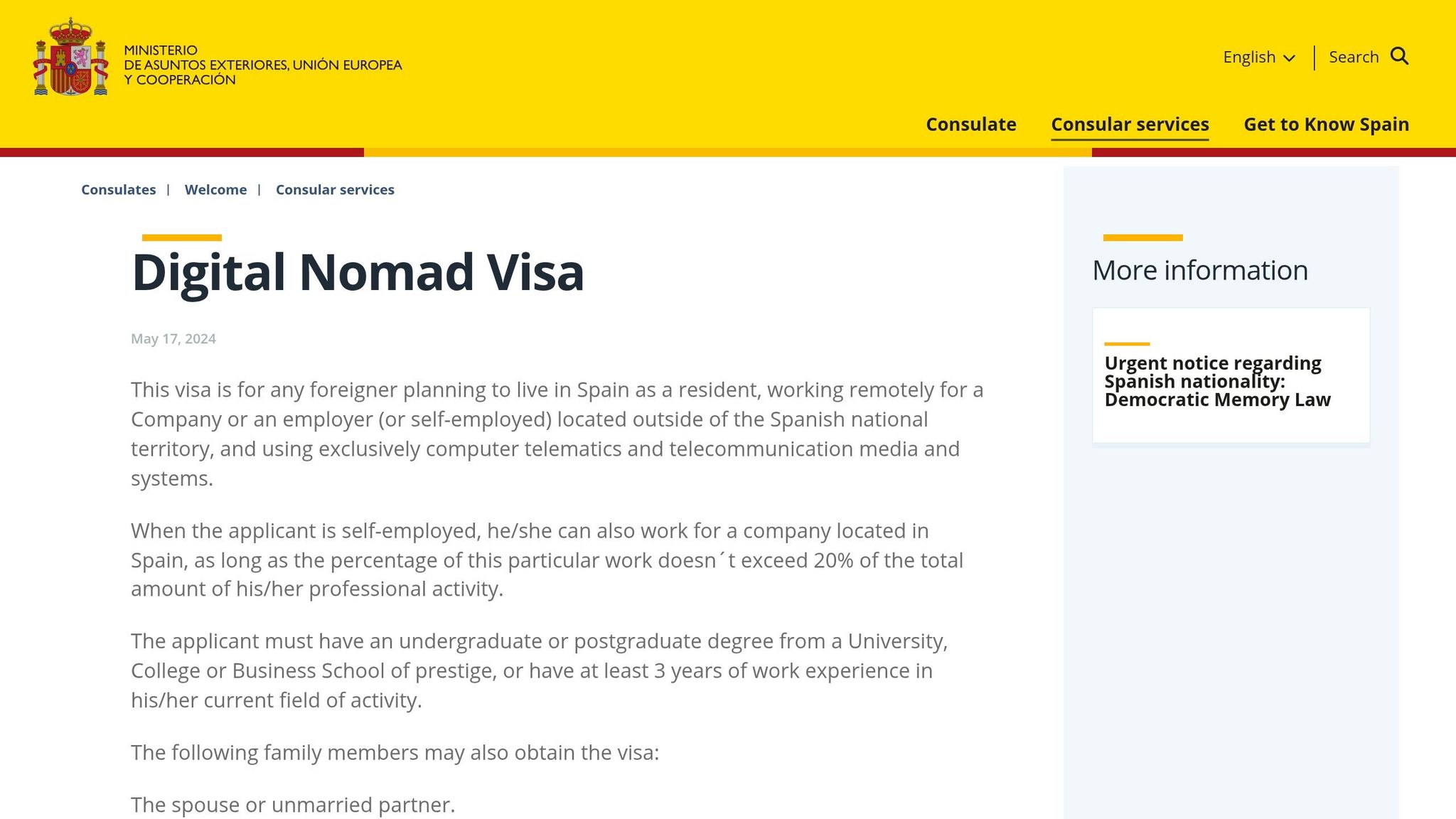
After choosing a city, most Americans run into the next big decision: which visa fits their life. That choice matters more than it may seem at first, because your visa can shape both your right to work and how Spain taxes you.
Spain’s Golden Visa was abolished on April 3, 2025, so for Americans moving in 2026, the two main paths are the Digital Nomad Visa (DNV) and the Non-Lucrative Visa (NLV). These visas are built for very different people.
| Feature | Digital Nomad Visa (DNV) | Non-Lucrative Visa (NLV) |
|---|---|---|
| Ideal Applicant | Remote workers and freelancers with non-Spanish clients | Retirees, FIRE followers, and people living on passive income or savings |
| Work Permissions | Yes, remote only | No active work allowed |
| Tax Regime | Potentially eligible for Beckham Law | Standard progressive rates |
| Wealth Tax | Exempt on non-Spanish assets under Beckham Law | Subject to Spain’s wealth tax on worldwide assets |
If you plan to keep earning income from work, the DNV is usually the visa to focus on. Beckham Law is generally open to qualifying DNV holders employed by non-Spanish companies, but it is usually not open to NLV holders or self-employed freelancers.
Both visas also require private health insurance. For applicants over 70, that cost can run $2,500 or more per year, per person.
Spanish Tax Residency and Wealth-Planning Issues
Visa status matters, but the calendar matters even more. Once you pass 183 days in Spain, you can be treated as a Spanish tax resident. If you spend more than 183 days there in a calendar year, or Spain sees it as your center of interests, it can tax your worldwide income at progressive rates from 19% to 47%. That may pull in U.S. dividends, rental income, and retirement distributions.
Your U.S. tax duties don’t go away. You still need to file annual U.S. federal returns, FBARs if the total value of foreign accounts goes above $10,000 at any point during the year, and FATCA-related filings where required. Put simply, many Americans end up filing in both countries.
Spain also requires Modelo 720. This form covers foreign assets like bank accounts, real estate, and insurance policies if any asset category goes above €50,000. Spain’s tax authority pays close attention to residency timing and foreign income, often within two to three years of arrival.
One point trips up a lot of Americans: Spain does not treat Roth IRAs as tax-free. Distributions are often taxed as savings income at rates between 19% and 30%. That makes Roth conversions or Roth distributions before Spanish residency starts worth a close review.
What Affluent Americans Should Set Up Before the Move
For Americans with more wealth, planning before the move matters a lot. U.S. LLCs, trusts, and brokerage accounts should be reviewed before Spanish residency begins, because Spain may not view them the same way the U.S. does. Trusts can be a sore spot in particular, since Spain may apply unfavorable look-through treatment to U.S. trusts.
Where you live inside Spain also matters. Madrid and Andalusia both offer 100% regional credits that can cut regional wealth tax liability to zero, though the national Solidarity Tax still applies to net wealth above €3 million. Pick the wrong region, and your tax bill may look very different from what you expected.
If you may qualify for Beckham Law, timing is tight. The application must be filed within six months of registering with Spanish Social Security. Miss that deadline, and you lose access to the flat 24% rate and drop into Spain’s standard progressive system instead.
Conclusion: Who Spain Makes Sense for in 2026
Who Benefits Most and What to Weigh Before Deciding
After looking at cities, visa paths, and tax exposure, the main issue is simple: fit. Spain makes the most sense for Americans who can line up their lifestyle goals with solid tax and residency planning, plus enough cash to cover upfront moving costs.
Spain is often a strong match for:
- Remote workers and entrepreneurs who can use the Digital Nomad Visa
- Retirees and financially independent Americans living on passive income
- Families who want safer, walkable cities
- Higher-net-worth Americans looking for diversification
The upside is easy to see. Spain can offer a better day-to-day pace of life, and healthcare is strong while costing far less than in the U.S.
But this move only works well when the tax and residency side is handled first. That means doing the planning before you leave, not after. For the right Americans, Spain can ease a lot of daily-life pressure, but it takes early tax and residency planning to make the move work.
FAQs
Can I live in Spain on Social Security alone?
Yes – if your monthly benefit meets the Non-Lucrative Visa income threshold. As of 2026, that’s about €2,400 per month.
For many single applicants, an average Social Security benefit of about $1,900 a month may fall short. But for a couple, combined benefits of more than $3,500 a month may be enough to qualify.
In Spain, Social Security benefits are generally taxable only in the U.S. Even so, you still have to declare that income in Spain.
Which Spanish city is best for Americans?
There’s no single best Spanish city for Americans. The right fit comes down to how you want to live and what you want to spend.
If you want big-city life, Madrid and Barcelona are often the top picks. They tend to work well for remote workers and anyone who wants more amenities, more international connections, and a busier day-to-day scene. The trade-off is simple: they usually cost more.
For Americans who want to keep living costs lower, Valencia, Málaga, and Seville come up again and again. You still get plenty of city life, but without the same price tag as Spain’s biggest hubs.
Retirees often lean toward coastal areas such as Costa del Sol or Costa Blanca. The appeal is pretty clear: a slower pace, warm weather, and easy access to the sea.
How do taxes change after moving to Spain?
After moving to Spain, Americans still file a U.S. federal tax return because the U.S. taxes worldwide income. In plain English, that means your move abroad doesn’t end your filing duty back home.
To help avoid being taxed twice on the same income, many people use the Foreign Tax Credit or the Foreign Earned Income Exclusion. Those are the two main tools Americans abroad lean on when both countries have a claim on their income.
If you spend more than 183 days a year in Spain, Spain will generally tax your worldwide income at rates from 19% to 47%. Some new arrivals may also qualify for the Beckham regime, which applies a 24% flat rate to Spanish-source employment income.
