
If I had to sum it up fast: Mexico is the low-cost, close-to-home pick, Panama is the tax-friendly pick, Spain is the healthcare-and-infrastructure pick, and Portugal is the long-term EU pick. Costa Rica works well for retirees who want stability and nature. Malaysia fits people who want lower costs and English-speaking private care, even if it’s far from the U.S.
Before I compare countries, I’d keep three U.S. rules in mind:
- I still have U.S. tax filing duties abroad
- I may need an FBAR if foreign accounts go over $10,000
- I need to plan state tax exit rules if I’m leaving a high-tax state
And in almost every country, I’d check these six things first:
- Monthly cost
- Retiree visa path
- Healthcare access
- Local tax on foreign income
- Safety
- Ease of settling in
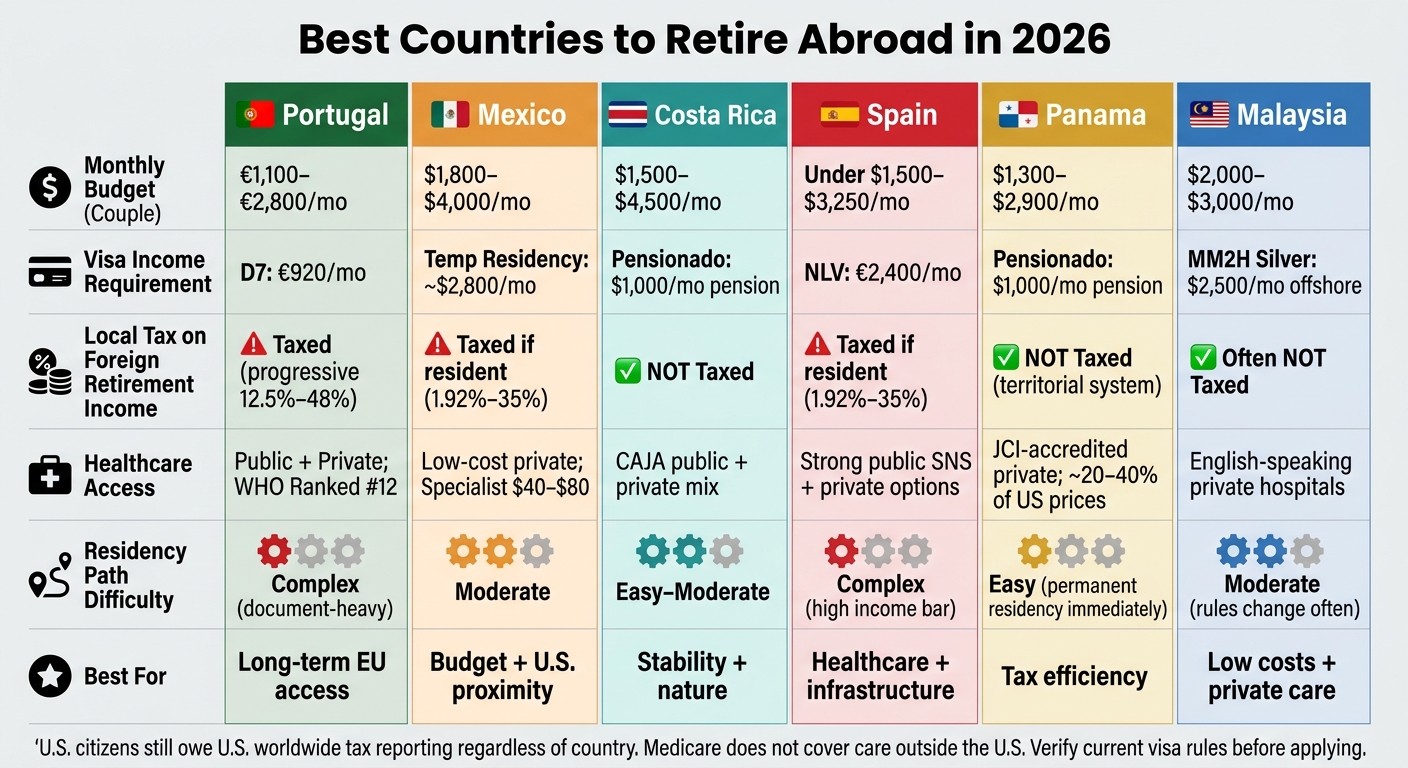
Quick Comparison
| Country | Budget fit | Visa bar | Healthcare | Local tax on foreign retirement income | Best match |
|---|---|---|---|---|---|
| Portugal | Mid-range | Lower income bar | Good public + private, but waits | Usually taxed | EU residency and long-term planning |
| Mexico | Low to mid | Moderate | Low private care costs | Taxed if resident | Budget + U.S. proximity |
| Costa Rica | Low to mid | Low pension bar | Public + private mix, waits in public care | Not taxed | Stability + nature |
| Spain | Mid to high | Higher income bar | Strong public system + private options | Taxed if resident | Healthcare + infrastructure |
| Panama | Mid-range | Low pension bar | Good private care in main areas | Not taxed | Tax setup + simple pension visa |
| Malaysia | Low to mid | Moderate | Strong private care, English widely used | Often not taxed | Lower costs + private healthcare |
A few numbers stand out right away:
- Portugal D7 income bar: about €920/month
- Spain NLV income bar: about €2,400/month
- Panama Pensionado: $1,000/month pension
- Costa Rica Pensionado: $1,000/month pension
- Mexico temporary residency: about $2,800/month income
- Malaysia MM2H Silver: about $2,500/month offshore income
My bottom line: if I wanted the lowest cost and easy trips back to the U.S., I’d start with Mexico. If I cared most about keeping local tax low on U.S. retirement income, I’d look hard at Panama or Costa Rica. If I wanted Europe, I’d compare Portugal and Spain based on budget, tax rules, and how much paperwork I can handle.
That’s the big picture. From there, the right pick comes down to what matters most to you: cost, taxes, healthcare, or long-term residency.
sbb-itb-39d39a6
1. Portugal
Portugal is a solid pick for American retirees in 2026. It offers a mix that many people want: lower day-to-day costs, decent healthcare access, and a residency path that’s fairly direct. Costs are lowest inland and in Porto, while Lisbon and the Algarve run higher. On the whole, living costs are about 35% to 45% below similar U.S. costs.
The main route for many retirees is the D7 Passive Income Visa. It calls for at least €920 a month in passive income, plus 50% more for a spouse. Processing often takes 3 to 6 months, though delays can stretch that to 9 months. Income that can count includes U.S. Social Security, pensions, rental income, and dividends. The paperwork can be a slog. You’ll usually need certified translations of financial records, an FBI background check, and proof of housing in Portugal. To keep residency, you must spend more than 183 days a year in the country.
Healthcare is one of Portugal’s big draws, but there’s a catch. Once you have a residence permit and NIF, you can sign up for the public system. A GP visit usually costs just €5 to €10. That said, wait times can test your patience. In the public system, non-emergency specialist visits often take 2 to 4 months. Because of that, many retirees add private insurance for faster access. Standard plans tend to cost €80 to €150 per month, and private specialist visits usually run €60 to €150. The WHO ranks Portugal’s healthcare system 12th globally.
Taxes need close attention before you make the move. Portugal taxes foreign-source pension income at progressive rates from 12.5% to 48%, and U.S. Social Security is also generally taxable for Portuguese residents. The 1994 U.S.-Portugal Tax Treaty has rules that can help reduce double taxation. At the same time, the old Non-Habitual Residency program is no longer open to new applicants. It closed in late 2023. Its replacement, the IFICI regime, is aimed at certain professional activities, not passive pension income. This is one area where getting help from a cross-border tax advisor isn’t just nice to have. It’s smart.
One of your first steps is getting a NIF. You’ll need it for banking, leases, and most admin tasks. After five years of legal residence, you can apply for permanent residency.
| Region | Monthly Budget (Couple) | 1BR Rent (Avg) |
|---|---|---|
| Lisbon | €2,500 – €2,800 | €1,000 – €1,600 |
| Porto | €1,600 – €2,100 | €700 – €1,100 |
| Algarve | €1,900 – €2,400 | €800 – €1,200 |
| Inland Towns (e.g., Tomar, Braga, Coimbra) | €1,100 – €2,000 | €450 – €700 |
If you want a move with less paperwork and a different cost setup, the next country gives you a useful point of comparison.
2. Mexico
Mexico is one of the best retirement picks for Americans in 2026. It’s close to the U.S., and there’s already a large American expat community in place. That matters more than it may seem. When a place already has other retirees, it’s often easier to settle in, find English-speaking services, and handle day-to-day life.
Costs depend a lot on where you land. Lake Chapala and Mérida tend to be easier on the budget, while San Miguel de Allende usually costs more. In lower-cost areas, a couple can often live on $1,800 to $2,500 per month. In higher-end spots, that usually moves up to $3,000 to $4,000 per month. For many retirees, that mix is the big draw: you stay close to the U.S. without paying U.S.-level living costs. Safety also changes by city and neighborhood, so it helps to look at each area block by block, not just country by country.
| Region | Furnished 1BR/2BR Rent |
|---|---|
| Lake Chapala | $450–$1,200 |
| Mérida | $450–$1,000 |
| San Miguel de Allende | $700–$1,800 |
Rents are 2026 estimates [3].
To get residency, you’ll need to apply at a Mexican consulate before moving. Approval usually takes 3 to 6 weeks. Temporary residency lasts 1 to 4 years and calls for yearly renewals during the first three years. In 2026, that usually means showing about $2,800 per month in income or around $46,000 in savings or investments.
Permanent Residency is also an option, but the bar is much higher. In most cases, you’ll need roughly $4,300 to $5,000 per month in income or $180,000 to $200,000 in assets. Because of that, many retirees start with temporary residency and later shift to permanent status. Exact figures can vary a bit by consulate, so check with the office where you plan to apply.
Once residency is sorted out, healthcare tends to be the next big issue. This is one area where Mexico stands out, especially for retirees who pay cash for routine care. U.S. Medicare does not work in Mexico, but private medical care is far less expensive than in the U.S.. A specialist visit usually costs $40 to $80, an MRI runs $200 to $400, and a dental crown is often $250 to $450.
A lot of retirees handle routine visits out of pocket and use private insurance for major needs. For people ages 60 to 65, basic or catastrophic plans can start around $100 to $150 per month, while more complete coverage can run $400 to $600 per month. There’s also voluntary IMSS coverage at about $500 to $600 per year. It includes surgeries and prescriptions, though wait times can be longer and care can differ by location.
Taxes need a close look too. If you spend more than 183 days per year in Mexico, the country taxes residents on worldwide income. That includes Social Security, pensions, and investment income. Tax rates range from 1.92% to 35%. There is a U.S.-Mexico tax treaty meant to help avoid double taxation, but using it the right way usually takes planning. Many retirees set aside $500 to $1,500 per year for a Mexican tax advisor to deal with local filing and treaty credits.
If Mexico feels a bit too busy or you want a slower pace, Costa Rica offers a different mix of cost and lifestyle.
3. Costa Rica
Costa Rica works well for retirees who want a quieter, greener life and a steady political climate. The country has had uninterrupted civilian rule since 1949 and no standing army, which helps explain why its political stability stands out in the region.
In Costa Rica, location drives cost more than almost anything else. Inland Central Valley towns like Atenas, Grecia, and San Ramón tend to offer the best value. In those areas, furnished one-bedroom rentals usually run $500 to $800 per month, and a couple can often live comfortably on $1,800 to $2,500 per month. Beach towns are a different story. You get the ocean and the lifestyle that comes with it, but you pay more for both.
| Region | Monthly Rent (Furnished) | Estimated Couple’s Budget |
|---|---|---|
| Central Valley (Atenas, Grecia, San Ramón) | $500–$800 | $1,800–$2,500 |
| Pacific Coast (Tamarindo, Nosara) | $900–$1,500 | $3,500–$4,500 |
| Rural/Inland (San Ramón, Lake Arenal) | $500–$750 | $1,500–$2,200 |
For residency, the Pensionado visa requires proof of a lifetime pension of at least $1,000 per month, and U.S. Social Security counts. Applications go through DGME and usually take 6 to 12 months. Many retirees hire a local immigration attorney to handle the process, with fees often falling between $800 and $1,500. After three years on Pensionado status, retirees can apply for permanent residency.
Healthcare is one of those areas where the details matter. Residents must enroll in the public CAJA system within 90 days of residency approval. Monthly payments are based on income and usually range from $70 to $250 per month. CAJA covers primary care and prescriptions, which helps keep day-to-day medical costs in check. The trade-off is wait times. Specialist appointments often take 2 to 6 months, so many retirees also pay out of pocket for private care at hospitals like CIMA or Clínica Bíblica.
Private care is often within reach, at least for routine visits. Private specialist appointments usually cost $60 to $100, and private insurance for people ages 60 to 65 starts around $120 to $180 per month for basic coverage. More complete plans usually run $450 to $650 per month. One thing to know up front: U.S. Medicare does not cover medical care in Costa Rica.
Costa Rica taxes only local-source income. That means foreign-source income, including U.S. Social Security, 401(k) distributions, and pensions, is not taxed locally. For retirees living mostly on U.S. income, that keeps things fairly simple. In 2026, Costa Rica is enforcing tax reporting more aggressively, with extra attention on local rental income.
If Costa Rica’s residency timeline or beach-town costs feel like a stretch, Spain is the next European option.
4. Spain
Spain costs more than Portugal, Mexico, and Costa Rica, but you get more for that extra spend. The big draw is better infrastructure, solid healthcare access, and a lot more choice if you want to live by the coast. And like most places, your monthly budget can swing a lot based on where you settle down.
| Region | Estimated Monthly Budget |
|---|---|
| Major Cities (Madrid, Barcelona) | $2,150–$3,250 |
| Coastal/Mid-sized (Valencia, Málaga, Seville) | $1,500–$2,150 |
| Smaller Inland Towns | Under $1,500 |
For most American retirees, the main residency path is the Non-Lucrative Visa (NLV). It calls for about €2,400 per month in passive income, and it does not allow work for Spanish employers. Remote work for a U.S. employer can also create compliance issues, which is where things get messy. For many retirees, that income bar is hard to clear with Social Security alone.
The first visa lasts one year. After that, you can renew it in two-year blocks, and permanent residency becomes possible after five years of continuous legal residence.
Health coverage is another key part of the move. You need private health insurance to get the visa, and plans usually cost €80 to €150 per month. After you arrive and get your TIE residence card, you can sign up for the public Sistema Nacional de Salud (SNS) at a local Centro de Salud. At that point, care is free at the point of use.
Even so, many retirees still use private care for one simple reason: speed. If you want to see a specialist sooner, private care can help. A private consultation usually runs about $40 to $80, while an MRI tends to cost around $200 to $400.
Taxes are the part that tends to trip people up. If you spend more than 183 days per year in Spain, you become a Spanish tax resident. That means Spain can tax your worldwide income, including U.S. Social Security and pension distributions. Spanish income tax rates range from 1.92% to 35%.
There is a U.S.-Spain tax treaty to help avoid double taxation, but this is not the kind of thing most people want to wing on their own. It makes sense to set aside $500 to $1,500 per year for cross-border tax help.
For retirees who want lower costs and an easier residency route, Panama is the next country to look at.
5. Panama
If Spain feels pricey, Panama gives you a simpler tax setup and a lower-cost path. It stands out for retirees who want U.S. dollar stability, easier monthly planning, and one of the best pension visas around. Since Panama uses the U.S. dollar, you don’t have to deal with exchange-rate swings or conversion fees. That makes your budget much easier to plan from month to month than in many other retirement spots.
Monthly costs depend on where you live, but Panama can work across a few different budgets:
| Region | Monthly Budget Range |
|---|---|
| Panama City | $2,300–$2,900 |
| Boquete (Highlands) | $1,500–$2,200 |
| El Valle de Antón (Inland) | $1,300–$1,900 |
The Pensionado visa is a big draw for Americans. To qualify, you need a guaranteed lifetime pension of at least $1,000 per month, and U.S. Social Security counts. Once approved, you get permanent residency right away. You don’t start on a temporary visa and then deal with renewals later. Applications go through a Panamanian immigration attorney, and the process usually takes a few months.
The visa also comes with discounts that can add up fast, such as:
- 50% off hospital stays
- 25% off utility bills
- 25% off airline tickets
- 20% off medical consultations
Healthcare in Panama City is strong by international standards. Hospital Punta Pacífica, which is affiliated with Johns Hopkins, is JCI-accredited and offers private care for about 20% to 40% of U.S. prices. To put that in plain English, a specialist visit usually costs $50–$80, while an MRI often falls between $250–$450. Most American retirees rely on private care and private insurance, with CSS serving as a public backup. Private health insurance for people ages 60–65 usually costs $150–$250 per month.
Panama’s clearest edge is its territorial tax system. It taxes only income earned inside Panama, which means U.S. Social Security, 401(k) distributions, pension income, and investment dividends are not taxed locally. So if a retiree brings in $60,000 a year from U.S. sources, the Panamanian income tax bill is $0. Panama also has no inheritance, gift, or estate taxes.
Before picking a place for the long haul, it’s smart to rent for 6 to 12 months before buying. Panama City feels very different from Boquete. One is urban and warmer; the other is cooler and set in the highlands. Spending time through both the dry season and the rainy season gives you a much better sense of where you’d want to live day to day, and whether a neighborhood fits the life you want.
For retirees who want an even lower-cost option outside the Americas, Malaysia is the next comparison.
6. Malaysia
Malaysia is a strong pick for retirees who are open to looking beyond the Americas. The big draw is simple: your money can go a long way without giving up day-to-day comfort. In Kuala Lumpur, Penang, or Johor Bahru, a couple can often live on $2,000 to $3,000 per month. In Penang, $2,000 to $2,300 is often enough.
The main residency route is the Malaysia My Second Home (MM2H) program. It was reworked in 2023 into tier-based options. Under the Silver tier, applicants need a minimum offshore income of $2,500 per month. You also need to place a deposit in a Malaysian bank account, and the amount depends on the tier you choose. One thing to watch: MM2H rules shift often, so it’s smart to check the current terms before you apply.
Healthcare is another big plus. Private hospitals in Penang and Kuala Lumpur offer English-speaking doctors, clear pricing, and shorter waits than public facilities. For many retirees, that can make a huge difference. No one wants to spend retirement stuck in long medical lines.
Malaysia also has a tax angle that appeals to many Americans. Foreign-source pension income is exempt from Malaysian tax, though U.S. citizens still have to meet U.S. filing rules. In plain English, that means retirees living mostly on U.S.-source income can often keep their local tax bill low.
Best for retirees who want low costs, English-friendly private healthcare, and a simple tax setup. Malaysia makes a lot of sense for retirees who care most about low living costs and strong private healthcare. The catch is the climate: it’s hot and humid year-round, and that’s not everyone’s cup of tea. For most people, that trade-off is pretty easy to judge based on the kind of retirement they want.
Pros and cons by retirement goal
No country wins across the board. The best choice comes down to what matters most to you: lower costs, being near family, or better tax treatment.
With the country profiles in place, this table makes the trade-offs easier to see at a glance.
| Country | Main advantage | Main drawback | Best for |
|---|---|---|---|
| Portugal | EU residency pathway | Document-heavy D7 visa process | Long-term planners wanting EU access and safety |
| Mexico | Lowest costs and proximity to the U.S. | Safety concerns vary by region | Budget-conscious retirees who want to stay close to home |
| Costa Rica | Political stability and nature | Slow bureaucracy and poor roads | Nature lovers prioritizing stability |
| Spain | Strong public healthcare and infrastructure | High income requirement (~€2,400/month) | High-income retirees wanting a premium European lifestyle |
| Panama | Territorial tax system and easy pension visa | Tropical humidity and heavy urban traffic | Tax-focused retirees who want the simplest residency path |
| Malaysia | Strong private healthcare with English-speaking doctors | Extreme distance from U.S. family | Retirees prioritizing affordability and English-speaking care |
Here’s the short version: Panama stands out for tax efficiency. Mexico is the go-to pick for budget and closeness to the U.S. Spain shines for healthcare and day-to-day living. Portugal makes the most sense for people thinking long term about EU access. Costa Rica appeals to retirees who want stability and nature. Malaysia offers low costs paired with private care.
One point matters no matter where you move: U.S. citizens still owe U.S. worldwide tax reporting. Local tax rules may help or hurt, but they don’t replace what you still have to report to the IRS.
Conclusion
The right pick comes down to your main priority: cost, taxes, healthcare, or a place to settle for the long haul. Mexico is the best fit for budget and proximity. Panama is the top pick for tax treatment, with a 0% tax on foreign-sourced income, and its Pensionado visa is one of the simplest residency routes in this group. Spain stands out for healthcare and infrastructure. And if EU access matters most over time, Portugal is the strongest long-term EU option.
The trade-off is pretty clear. Europe offers stronger infrastructure and healthcare. Latin America tends to offer lower living costs and simpler residency paths.
One thing to watch: rules don’t sit still. Portugal ended its NHR tax regime for new applicants in 2024 and replaced it with IFICI. Costa Rica stepped up digital enforcement of tax reporting for foreign residents in 2026. A plan that made sense two years ago might not hold up now.
Before you move, check visa rules, confirm your tax position, and set up healthcare coverage – Medicare does not cover care outside the U.S.. Then verify the current rules again before you apply, and rent first, buy later.
FAQs
Which country is best if I only have Social Security income?
If you’re living on Social Security alone, Panama is often seen as the top pick. The big reason is simple: its Pensionado visa accepts Social Security as qualifying lifetime income, with a minimum of $1,000 per month.
That can make the move feel a lot more within reach.
Panama also gives retirees legally required discounts on things like:
- Utilities
- Medical costs
- Travel
Another plus is Panama’s use of the U.S. dollar. That means you can avoid currency conversion fees and the ups and downs of exchange rates.
Costa Rica and Ecuador also stand out as strong options. Both are fairly accessible and officially accept Social Security income for residency.
How do I choose between lower taxes and better healthcare?
It comes down to your health needs, your comfort with risk, and your budget.
Places like Panama can work well if your main goal is lower taxes. Foreign-sourced income, such as Social Security or pension payments, is generally not taxed there at the local level.
Spain and Portugal, on the other hand, may give you stronger public healthcare options. The trade-off is that if you become a tax resident, your worldwide income may be subject to local taxes.
That’s why many retirees split the difference. They look for a country with a tax setup they can live with, then use private hospitals or buy private insurance to fill gaps in care.
What should I do before applying for a retiree visa?
Before you apply, pull together the paperwork your target country asks for. That often includes certified translations, background checks, and proof that you meet the passive income rules. You’ll also want to check the income minimum and the usual processing timeline so there are no surprises.
Set up health coverage for any gap before local insurance starts. Medicare usually won’t cover you outside the U.S. On top of that, take a hard look at your tax, estate, banking, and money transfer setup before the move.
