
If I were sizing up Mexico in 2026, I’d narrow it down like this: Guadalajara for the lowest monthly cost, Mérida for safety, Mexico City for jobs and services, Playa del Carmen for Caribbean beach life, and Puerto Vallarta for a higher-end coastal setup. For visas, I’d treat the tourist stay as short-term only, Temporary Residency as the usual path for remote workers, and Permanent Residency as the long-stay option for retirees and full-time movers.
Here’s the short version:
- Lowest cost: Guadalajara at about $800 to $1,500/month for one
- Safety pick: Mérida
- Best big-city setup: Mexico City
- Best Caribbean beach town: Playa del Carmen
- Best Pacific beach town: Puerto Vallarta
- Short stay visa: Tourist status, often up to 180 days, but some people now get much less
- Remote worker visa path: Temporary Resident, usually around $4,432 to $5,200/month in income
- Long-term retiree path: Permanent Resident, usually around $7,430 to $8,200/month in income
Mexico can still cost about 56% less than the U.S. on average, but that doesn’t mean every city feels cheap. Beach towns and expat-heavy areas can push rent up fast. And private hospitals may ask for a $3,000 to $10,000 deposit in an emergency, so I’d factor that into any move plan from day one.
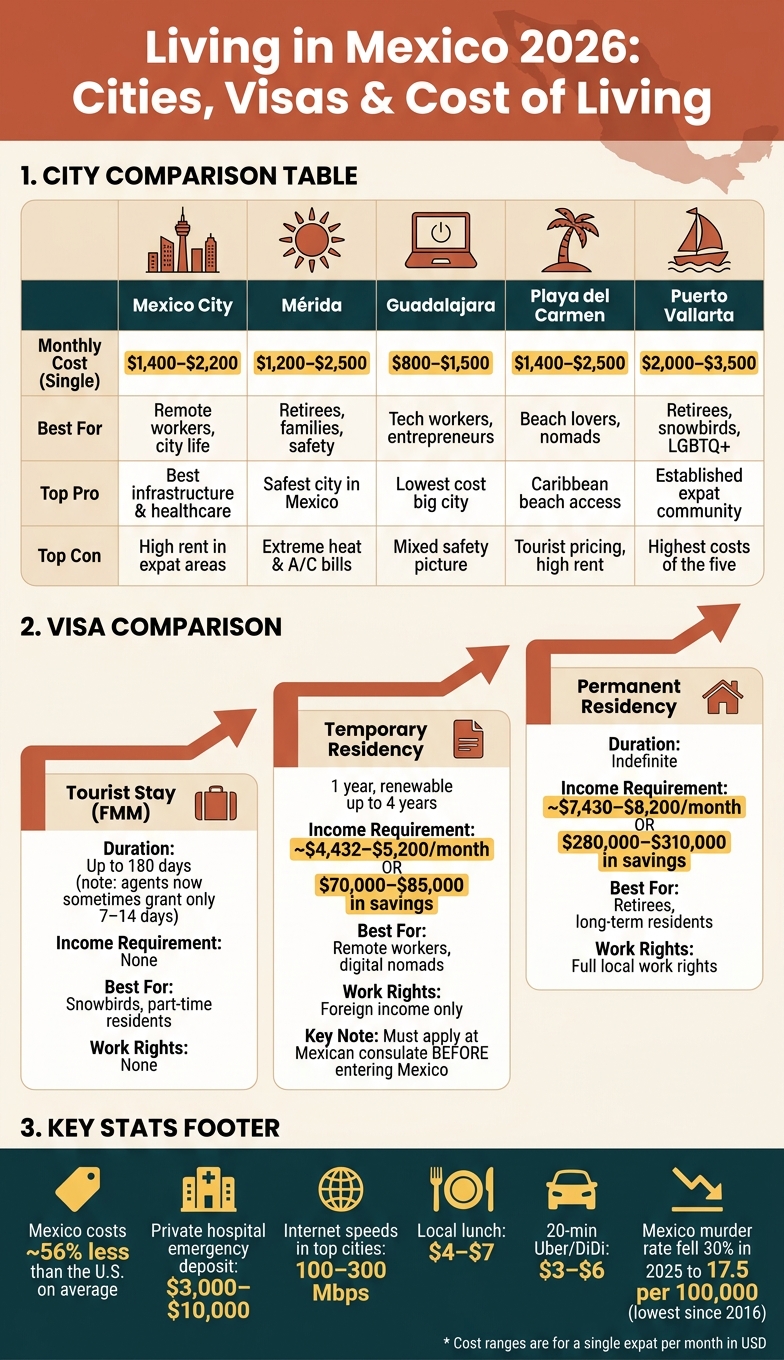
Quick Comparison
| City | Monthly cost for one | Best match | Main trade-off |
|---|---|---|---|
| Mexico City | $1,400 to $2,200+ | Remote workers, city life | Higher rent in top areas |
| Mérida | $1,200 to $2,500 | Retirees, families, safety-first movers | Heat and A/C bills |
| Guadalajara | $800 to $1,500 | Budget-minded remote workers, founders | Mixed safety picture |
| Playa del Carmen | $1,400 to $2,500 | Beach lovers, divers, nomads | Tourist pricing and high rent |
| Puerto Vallarta | $2,000 to $3,500 | Retirees, snowbirds, LGBTQ+ expats | Highest costs of the five |
What matters most is simple: city, visa, and budget need to match. If those three line up, the move makes sense. If they don’t, Mexico can get expensive or hard to stay in fast.
sbb-itb-39d39a6
1. Mexico City
Lifestyle Fit
CDMX works best for people who want the strongest mix of jobs, public transit, healthcare, and big-city living. It has a dense coworking scene, solid tech and creative sectors, and neighborhoods that feel very different from one another, including Roma Norte, Condesa, and Polanco.
Roma Norte and Condesa tend to attract younger expats and nomads. Polanco is a better match for business professionals and families. Coyoacán and San Ángel often appeal more to retirees.
Monthly Budget
A comfortable lifestyle for one person in CDMX starts at about $1,400 per month. Many mid-range expats spend between $1,850 and $3,300 per month, depending on the neighborhood they choose and how they live.
Rent is the biggest swing factor. A furnished one-bedroom in Roma or Condesa usually costs $1,500 to $2,500 per month. In more local neighborhoods outside the main expat areas, that can drop to about $600 to $900 per month.
Day-to-day costs are also fairly manageable:
- A 20-minute Uber or DiDi ride usually costs $3 to $6
- A sit-down lunch at a local spot runs about $4 to $7
- Fiber internet averages $25 to $40 per month
Climate and Safety
CDMX sits at about 7,400 feet above sea level, which helps keep the climate mild through the year. That said, altitude can hit new arrivals a bit hard. Some people deal with fatigue or headaches during their first few days, so it’s smart to give yourself a short adjustment window.
Safety depends a lot on the neighborhood. The main expat areas are generally safe, but this is still a huge city, so basic street smarts matter. Use Uber, DiDi, or authorized taxis instead of hailing street taxis.
Healthcare and Infrastructure
Private healthcare is one of CDMX’s biggest draws. Hospitals like ABC Medical Center and Médica Sur offer care on par with what many people expect in the U.S., often at about 10% to 20% of U.S. prices. That price gap can be a huge relief, but there’s one catch: top private hospitals may ask for a $3,000 to $10,000 deposit up front. Because of that, international health insurance or solid cash reserves matter a lot.
Internet is strong in central neighborhoods, with speeds of 100 to 300 Mbps. That’s well above Mexico’s national average of about 91 Mbps. Public transit is also a strong point. The metro is one of the cheapest in the world, and between trains, buses, and ride-share apps, many people can live here without owning a car.
If you want a similar expat network with a slower pace and lower costs, the next city is a good contrast.
2. Mérida
Lifestyle Fit
Mérida is a strong match for retirees, remote workers, and budget-minded expats who want safety, a slower pace, and a city with deep local character. It’s often ranked among Mexico’s safest cities, and as of 2026, it has the expat opportunities in Latin America.
If Mexico City feels like too much and Playa del Carmen feels too built around tourism, Mérida sits in the middle. It still feels local and community-focused, but it also has enough day-to-day infrastructure to make life easy.
Monthly Budget
Mérida stands out for its low housing costs, although utilities can eat into those savings. For a single person, a comfortable lifestyle usually falls between $1,200 and $2,500 per month.
Housing is where the city often shines:
- A spacious two-bedroom apartment in a older neighborhood usually costs $600 to $900 per month
- A three-bedroom house with a pool in a northern suburb can still come in under $1,000 per month
Some of the best rental deals don’t show up on big websites. They’re often found through local listings and street-front "Se Renta" signs.
The catch is electricity. Air conditioning is a must for much of the year, so power bills can swing hard. A subsidized bimonthly bill might start around $15 to $30, but heavy A/C use can push that to $200 to $300 every two months.
Climate and Safety
The main tradeoff in Mérida is the weather. It stays hot and humid for a large part of the year, and that can wear people down if they’re not used to it.
What do you get in return? A level of personal safety that’s tough to find elsewhere in Mexico. That’s a big part of why Mérida keeps drawing retirees and families.
Healthcare and Infrastructure
Mérida works well for long-term living because lower costs don’t mean giving up the basics. Private healthcare is still within reach for many expats. General practitioner visits usually cost $20 to $40, while specialist appointments tend to run $40 to $85 out of pocket.
Top private hospitals such as Star Médica are well known among the expat community, though patients may still need to make large upfront payments if they don’t have international health insurance.
Internet is another plus. Fiber-optic service is widely available for $25 to $40 per month. During the rainy season, outages do happen, so a UPS backup for your router is a smart small fix.
3. Guadalajara
Lifestyle Fit
Guadalajara works well for remote workers, founders, and expats who want a big-city setup without the scale or cost of Mexico City. It’s Mexico’s main tech hub and, in 2026, it still serves as a major base for tech workers, digital nomads, and entrepreneurs.
The city also has a more traditional and conservative feel than Mexico City. That matters more than people think. You get urban perks, but the pace can feel a bit less intense. Coworking spaces are easy to find, and in developed areas, fiber-optic internet often reaches 100 to 300 Mbps.
If you’re weighing city living against beach access, Playa del Carmen is the next point of comparison.
Monthly Budget
A single expat can live well in Guadalajara for $800 to $1,500 per month. For housing, a two-bedroom apartment in a traditional neighborhood usually costs $600 to $900 per month.
Day-to-day costs stay pretty reasonable too:
- Lunch specials usually run $4 to $7
- A 20-minute Uber or DiDi ride across town costs about $3 to $6
- Fiber-optic internet adds around $25 to $40 per month
Climate and Safety
Guadalajara has a temperate highland climate, with mild temperatures through most of the year.
Safety in 2026 is mixed. Guadalajara is generally safer than Mexico’s border states, but Jalisco still sees cartel-related disruption. So while many expats and remote workers live there without issue, it makes sense to keep an eye on local conditions.
Healthcare and Infrastructure
Private healthcare is one of Guadalajara’s big selling points. The city’s top private hospitals offer strong care at 10% to 20% of U.S. prices. A GP visit usually costs $20 to $40, while specialist visits tend to fall between $40 and $80.
Guadalajara is also a medical tourism destination, especially for dental and orthopedic procedures. For families, private international schools with American, British, and IB curricula are available, with average annual tuition around $7,000.
That mix of tech jobs, lower living costs, and solid services puts Guadalajara in a practical middle spot between Mexico City and the beach towns.
4. Playa del Carmen
Lifestyle Fit
If Guadalajara is the inland workhorse, Playa del Carmen is the beach-life pick. It sits on the Caribbean coast and draws beach lovers, divers, families, and digital nomads who want a resort-style setup with modern comforts. It’s more established and more family-friendly, with a large expat base and solid coworking options.
Playa isn’t cheap anymore. Rents in popular neighborhoods have climbed 40% to 60% since 2020, and prices in expat-heavy areas can rival mid-sized U.S. cities. If the Caribbean lifestyle is the goal, plan for a higher monthly spend.
Monthly Budget
A comfortable monthly budget usually falls between $1,400 and $2,500, depending on housing and how much you run the A/C. Housing is the big swing factor. A modern, furnished one-bedroom in a popular area often costs $1,500 to $2,500 per month.
There’s also mantenimiento to factor in. These HOA-like fees can add $50 to $150 per month, and they’re often left out of the listed rent.
Electricity can sneak up on you too. If you use A/C heavily, a two-month bill can hit $200 to $300. Food costs split in an interesting way: at local tianguis, a week of produce for two can cost under $20, but imported groceries come with a steep markup.
Climate and Safety
Playa’s tropical weather means high cooling costs for much of the year, and rainy-season outages can interrupt internet service. The area is generally expat-friendly, but it still makes sense to stay alert in tourist zones and use ride-hailing at night.
Healthcare and Infrastructure
Private healthcare is affordable compared with U.S. prices. A GP visit usually costs $20 to $40, and a specialist visit runs about $40 to $80. Private health insurance for a healthy 40-year-old is often $150 to $300 per month.
Emergency care has one big catch. Private hospitals may ask for a $3,000 to $10,000 deposit upfront, so keeping that amount in a liquid emergency fund is a smart move.
Fiber internet is available downtown, but rainy-season outages can still affect service. Tap water isn’t safe to drink, so residents buy 20-liter garrafones for $2 to $3. For remote workers, Playa can still work well. It just tends to cost more than inland cities, which puts more pressure on visa planning and day-to-day budgeting.
5. Puerto Vallarta
Lifestyle Fit
Puerto Vallarta is also a beach town, but the feel is different from Playa del Carmen. It tends to be older, calmer, and more settled. Set on Banderas Bay on Mexico’s Pacific coast, it has long been a winter base for retirees, part-time residents, the LGBTQ+ community, and remote workers. The Zona Romántica, or Old Town, is the center of expat life, with restaurants, cafés, and a busy international crowd.
Compared with Playa del Carmen, Puerto Vallarta feels more established and less transient. There’s more of a sense that people stick around, get to know each other, and build routines. It’s also well known for its dining scene and active expat community.
Monthly Budget
That more settled feel usually comes with a higher monthly price than inland cities. A comfortable life in Puerto Vallarta runs about $2,000 to $3,500 per month. Housing is the main reason. In a popular area, a modern furnished one-bedroom usually costs $1,500 to $2,500 per month.
Food is where the city can still feel like a deal. A local fixed-price lunch, or comida corrida, usually costs $4 to $7. A mid-range dinner for two with drinks comes out to about $30 to $50. Getting around is also cheap. A 20-minute Uber or DiDi ride often costs just $3 to $6. And in the main expat neighborhoods, fiber internet is widely available.
Climate and Safety
Puerto Vallarta has a tropical Pacific climate, so expect warm, humid weather for most of the year. If you run the A/C hard, your electric bill can climb fast. Once you hit the DAC tier, government subsidies drop off, and a bimonthly bill can land at $200 to $300.
Puerto Vallarta is seen as one of the safer parts of Mexico for expats. At the national level, Mexico’s murder rate fell 30% in 2025 to 17.5 per 100,000 inhabitants, the lowest level since 2016. Petty crime still happens in tourist zones, but violent crime is rarely aimed at expats.
Healthcare and Infrastructure
Private hospitals in Puerto Vallarta offer care at international standards, but there’s a catch: emergency rooms often ask for a $3,000 to $10,000 deposit before treatment. That can be a shock if you’re not ready for it.
Private health insurance for a healthy 40-year-old runs about $150 to $300 per month, while coverage for people over 65 can go past $600 per month. International health insurance with direct billing can make this a lot less stressful, since it may help you avoid paying a large deposit upfront.
These trade-offs start to matter once you line up the city with the visa you plan to use and how long you want to stay. A short stay, a temporary move, and a permanent setup can each change both your visa route and your monthly budget.
Visa Options and Cost of Living in 2026
After you pick a city, visa status decides how long you can stay and whether you can work. For U.S. citizens, the main routes are a tourist stay, temporary residency, and permanent residency. Put simply, visa rules and monthly costs are the two things that turn a nice-looking shortlist into a plan that can work in daily life.
The tourist stay (FMM) is geared toward part-time residents and snowbirds who spend less than 180 days per year in Mexico. There is no income requirement. That said, long back-to-back tourist stays are getting more attention. In 2026, border agents have started granting only 7 to 14 days to travelers who seem to be living in Mexico on a tourist status.
Temporary residency is the usual fit for remote workers and digital nomads. To qualify, you generally need to show about $4,432 to $5,200 per month in post-tax income, or $70,000 to $85,000 in liquid savings. This route is built for people earning income from outside Mexico. If you want to work for a Mexican employer, you need separate authorization. One detail matters a lot here: you must apply at a Mexican consulate before entering Mexico. Then, after you arrive with the visa sticker in your passport, you have exactly 30 calendar days to go to an INM office and swap it for a plastic residency card.
Permanent residency makes the most sense for retirees and people who plan to stay for the long haul. The financial bar is higher: about $7,430 to $8,200 per month in income or $280,000 to $310,000 in liquid savings. There is also a rule many people miss: permanent residents cannot drive a foreign-plated vehicle in Mexico. If they bring one in, it can be confiscated on the spot.
Here’s a side-by-side look at the main residency paths in 2026:
| Visa Type | Duration | 2026 Income Requirement | Best For | Work Rights |
|---|---|---|---|---|
| Tourist (FMM) | Up to 180 days | None | Snowbirds / part-time residents | None |
| Temporary Resident | 1 year (renewable to 4) | ~$4,432/month | Remote workers / digital nomads | Foreign income only; local work requires a separate permit |
| Permanent Resident | Indefinite | ~$7,430/month | Retirees / long-term residents | Full local work rights |
Once the legal side is sorted out, the next issue is budget. How much does each city cost in day-to-day life? The table below pulls the five city profiles into one planning snapshot.
| City | Single Expat | Couple | Best For |
|---|---|---|---|
| Mexico City | $1,400 – $2,200 | $2,500 – $4,000 | Cosmopolitan / nomad hub |
| Mérida | $1,200 – $2,500 | $2,000 – $3,500 | Safe / colonial / hot |
| Guadalajara | $800 – $1,500 | $1,400 – $2,500 | Tech hub / traditional |
| Playa del Carmen | $1,400 – $2,500 | $2,500 – $4,500 | Caribbean / resort |
| Puerto Vallarta | $2,000 – $3,500 | $3,000 – $5,000 | Beach / retiree / luxury |
With your visa path and budget range in place, you can start looking at each city with a clearer eye. Some places are easier on the wallet. Others give you beach access, a bigger expat scene, or more city energy. That trade-off is where the short list starts to get real.
Pros and Cons of Living in Mexico’s Top Expat Cities
Once you’ve gone through each city profile, the easiest way to compare them is to look at the trade-offs side by side.
| City | Main Pros | Main Cons | Best Fit |
|---|---|---|---|
| Mexico City | Top food scene and culture, strong private healthcare and fast internet | High altitude, heavy traffic, rents in Roma and Condesa up 40–60% since 2020 | Digital nomads, remote workers, foodies |
| Mérida | Widely regarded as Mexico’s safest city, colonial charm, modern healthcare and shopping | Extreme heat and humidity, high electricity bills from near-constant A/C use | Retirees, families, safety-conscious expats |
| Guadalajara | Mexico’s main tech hub, affordable cosmopolitan lifestyle | More conservative social norms than CDMX, significant traffic congestion | Tech workers, entrepreneurs, digital nomads |
| Playa del Carmen | Caribbean beach access, walkable core, large and active nomad community | Inflated tourist pricing in expat areas, seasonal sargassum, heavy seasonal crowds | Beach lovers, divers, resort-lifestyle seekers |
| Puerto Vallarta | Established LGBTQ+ community, Pacific coast sunsets, walkable Zona Romántica, strong dining scene | Highest costs of the five, hot, humid summers | Retirees, snowbirds, LGBTQ+ community |
If you want the lowest monthly cost, Guadalajara stands out at $800–$1,500 per month. If safety sits at the top of your list, Mérida tends to lead the pack. And if your work depends on solid internet, private healthcare, and a big-city setup, Mexico City has the strongest remote-work infrastructure.
That’s where the choice gets more personal. A city can look great on paper, then feel like the wrong fit once your visa status and monthly budget come into play.
Conclusion
Pick the city based on what matters most to you: Guadalajara for budget, Mérida for safety, Mexico City for infrastructure, Playa del Carmen for beach access, and Puerto Vallarta for a more upscale coastal lifestyle.
Once you know where you want to live, your visa status shapes how long you can stay. Tourist status works for short visits only. If you want to stay longer, you’ll need Temporary Resident or Permanent Residency, with income thresholds of about $4,432 per month and $7,430 per month.
Then comes the monthly budget. On average, Mexico’s cost of living is about 56% lower than in the U.S., but that gap can shrink fast in gentrified areas and tourist-heavy beach towns. It’s also smart to budget for private health insurance and the paperwork required before your move.
Match your city, visa, and budget before you move.
FAQs
How much money should I save before moving to Mexico?
Your savings target mostly comes down to visa solvency proof.
For Temporary Resident status in 2026, the requirement is about $4,300 to $4,400 per month in income or roughly $74,000+ in savings.
For Permanent Residency, the bar is higher: about $7,300 to $7,400 per month in income or around $300,000 in savings.
That said, visa proof is only part of the picture. It’s smart to set aside extra cash for moving and setup costs too.
Which Mexico city is best for remote work?
Mexico City is the best all-around pick for remote work in 2026.
It has a lot going for it: a strong tech scene, a busy creative world, a large expat crowd, solid infrastructure, and no shortage of coworking spaces with fast internet.
Another big plus is timing. Mexico City runs on Central Time, so it lines up well with North American work hours and can make calls and meetings much easier to handle.
Can I live in Mexico long-term on a tourist stay?
No. A tourist stay is for tourism only. It does not let you live in Mexico long term, and it does not permit employment or self-employment there.
If you want to live in Mexico for more than a short visit, you need to apply for a Temporary or Permanent Resident Visa through a Mexican consulate in your home country before you travel.
