
If I wanted the short answer, I’d say this: the best picks split into two groups. UAE, Bahamas, Monaco, and Cayman Islands offer 0% local personal income tax. Panama and Costa Rica use territorial tax systems, so foreign income like U.S. Social Security, pensions, dividends, and interest is generally not taxed locally.
That sounds simple. But there’s a catch: “tax-free” does not mean IRS-free for U.S. citizens. If you’re American, you still file U.S. taxes on worldwide income, and the 2026 FEIE is $132,900, which usually does not help with pension or investment income.
Here’s the fast breakdown:
- Best pure zero-tax choice for infrastructure: UAE
- Best zero-tax choice near the U.S.: Bahamas
- Best zero-tax choice in Europe: Monaco
- Best zero-tax choice for asset protection: Cayman Islands
- Best low-cost residency path: Panama
- Best mix of stability and healthcare: Costa Rica
What I’d focus on before moving:
- Local tax treatment
- Residency cost and income rules
- Monthly living costs
- Healthcare access
- How much time you must spend there
- What the IRS still wants from you
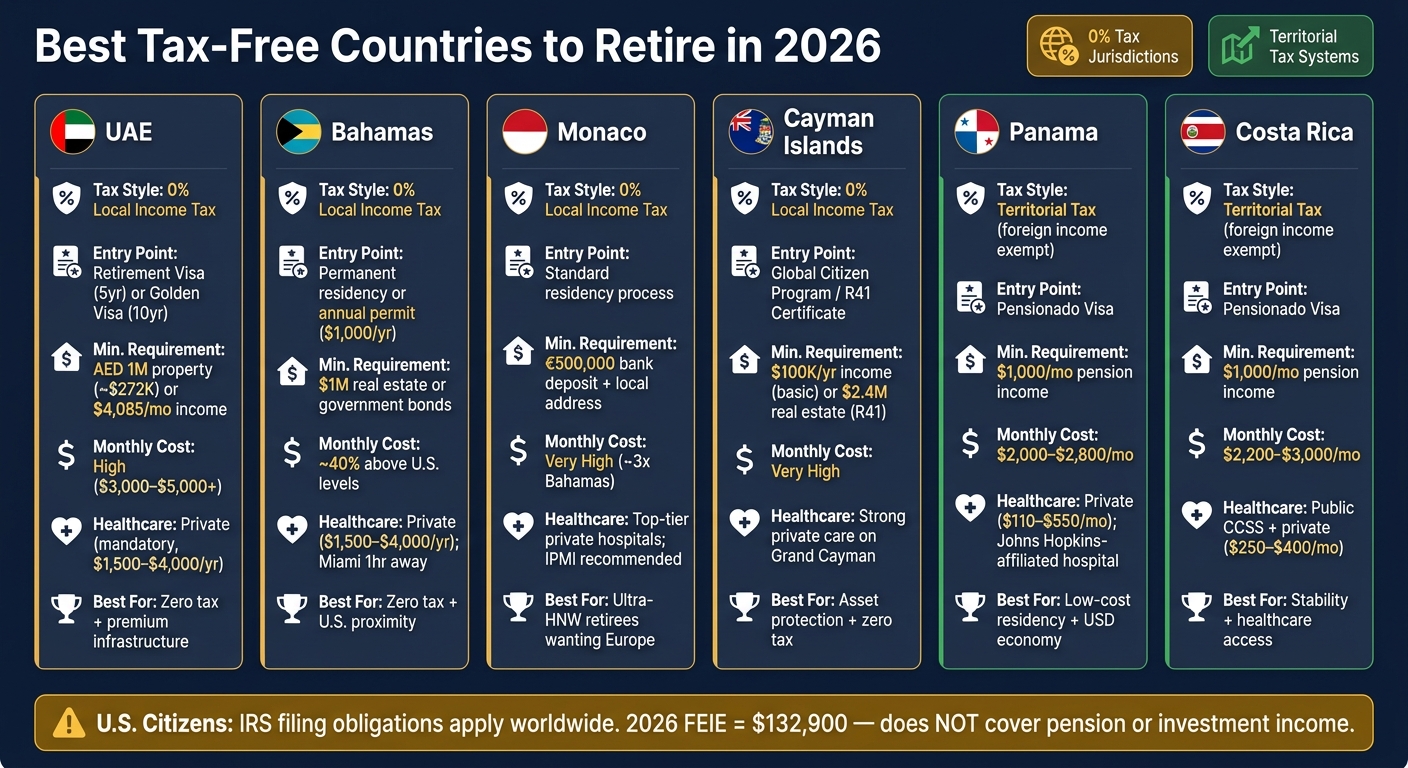
Quick Comparison
| Country | Tax Style | Typical Fit | Main Entry Point | Big Trade-off |
|---|---|---|---|---|
| UAE | 0% local income tax | Retirees who want modern city life | 5-year or 10-year visa | Higher housing and insurance costs |
| Bahamas | 0% local income tax | Retirees who want to stay close to the U.S. | Real estate or annual permit | Living costs can run about 40% above U.S. levels |
| Monaco | 0% local income tax | Very wealthy retirees who want Europe | Residency with €500,000 bank deposit | Very high housing and daily costs |
| Cayman Islands | 0% local income tax | Wealthy retirees focused on asset protection | Income-based or investment-based residency | High buy-in and high day-to-day costs |
| Panama | Territorial tax | Retirees who want a lower-cost move | Pensionado visa at $1,000/month | More paperwork and mixed infrastructure outside Panama City |
| Costa Rica | Territorial tax | Retirees who want healthcare and political stability | Pensionado visa at $1,000/month | Slower processing and required public health enrollment |
My quick read: if you want the lowest local tax no matter the cost, look at UAE, Bahamas, Monaco, or Cayman. If you want a move that is easier to afford and easier to qualify for, Panama and Costa Rica usually make more sense.
That’s the full picture in plain English: lower taxes, yes – but only if the residency rules, healthcare, and total cost still work for your life. It is also vital to understand tax residency and how global reporting standards might impact your move.
sbb-itb-39d39a6
1. United Arab Emirates
Best for retirees who want zero local tax, strong infrastructure, and can handle higher living costs.
The UAE has no personal income tax, capital gains tax, or local inheritance tax. That’s a big draw for retirees, especially those who care about keeping taxes simple. The catch is cost: housing and private insurance can get pricey.
It’s not totally cost-free, though. Most goods and services come with a 5% VAT, and private health insurance is required. That usually costs about $1,500 to $4,000 per person per year. So while the tax side is light, your day-to-day budget still needs some breathing room.
Residency pathway
For retirees, the visa route matters just as much as the tax setup. In the UAE, two options stand out.
The Retirement Visa lasts 5 years and can be renewed. To qualify, you need either a monthly income of at least AED 15,000 (about $4,085) or property worth at least AED 1 million (about $272,250).
The Golden Visa lasts 10 years and is also renewable. It requires either a property investment of AED 2 million (about $545,000) or a fixed deposit at the same amount. If you can meet that higher bar, the Golden Visa is often the better long-term pick. It gives you a longer renewal cycle and relies less on monthly income.
| Visa Type | Duration | Property Threshold | Alternative Requirement |
|---|---|---|---|
| Retirement Visa | 5 years (renewable) | AED 1M (~$272,250) | AED 15,000/month (~$4,085) |
| Golden Visa | 10 years (renewable) | AED 2M (~$545,000) | AED 2M fixed deposit |
Cost, healthcare, and safety
Dubai is expensive, plain and simple. A central two-bedroom apartment usually costs AED 120,000 to AED 200,000+ per year (about $32,700 to $54,500+). Ras Al Khaimah sits in the same zero-tax federal system but offers a quieter coastal lifestyle at a lower cost. That tradeoff says a lot about the UAE: you’re paying for safety, infrastructure, and a very simple tax setup.
Private healthcare is strong, although more complex treatment may mean going abroad for care. On top of that, the UAE ranks very well for safety and infrastructure quality.
One limit matters here: the UAE does not offer retirees a path to citizenship.
If the UAE feels out of reach on cost or visa thresholds, the Bahamas is the simpler zero-tax option.
2. Bahamas
Best for retirees who want zero local tax, easy access to the U.S., and don’t mind paying more to live there.
The Bahamas gets rid of the taxes many retirees focus on most: no personal income tax, no capital gains tax, no estate or inheritance tax, and no tax on pensions, dividends, or interest income.
That sounds great on paper. But for U.S. citizens, there’s a catch. The 2026 Foreign Earned Income Exclusion is $132,900, and it generally does not cover pension distributions or investment income. So the tax headline matters, but your residency setup matters too.
Residency pathway
Permanent residency isn’t cheap. You’ll need to invest at least $1 million in Bahamian real estate or put $1 million into government-issued zero-coupon bonds held for 10 years.
If that price tag feels steep, there’s another route. Annual residency permits are available for $1,000 per year and can be renewed without a set end date. Processing usually takes 6 to 18 months.
There’s also one point many U.S. retirees pay close attention to: the Bahamas generally does not allow dual citizenship. Because of that, many stop at permanent residency instead of going further, so they can keep their U.S. passports.
Cost and healthcare
The low-tax setup comes with a high bill. Living costs are about 40% higher than in the U.S. because most goods have to be imported. In some cases, Nassau and Paradise Island can even cost more than Miami for similar housing.
Private health insurance usually runs from $1,500 to $4,000 per person per year. That’s a line item worth planning for early, not later.
Healthcare in Nassau and Freeport handles routine care and urgent issues well enough, but more serious cases often mean a medical trip to Miami. The good news is that Nassau is only about a one-hour flight from Miami. U.S. care is close. Still, if you have chronic health issues, medical evacuation insurance isn’t just nice to have. It’s part of the budget.
For retirees who want a similar tax setup in a smaller, prestige-led setting, Monaco comes next.
3. Monaco
Best for high-net-worth retirees who want zero personal income tax in Europe and are okay with paying a premium for it.
This is where the comparison moves from the Caribbean to Europe’s most exclusive zero-tax address.
Monaco is Europe’s only zero-personal-income-tax jurisdiction. Retirees pay no local tax on foreign pensions, investment income, capital gains, or wealth. Direct heirs also pay 0% inheritance tax. And this isn’t a retiree-only perk. The tax treatment applies to all residents, which helps if your income comes from several places.
Residency pathway
Monaco doesn’t offer a retiree-only visa. Instead, applicants go through the country’s standard residency process.
In most cases, you’ll need:
- A €500,000 bank deposit
- A local address
- Proof that you can support yourself
- A background check
- An interview
To qualify as a tax resident, you need to spend at least 183 days per year in Monaco. You’ll also want a Monaco Tax Residency Certificate. That document helps prove your status and can support double-tax relief.
Cost and healthcare
Monaco is expensive. In fact, it costs about three times more than the Bahamas. On top of that, a 20% VAT pushes up day-to-day spending.
Healthcare is one of Monaco’s strong points. The country is known for top-tier private hospitals and specialists. U.S. retirees usually use International Private Medical Insurance (IPMI) for local coverage.
Safety and asset protection
Monaco ranks among the world’s most stable jurisdictions. Its zero taxes on income, capital gains, and wealth make it a strong European choice for tax efficiency and asset protection.
If Monaco feels out of reach, the Cayman Islands present another zero-tax path, just with a different cost setup.
4. Cayman Islands
Best for high-net-worth retirees who want a permanent zero-tax base in the Caribbean.
The Cayman Islands charge no personal income tax, capital gains tax, wealth tax, or inheritance tax. Foreign pensions, dividends, and interest are also tax-free at the local level. That’s the big draw.
The catch is simple: Cayman is expensive. This is a place that works best if you want a clean tax setup and can afford the price tag. It’s not built for budget retirement.
Residency pathway
Retirees have three main paths.
- The Global Citizen Concierge Program is the easiest entry point. It requires $100,000 in annual income and no minimum investment.
- The Residency Certificate for Persons of Independent Means asks for a $1.2 million investment in real estate or a local business, plus at least $145,000 in annual income.
- The Permanent Residence Certificate (R41) sits at the top end. It requires about $2.4 million in real estate and can be kept with very little physical presence, as little as one day per year.
There’s also one tax point U.S. retirees can’t ignore: the Cayman Islands have no Double Taxation Agreement (DTA) with the United States. So even if Cayman charges nothing locally, U.S. citizens still owe the IRS on worldwide income. The Foreign Earned Income Exclusion (FEIE) covers up to $132,900 in earned income for 2026, but passive retirement income doesn’t count.
Cost and healthcare
The Cayman Islands cost a lot, but Grand Cayman gives retirees access to strong private healthcare and internationally trained specialists.
Safety and asset protection
For asset protection, Cayman has a strong reputation. It offers a stable legal system and firm creditor protections, which is why many people view it as an institutional-grade jurisdiction.
Still, there’s friction on the compliance side. In 2026, AML (Anti-Money Laundering) rules are strict. Applicants need a well-documented source-of-wealth declaration to get through screening. If your finances are clean and easy to trace, that’s usually workable. If they’re messy, the process can get complicated before you even set foot on the island.
If you want a lower-cost territorial-tax option instead of a pure zero-tax base, Panama comes next.
5. Panama
Best for retirees who want a territorial tax system, immediate permanent residency, and a U.S. dollar economy.
Panama is the practical step down from the zero-tax islands. You still get strong tax perks, but day-to-day life is often simpler and, in many cases, less expensive.
The big draw is Panama’s territorial tax system. It taxes only Panama-source income, which means foreign pensions, Social Security, dividends, 401(k) withdrawals, and offshore capital gains are exempt. Panama also has no inheritance, gift, or estate tax. For U.S. citizens, that doesn’t erase IRS rules on worldwide income. It does, however, cut out local tax on money earned abroad. And because Panama uses the U.S. dollar, American retirees don’t have to deal with currency swings.
Residency pathway
Panama’s Pensionado Visa is built for retirees. To qualify, you need at least $1,000 per month in lifetime pension income. If you buy at least $100,000 in Panamanian real estate, that drops to $750 per month. For each dependent, add $250 per month to the income requirement.
One of the strongest parts of this visa is the timing: approval gives you permanent residency right away. There’s no temporary stage first. Processing usually takes 3 to 6 months, and the paperwork can be heavy. To keep your status active, you need to visit Panama at least once every two years. After five years as a permanent resident, you can apply for citizenship, though Spanish ability is required and approval is still discretionary.
| Requirement | Pensionado Visa |
|---|---|
| Minimum monthly income | $1,000 (or $750 with $100,000 property) |
| Per dependent | +$250/month |
| Processing time | 3–6 months |
| Residency status | Permanent residency on approval |
| Physical presence | Visit once every 2 years |
| Tax on foreign pension | 0% |
| Currency | U.S. Dollar (USD) |
| Path to citizenship | 5 years |
Pensionado status also comes with legal discounts under Panamanian law. These apply to utilities, travel, dining, medical care, and entertainment.
Cost and healthcare
A comfortable mid-range retirement in Panama usually costs $2,000 to $2,800 per month, depending on where you live. That range puts Panama in a sweet spot for many retirees: not dirt cheap, but often far less than many U.S. cities.
Boquete, a mountain town that’s popular with American retirees, has 2-bedroom condos and homes in the $150,000 to $320,000 range. Coronado, a coastal community, tends to run a bit lower at $130,000 to $280,000.
For healthcare, most retirees use private hospitals. Hospital Punta Pacífica in Panama City is affiliated with Johns Hopkins and is JCI-accredited. Private health insurance usually costs about $110 to $160 per month for basic coverage, or $380 to $550 per month for broad coverage. A lot of retirees keep Medicare Part B for care in the U.S. and pair it with a local or global plan in Panama.
Safety and asset protection
Panama allows full foreign ownership of titled land, with strong legal protections for owners. Its banking system is well established, though expat bank accounts often require an opening deposit of $2,000 to $5,000. In practice, many retirees use a two-account setup: a U.S. bank account as their anchor for Social Security and U.S. bills, plus a local Panamanian account for life on the ground.
If Panama’s residency rules or more city-centered feel seem a bit too structured, Costa Rica offers a simpler near-tax-free option.
6. Costa Rica
Best for retirees who want a territorial tax system, a stable democracy, and a lower-cost lifestyle without giving up access to quality healthcare.
Costa Rica uses a territorial tax system, which means it taxes only Costa Rica-source income. Foreign income, including U.S. Social Security, pensions, and investment distributions, is exempt from local income tax. There’s also no wealth tax or inheritance tax. For Americans, that doesn’t erase IRS filing duties, but it does mean Costa Rica won’t add a local tax bill on money earned abroad. It lands somewhere in the middle: lighter taxes than the U.S., but with more rules and paperwork than Panama.
Residency pathway
The Pensionado Visa is the main path for retirees. To qualify, you need at least $1,000 per month in lifetime pension income from a government or approved private pension source. Married couples can qualify with one $1,000 pension, no matter which spouse receives it.
Costa Rica grants temporary residency first, which is valid for two years. Permanent residency becomes available after three years of legal residence. Processing through the DGME, Costa Rica’s immigration office, now takes about 6 to 12 months, so this isn’t something to leave until the last minute. Many retirees bring in an immigration attorney, and that usually costs $800 to $1,500.
There’s also a stay rule to watch. To keep temporary residency active, you must spend at least four months per year in Costa Rica. After you move to permanent residency, that drops all the way to three days per year.
| Requirement | Pensionado Visa |
|---|---|
| Minimum monthly income | $1,000/month (lifetime pension) |
| Couples | Single $1,000 pension qualifies both |
| Processing time | 6–12 months |
| Residency status | Temporary (2 years), then permanent after 3 years |
| Physical presence (temporary) | 4 months/year |
| Physical presence (permanent) | 3 days/year |
| Tax on foreign pension | 0% |
Cost and healthcare
A comfortable retirement in Costa Rica usually costs $2,200 to $3,000 per month. In the Central Valley, including San José and nearby towns like Escazú and Santa Ana, a one-bedroom apartment often rents for $500 to $800 per month. In beach areas such as Tamarindo, that often climbs to $900 to $1,500 per month.
Healthcare is a fixed part of the budget, not an optional extra. All legal residents must enroll in CCSS (Caja), Costa Rica’s public healthcare system, within 90 days of approval. Monthly contributions usually fall between 7% and 11% of declared income, which comes out to about $70 to $150 per month for many retirees.
The public system can be a good fit for routine care, but wait times for non-urgent procedures can be long. Because of that, many retirees keep Caja and also buy private international insurance. That usually costs $250 to $400 per month for a healthy 60- to 65-year-old and can make it much easier to use private hospitals like CIMA or Clínica Bíblica in San José.
Safety and asset protection
Foreigners in Costa Rica have the same property ownership rights as citizens when it comes to titled land. The big exception is government-leased beachfront property, which follows leasehold rules instead of full title. That’s a detail worth checking twice before signing anything.
Real estate transaction costs usually run 3% to 7% of the purchase price, covering legal fees and transfer taxes. If you’re unsure where to settle, renting for 6 to 12 months first makes a lot of sense. It gives you time to test daily life, get a feel for different towns, and see the September–October rainy season for yourself. In Costa Rica, microclimates can change the experience from one area to the next in a pretty big way.
The official currency is the colón, but the U.S. dollar is widely accepted for bigger transactions like rent and real estate.
That tradeoff becomes clearer when taxes, healthcare, and residency rules are weighed side by side.
Pros and Cons by Country
This summary helps you compare the six options based on tax freedom, residency cost, and how workable each one is over time.
The table below turns the country-by-country review into a quick decision tool.
| Country | Biggest Advantages | Main Drawbacks | Best Match Retiree Profile |
|---|---|---|---|
| UAE | 0% personal income tax; modern infrastructure | High cost of living; Dubai rents surged between 2022 and 2026; mandatory private health insurance; no path to citizenship | Retirees who want zero tax and premium infrastructure |
| Bahamas | No local income, capital gains, or inheritance tax; close to the U.S. | Cost of living runs roughly 40% above U.S. benchmarks; permanent residency requires $1,000,000 in real estate or government bonds | High-net-worth retirees who want U.S. proximity |
| Monaco | 0% personal income and wealth tax; European location; secure, prestigious setting | Requires a bank deposit of at least €500,000; real estate averages roughly €50,000 per square meter | Ultra-high-net-worth retirees seeking a European base |
| Cayman Islands | No local income, capital gains, or inheritance tax; strong asset-protection rules | R41 Certificate requires a CI$2,000,000 (~$2.4M) real estate investment | Retirees prioritizing asset protection and zero tax |
| Panama | Territorial tax; USD currency; low $1,000 monthly income threshold for permanent residency; Pensionado discounts up to 50% on hospital stays | Tropical humidity; weaker infrastructure outside Panama City | Retirees seeking low-cost residency and USD stability |
| Costa Rica | Territorial tax system; politically stable; strong public and private healthcare options | Slower bureaucracy; rising costs | Retirees who want stability, healthcare access, and a simpler lifestyle |
The pattern is pretty clear. The places with the lowest tax burden are usually the hardest to get into and the most expensive to maintain. Zero-tax jurisdictions ask for more money up front and often come with higher day-to-day costs. Territorial-tax countries, by contrast, tend to be easier to access and less costly to use.
Put simply, UAE, Bahamas, Monaco, and the Cayman Islands lean toward wealthier retirees who can handle steep entry costs. Panama and Costa Rica make more sense for people who want a lower-cost path to residency without giving up too much day-to-day comfort.
One more point matters for Americans: U.S. citizens still have IRS filing obligations, even if local tax is 0%.
Conclusion
The trade-off is pretty straightforward: the places with the lowest taxes usually cost more and are tougher to qualify for, while Panama and Costa Rica are easier to move to and cheaper to live in. So the better pick comes down to what matters most to you.
If your main goal is zero local tax, look at UAE, Bahamas, Cayman Islands, and Monaco. If lower living costs matter more, Panama and Costa Rica stand out because they use territorial-tax systems. For residency, Panama is the fastest route, while Costa Rica also has a $1,000 Pensionado threshold but begins with temporary residency. And if asset protection is high on your list, the Cayman Islands is the clearest option here.
Before making a move, check the visa rules, how the country taxes Social Security, 401(k)s, and pensions, what healthcare residents can actually access, and what you still need to file with the IRS. The 2026 FEIE is $132,900, but it does not apply to pension or investment income.
FAQs
Which country is easiest to qualify for?
For retirees, the Dominican Republic has one of the easiest residency paths in the Caribbean. You need $1,500 per month in verifiable income, and there’s no real estate purchase requirement.
If you’re looking at pensionado programs, Panama and Costa Rica are also within reach at $1,000 per month in lifetime pension income.
In Europe, Cyprus is the easiest option for people living on passive income. By contrast, the UAE and Monaco usually come with much higher financial commitments.
Will I still owe U.S. taxes if I retire there?
Yes. If you’re a U.S. citizen, you still generally owe federal taxes on your worldwide income no matter where you live or how your new country handles taxes.
So even if you move to a zero-tax country, that doesn’t make your U.S. filing or tax bill go away. The IRS still expects you to report what you earn.
That’s why a sound retirement plan needs to look at both sides of the picture:
- Taxes in your new country
- Your remaining IRS obligations
Miss one side, and the plan can fall apart fast.
What hidden costs should I budget for?
Budget for more than taxes. The price of living abroad often starts before you get the tax break.
Residency can come with its own price tag, including income minimums, real estate purchases, bank deposits, and rules about how many days you must spend in the country each year. In some places, that means showing steady monthly income. In others, it means tying up cash in a local account or buying property that meets a set amount.
Healthcare is another cost people sometimes miss. You may need private insurance, public system payments, or both. For example, Costa Rica requires many residents to pay into Caja, its public healthcare system, and that expense needs to be part of the math from day one.
Then there are the day-to-day compliance costs. Immigration filings, document translations, apostilles, legal help, banking paperwork, and extra account checks can all add up. Opening and keeping a bank account abroad may also mean more documentation than you expect, especially if you’re a U.S. citizen.
You should also factor in U.S. compliance costs. That can include FBAR/FATCA reporting and U.S. tax filing when required. Even if your tax bill drops, the filing burden often does not.
