
If I were moving abroad in 2026, I’d ignore the lowest premium and check five things first: core medical cover, where the plan works, exclusions, provider access, and visa rules. That’s the short answer.
Medical costs are still climbing, with global medical inflation projected at 10.3% in 2026. A hospital stay in the U.S. can cost $30,000 to $50,000, and an evacuation from Asia to Europe can run $100,000 to $250,000. So when I look at expat health insurance, I don’t just ask, “What does it cost?” I ask, “What big bill could this plan leave me with?”
Here’s what matters most:
- Inpatient care and emergency evacuation should be non-negotiable
- Outpatient care, maternity, mental health, and preventive care depend on your life stage and health needs
- Coverage area changes the price a lot, especially if the plan includes the U.S.
- Pre-existing condition rules, waiting periods, and sub-limits can decide whether a claim gets paid
- Direct billing, telemedicine, and a strong hospital network can make day-to-day use much easier
- Portability and residency compliance matter if you may move again or need the plan for a visa
If I had to sum up the article in one line, it would be this: buy the plan that fits your countries, your medical risks, and your legal needs – not just your budget.
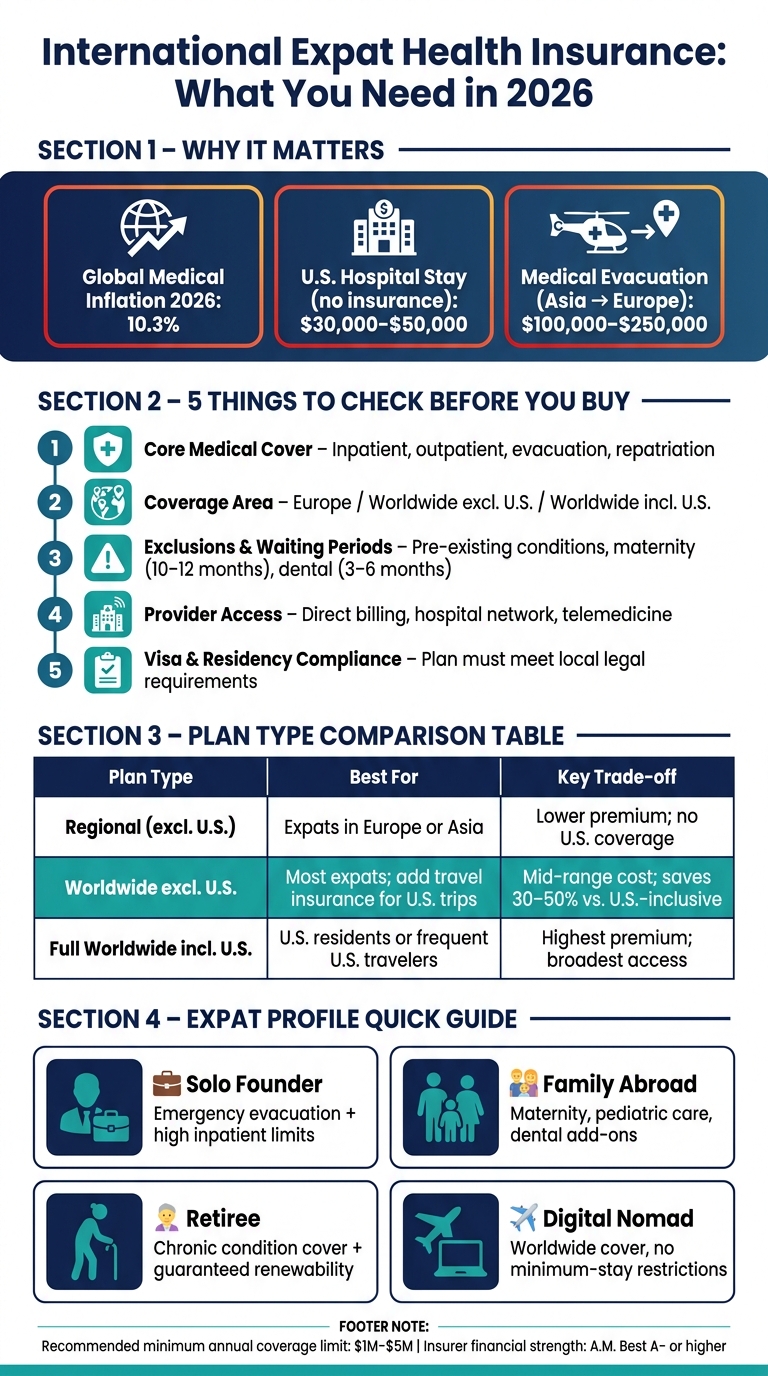
Quick comparison
| What to check | What I’d look for in 2026 | Why it matters |
|---|---|---|
| Core cover | Inpatient, outpatient, evacuation, repatriation | Big claims often come from hospital care or transport |
| Coverage area | Europe, worldwide excl. U.S., or worldwide incl. U.S. | Geography is one of the biggest price drivers |
| Pre-existing conditions | Clear underwriting terms | This is where many disputes start |
| Cost sharing | Deductible, copays, coinsurance, sub-limits | Low premium can mean higher out-of-pocket costs |
| Provider access | Direct billing and hospitals near where you live | You may not want to pay first and claim later |
| Mobility and legal fit | Portable cover that meets residency rules | A policy can be medically useful but fail visa rules |
I’d use this article as a checklist before buying: make sure the policy covers the care you may need, works in the places you’ll be, pays claims in a usable way, and meets any residency or permit rules tied to your move.
sbb-itb-39d39a6
Step 1: confirm the core benefits your policy must include
Before you compare prices, make sure the plan covers the care you’re likely to use. A low premium doesn’t help much if the policy leaves big gaps.
Hospitalization, outpatient care, and emergency evacuation
Inpatient care – including same-day hospital care – is the backbone of the policy. It covers hospital stays, surgery, ICU time, specialist fees, and diagnostics. And this isn’t a small-cost area. Private hospital care can run past $12,000 per day in Singapore, and a short hospital stay in the U.S. can cost $30,000 to $50,000 without insurance.
Outpatient care is often sold as a separate module. It usually covers GP visits, specialist consultations, prescription drugs, and physiotherapy. If you leave it out, you’ll pay those routine medical costs yourself.
Emergency medical evacuation covers transport to the nearest high-quality hospital when local care isn’t good enough. Repatriation is related, but not the same thing: it brings you back to your home country to recover. That difference matters. An evacuation from Asia to Europe can cost $100,000 to $250,000 out of pocket. Without this benefit, one bad event can turn into a huge bill fast. Check the transport limits and the conditions that trigger cover.
Once hospital cover looks solid, the next step is to see how the plan deals with long-term health issues and stage-of-life care.
Chronic conditions, maternity, mental health, and preventive care
Chronic conditions like hypertension, diabetes, and asthma are often where underwriting matters most. With full medical underwriting, you share your medical history upfront and get clear terms. With moratorium underwriting, pre-existing conditions are excluded for a set period, usually 24 months. This is one of those make-or-break details for long-term cost.
Maternity coverage usually appears only in higher-tier plans and often comes with a 10- to 12-month waiting period before it starts. It should include both routine delivery and pregnancy complications.
Mental health is shifting from a limited extra to a more common feature in 2026. Look for plans that include both inpatient psychiatric care and outpatient therapy sessions.
Preventive care covers annual check-ups, screenings, and vaccinations.
After that, check where the policy applies and whether you need extra cover for care across borders.
Coverage across multiple countries and optional add-ons
Most IPMI plans are sold in three main geographic setups:
- Europe
- Worldwide excluding the U.S.
- Worldwide including the U.S.
This becomes a big deal if you live in one country and get treatment in others. Planned treatment abroad may need a rider. If you want the option to see a specialist in another country, read the policy wording closely.
Add-ons like dental, vision, wellness, or telemedicine make sense only if you’ll use them. The table below helps separate must-haves from nice-to-haves.
| Benefit Category | Typical Status |
|---|---|
| Inpatient care | Core |
| Emergency evacuation | Core |
| Outpatient care | Optional / standard |
| Mental health | Increasingly standard |
| Maternity | Optional |
| Dental and vision | Optional |
| Telemedicine | Standard or add-on |
Aim for at least $1 million in annual coverage. A range of $1 million to $5 million is a fit for catastrophic illness or complex treatment. When you pick the annual limit, let the big, low-frequency claims drive that choice – not routine doctor visits.
Step 2: compare plan structure, pricing, and exclusions before you buy
Regional vs. global plans, including U.S. coverage
Coverage area usually has the biggest effect on price. Regional plans tend to cost the least. Worldwide plans excluding the U.S. usually fall in the middle. U.S.-inclusive plans are often the most expensive.
One reason is simple: care in the U.S. costs more. So leaving the U.S. out of a worldwide plan can cut premiums by 30% to 50%. That matters even more when global medical inflation is projected to hit 10.3% in 2026.
Still, leaving out the U.S. isn’t always the smart move. If you travel there often, study there, or may need care there because of family ties, a worldwide-excluding-U.S. plan can leave a hole in your coverage. One common 2026 budget tactic is to keep a "Worldwide excluding U.S." policy all year and then add separate short-term travel insurance for U.S. trips.
Before you choose, map out where you actually live, work, and expect to get major treatment. That part matters more than many people think. Some high-cost countries can make a regional plan less cheap than it first appears.
Next, look at how the plan splits costs when you use care.
Deductibles, copays, annual limits, and sub-limits
The deductible is the amount you pay before the insurer starts paying. A copay is a set amount for a visit or service. Coinsurance means you pay a share of the bill after the deductible has been met.
A $0 deductible can make care less painful at claim time, but it usually comes with a higher premium. A higher deductible flips that tradeoff: lower premium now, more out-of-pocket risk later.
You also need to look past the headline annual maximum. This is where sub-limits can trip people up. These are caps on certain benefits inside the policy, even when the total sum insured looks high. They often show up in areas like:
- Maternity
- Mental health
- Chronic condition treatment
In expensive care markets, sub-limits and provider network rules can matter just as much as the top-line annual limit.
Ask for the full Table of Benefits and Policy Wording before you buy. That’s where you can spot hidden caps, carve-outs, and exclusions that don’t always show up in the sales summary.
After cost-sharing, the next step is checking what the plan doesn’t cover.
Exclusions, waiting periods, and 2026 premium pressure
Pre-existing conditions are behind many claim disputes. A low-price plan can look good on paper and still leave you paying big bills if it cuts out the treatment you are most likely to need.
Common exclusions include elective care, fertility treatment, experimental therapies, and hazardous activities unless you add them through a rider.
Waiting periods add another catch. Maternity often comes with a 10- to 12-month wait, while dental, vision, and some elective procedures may have 3- to 6-month waits.
Price always gets attention. But a lower premium can stop looking cheap if the plan blocks the care you may actually use. That issue is even more important in 2026, with premiums climbing fastest in Asia Pacific, Latin America, and the Middle East and Africa.
| Plan Type | Best For | Pros | Cons |
|---|---|---|---|
| High-deductible global | Self-employed / HNWIs | Big premium savings; covers catastrophic events | High out-of-pocket cost for routine care |
| Regional (excl. U.S.) | Expats in Europe or Asia | Lower premiums than full worldwide | No coverage for treatment in the U.S. |
| Full worldwide | U.S. residents or frequent visitors | Broad geographic access; access to U.S. medical tech | Highest premium tier |
Once price and exclusions are clear, check provider access and claims handling.
Step 3: check provider access, portability, claims handling, and insurer reliability
Provider networks, direct billing, and telemedicine access
Once the price looks fair and the exclusions seem workable, the next step is simple: make sure the plan will actually work where you live and travel.
A plan’s network decides whether you get cashless treatment at the hospital or have to pay out of pocket first. Direct billing, or direct settlement, means the insurer pays the hospital directly. If that option isn’t available, you may have to front the money yourself and wait for reimbursement. And when the bill is large, that can hurt.
Before you sign, ask the insurer for a specific list of network hospitals in your city of residence and in the countries you visit most often. Don’t stop at a general network summary. Check the actual hospitals and clinics you’d be likely to use in your home city and your usual travel destinations.
Then look at access beyond the hospital network. If you’re away from your main city, can you still get help fast? Good plans often include:
- 24/7 symptom triage
- Video visits
- Multilingual support
Portability when changing countries of residence
Portability is where many people get caught off guard. Check the terms before you move.
Most local plans lapse after 90 to 180 days abroad, which can leave you with a coverage gap as soon as you relocate.
If you move from one country to another in the middle of a policy term, look closely at how the insurer handles continuation of care. If you’re already being treated for a serious condition, the wording of the policy will decide whether that treatment stays covered. You should also check whether the plan stays portable without making you buy a new policy or go through fresh underwriting. Some insurers use carryover exclusions to keep existing coverage terms in place when you move.
Short-term travel insurance is not meant for a long-term relocation. If you spend time in more than one country, map out where you live, work, study, and get specialty care before you pick a coverage area. A plan that covers your main residence but not your second base leaves a very real hole.
After portability, the next thing to check is whether the insurer pays cleanly when you need care.
Claims process, pre-authorization, and insurer strength
Most planned hospital admissions and high-cost outpatient procedures require pre-authorization. Miss that step, and you could end up with reduced benefits or a declined claim. In an emergency, notify the insurer within 24 to 48 hours of admission. Keep all original receipts, medical records, and pre-authorization correspondence together so you’re not scrambling later.
If you pay upfront, reimbursement often takes 5 to 15 business days, though it can stretch to 3 to 4 weeks. Some insurers now offer faster digital claims tools, which can make the process less painful.
Financial strength also matters more than people think. A medical evacuation from Southeast Asia or Africa can cost more than $100,000, so it makes sense to look for insurers with an A.M. Best rating of A- or higher.
| Factor | High Dependability | Low Dependability |
|---|---|---|
| Claims process | Direct billing at major hospitals | Reimbursement only; pay upfront |
| Pre-authorization | Clear 24/7 digital approval | Opaque rules; high denial risk |
| Financial strength | A.M. Best rated A- or higher | Unrated or local-only solvency |
| Portability | Policy follows you to new countries | Policy lapses upon relocation |
| Network depth | Broad global provider network with direct access | Limited to regional providers |
| Support | 24/7 multilingual assistance | Business hours only |
Step 4: match the policy to your residency, family, and wealth planning needs
Visa and residency insurance requirements in 2026
Your policy needs to do two jobs at once: pay for care and meet local residency rules. In many countries, you now need proof of qualifying health insurance before you can get a work or residence permit. In the UAE, health insurance is mandatory for residents, and employers are responsible for employee coverage.
There’s another catch. In some GCC countries, a policy from an unregistered foreign insurer may still fail the legal test, even if the medical cover looks strong on paper. That’s why plan quality alone isn’t enough.
Some of the most common 2026 residency paths – including Portugal’s D7 and Golden Visa and Spain’s Digital Nomad and Non-Lucrative Visas – each come with their own insurance rules. Before you count on any plan for immigration, check with the relevant consulate or immigration authority that your exact insurer and plan setup qualifies.
Legal fit comes first. Personal fit is what makes the plan workable in daily life.
Choosing a plan by expat use case: solo founder, family, retiree, or frequent traveler
A valid policy isn’t always a useful one. The way you live should shape the plan you buy. A solo founder may care most about evacuation and high inpatient limits. A family usually needs help with routine care, kids’ health, and maternity timing. A retiree may be focused on chronic conditions and renewal terms. A frequent traveler may need cover that follows them without awkward stay limits.
The table below shows what tends to matter most for each profile.
| Expat Profile | Main Need | Watch For |
|---|---|---|
| Solo founder | Emergency evacuation + high inpatient limits | Portability if you relocate; modular structure |
| Family abroad | Maternity, pediatric care, dental/optical add-ons | Maternity modules often have a 10- to 12-month waiting period |
| Retiree | Chronic condition coverage + guaranteed renewability | High annual limits for serious conditions |
| Frequent traveler / digital nomad | Worldwide coverage without minimum-stay rules | Check minimum-stay rules and transit coverage |
Conclusion: a 2026 checklist for selecting expat health coverage
If you’re comparing plans side by side, keep it simple. Focus on five checks: core benefits, geography, exclusions, provider access, and residency compliance.
Start with the medical basics. Make sure the plan covers inpatient care, outpatient care, emergency evacuation, and any add-on modules your household may need. Then look at geography honestly. That means where you live, where you’d go for specialist treatment, and where you travel on a regular basis. A worldwide plan can still have limits that matter.
Next, read the exclusions and waiting periods line by line, not just the summary of benefits. After that, test the provider network in your actual city of residence. A big global network sounds good, but what matters is whether you can get decent care nearby and whether claims are handled well. Last, confirm that the plan meets local visa or residency insurance rules before you sign anything.
With global medical inflation projected at 10.3% in 2026 and an estimated 165,000 high-net-worth individuals relocating internationally in 2026, the price of a bad choice – both financial and legal – is steep. The right international health plan can help shield your savings from catastrophic bills, keep you compliant across borders, and support a broader cross-border wealth and residency plan.
FAQs
How much coverage do I really need?
It depends on your lifestyle, risk tolerance, and where you live and travel. Start with strong inpatient cover. Then decide if you also need outpatient care, diagnostics, and physiotherapy.
Look closely at your geographic area, annual benefit limit, and medical evacuation. Including the U.S. often pushes premiums up. If you have a family or pre-existing conditions, check maternity, pediatric, and underwriting rules. Choosing a higher deductible can bring your premium down.
Do I need U.S. coverage in my plan?
You only need U.S. coverage if you expect to get care in the United States. If not, leaving the U.S. out is one of the most common ways to cut premiums.
Plans without U.S. coverage often cost less. In many cases, worldwide coverage excluding the U.S. is 30%–50% cheaper than full worldwide coverage.
If you only visit the U.S. once in a while, a separate short-term U.S. travel medical plan may do the job.
It’s also smart to look closely at how “global” coverage works in high-cost countries like the U.S. A plan may say it covers you worldwide, but caps, copays, and network limits can shrink what a claim is actually worth.
Will my plan still work if I move again?
Yes – if you pick a true international/private medical insurance (IPMI) plan with portability and renewability, your coverage is meant to stay in place if you move again.
A portable plan keeps the same policy active when you relocate to a new country. In many cases, the insurer just adjusts your coverage area instead of making you start over with a new policy.
Renewability should continue no matter your claims history. That said, you still need to meet the plan’s geographic eligibility rules and residency terms.
