
Protecting your wealth in emerging markets requires balancing high growth potential with significant risks like political instability, currency devaluation, and regulatory changes. Diversifying assets across stable jurisdictions, currencies, and legal structures can safeguard your finances while capitalizing on growth opportunities.
Key Takeaways:
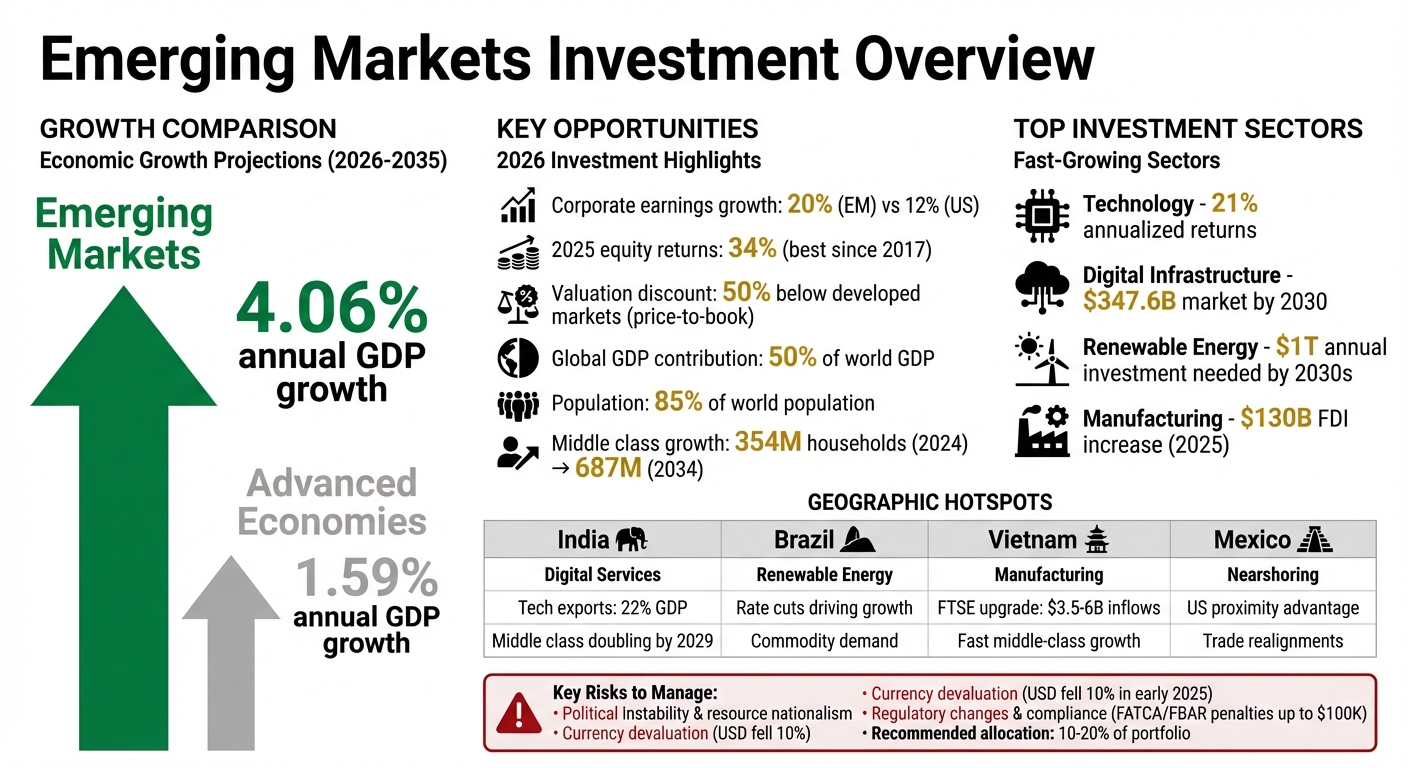
- Emerging Markets Offer Growth: These economies are projected to grow at 4.06% annually through 2035, with sectors like tech, renewable energy, and manufacturing leading the way.
- Risks to Manage: Political shifts, currency fluctuations, and sudden regulatory changes can threaten investments.
- Wealth Protection Strategies:
- Diversify across stable jurisdictions (e.g., Singapore, Switzerland).
- Use multi-currency accounts to hedge against currency devaluation.
- Set up offshore trusts and companies for offshore asset protection.
- Compliance is Critical: U.S. investors must adhere to FATCA and FBAR reporting to avoid penalties.
Emerging markets present opportunities to grow wealth, but success depends on careful planning, legal safeguards, and compliance with international regulations.
Main Risks in Emerging Markets
Emerging markets come with risks that can quickly diminish wealth if not handled wisely. To take advantage of growth opportunities while protecting your assets, it’s crucial to understand these risks and implement targeted safeguards. Each challenge requires a specific approach to ensure your investments remain secure.
Political Instability and Regional Conflicts
Political shifts and geopolitical tensions can disrupt investments overnight. In January 2026, the World Economic Forum ranked geoeconomic confrontation as the top global risk, reflecting a shift toward a multipolar world where economic policies increasingly serve national security goals. This shift has brought trade barriers, sanctions, and asset freezes into the spotlight as tools of foreign policy.
One major concern is resource nationalism. Governments are tightening control over critical minerals like lithium, cobalt, and rare earths, leading to risks like sudden expropriation or changes in mining rights. For example, during the World Economic Forum in Davos in January 2026, discussions over Greenland’s neodymium, praseodymium, and dysprosium underscored tensions among the U.S., China, and Europe. While a temporary agreement was reached, unresolved issues around sovereignty and mining access left investors uncertain about the future.
The political transition in Venezuela in early 2026 offers a clear example of the risks and opportunities tied to regime changes. Following Nicolás Maduro’s fall, the U.S. expanded Chevron‘s licenses in the Orinoco Belt, with revenues monitored through U.S.-controlled accounts to ensure compliance. This situation highlighted both the potential for gains in distressed assets and the risks of political pushback from remaining regime loyalists.
To counter these threats, investors are diversifying across neutral jurisdictions like Singapore, the UAE, Switzerland, and the Cayman Islands. Additionally, offshore trusts and Private Trust Companies act as legal shields, protecting assets from unilateral government actions during periods of political upheaval.
Currency Devaluation and Economic Instability
Currency devaluation and inflation can quickly erode purchasing power. Relying on a single currency leaves you vulnerable to what experts call "one country, one set of rules" risk, where local economic changes can impact all your assets simultaneously. For example, in early 2025, the U.S. dollar fell over 10% against the DXY index of major currencies. Analysts view this as part of a broader trend of devaluation rather than a temporary fluctuation.
Banking system issues have further highlighted these risks. In 2025, the Bank of Russia imposed stricter limits on outbound money transfers for residents and non-residents alike, showing how geopolitical tensions can suddenly restrict access to offshore funds.
To manage forex risks, strategies like currency overlays using forwards and options can help mitigate exposure to devaluation. Multi-currency accounts provide flexibility, allowing investors to switch currencies during volatile periods. Holding assets in strong currencies like the Swiss franc or in gold also serves as a hedge against inflation and devaluation. Experts recommend maintaining tiered liquidity buffers of 10–20% in 2026 to ensure financial stability during market disruptions.
"Banking offshore in stable jurisdictions can also help protect your funds from currency devaluation, inflation, political unrest, or sudden government-imposed restrictions on capital movement or withdrawals." – Statrys
Beyond currency concerns, shifting legal frameworks add another layer of complexity for investors.
Changing Regulations and Compliance Requirements
Emerging markets often experience sudden regulatory changes, which can lead to unexpected legal and financial challenges. Shifting local laws or international standards like the Common Reporting Standard (CRS) or FATCA can create compliance headaches if reporting isn’t carefully managed. In the U.S., even unintentional violations of foreign account reporting rules (FinCEN) can result in penalties up to $10,000, while intentional violations can incur fines as high as $100,000 or 50% of the account balance.
Regulatory instability often follows political changes. New governments can quickly nullify tax treaties, impose strict capital controls, or even seize assets, leaving investors scrambling to adapt. These changes can happen so abruptly that even previously compliant structures may become problematic, exposing investors to severe penalties.
Conducting comprehensive exposure audits can help identify hidden risks across assets, liabilities, and jurisdictions. Partnering with experienced advisors who track regulatory developments in real-time is critical for staying ahead of policy changes. Establishing family governance structures, such as binding family charters and councils, ensures that risk management and compliance protocols are built into long-term wealth planning.
In 2026, offshore banking has increasingly focused on privacy measures to protect identities and political exposure while ensuring full compliance. Proper compliance isn’t just a legal necessity – it also provides a strategic advantage, allowing you to safeguard your assets while avoiding the steep penalties associated with non-compliance.
sbb-itb-39d39a6
Financial Benefits of Emerging Market Investments
Emerging markets, while carrying their share of risks, also present compelling financial opportunities. These economies are expected to grow at an average annual GDP rate of 4.06% through 2035, far outpacing the 1.59% projected for advanced economies. This rapid growth, when paired with smart investment strategies, can significantly strengthen financial portfolios.
For instance, in 2025, emerging market equities delivered a 34% return, the best performance since 2017. By 2026, corporate earnings in these markets are projected to climb by 20%, compared to just 12% for U.S. companies. Yet, despite these promising figures, emerging markets remain undervalued, trading at a 50% discount to developed markets on a price-to-book basis – the widest valuation gap ever recorded.
"MSCI EM is expected to deliver the highest global EPS growth rate in 2026 at 20%, fueled by China’s earnings recovery, rapid AI adoption, and resilient domestic and external demand." – UBS
This combination of strong growth potential and discounted valuations presents a rare opportunity: the chance to acquire high-growth assets at bargain prices. With emerging markets accounting for about 50% of global GDP and home to 85% of the world’s population, the scale of opportunity is immense. Additionally, the middle-class population in these regions is set to nearly double, growing from 354 million households in 2024 to 687 million by 2034, driving consumer demand and investment growth.
Fast-Growing Investment Sectors
Some sectors in emerging markets are expanding at a pace that surpasses anything seen in developed economies. Technology is a standout, with information technology delivering annualized returns of 21% in these regions. In India, tech exports alone now contribute 22% of GDP, and the country’s middle class is expected to more than double by 2029.
The digital infrastructure sector is also booming. Experts describe this transition as "Digital Infrastructure 2.0", characterized by advancements like AI-ready data centers and 5G platforms. The global data center market is growing at double-digit rates and is projected to hit $347.6 billion by 2030. North Asia, particularly South Korea and Taiwan, plays a central role in this growth, given its dominance in semiconductor supply chains.
Renewable energy is another area of rapid expansion. To meet climate goals, clean energy investments in emerging economies need to reach $1 trillion annually by the early 2030s. This surge in investment is boosting demand for key minerals like lithium and copper, benefiting resource-rich nations like Brazil and Indonesia. Moreover, sustainable investments in agritech and renewable energy projects are increasingly linked to attractive returns.
Manufacturing is being reshaped by trends like supply chain regionalization. The "China+1" strategy has positioned countries like Vietnam (electronics and textiles), Mexico (nearshoring), and India (pharmaceuticals and auto components) as key players. Vietnam, for example, is set to benefit from a potential FTSE Russell index upgrade in 2026, which could draw an estimated $3.5 billion to $6 billion in passive capital flows. Meanwhile, India, Mexico, and Brazil each saw inward direct investment increase by about $130 billion in 2025.
| Country | GDP Growth Driver | Key Investment Sectors | Sector Drivers |
|---|---|---|---|
| India | Middle-class growth by 2029 | Digital Services, Fintech, Retail | Fiscal reforms, AI adoption, large consumer base |
| Brazil | Rate cuts, commodity demand | Renewable Energy, Metals, Fintech | High policy rates, demand for transition minerals |
| Vietnam | Fast middle-class growth | Manufacturing, Tech, Logistics | Supply chain diversification, trade pacts (RCEP) |
| Mexico | Nearshoring hub | Manufacturing, Real Estate | Proximity to U.S., trade realignments |
These sector-specific opportunities not only drive growth but also enhance portfolio diversification, helping to manage risk effectively.
Geographic and Economic Diversification
Investing in emerging markets is an effective way to hedge against over-concentration in developed economies, reducing vulnerability to localized economic or political disruptions.
The data supports this strategy. Between 2000 and 2010, the MSCI EM Index delivered +16% annually, while the S&P 500 returned -1%. By 2026, emerging markets are expected to contribute nearly two-thirds of global growth, offering a counterbalance to the slower growth seen in advanced economies.
Currency diversification adds another layer of protection. Access to local currencies and hard assets like gold can shield against long-term U.S. dollar devaluation. Additionally, high-rate markets like Brazil and Mexico allow investors to benefit from interest rate differentials. Historically, a 1% drop in the U.S. Dollar Index (DXY) has correlated with a 3.8% gain in emerging market equities.
Most successful portfolios allocate 10–20% to emerging markets. This balanced approach provides exposure to high-growth sectors while managing the higher volatility of these markets, which can fluctuate 20–40% annually. Low-cost ETFs like Vanguard FTSE Emerging Markets (VWO) or iShares Core MSCI Emerging Markets (IEMG), with fees as low as 0.08%–0.09%, offer a practical way to access thousands of stocks across diverse countries and sectors.
How to Protect Wealth in Emerging Markets
When it comes to investing in emerging markets, the potential for high returns is often accompanied by significant risks. To balance these, many investors turn to offshore structures – not just for asset security but as part of a broader diversification strategy. These structures help shield assets from political instability, currency fluctuations, and legal challenges, while also ensuring compliance with international regulations.
One key strategy involves creating jurisdictional barriers through offshore structures. By placing assets in foreign entities governed by local laws, creditors face the costly and complex task of pursuing claims across multiple countries. This approach focuses on isolating assets legally while adhering to tax obligations.
"The value of an offshore trust today is no longer in secrecy, but in the legal strength and procedural advantages a specific jurisdiction offers." – Raea Khan, International Estate Planning Lawyer
For U.S. citizens, compliance with FATCA is non-negotiable. This law mandates reporting all foreign accounts and paying taxes on global income. Foreign banks are also required to report U.S. account holder information directly to the IRS. The goal here isn’t to avoid taxes but to protect assets through strategic legal frameworks.
Offshore Banking for Asset Protection
Offshore banking is a practical way to diversify funding sources and protect against potential domestic banking instability. For example, the 2023 failures of Silicon Valley Bank and First Republic highlighted the importance of safeguarding assets in stable foreign accounts. Offshore accounts also offer added privacy and can help mitigate currency risks by holding funds in stable currencies like Swiss francs or Singapore dollars.
Different jurisdictions provide distinct benefits for U.S. investors:
- Singapore: Known for its political stability and robust legal system, Singapore offers a territorial tax regime. However, it requires licensed trustees and involves high setup and maintenance costs.
- Switzerland: Famous for its financial infrastructure and wealth management expertise, Switzerland often requires a minimum deposit of $1,000,000 for asset management accounts.
- Cayman Islands: This jurisdiction offers no direct taxes on income, capital gains, or inheritance. It is highly regulated but comes with high operational costs.
| Jurisdiction | Stability Rating | Tax Treatment | Key Advantage | Primary Drawback |
|---|---|---|---|---|
| Singapore | Excellent | Territorial tax regime | Strong legal system; licensed trustees | High setup/maintenance costs |
| Cayman Islands | Excellent | No income/capital tax | Regulated banking; STAR trusts | High operational costs |
| Switzerland | Excellent | Favorable for non-residents | Top-tier banking stability and services | High entry barrier; selective clients |
For U.S. investors, compliance is critical. Filing an FBAR (FinCEN Form 114) is required if foreign accounts exceed $10,000 at any point in the year. Additionally, FATCA mandates filing IRS Form 8938. Non-compliance can result in severe penalties.
Using Offshore Companies and Trusts
Offshore Asset Protection Trusts (OAPTs) are another powerful tool for safeguarding wealth. Jurisdictions like the Cook Islands and Nevis offer legal frameworks that make it nearly impossible for creditors to access assets. These regions often don’t recognize U.S. court orders, requiring creditors to start new, expensive lawsuits under local laws.
- Cook Islands: Often considered the gold standard for asset protection trusts, this jurisdiction offers strong legal barriers. While setup costs average $29,000, the high level of protection makes it a worthwhile investment for high-net-worth individuals.
- Nevis: Offers similar protections with minimal public disclosure. However, its local banking services can be inconsistent.
Offshore LLCs provide a different layer of security. In Nevis, for example, creditors are typically limited to a "charging order", which allows them to claim only distributed income rather than seizing underlying assets. This structure is particularly useful for protecting real estate or investment portfolios.
"In my 15+ years advising clients on asset protection, the most durable plans combine domestic protection… with limited, carefully documented offshore elements only after full legal and tax review." – Author, Finhelp.io
Private Placement Life Insurance (PPLI) is another option, offering creditor protection and tax-deferred growth for accounts starting at $2,000,000. Unlike many other offshore insurance products, PPLI remains compliant with FATCA regulations, making it a viable choice for Americans.
Timing is essential. These structures must be established before any legal issues arise. Transfers made after lawsuits are filed can be deemed "fraudulent transfers" and could be undone by the courts. Proper documentation and compliance with forms like 3520/3520-A for foreign trusts or 5471 for foreign corporations are crucial.
Choosing the Right Jurisdiction
Not all offshore jurisdictions are created equal. The ideal choice depends on your specific needs, such as asset protection, tax treatment, and operational costs. For instance, Anguilla has gained attention as a cost-effective option for forming offshore companies and trusts. As a British Overseas Territory, it offers political stability, modern corporate laws, and no taxes on capital gains, inheritance, or corporate income for offshore structures.
| Jurisdiction | Best For | Legal Strength | Cost Level | Special Features |
|---|---|---|---|---|
| Cook Islands | Asset protection trusts | Strongest creditor barriers | High ($29,000+) | Doesn’t recognize U.S. court orders |
| Anguilla | Offshore companies, trusts | Strong with lower costs | Moderate | British Overseas Territory; flexible trust laws |
| Nevis | LLCs and trusts | Very strong | Moderate to High | Charging order protection; minimal disclosure |
| Isle of Man | Modern trust structures | Strong | High | No capital gains/inheritance tax; mandatory trustees |
As global regulations evolve, the focus of offshore structures has shifted from secrecy to legal strength and procedural advantages. For example, Panama’s Executive Decree 177, effective December 2024, will require annual accounting records, while Singapore’s new tax rules will begin taxing certain foreign asset gains received locally.
To minimize risks, work with reputable institutions and independent trustees. Keep some assets onshore for immediate needs and legal expenses. The most effective strategies combine domestic protections, like insurance and estate planning, with carefully managed offshore elements reviewed by legal and tax professionals.
Building a Balanced Portfolio for Emerging Markets
Building a portfolio that taps into the growth potential of emerging markets while managing risks takes careful planning. The objective isn’t just chasing returns – it’s about creating a resilient structure that can handle challenges like political instability, currency fluctuations, and changes in regulations.
How to Diversify Your Portfolio
Allocate 10–20% of your portfolio to emerging markets. This approach lets you benefit from growth opportunities while limiting exposure to volatility. A well-rounded global portfolio often includes around 70% stocks for growth, 20% bonds for stability, and 10% in alternative assets. Within the emerging market portion, diversify across different countries, industries, currencies, and asset types to spread out risks.
Diversify across regions and industries. Emerging markets contribute about 50% of global GDP when measured by purchasing power parity. However, performance can vary widely. For example, UBS highlighted China’s tech sector as "Most Attractive" in 2026 due to government backing for AI and digital platforms. Meanwhile, Brazil and Indonesia offer growth opportunities in commodity-linked sectors. Key industries to consider include clean energy, cybersecurity, AI, healthtech, and manufacturing. For instance, clean energy investments in emerging markets need to triple to $1 trillion annually by the early 2030s to meet climate goals. Similarly, the data center market is expected to hit $347.6 billion by 2024, with an annual growth rate of 11.2% through 2030.
Manage currency risk with diverse holdings. Holding assets in multiple stable and high-yielding currencies – such as Swiss francs, Singapore dollars, or even emerging market currencies like the Brazilian real or Mexican peso – can protect against home currency devaluation. For example, when the US dollar dropped over 10% against the DXY in early 2025, it highlighted the importance of currency diversification during inflation or volatility. Historically, a 1% drop in the US dollar index has been linked to a 3.8% rise in emerging market equities.
Use ETFs for convenience and accessibility. Exchange-traded funds (ETFs) are an excellent option for newer investors. They offer instant diversification, real-time pricing, and tax efficiency compared to mutual funds. More experienced investors may combine ETFs with direct investments in specific companies or sectors where they have expertise.
Rebalance regularly. Set clear thresholds for your emerging market allocation and adjust when it moves away from your target. Rebalancing helps lock in gains during market rallies and allows you to buy during dips. This disciplined approach can reduce emotional decision-making.
"Rebalancing… helps lock in gains, manage risk, and maintain exposure to future growth." – UBS Chief Investment Office
Add legal protection through offshore structures. Incorporating offshore trusts or LLCs can create legal barriers to separate personal assets from business risks and protect against domestic litigation.
Monitor your portfolio closely. Keep track of key metrics like asset allocation, currency exposure, regional performance, and volatility. Portfolio management tools with real-time tracking and alerts can help you respond quickly when your investments deviate from your strategy.
These strategies lay the foundation for a well-diversified and legally protected portfolio, supported by services designed to help you put these plans into action.
Working with Global Wealth Protection

Global Wealth Protection offers services to help investors implement these strategies effectively. Whether you’re new to offshore structures or building a comprehensive wealth protection plan, their offerings provide the tools and guidance needed to navigate emerging markets confidently.
Private US LLC Formation helps protect assets domestically while allowing for international flexibility. Services include all necessary filings, registered agent support, and compliance consultations.
Offshore Company Formation is available in Anguilla, a jurisdiction known for its stable political environment and favorable tax rules. These services cover everything from filings to banking introductions, making it easier for investors to manage emerging market investments.
Offshore Trusts and Private Interest Foundations are tailored for high-net-worth individuals who want strong asset protection and estate planning solutions. These structures, often set up in Anguilla, separate personal assets from creditors and allow for flexible management.
Private Consultations provide step-by-step advice on jurisdiction selection, tax strategies, and structuring a portfolio across multiple countries.
GWP Insiders Membership offers ongoing support, exclusive resources, and personal consultations for investors and entrepreneurs navigating global opportunities.
| Service | Primary Use Case | Key Benefits |
|---|---|---|
| Private US LLC Formation | Domestic asset protection with international flexibility | Privacy, asset protection, compliance support |
| Offshore Company Formation | International business operations and investment holding | Tax-efficient structure, political stability (Anguilla), banking introductions |
| Offshore Trusts & Foundations | High-net-worth asset protection and estate planning | Legal separation from creditors, multi-generational planning |
| Private Consultations | Personalized strategy development | Tailored jurisdiction selection, tax optimization |
| GWP Insiders Membership | Ongoing internationalization support | Continuous access to strategies, personal consultations |
These services can be combined for a comprehensive wealth protection plan. For example, you could use a Private US LLC for domestic operations, an offshore company in Anguilla for emerging market investments, and an offshore trust for safeguarding high-value assets. Custom consultations ensure the right mix of strategies for your goals, risk tolerance, and timeline.
Emerging markets are poised for growth, with the middle class expected to double to 687 million households by 2034 and annual GDP growth projected at 4.06% through 2035, compared to 1.59% for advanced economies. By structuring your portfolio thoughtfully and adding legal safeguards, you can position yourself to take advantage of these opportunities while managing risks effectively.
Conclusion
The strategies we’ve covered offer a clear path for navigating the complexities of emerging markets. These regions present exciting opportunities, but they also come with challenges like political instability, currency fluctuations, and changing regulations – any of which can impact your wealth if you’re not prepared.
To strike a balance between risk and reward, it’s crucial to diversify your assets across different jurisdictions, currencies, and legal structures. This diversification helps shield your wealth from sudden political or economic changes. As emphasized throughout this guide, taking action early is key to effective asset protection.
One critical point to remember: establish safeguards before risks arise. The rise in litigation makes this especially urgent. Waiting too long could lead to asset transfers being deemed fraudulent in court, leaving you unprotected when you need it most.
The tools discussed – like offshore banking, forming international companies, diversifying portfolios, and setting up structured legal protections – can help you grow your wealth in emerging markets without unnecessary exposure to risk. Start now, ensure compliance with requirements like FBAR and Form 8938, and consult experienced professionals who understand the nuances of international wealth management. By acting today, you can seize opportunities in emerging markets while keeping your wealth secure.
FAQs
How much of my portfolio should go into emerging markets?
The right amount to invest in emerging markets largely depends on your risk tolerance, investment objectives, and diversification plan. For many investors, financial experts often recommend dedicating 10-20% of a balanced portfolio to these markets. This range helps balance the higher growth opportunities with the associated risks.
Spreading your investments across different countries, industries, and asset types can help smooth out some of the volatility. To fine-tune your approach and align it with your personal goals, it’s a good idea to consult a financial advisor. They can guide you in managing your exposure wisely.
What’s the simplest way to hedge currency devaluation risk?
The easiest method to manage the risk of currency devaluation is by using tools like forward contracts or options. These financial instruments allow you to lock in exchange rates, protecting you from unfavorable currency fluctuations. They offer a practical and efficient way to handle this type of risk.
Which offshore structure should I use first – bank account, LLC, or trust?
Starting with an offshore bank account is a smart move. It gives you access to foreign funds, allows international transactions, and sets the stage for more advanced financial structures. Once that’s in place, consider forming an offshore LLC. This is ideal for handling business activities or managing assets, offering liability protection and potential tax benefits. Lastly, think about setting up an offshore trust. It’s a reliable option for long-term asset protection, estate planning, and maintaining privacy. By following this process, you can create a flexible and secure framework for safeguarding your wealth.
