
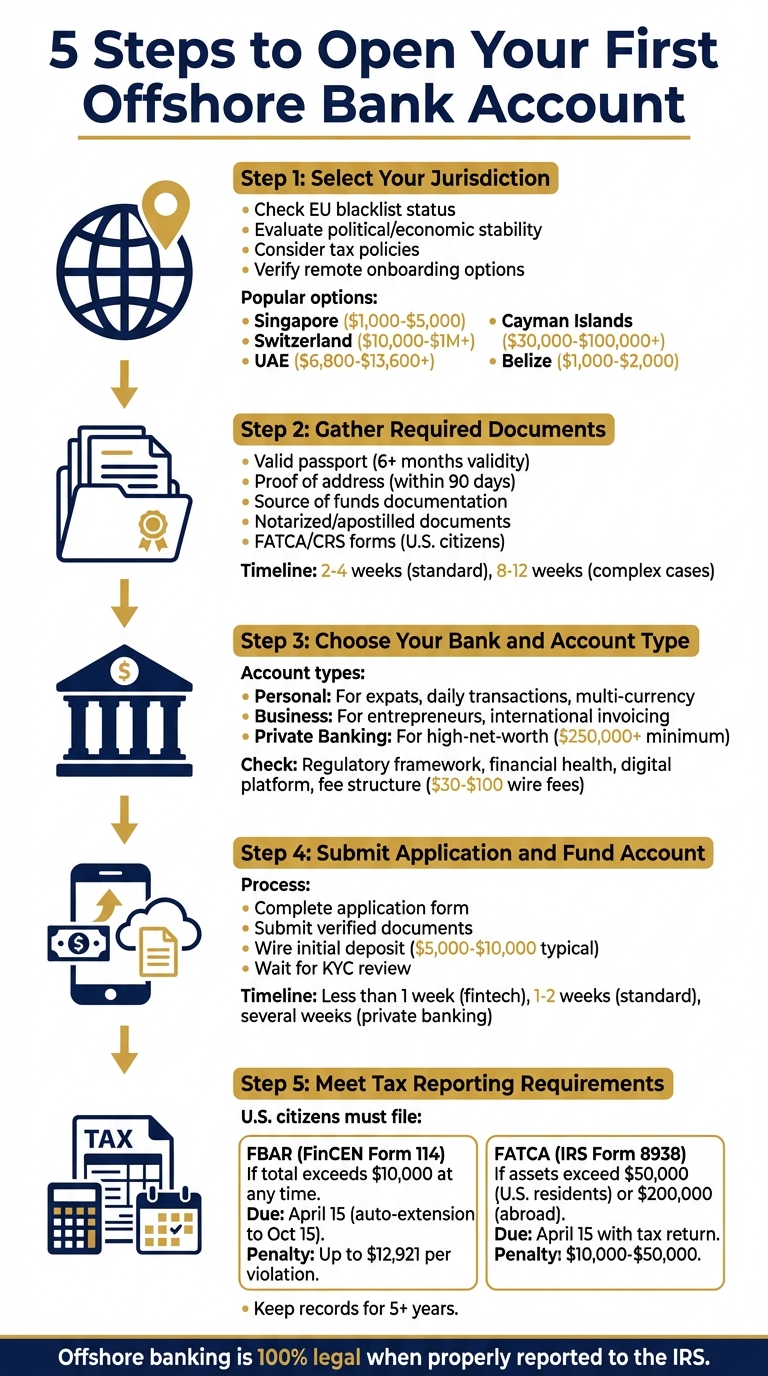
Opening an offshore account is easier than you think – and completely legal if you follow the rules. Here’s how to get started:
- What is an offshore account? A bank account outside your home country, offering benefits like multi-currency options, asset protection, and global investment opportunities.
- Is it legal? Yes, as long as you report it to the IRS (via FBAR and FATCA) and avoid tax evasion or money laundering.
- Why open one? To diversify assets, protect against local economic risks, and simplify international transactions.
Steps to Open an Offshore Account:
- Choose a jurisdiction: Look for stable economies like Switzerland, Singapore, or Belize.
- Prepare documents: Passport, proof of address, and source of funds are required.
- Pick your bank and account type: Options range from personal accounts to structuring offshore trusts for asset protection, with minimum deposits starting as low as $1,000.
- Submit your application: Complete forms, provide documentation, and fund your account via wire transfer.
- Report to the IRS: File FBAR (if accounts total over $10,000) and FATCA (if assets exceed $50,000).
Key takeaway: Offshore accounts are a legal tool for financial flexibility, but compliance with U.S. tax laws is mandatory to avoid penalties.
What Is Offshore Banking and Is It Legal?
Understanding the legal framework of offshore banking is essential for safeguarding your assets and avoiding potential pitfalls.
Offshore banking, despite its portrayal in outdated stereotypes, is completely legal – as long as it’s not used for tax evasion, hiding assets, or money laundering. When accounts are established for legitimate purposes and properly reported to the IRS, they remain within legal boundaries. The confusion often stems from high-profile cases of tax evasion in the past, but the reality is straightforward: offshore banking only crosses into illegal territory when it’s used to break the law.
"Offshore banking is legal when created for legitimate reasons, such as diversifying investments, protecting your money from potential economic instability, or making international transactions easier." – Investopedia
Offshore accounts offer features you might not find in domestic banking. For example, they allow multi-currency holdings (like USD, EUR, or CHF) and rely on international wire transfers, which typically cost between $30 and $100 per transaction. Additionally, many offshore jurisdictions provide stronger legal protections and greater privacy than U.S. banks.
Legal Uses of Offshore Accounts
Offshore accounts are often used for legitimate purposes like asset protection, currency diversification, and simplifying international transactions for expats or global businesses. Holding funds in currencies such as Swiss francs, euros, or Singapore dollars can help hedge against inflation or domestic currency devaluation. While illegal activities make up an estimated 2–5% of global GDP (roughly $2 trillion), the majority of offshore banking is entirely lawful.
Legal Requirements You Need to Know
If you’re a U.S. citizen, you’re required to report all worldwide income – including interest, dividends, and capital gains earned from offshore accounts – on your tax return. Two key reporting obligations apply here: FBAR (Foreign Bank Account Report) and FATCA requirements for asset protection.
| Requirement | FBAR (FinCEN Form 114) | FATCA (IRS Form 8938) |
|---|---|---|
| Threshold | Over $10,000 aggregate at any time | Over $50,000 (U.S. residents) / $200,000 (abroad) |
| Where to File | FinCEN (Treasury Department) | IRS (attached to tax return) |
| Purpose | Reporting foreign financial accounts | Reporting specified foreign financial assets |
Non-compliance comes with steep penalties – up to $10,000 per non-willful violation, with much harsher consequences for intentional concealment. Moreover, most reputable offshore banks now automatically report U.S. clients’ account details to the IRS under FATCA agreements, making non-disclosure both risky and ineffective.
"The days of using offshore accounts to evade taxes are long gone for Americans… Today, offshore accounts serve completely different purposes." – The Nestmann Group
Transparency is critical. You must inform foreign banks of your U.S. citizenship status; failing to do so could be seen as fraudulent behavior. Major banking jurisdictions now operate under stricter transparency standards.
With the legal groundwork covered, the next step is choosing the best offshore banking jurisdiction for your account.
sbb-itb-39d39a6
Step 1: Select Your Jurisdiction
Picking the right jurisdiction for your offshore account is a crucial step. It influences everything from deposit requirements to how well your assets are safeguarded. With over $7 trillion held in offshore accounts worldwide, the choices can seem daunting. However, your decision should align with your specific financial goals.
How to Evaluate a Jurisdiction
The first thing to check is whether the country is on the EU’s blacklist of non-cooperative jurisdictions. Banks in these regions often face hurdles with payment providers and global partners, which could complicate your transactions. Beyond reputation, look for political and economic stability – countries with reliable legal systems and stable currencies like the Swiss franc (CHF) or Singapore dollar (SGD) are good options.
Tax policies are another key factor. Some jurisdictions only tax income earned within their borders (territorial tax system), while others impose no corporate or income taxes at all. If traveling isn’t an option, focus on locations that offer remote onboarding, often through digital banks or fintech platforms. Lastly, consider deposit insurance limits. For example, Singapore’s SDIC protects up to SGD 75,000 (about $56,000), while Hong Kong insures up to HKD 500,000 (approximately $64,000).
"The key distinction of modern offshore banking isn’t privacy – it’s financial sophistication and regulatory efficiency." – Project Blackledger
By keeping these considerations in mind, you can narrow down jurisdictions that align with your financial strategy.
Top Offshore Banking Locations
Singapore is a top choice for business operations, offering excellent infrastructure under the regulation of the Monetary Authority of Singapore (MAS). Traditional banks here require minimum deposits of SGD 1,000–$5,000, but fintech options often have no minimum requirement. Switzerland remains a trusted option for wealth management, though opening an account typically requires deposits ranging from $10,000 to over $1,000,000, depending on the institution.
For tax advantages, the UAE (Dubai and Abu Dhabi) offers zero-tax banking, with minimum deposits starting at AED 25,000 ($6,800) and going up to AED 50,000+ ($13,600). The Cayman Islands specialize in private banking and investment funds, with initial deposits ranging from $30,000 to $100,000 or more. For those with smaller budgets, Belize is an affordable and remote-friendly option, requiring only $1,000–$2,000 to get started.
| Jurisdiction | Best For | Typical Minimum Deposit | Remote Opening |
|---|---|---|---|
| Singapore | Global business & stability | $1,000–$5,000 (or $0 via fintech) | Yes, via fintech |
| Switzerland | Wealth management | $10,000–$1,000,000+ | Rare (usually in-person) |
| UAE | Zero-tax entrepreneurs | $6,800–$13,600+ | Medium (often in-person) |
| Cayman Islands | Investment funds | $30,000–$100,000+ | Available via agents |
| Belize | Low-cost & crypto | $1,000–$2,000 | High (remote-friendly) |
Choose your jurisdiction based on your needs: Singapore for active business dealings, Switzerland for long-term wealth preservation, and Belize or Mauritius for quick, remote account setups. Before finalizing your choice, consult a tax professional to ensure compliance with reporting obligations like FBAR or the Common Reporting Standard.
Step 2: Gather Required Documents
Once you’ve chosen your jurisdiction, the next step is to pull together all the necessary paperwork. Offshore banks are known for their strict compliance protocols, so having your documents in order can save you a lot of time and hassle. Generally, you’ll need to prepare documents in three main categories: identity verification, proof of residency, and evidence of the source of funds. These are the essentials most institutions will ask for.
ID and Address Verification
Start with a valid passport (make sure it has at least six months before expiration) and, if possible, a secondary government-issued ID like a driver’s license. Both documents should be submitted as clear color copies. For address verification, you’ll need something dated within the last 90 days – think utility bills, bank statements, or official government correspondence that clearly display your full name and residential address.
To ensure everything is accepted, get your documents either notarized or authenticated with an apostille. If your documents aren’t in English, certified translations will also be required. Some modern financial technology providers simplify this process by offering Video KYC (Know Your Customer), where you can verify your identity through a secure video call instead of submitting physical copies.
Once your identity and address are confirmed, the next step is proving where your funds come from.
Proof of Source of Funds
Banks are required to document the origin of your funds to comply with anti-money laundering laws. You’ll need to provide evidence for both the specific Source of Funds (SOF) for your deposit and, if requested, your overall Source of Wealth (SOW). This might include recent payslips, bank statements, audited financial records for business income, or legal documents tied to property sales, inheritances, or other transactions.
To strengthen your case, include third-party verification. For example, contracts, letters from accountants, or other documentation from regulated professionals can substantiate your claims. Banks typically prefer documents issued by independent and qualified sources.
Finally, make sure to complete any regulatory forms required by the bank to demonstrate compliance.
Other Compliance Documents
If you’re a U.S. citizen, you’ll also need to provide your SSN or TIN and complete FATCA/CRS self-certification forms, which facilitate the automatic exchange of tax information between authorities. Additionally, many offshore banks may ask for a reference letter from your current bank. This is usually supported by six to twelve months of account statements to confirm your banking history is in good standing.
For business accounts, the requirements are more extensive. You’ll need to provide documents like the Certificate of Incorporation, business licenses, shareholder registers, and a company structure diagram. Established companies may also need to submit a Letter of Good Standing to confirm compliance with local regulations and the absence of outstanding liabilities.
The entire verification process typically takes between 2–4 weeks, but for more complicated cases, it can stretch to 8–12 weeks. Proper preparation can help keep things moving smoothly.
Step 3: Choose Your Bank and Account Type
Once you’ve gathered your documents, it’s time to pick a bank and account type that fits your financial plans. Offshore banks vary widely in terms of fees, service quality, and deposit requirements. Some cater to everyday users with minimum deposits starting at $5,000, while private banks often set the bar at $250,000 or higher.
How to Evaluate Banks
Start by looking into the regulatory framework of the bank’s jurisdiction. A strong regulator plays a critical role in licensing, supervising, and enforcing compliance among financial institutions. Make sure the regulator’s reputation is recognized internationally rather than being self-proclaimed.
Next, assess the bank’s financial health. Look at how it performed during economic downturns and review its liquidity ratios. It’s also crucial to ensure the bank adheres to international compliance standards like Anti-Money Laundering (AML), Know Your Customer (KYC), and tax reporting systems such as FATCA or CRS.
Check the bank’s digital platform for ease of use and robust security measures, like multi-factor authentication. Multi-currency support (USD, EUR, GBP, CHF) under a single account is another key feature to consider – it can help you manage currency risks and cut down on exchange fees.
Pay close attention to fee structures. Maintenance fees can range from $0 to over $1,000, and international wire transfers typically cost $30–$100. Be mindful of hidden costs, including foreign exchange spreads, transaction limits, and inactivity fees. Also, ensure customer support is available in a language you’re comfortable with to avoid communication issues during urgent situations.
After confirming the bank’s credibility and digital features, focus on choosing the right account type for your goals. For a deeper dive into specific institutions and jurisdictions, consult our offshore banking report.
Personal vs. Business vs. Private Banking Accounts
The account type you choose should align with your financial priorities.
- Personal Accounts
These accounts are ideal for individuals, expats, and digital nomads who need flexible options for daily transactions and multiple currencies. They’re great for handling salary payments, travel expenses, or building savings in stable currencies. - Business Accounts
Tailored for entrepreneurs, trading firms, and companies, these accounts support international invoicing, vendor payments, and payroll. Opening one requires more documentation, such as proof of incorporation and business licenses, along with clear records of payment flows. - Private Banking Accounts
Designed for high-net-worth individuals, private banking offers wealth management services and requires deposits of $250,000 or more. Benefits include personalized portfolio management, custody services, and access to global markets.
"By defining the primary purpose of having the offshore account, it’s easier to focus on institutions that can help you meet that goal" – Luigi Wewege, Senior Vice President and Head of Private Banking at Caye International Bank
Consider your liquidity needs when choosing between account types. Checking or demand deposit accounts allow instant access to funds, while term deposits offer fixed returns if you’re able to lock in your money for one to five years. Lastly, factor in the political and economic stability of the bank’s jurisdiction to safeguard your assets from local risks like government overreach or economic instability.
Step 4: Submit Your Application and Fund Your Account
Now it’s time to submit your application and activate your account. This step involves sending in all required documents, funding your account via an international wire transfer, and waiting while the bank verifies your information.
How to Complete Your Application
Use the verification documents you’ve prepared to make this process smoother. Most offshore banks provide an application form that requires detailed information about your identity, financial history, and the purpose of the account. You’ll typically need to submit:
- A valid passport
- A secondary government-issued ID (like a driver’s license)
- Proof of residence (such as a recent utility bill or bank statement)
Additionally, banks often ask for a reference letter from your current bank and 6–12 months of bank statements. You’ll also need to verify your source of funds. This could mean providing wage slips, tax returns from the past 1–3 years, investment statements, or inheritance documents.
If you’re setting up a business account, there’s extra paperwork involved. Be ready to provide:
- Certificate of Incorporation
- Articles of Association
- A business plan
- Company structure chart
- Letter of Good Standing (if your company has been active for over a year)
Don’t forget to complete any required tax compliance forms. Some jurisdictions may also require an apostille stamp, which is an international certification to authenticate your documents. In certain cases – especially in places like Switzerland or Singapore – the bank might request a video call or even an in-person meeting to confirm your identity and the purpose of the account. Being upfront about your account’s purpose and the source of your funds is crucial to avoid delays or rejection during the bank’s due diligence process.
"Choose a jurisdiction that aligns with your business model, risk tolerance, and need for access." – Nestor Garcia, Head of Company Creation Services, Statrys
Once everything is in place, you’ll move on to funding your account.
Making Your First Deposit
After your application is approved, the bank will send you your account details along with wiring instructions. You’ll need to fund your account using an international wire transfer from an account in your name. Be sure that your deposit meets the minimum amount required to activate your account. Wire fees typically range from $30 to $100 per transaction, so factor that into your costs.
Banks usually set a specific deadline for completing your initial deposit. Missing this deadline could result in your account being deactivated, so it’s important to act quickly.
The initial deposit requirements vary depending on the jurisdiction and type of account. For example:
- Offshore accounts generally require $5,000–$10,000 to start.
- Private banking accounts often have much higher minimums, starting at $100,000 or more.
- Some Swiss banks require at least $10,000 as an initial deposit.
"Offshore bank accounts are most often funded electronically through international wire transfers." – Investopedia
Once the funds are transferred, the bank will review your deposit and move forward with the final steps of the activation process.
Application Review Timeline
The time it takes for your application to be reviewed depends on the type of provider and the complexity of your case. Here’s a general breakdown:
| Provider Type | Typical Review Timeline | Activation Requirement |
|---|---|---|
| Fintech / Digital Provider | Less than 1 week | Initial deposit |
| Standard Offshore Bank | 1–2 weeks | Initial deposit |
| Complex / Private Banking | Several weeks | Initial deposit and successful KYC |
The review process usually takes 1–2 weeks once all verified documents are submitted. However, complex cases or traditional banks might take longer, while fintech providers are often quicker, sometimes completing the process in under a week.
Your account won’t be fully activated until the bank receives and verifies your initial deposit. During this time, the bank will perform strict "Know Your Customer" (KYC) checks, which may include detailed questions about your planned transactions and business activities. Once the funds are confirmed and the compliance review is complete, your account will be activated. At this stage, you may also receive tools like a digital signature device or a secure mobile app for managing transactions.
"Once the forms are verified, they are submitted to the bank, with the account opening process typically taking 1–2 weeks." – Alpen Partners
Step 5: Meet Tax Reporting Requirements
Once you’ve set up and funded your offshore account, the next essential step is addressing U.S. tax reporting obligations. Having an offshore account doesn’t free you from U.S. tax responsibilities. You’re still required to report your global income and disclose foreign accounts to the IRS and FinCEN. Failure to comply can lead to severe penalties. Here’s what you need to know about the forms and deadlines involved.
U.S. Tax Reporting Requirements
If you’re a U.S. citizen or resident, there are two key forms you’ll need to file if your offshore accounts surpass specific thresholds:
- FBAR (FinCEN Form 114): This form is required if the total value of all your foreign financial accounts exceeds $10,000 at any point during the calendar year. These accounts can include bank accounts, brokerage accounts, and mutual funds. FBAR must be filed electronically through the FinCEN BSA E-Filing System, separate from your tax return.
"The law requires U.S. persons to report their overseas financial accounts because foreign financial institutions may not be subject to the same reporting requirements as domestic institutions." – Internal Revenue Service
- FATCA (IRS Form 8938): This applies to foreign financial assets that go beyond certain thresholds. For single filers living in the U.S., the threshold is $50,000 on the last day of the tax year or $75,000 at any time during the year. If you live abroad, the thresholds increase to $200,000 and $300,000, respectively. Unlike FBAR, Form 8938 is submitted with your annual federal income tax return and covers a broader range of assets, such as foreign stocks, bonds, and interests in foreign entities.
Deadlines and Penalties:
- FBAR: Due by April 15, with an automatic extension to October 15. Penalties for not filing can reach $12,921 per violation for non-willful failure, while willful violations may result in the greater of $100,000 or 50% of the account balance.
- FATCA: Submitted with your annual tax return by April 15. Failure to file Form 8938 carries a $10,000 penalty, with additional fines up to $50,000 for continued non-compliance after IRS notification. Criminal violations can lead to fines and up to five years in prison.
Keep Detailed Records
Maintaining accurate records is critical for staying compliant with these reporting requirements. You’re required to keep documentation for at least five years from the FBAR due date. These records should include:
- Account holder names
- Account numbers
- Names and addresses of foreign banks
- Account types
- Maximum balances during the reporting period
To simplify tracking, save quarterly statements to monitor the highest balance during the year. When converting foreign currency to U.S. dollars, use the Treasury Bureau of the Fiscal Service’s last-day exchange rate. Keep copies of all filed FBARs and Forms 8938, along with supporting documents like bank statements and proof of funds. These records will be invaluable in case of IRS inquiries or audits.
Conclusion
By following the steps outlined earlier, you’re ready to start your offshore banking journey with confidence.
To open your first offshore account, focus on selecting a stable jurisdiction, gathering the necessary documents, choosing a reliable bank, completing the application process, and adhering to U.S. tax reporting obligations. A critical part of this process is ensuring compliance with U.S. tax reporting requirements, including filing FBAR and FATCA forms, to avoid hefty penalties.
Today’s offshore banking is about creating legitimate financial flexibility within a well-regulated framework. As Q Wealth Report explains, "Offshore banking in 2026 has very little to do with hiding money or slipping under the radar. Banks operate in a tightly regulated environment and take compliance seriously". Transparency with both your bank and the IRS is essential for long-term success.
Working with experienced tax professionals and international banking advisors can help you navigate complex reporting rules and maintain compliance. This support is especially crucial for U.S. citizens, who face strict reporting standards that can be challenging for some foreign banks to manage.
Keep meticulous records and provide clear documentation of your funds’ origins to meet reporting deadlines. When managed properly, an offshore account can be a valuable tool for currency diversification, asset protection, and expanding international business operations – all while staying within the bounds of the law.
The formula for successful offshore banking is straightforward: make informed choices, maintain thorough documentation, report accurately, and seek expert advice when needed. With proper planning and adherence to regulations, your offshore account can offer security and global financial access, underscoring the importance of a thoughtful, compliant approach in today’s regulated financial landscape.
FAQs
Which offshore country is best for my situation?
When choosing the best offshore country, your priorities – like asset protection, tax advantages, privacy, or accessibility – play a key role. For those with high deposits (over $250,000), countries like Switzerland, Luxembourg, and Liechtenstein are appealing due to their financial stability and established banking systems. On the other hand, if you’re dealing with smaller deposits, options such as Belize, the Cook Islands, and various Caribbean nations often provide more accessible solutions.
It’s crucial to weigh factors like the size of your deposit, your privacy requirements, and any legal considerations. Consulting with a professional can help you navigate these choices and find the jurisdiction that aligns best with your financial goals.
What can cause my application to be rejected?
Your offshore bank account application might face rejection for several reasons, such as:
- Incomplete or inaccurate documentation: Submitting paperwork that’s missing key details or contains errors is a common stumbling block.
- Unclear source of funds: Banks need clear evidence of where your money originates to meet compliance standards.
- Applying in the wrong jurisdiction: Choosing a country that doesn’t align with your financial goals or needs can lead to complications.
- Lack of business activity: Banks tend to avoid accounts linked to shell companies with no genuine operations.
- Inconsistent information: Any mismatches or irregularities in your application or background can trigger concerns.
Paying close attention to these factors can help improve your chances of a successful application.
How do I track the max account balance for FBAR?
To determine the maximum account balance for FBAR reporting, you need to identify the highest value your foreign account reached during the calendar year. Use account statements or financial tracking tools to record balances and pinpoint the peak amount. FBAR (FinCEN Form 114) reporting is mandatory if the combined total of all your foreign accounts exceeds $10,000 at any time during the year. Keeping thorough records helps ensure you meet these reporting requirements.
