
Overseas investment scams are becoming more sophisticated, targeting unsuspecting individuals with promises of high returns and low risks. These scams often rely on high-pressure tactics, unregistered firms, and fake guarantees. Here’s what you need to know to protect yourself:
- Red Flags:
- Guaranteed profits with no risk.
- Unregistered companies or promoters.
- High-pressure sales tactics and unsolicited contact.
- Lack of audited financial records or transparency.
- How to Protect Yourself:
- Verify company registration with tools like the SEC‘s EDGAR system or FINRA‘s BrokerCheck.
- Research the company’s history and reputation, checking for past regulatory issues.
- Understand the legal environment of the investment’s home country and potential risks.
- Carefully review all investment documents for inconsistencies or vague details.
- Key Tools:
Avoid rushed decisions, verify every claim, and never send money without thorough research. If it seems too good to be true, it probably is.
Red Flags That Signal Potential Investment Scams
Spotting warning signs early can protect both your wallet and your personal information. Scammers often stick to predictable tactics, and recognizing these patterns can help you steer clear of fraudulent schemes. Below are some common red flags that can help you identify potential scams.
Guaranteed High Returns with Little or No Risk
Every legitimate investment carries some level of risk. If someone promises "guaranteed" profits or claims an opportunity is completely "risk-free", it’s a major red flag. As Investor.gov puts it:
"There’s no such thing as high guaranteed investment returns, and every investment involves risk." – Investor.gov
Market conditions naturally affect legitimate investments, so be wary of any offer that guarantees steady, positive returns no matter what. Phrases like "incredible gains", "breakout stock pick", or "huge upside with no risk" should immediately trigger skepticism.
Unregistered Companies and Promoters
A common tactic among scammers is operating through unregistered firms or unlicensed individuals. Registration with the SEC or state regulators gives you access to crucial information about a company’s management, financials, and track record. As Investor.gov warns:
"Never invest your money with someone who is not licensed and registered." – Investor.gov
You can verify a company’s or promoter’s registration using tools like Investor.gov or the SEC’s EDGAR database. If someone claims their "private" or "exclusive" status exempts them from registration, consider it a warning sign.
High-Pressure Sales Tactics and Unexpected Contact
Scammers often create a false sense of urgency to push you into making hasty decisions. Claims like "once-in-a-lifetime opportunity" or "limited time only" are designed to pressure you into acting without proper research. This fear-of-missing-out tactic is a hallmark of fraudulent schemes.
Be extra cautious if you receive unsolicited investment offers through social media, text messages, or unexpected emails. Legitimate investment professionals don’t cold-call or randomly message people with pitches. Always take the time to research thoroughly before committing any money.
Missing or Unverified Financial Records
Transparency is key when evaluating any investment. Legitimate companies provide audited financial statements, detailed business plans, and clear explanations of how they generate revenue. If a promoter can’t – or won’t – provide these materials, or tells you the investment is "too technical" or "complex" to explain, it’s best to walk away.
Look out for inconsistencies in account statements, vague profit strategies, or difficulties withdrawing your money. Ponzi schemes, for example, often unravel under the pressure of withdrawal requests. Always verify financial information through official channels like the SEC’s EDGAR system, rather than relying solely on promotional claims. Reliable, independently audited documentation is essential for making informed decisions.
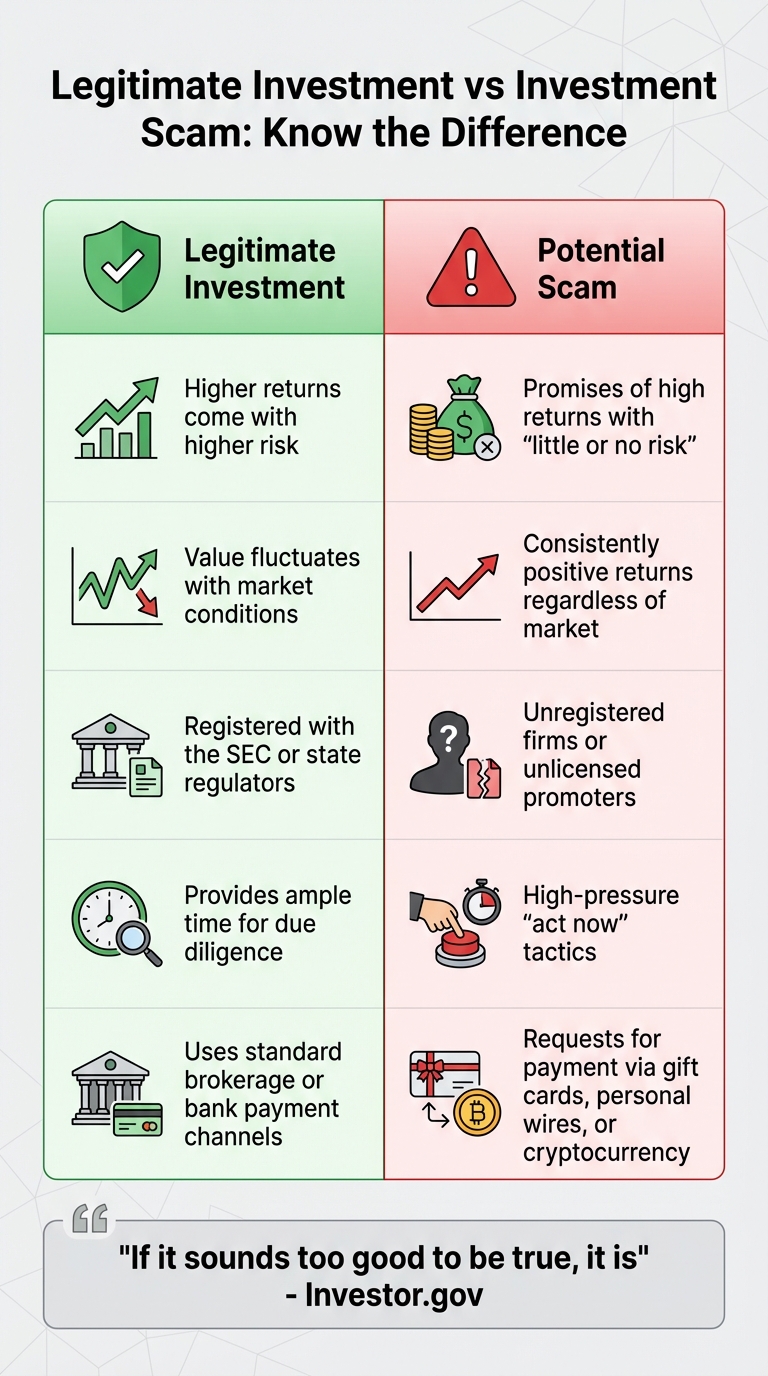
| Legitimate Investment | Potential Scam |
|---|---|
| Higher returns come with higher risk | Promises of high returns with "little or no risk" |
| Value fluctuates with market conditions | Consistently positive returns regardless of market |
| Registered with the SEC or state regulators | Unregistered firms or unlicensed promoters |
| Provides ample time for due diligence | High-pressure "act now" tactics |
| Uses standard brokerage or bank payment channels | Requests for payment via gift cards, personal wires, or cryptocurrency |
sbb-itb-39d39a6
How to Perform Due Diligence on Overseas Investments
Once you’ve identified potential red flags, it’s time to dive deeper into any overseas investment opportunity. A systematic verification process is essential to ensure you’re making informed decisions. Here’s how to tackle this step-by-step.
Check Registration with Financial Authorities
Start by confirming the company’s registration with official regulatory bodies. Use trusted databases like the SEC’s EDGAR system to access corporate filings, registration statements, and financial reports. Tools like FINRA’s BrokerCheck and the SEC’s Investment Adviser Public Disclosure (IAPD) database can help you verify licenses and check for any disciplinary actions involving brokers or firms.
If the company claims exemption from registration, make sure it’s legitimate. For instance, some offerings may qualify for exemptions under Regulation D. For investments tied to futures or commodities, the National Futures Association’s BASIC tool is a reliable resource for verifying registration and membership. You can also reach out to your state securities regulator for additional insights about the company or the investment opportunity.
Be cautious of impersonation scams, where fraudsters might misuse the credentials of real, registered professionals. Always cross-check the seller’s claims against official records. As FINRA points out:
"Registration with the SEC doesn’t guarantee that an investment will be a good one or immune to fraud. Likewise, lack of registration doesn’t automatically mean the investment lacks legitimacy."
Here’s a quick reference table for commonly used tools:
| Tool | Regulatory Body | Purpose |
|---|---|---|
| EDGAR | SEC | Research corporate filings, registration statements, and financial data |
| BrokerCheck | FINRA | Verify registration and background of brokers and brokerage firms |
| IAPD | SEC/State Regulators | Check investment advisers’ registration and disciplinary history |
| BASIC | NFA/CFTC | Confirm registration for commodities and futures professionals |
Research the Company’s History and Reputation
Dig into the company’s background to uncover any potential red flags. Use tools like BrokerCheck to investigate their history, and review Form ADV for details on business practices, fee structures, and any past regulatory troubles. Disclosure events, such as regulatory actions or customer disputes, can be significant warning signs.
The SEC’s Action Lookup Tool is another valuable resource for identifying individuals or firms with a history of regulatory penalties. Additionally, state securities regulators may have information not available in federal databases. As Investor.gov advises:
"Fraudsters are counting on you not to investigate before you invest. Fend them off by doing your own digging."
If you’re working with a brokerage firm, confirm their membership with the Securities Investor Protection Corporation (SIPC). SIPC membership provides limited protection if the firm goes bankrupt. Be wary of firms that are heavily promoted on internet forums or through unsolicited emails, especially if you can’t verify their financial information from independent sources.
Review Local Laws and Jurisdiction Risks
Understanding the legal environment in the investment’s home country is crucial. Different countries offer varying levels of investor protection and regulatory oversight. If something goes wrong, recovering your funds can be far more difficult with an overseas investment, especially given the jurisdictional challenges flagged earlier.
Be particularly cautious with unsolicited offers from foreign entities. As Investor.gov highlights, tracing funds or investigating fraud becomes much harder once money leaves the U.S. Check whether the foreign country has cooperative agreements with U.S. regulators, and consider your legal options in case of fraud. Consulting an attorney with expertise in international investment law can provide additional clarity.
Examine All Investment Documents Carefully
Scrutinize every document associated with the investment, as promotional materials can often be misleading. Use official sources like the SEC’s EDGAR system to verify corporate filings and financial statements. Pay close attention to the prospectus, which outlines the investment’s objectives, strategies, risks, and performance history.
Look carefully at the fee structure, as high fees can erode your returns over time. Regularly review filings like annual 10-K reports and current 8-K updates for critical financial details and business descriptions.
Finally, compare the promised returns to well-known stock indexes. If the returns seem excessively high with little to no risk, treat it as a red flag. Be skeptical of claims that the investment is "too technical" or "too complex" to explain – this is often a tactic used to distract from underlying risks.
Tools and Resources for Verifying Investment Legitimacy
Free Government and Industry Verification Tools
You can verify overseas investments without spending a dime by leveraging government and industry databases. These tools are a great addition to earlier advice about checking registrations and company history. For example, FINRA’s Fund Analyzer allows you to compare mutual funds, ETFs, and ETNs in detail. If you’re looking into municipal securities or 529 college savings plans, EMMA (Electronic Municipal Market Access) is the go-to source for disclosures and market data. It’s also wise to confirm SIPC membership online to ensure limited protection in case a firm becomes insolvent. And if you’re still unsure about an investment, state securities regulators – accessible through NASAA – can provide additional details.
If these tools leave you with unanswered questions or if the investment seems overly complicated, it’s time to consider professional guidance.
When to Hire Professional Advisors
After using free tools, assess whether the investment’s complexity requires expert evaluation. Hiring professional advisors can be particularly helpful for offshore investments in foreign jurisdictions, where uncovering fraud and recovering funds can be extremely challenging. The SEC emphasizes this point:
"When you send your money abroad, and something goes wrong, it’s more difficult to find out what happened and to locate your money".
Emerging technologies like cryptocurrency or AI are also frequent targets for scams, so seeking professional advice when evaluating these investments is a smart move. A lack of current, independent financial information about a company is another red flag that signals the need for expert help.
Before hiring an advisor, make sure they are licensed to sell securities in your state. Use official databases to check their disciplinary history. And don’t just take a promoter’s word for it – verify their claims independently or hire a neutral third party to do so.
Assessing Risk and Diversifying Your Investments
How to Tell Legitimate Investments from Scams
Recognizing genuine investment opportunities is key to safeguarding your money. Legitimate investments don’t promise guaranteed high returns. Instead, they fluctuate with the market, and higher potential rewards always come with higher risks. As the U.S. Securities and Exchange Commission puts it:
"Every investment carries some degree of risk, which is reflected in the rate of return you can expect to receive."
When evaluating overseas investment opportunities, compare them to market indexes to determine if the returns being promised are realistic. Be cautious about offers that claim absolute safety or fixed returns – they’re often a red flag. Legitimate investments give you time to conduct thorough research. Additionally, how payments are handled can reveal a lot. Standard banking methods are a good sign, but requests for payment via credit cards, gift cards, or overseas wire transfers to individuals should raise immediate concerns. These steps are essential for avoiding scams and building a secure investment strategy.
Diversify Across Verified Investments
Once you’ve confirmed an investment is legitimate, spreading your money across multiple options is a smart way to manage risk. U.S.-registered mutual funds and ETFs are great examples – they offer international exposure while staying under U.S. regulatory oversight. Diversification can include a mix of:
- Global funds: Combine U.S. and foreign holdings.
- International funds: Focus solely on non-U.S. investments.
- Regional or country-specific funds: Target specific areas or nations.
- International index funds: Track non-U.S. market indexes.
Another option is investing in American Depositary Receipts (ADRs), which allow you to buy foreign stocks through U.S. exchanges under regulated conditions.
Keep in mind, foreign investments come with unique challenges. Currency fluctuations, liquidity concerns, and limited legal protections can all impact your returns . It’s also crucial to monitor your account statements regularly for unauthorized transactions or unexpected changes to your personal details. By staying vigilant and informed, you can better protect your investments while exploring opportunities globally.
Conclusion
Protecting yourself from overseas investment scams starts with thorough research and resisting rushed decisions. The most effective safeguard is independent verification before you part with any money. Leverage free tools like the SEC’s EDGAR system and FINRA’s BrokerCheck to confirm that both companies and advisors are properly registered and free of disciplinary issues. As highlighted earlier, careful document review and detailed research are crucial steps.
It’s important to remember that all legitimate investments carry some level of risk. Be wary of anyone promising guaranteed profits or pressuring you to act quickly. As Investor.gov wisely states:
If it sounds too good to be true, it is.
Take your time. Ask pointed questions. Insist on receiving written documentation that you can examine thoroughly. This approach is essential for navigating the complexities of international investments.
Overseas investments, while potentially rewarding, come with significant risks. Recovering money lost in foreign schemes is particularly difficult, as the U.S. Securities and Exchange Commission notes. Once funds are sent overseas, tracing them and recovering losses becomes a daunting task. Even if you secure a favorable U.S. court judgment, enforcement in another country may be impossible.
If you come across red flags – such as unregistered brokers or requests for payment via gift cards or wire transfers – report the activity immediately to the SEC, FINRA, or your state securities regulator. By staying alert, verifying every claim, and exercising patience, you not only protect your assets but also strengthen the secure investment practices discussed throughout this guide.
FAQs
How can I confirm if an overseas investment company is legitimate?
To determine whether an overseas investment company is legitimate, the first step is to verify its registration with the relevant regulatory authorities. Look up its licensing details and cross-check them with reliable sources, such as government agencies or financial regulators. This ensures the company is recognized and operates within the legal framework of its country.
Additionally, stay alert for potential red flags. These might include guarantees of unrealistically high returns, aggressive sales tactics, or a lack of clear information about their operations. Dedicating time to thoroughly investigate the company can safeguard your investments and help you make well-informed choices.
What are the warning signs of an overseas investment scam?
Be wary of guarantees of high returns with little to no risk – real investments always come with some level of uncertainty. Scammers often rely on high-pressure tactics, pushing you to act fast before a so-called "exclusive" opportunity vanishes. Be skeptical of unverified credentials or people posing as professionals without proper licensing. If an offer sounds too good to be true, like promises of "guaranteed" profits or "risk-free" investments, it likely is. Take the time to do your homework, and trust your gut if something doesn’t feel right.
Why is it so difficult to recover money lost to overseas investment scams?
Recovering money lost to overseas investment scams can be quite a challenge, mainly because of the tangled web of international laws and regulations. Once your funds have crossed borders, tracking where they go becomes a daunting task. On top of that, differences in legal systems can turn the pursuit of justice into a lengthy and expensive ordeal.
To make matters worse, many scammers base their operations in countries with lax enforcement or limited collaboration with U.S. authorities. This lack of cooperation adds another layer of difficulty to recovering lost funds. These hurdles highlight just how crucial it is to conduct thorough research and due diligence before diving into any overseas investment. A little caution upfront can save a lot of trouble later.
