
Looking for faster, cheaper, and more secure ways to handle global payments? SWIFT, the long-standing international payment system, is no longer the only option. Businesses today have access to alternatives that offer real-time payments, lower fees, and better privacy. Here’s a quick overview of the top SWIFT alternatives:
Key Alternatives:
- SEPA: Ideal for euro transactions in the EU.
- FedNow: Instant domestic payments in the U.S. with low costs.
- RippleNet: Blockchain-based, fast, and cost-effective for cross-border transfers.
- Wise: Transparent fees and multi-currency accounts for small to medium payments.
- Payoneer: Global payment platform with easy integration.
- Visa B2B Connect: Direct bank-to-bank transfers with same-day settlement.
- Stellar/Ethereum: Blockchain networks for decentralized payments.
- Airwallex: Multi-currency platform supporting over 180 countries.
Quick Comparison:
| System | Speed | Best For | Key Feature |
|---|---|---|---|
| SEPA | 1–2 days | Eurozone businesses | Affordable euro transfers |
| FedNow | Instant (24/7) | U.S. domestic payments | Low-cost, real-time transfers |
| RippleNet | 3–5 seconds | Cross-border payments | Blockchain efficiency |
| Wise | 0.5–2 days | SMBs with global operations | Transparent pricing |
| Payoneer | 2–3 days | Freelancers, global businesses | Easy integration |
| Visa B2B Connect | Same day | Large business transactions | Direct bank-to-bank transfers |
| Stellar/Ethereum | 2–5 seconds | Programmable, decentralized payments | Blockchain innovation |
| Airwallex | 1–2 days | Multi-currency global payments | Low FX markup |
These systems address common SWIFT issues like delays, high fees, and limited transparency. Whether you need instant payments, blockchain solutions, or multi-currency support, there’s an option tailored to your needs.
How to Choose a SWIFT Alternative
Selecting a SWIFT alternative requires careful consideration of several factors that can impact your business operations. Here’s a breakdown of what to evaluate:
Transaction Speed and Processing Time
Modern payment systems often provide near-instant or same-day settlements, unlike SWIFT’s typical processing time of 2–5 business days. Think about whether your business needs real-time payments or if next-day settlements are sufficient.
Cost Structure
Examine all associated fees to fully understand the platform’s pricing. These may include:
- Transaction fees (fixed or percentage-based)
- Currency conversion costs
- Subscription fees (monthly or annual)
- Any hidden charges
Geographic Reach
Check if the platform covers the regions and currencies your business operates in. Look into:
- Countries and regions supported
- Partnerships with local banks
- Range of supported currencies
- Adherence to local regulations
Security Features
A reliable platform should offer strong security measures, such as:
- Advanced authentication and encryption
- Fraud detection systems
- Transaction monitoring
- Clear dispute resolution processes
Technical Integration
Assess how easily the platform integrates with your existing systems. Consider:
- Availability of APIs and detailed documentation
- Complexity of integration
- Compatibility with your accounting software
- Automation options
Compliance and Reporting
Ensure the platform aligns with regulatory requirements, including:
- KYC (Know Your Customer) and AML (Anti-Money Laundering) standards
- Transaction reporting capabilities
- Access to audit trails
- Data retention policies
System Reliability
Evaluate the platform’s reliability by looking into:
- Uptime guarantees
- Customer support availability
- Service level agreements (SLAs)
| Factor | Key Considerations |
|---|---|
| Speed | Settlement times and processing speeds |
| Cost | Transaction fees, currency exchange rates |
| Coverage | Supported countries, currencies, and payment types |
| Security | Authentication, fraud prevention tools |
| Integration | API availability, software compatibility |
| Support | Response times, support channels |
The best choice will depend on your specific transaction volume and the markets you serve. For example, a platform suited for e-commerce might not meet the needs of a manufacturing supply chain. To ensure the system fits your requirements, consider running a pilot program before fully committing. This allows you to identify any potential issues and adjust accordingly.
1. SEPA: European Payment Network
SEPA simplifies euro transactions within the EU, ensuring cross-border transfers are as fast and affordable as domestic ones. This system highlights how regional efforts can transform the way cross-border payments are handled.
2. FedNow: U.S. Instant Payment System
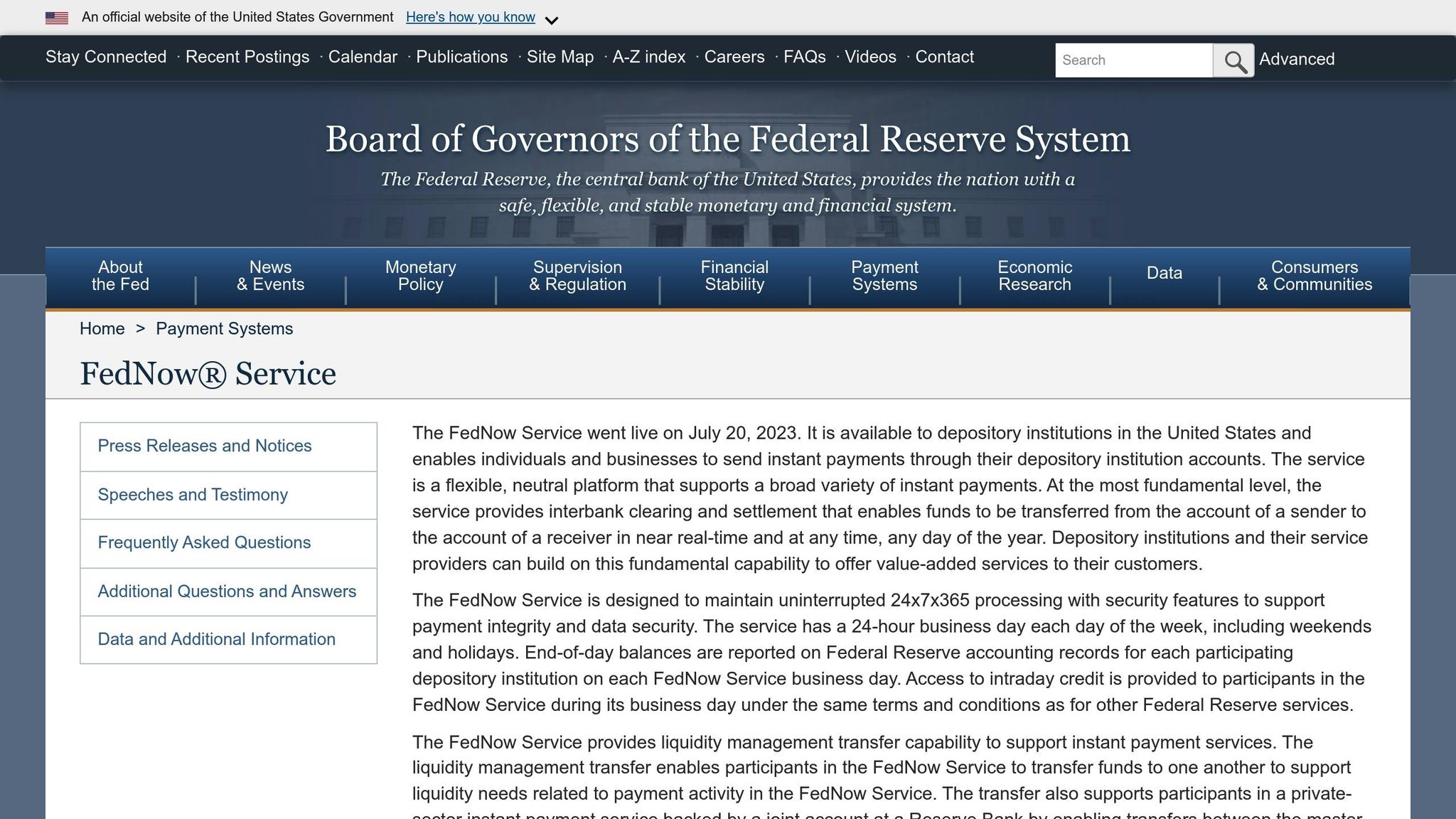
FedNow, launched in July 2023, provides U.S. businesses with instant domestic payment processing. Operating 24/7/365, it settles transactions in under 5 seconds.
This system can handle up to 5,000 transactions per second and supports transfers up to $1 million (effective 2025). Businesses benefit from its highly competitive fee structure – banks typically charge about $0.50 per transfer, a fraction of the $15–$30 cost for SWIFT payments.
Sarah Bloom Raskin, former Federal Reserve Vice Chair, explains the impact: "FedNow is reshaping how businesses manage liquidity. Companies using FedNow for domestic legs of international transactions reduce working capital needs by 18–22%."
Currently, over 350 U.S. financial institutions are on board. Major companies have also integrated FedNow into their workflows. For example, Amazon uses it for vendor payments, while Salesforce processes subscription refunds through the system.
Security and Compliance Features
FedNow prioritizes security and compliance with features like:
- AES-256 encryption via the FedLine Secure® network
- Real-time fraud detection
- Mandatory AML compliance under the Bank Secrecy Act
- No reported cyberattacks since its launch
Benefits for International Businesses
FedNow offers unique advantages for global companies operating in the U.S. For instance, ADP uses FedNow for instant U.S. payroll funding while partnering with currency exchange services for international disbursements, cutting payroll costs by 35% compared to SWIFT. Similarly, U.S.-based exporters combine FedNow with offshore banking to secure instant domestic receivables and streamline tax settlements.
The Federal Reserve anticipates 90% of U.S. banks will adopt FedNow by 2026, with current transaction volumes already surpassing $12 billion daily. Here’s a look at its cost structure:
| Feature | Cost Structure |
|---|---|
| Monthly Participation | $25 |
| Per Transaction Fee | $0.045 |
| First 2,500 Monthly Transactions | Free |
| Maximum Transfer Amount | $1 million |
Though primarily designed for domestic transfers, FedNow connects to international systems through correspondent banking.
3. RippleNet: Blockchain Payment Network
RippleNet offers a blockchain-based solution for cross-border payments, delivering fast and efficient transactions. Settlements on RippleNet take just 3–5 seconds, a stark contrast to SWIFT’s 1–5 day processing time.
Lower Costs for Global Transfers
RippleNet significantly reduces transaction costs by using On-Demand Liquidity (ODL). Each transaction costs an average of $0.0002, compared to SWIFT’s $25–$50 fees. This is achieved by eliminating the need for pre-funded accounts and leveraging XRP as a bridge currency.
Success Stories from Enterprises
Several organizations have reported impressive results with RippleNet:
| Institution | Achievements | Timeframe |
|---|---|---|
| Nium | Reduced costs by 98% for US–Philippines/Mexico transfers | Q3 2023 |
| MoneyGram | Processed $10.8B in cross-border volume with 40% lower liquidity costs | 2023 |
| SBI Remit | Enabled over $1B annually in Japan–Thailand remittances with a 47% cost reduction | 2023 |
Technical Features
RippleNet’s technical foundation includes the XRP Ledger, capable of handling 1,500 transactions per second, and RippleNet Cloud, which connects financial institutions. The On-Demand Liquidity feature ensures real-time liquidity management. Integration with existing systems is streamlined through ISO 20022 APIs, which can be implemented in just 2–4 weeks.
Security and Compliance Measures
The network employs AES-256 encryption and operates with over 150 validator nodes, requiring an 80% consensus for transactions. Automated KYC/AML checks and compliance with the FATF Travel Rule further enhance security. RippleNet supports operations in over 70 countries, offering 98% global payout coverage through its partner network. Financial institutions benefit from a revenue-sharing model, avoiding upfront costs while maintaining competitive pricing.
Practical Applications
RippleNet’s features deliver tangible results. Santander’s One Pay FX processes EUR/USD transfers across more than 10 countries in under 60 seconds, achieving a 75% cost reduction and handling 50% more volume. NCB Saudi Arabia facilitates 45% of Saudi–Malaysia trade payments, while Airwallex converts GBP to AUD in just 4 seconds.
4. Wise: Direct Currency Exchange
Wise simplifies international money transfers, offering faster alternatives to traditional systems. With 60% of transfers completed instantly and 90% finalized within 24 hours, it’s a much quicker option compared to SWIFT.
Transparent Fee Model
| Transfer Amount (USD) | Fixed Fee | Variable Rate | Total Cost Example |
|---|---|---|---|
| $1,000 → EUR | $7.00 | 0.40% | $10.96 |
| $10,000 → EUR | $4.14 | 0.33% | $37.14 |
| $100,000+ → EUR | $4.14 | 0.17% | $174.14 |
Businesses transferring more than $100,000 per month benefit from volume discounts, with conversion fees dropping to 0.17%. Wise also supports a wide range of currencies, making it an excellent choice for companies with global operations.
Multi-Currency Business Solutions
Wise business accounts support over 40 currencies and provide local banking details in 10 major currencies. This allows businesses to:
- Receive EUR payments through SEPA
- Accept GBP via Faster Payments
- Process USD using ACH without SWIFT codes
- Automatically convert balances at mid-market rates
This functionality makes Wise a practical alternative to SWIFT for international payments.
Integration Capabilities
Wise also integrates seamlessly with other systems to automate international transactions. For example, N26 Bank’s 2022 Wise API integration reduced transfer times from 3 days to just 4 hours and cut fees by 62%.
Security and Compliance
Wise prioritizes security with features like:
- Mandatory two-factor authentication (2FA) for API access
- TLS 1.2 encryption protocols
- Real-time sanctions screening
- SOC 2 Type II compliance certification
- Money services business (MSB) licenses in all 50 U.S. states
Real-World Impact
"We processed $4.2M in cross-border payroll through Wise API in Q1 2024, with a 99.7% payment success rate", shared tech startup Deel in the Pipedream Integration Report 2024.
E-commerce platform Preply reported saving $78,000 annually after switching from SWIFT to Wise for contractor payments. Additionally, Wise’s Xero integration syncs transactions every 4 hours, automatically matching payments with invoices to simplify bookkeeping.
Limitations
While Wise performs well for transfers up to $1 million, transactions exceeding $5 million require manual approval. The platform also doesn’t support specialized trade finance tools like letters of credit, though 87% of surveyed small and medium-sized businesses found it sufficient for cross-border payments under $2 million.
5. Payoneer: Global Payment Platform
Payoneer is a reliable option for cross-border payments, offering an alternative to SWIFT. It complies with international regulations and prioritizes strong security measures. Designed for smooth transactions, Payoneer provides competitive fees, fast settlements, and easy API integration, making it a practical choice for businesses handling global operations. This platform fits well into the growing range of modern SWIFT alternatives.
sbb-itb-39d39a6
6. Visa B2B Connect: Bank Network
Visa B2B Connect is reshaping cross-border payments as a practical alternative to SWIFT. It uses distributed ledger technology to enable direct bank-to-bank transactions, cutting out intermediaries and improving efficiency.
The platform offers a straightforward pricing structure based on transaction size:
| Transaction Amount | Fee |
|---|---|
| Up to $20,000 | $40 |
| $20,000.01 – $50,000 | $55 |
| $50,000.01 – $100,000 | $70 |
| Over $100,000.01 | $85 |
This clear fee system pairs well with its fast processing times. Unlike SWIFT, which typically takes 3–5 business days, Visa B2B Connect settles payments on the same day or the next business day using API-driven processing that eliminates intermediary banks.
The platform’s security measures include tokenized account numbers, AI-based fraud detection, and end-to-end encryption, which have reduced fraud-related recalls to less than 0.01%.
Real-world results back up its efficiency. For example, Union Bank of the Philippines cut average cross-border payment fees from $120 to $55 for $35,000 transactions, while reducing settlement times from 72 hours to just 8 hours.
Currently, Visa B2B Connect operates in over 30 markets and supports major currencies like USD, EUR, GBP, and SGD. Standard Chartered’s recent integration highlighted its capabilities, achieving 80% faster processing times compared to traditional systems through API connectivity.
Implementation Process
The setup typically follows these steps:
- Bank enrollment and KYC verification: 2–4 weeks
- Technical integration and security testing: 3–6 weeks
- Pilot transaction phase: 1–2 weeks
Limitations to Consider
While the platform has many strengths, it does have some restrictions. Transactions are capped at $500,000 unless special arrangements are made, and only four major currencies are currently supported. However, this impacts a small percentage of users, as 78% of corporate transactions fall within these limits.
Who Benefits Most?
Visa B2B Connect is ideal for organizations handling over $5 million annually, especially those needing precise settlement timing and transparent fees. U.S. exporters working with EU partners, for example, have seen 82% faster reconciliation times. This aligns with the growing demand for faster, more reliable international payment solutions.
7. Blockchain Networks: Stellar and Ethereum

Stellar and Ethereum are two blockchain networks that enable decentralized cross-border payment systems. Successfully implementing these networks requires careful attention to integration, compliance, and staff training.
Key Integration Steps
- Technical Setup: Establish blockchain nodes (in-house or outsourced), integrate secure digital wallets and APIs, and ensure private keys and assets are protected with robust security measures.
- Compliance Measures: Develop thorough KYC (Know Your Customer) and AML (Anti-Money Laundering) processes, maintain transaction monitoring and regulatory reporting, and ensure secure custody of digital assets.
- Staff Training: Educate your team on blockchain fundamentals, teach them how to manage smart contracts, and introduce protocols for identifying and mitigating risks.
Selecting the Best Platform
The choice between Stellar and Ethereum depends on what your business needs. If your focus is on simple, efficient cross-border transfers, Stellar may be a better fit. For businesses requiring programmable transactions or more complex operations, Ethereum’s smart contract capabilities might be the way to go. Always align your platform choice with your operational goals and transaction complexity.
8. Airwallex: Multi-Currency Platform
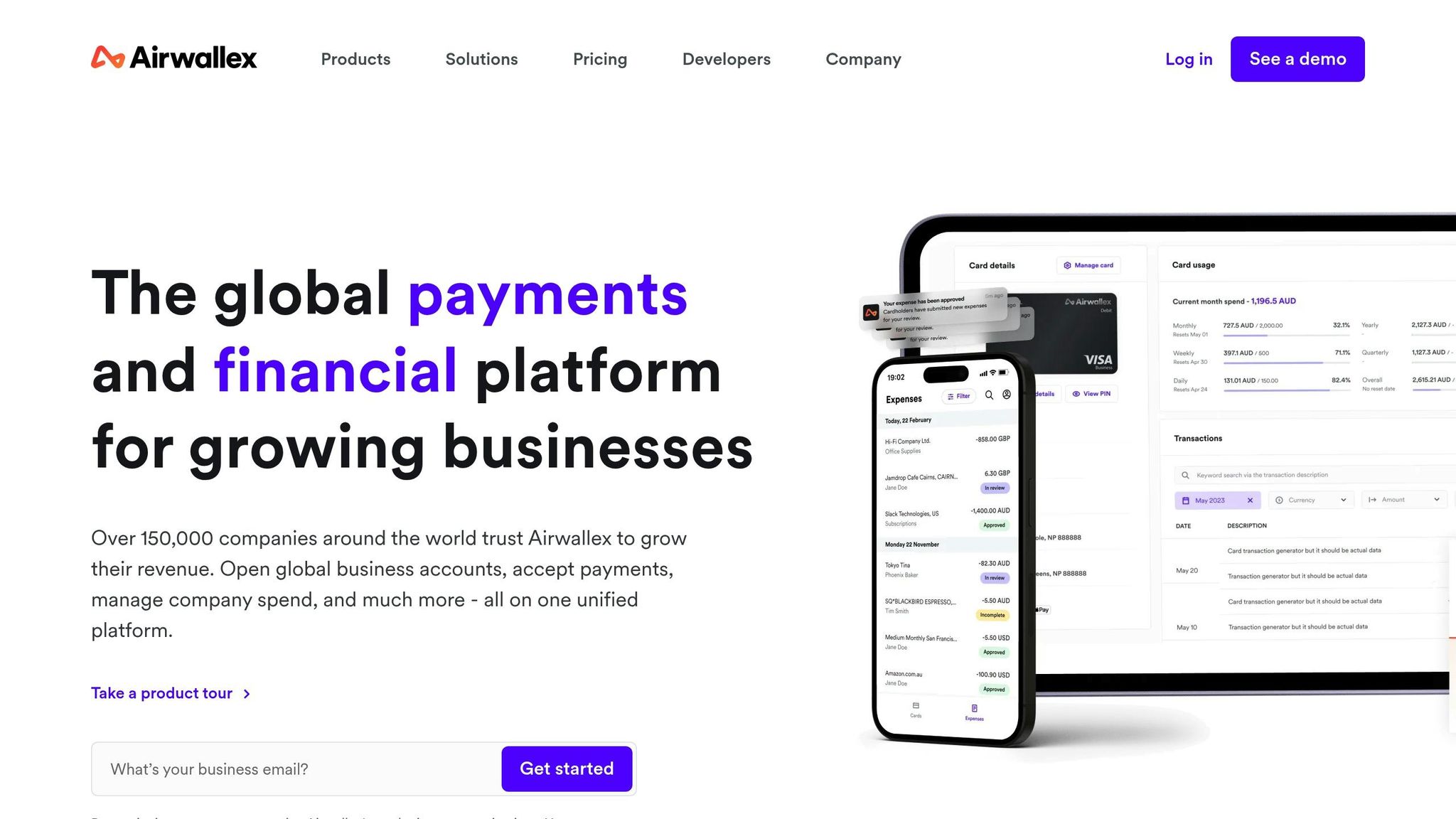
Airwallex offers a streamlined alternative to SWIFT, designed for fast and cost-effective international payments. Supporting transactions in over 180 countries and offering more than 160 payment methods, it’s built for businesses with global needs.
The platform’s multi-currency account setup allows users to hold balances in over 20 major currencies, cutting down on conversion fees. Here’s how its pricing stacks up:
- FX markup: 0.3%–0.6% (compared to traditional banks’ 3%–5%)
- Domestic card transactions: 2.8% + $0.30
- No monthly account fees or minimum balance requirements
These features help businesses save on costs while simplifying international transactions. Plus, Airwallex integrates easily into existing systems with options like pre-built plugins, payment links, REST APIs, and white-label solutions. Automation tools further simplify global payments, and partnerships have helped expand its market presence.
Security is a top priority. Airwallex uses AI-powered fraud detection, 3D Secure 2.0, bank-grade encryption, and holds PCI DSS Level 1 certification. It’s also licensed in key markets, including the UK (FCA), Australia (ASIC), Singapore (MAS), and the US (State Money Transmitter Licenses). This combination of security and compliance ensures reliable, high-volume transactions.
Most payments are processed within 1–2 business days. The platform’s API-driven system can handle over 10,000 transactions per minute. For example, a SaaS company converting 10,000 EUR to USD monthly saved about $78,000 in fees compared to traditional banks.
Payment Systems Comparison
When it comes to global transactions, processing speed can make a big difference. Here’s a quick look at how various payment systems stack up:
| Payment System | Processing Speed |
|---|---|
| SEPA | 1–2 business days |
| FedNow | Instant (24/7/365) |
| RippleNet | 3–5 seconds |
| Wise | 0.5–2 business days |
| Payoneer | 2–3 business days |
| Visa B2B Connect | Same day |
| Stellar/Ethereum | 2–5 seconds |
| Airwallex | 1–2 business days |
The time it takes to process a transaction can directly affect your business operations. For example, FedNow provides real-time settlements around the clock, while blockchain-based systems like RippleNet and Stellar/Ethereum boast near-instant speeds. If quick transfers are essential for your business, these options might be worth considering. On the other hand, traditional systems like SEPA or Payoneer may work better for less time-sensitive transactions. Always weigh processing speeds against your specific needs to find the best fit.
International Banking and Asset Protection
Payment systems are more than just tools for moving money – they’re integral to safeguarding assets and ensuring financial security. They influence privacy, security, and tax efficiency, making them a key part of any banking and asset protection strategy.
When it comes to privacy, payment systems offer varying levels of protection. Blockchain-based solutions use cryptography to enhance privacy, while traditional banking networks operate under strict regulations designed to ensure compliance and stability.
Protecting assets is just as important. Bobby Casey, Managing Director of Global Wealth Protection, explains:
"We work with location independent entrepreneurs (digital nomads) and investors on properly structuring their business and residency. Our focus is on tax minimization and asset protection while creating privacy for our clients’ business and personal affairs."
Both traditional banking and modern payment systems come with their own advantages, depending on your needs:
| Aspect | Traditional Banking | Modern Payment Systems |
|---|---|---|
| Privacy Level | Standard regulatory reporting | Enhanced transaction privacy |
| Settlement Speed | 1–3 business days | Often real-time or near-instant |
| Compliance Requirements | Extensive documentation | Varies by platform |
| Asset Protection Features | Standard banking protections | Platform-specific security features |
To strengthen your asset protection strategy, consider these steps:
- Jurisdiction Selection: Opt for payment systems that work efficiently in tax-friendly jurisdictions.
- Corporate Structure Alignment: Ensure your payment system aligns with your company’s legal framework.
- Risk Management: Use advanced security measures across different payment platforms.
For businesses needing additional protection, offshore structures can be a powerful tool. As Global Wealth Protection highlights:
"An offshore company can be a very useful tool for asset protection, privacy and tax minimization."
Collaborating with experts who understand both traditional banking systems and modern payment technologies can help you navigate compliance while leveraging the benefits of newer platforms for your global operations.
Conclusion
When selecting an alternative to SWIFT, focus on factors like privacy, settlement speed, compliance, asset protection, and costs. These elements are crucial as emerging payment systems continue to transform global trade.
| Factor | Key Considerations |
|---|---|
| Privacy Level | Transaction visibility and data protection |
| Settlement Speed | Real-time vs. batch processing capabilities |
| Regulatory Compliance | Reporting requirements and jurisdictional rules |
| Asset Protection | Security features and risk management tools |
| Cost Structure | Transaction fees and currency conversion rates |
As highlighted:
Global Wealth Protection works with location-independent entrepreneurs and investors on structuring their business and residency, focusing on tax minimization and asset protection.
To ensure success, align your payment systems with your business needs and jurisdiction. A well-rounded strategy should:
- Assess payment systems within your business and tax framework
- Account for jurisdiction-specific regulations
- Prioritize strong security measures
- Stay updated on regional compliance requirements
The international payment landscape is constantly changing, making informed choices essential for thriving in global commerce.
FAQs
What should businesses look for when choosing an alternative to SWIFT for international payments?
When evaluating alternatives to SWIFT for international payments, businesses should focus on key factors such as transaction costs, speed of transfers, and global accessibility. It’s also important to assess the security features offered by the payment system and how well it integrates with your existing financial processes.
Additionally, businesses should consider the system’s ability to handle multiple currencies, its compliance with international regulations, and any potential tax implications. Ensuring that the chosen platform aligns with your company’s financial goals and operational needs is essential for seamless global transactions.
How do blockchain-based payment systems like RippleNet and Stellar improve transaction speed and security compared to traditional methods?
Blockchain-based payment systems, such as RippleNet and Stellar, enhance transaction speed and security by leveraging decentralized ledger technology. Unlike traditional systems, which often rely on intermediaries and can take several days to process cross-border payments, blockchain networks facilitate near-instantaneous transactions by directly connecting parties and verifying transactions in real time.
These systems also improve security by using cryptographic protocols to safeguard data and prevent unauthorized access. Additionally, the decentralized nature of blockchain reduces the risk of a single point of failure, ensuring greater reliability and resilience compared to centralized systems.
What are the advantages and challenges of using platforms like Wise or Airwallex for international business payments?
Platforms like Wise and Airwallex offer several benefits for international business transactions. They typically provide lower fees compared to traditional banking systems and faster transfer speeds, making them attractive for businesses looking to reduce costs and improve efficiency. Additionally, these platforms often support multiple currencies and come with user-friendly interfaces, making it easier for businesses to manage global payments.
However, there are some limitations to consider. For instance, the availability of services may vary depending on the country, and certain platforms may have transaction limits or restrictions based on the type of business. It’s important to carefully review the platform’s features to ensure they align with your specific business needs.
