
Protecting your wealth by diversifying bank accounts across countries is a smart move. This strategy shields you from economic instability, currency fluctuations, and domestic legal risks. For more robust security, consider structuring offshore trusts alongside your banking strategy. By distributing your assets globally, you reduce reliance on a single banking system and gain access to stronger financial protections.
Key Takeaways:
- Why diversify? Protect against government interference, currency crashes, or banking failures.
- Top countries: Singapore, Switzerland, and the UAE offer stability, strong legal frameworks, and multi-currency options.
- Benefits: Better asset protection, hedging against currency devaluation, and enhanced privacy.
- How to start: Choose countries with solid regulations, prepare proper documentation, and ensure compliance with global reporting standards (e.g., FBAR, FATCA).
This isn’t about hiding money – it’s about reducing risks and maintaining financial security. With the right approach, you can safeguard your savings and grow your wealth across borders.
Why Spreading Your Bank Accounts Across Countries Works
International banking acts as a safety net, protecting your wealth from risks tied to a single country. By distributing your assets across various banking systems, you create multiple layers of defense against domestic threats, currency fluctuations, and privacy challenges. Together, these layers work to safeguard your financial stability in the face of economic and legal uncertainty.
In 2023, the U.S. saw 5 million new court cases filed. At the same time, the national debt surpassed $31 trillion, and in early 2025, the U.S. dollar experienced a 10% drop against the DXY – a basket of major global currencies – marking its worst six-month performance since 1973.
"Concentrating investments in one country exposes you to localized economic and political risk. Global diversification across regions, asset classes, and currencies helps stabilize returns." – Suisse Bank
The strength of this strategy lies in jurisdictional diversification. By spreading your assets across multiple countries, you reduce reliance on a single economy or legal system. If domestic issues arise – whether from economic instability, political unrest, or banking failures like those seen with Silicon Valley Bank and Signature Bank in 2023 – only a portion of your wealth is at risk.
Protection from Domestic Threats
Banking in places like the Cook Islands and Nevis offers a shield against creditors because these jurisdictions don’t recognize foreign court orders. Creditors are forced to re-litigate cases locally, which is both costly and time-intensive.
Beyond lawsuits, governments facing financial crises may impose capital controls, restricting access to your funds. Having international accounts ensures you maintain access to liquid assets even when domestic accounts are frozen or limited.
The distance provided by jurisdictional diversification makes it harder for creditors to access your assets. For example, while domestic LLCs (like those in Wyoming) provide some protection, offshore LLCs add extra layers of complexity. Creditors must hire foreign legal experts and navigate unfamiliar systems, often making recovery efforts financially impractical.
It’s important to establish asset protection structures early. Doing so prevents "fraudulent transfer" claims and ensures courts recognize your arrangements as legitimate financial planning. Managing currency risks is another crucial aspect of this strategy.
Hedging Against Currency Problems
Holding assets in multiple currencies helps preserve your purchasing power during domestic currency declines. For instance, some Singaporean banks let clients manage 12 different currencies within a single account. When the U.S. dollar fell over 10% in early 2025, those holding Swiss Francs or Singapore Dollars saw their wealth retain its value, while dollar-based assets lost ground.
If you frequently conduct business abroad, maintaining accounts in the currencies you use can save on conversion fees and protect against exchange rate swings. For instance, a Euro account can simplify transactions in Europe. Additionally, some international banks – like those in Belize – offer inflation-adjusted interest rates as high as 4%, helping to counteract domestic inflation. This multi-currency approach is a cornerstone of global asset protection.
Better Privacy and Security
Although traditional banking secrecy has waned due to global transparency initiatives like the Common Reporting Standard (CRS), modern offshore banking still offers strong confidentiality through advanced legal frameworks. While you must comply with reporting requirements like FBAR and Form 8938, banking in jurisdictions with stringent privacy laws can make you less vulnerable to lawsuits or data breaches.
"The key distinction of modern offshore banking isn’t privacy – it’s financial sophistication and regulatory efficiency." – Project Black Ledger
Stability matters, too. Countries with well-established banking systems, such as Singapore and Switzerland, are less likely to implement drastic changes that could limit access to your assets. For instance, Switzerland boasted 15 banks on Forbes‘ 2022 list of the world’s best banks.
Privacy also benefits from strategic structuring. Using offshore LLCs or trusts creates a legal buffer between you and your assets, making it harder for potential litigants to trace your holdings. This isn’t about tax evasion or illegal activity – it’s about building legitimate protections that shield your financial information from public exposure and cyber threats. This strategy reinforces the importance of international diversification in securing your wealth.
sbb-itb-39d39a6
Best Countries for Secure International Banking
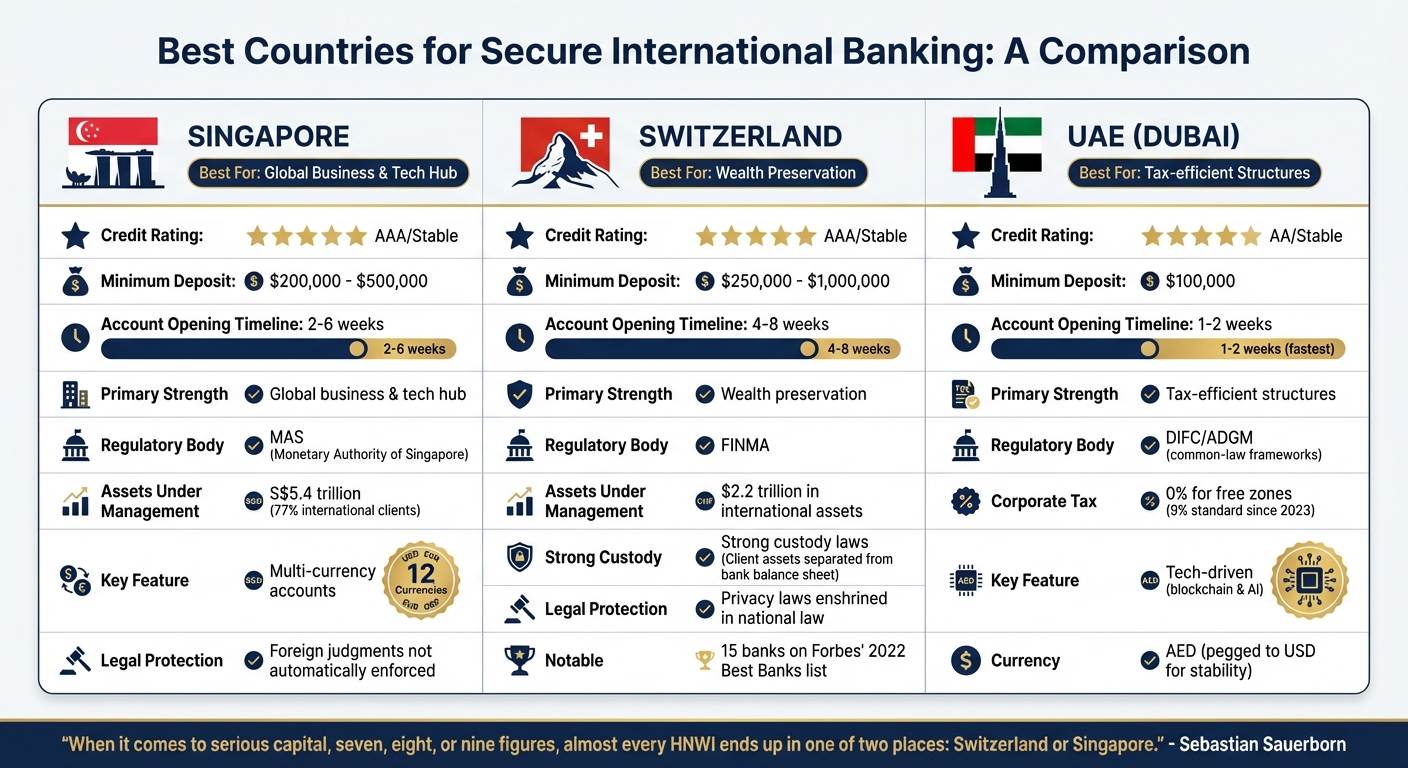
International Banking Comparison: Singapore vs Switzerland vs UAE
When it comes to safeguarding your wealth across borders, a few jurisdictions stand out for their stability and robust legal protections. Singapore, Switzerland, and the UAE each offer distinct advantages for international banking, making them popular choices depending on your financial priorities. These countries combine political stability, strict regulatory oversight, and legal frameworks designed to protect assets from external threats.
Stability and Regulatory Strength
A key factor in choosing a banking jurisdiction is its sovereign credit rating and regulatory environment. Singapore and Switzerland both hold AAA/Stable ratings, reflecting their strong economies and governance. The UAE (Dubai) follows closely with an AA/Stable rating, indicating solid economic resilience. Regulatory bodies like Switzerland’s FINMA and Singapore’s MAS enforce strict rules on capital and liquidity, ensuring banks remain stable even during market disruptions.
"When it comes to serious capital, seven, eight, or nine figures, almost every HNWI ends up in one of two places: Switzerland or Singapore." – Sebastian Sauerborn
Each country brings something unique to the table: Switzerland excels in preserving wealth for future generations, Singapore thrives as a global business hub, and the UAE offers tax-efficient options with fast, tech-driven banking solutions.
| Country | Typical Min. Deposit | Account Opening Timeline | Primary Strength |
|---|---|---|---|
| Singapore | $200,000 – $500,000 | 2 – 6 weeks | Global business & tech hub |
| Switzerland | $250,000 – $1,000,000 | 4 – 8 weeks | Wealth preservation |
| UAE (Dubai) | $100,000 | 1 – 2 weeks | Tax-efficient structures |
Singapore
Singapore offers a secure and forward-thinking banking environment, making it ideal for those looking to mitigate risks tied to their home country. The Monetary Authority of Singapore (MAS) enforces conservative regulations, ensuring banks operate with high levels of solvency. With S$5.4 trillion in assets under management – 77% of which comes from international clients – Singapore has proven itself as a trusted financial hub.
One of Singapore’s standout features is its legal framework. Foreign civil judgments aren’t automatically enforced, protecting assets from external creditors unless reviewed by local courts. Additionally, Singaporean banks excel in offering multi-currency accounts, perfectly suited for international businesses. Opening an account typically takes 2 to 6 weeks and requires a minimum deposit of $200,000 to $500,000 for premium non-resident accounts. However, banks prioritize clients with genuine international business activity.
Switzerland
Switzerland is synonymous with wealth preservation, managing $2.2 trillion in international assets. Its legal system provides unparalleled security by separating client holdings from the bank’s operational funds. This means your assets remain protected even if the bank faces financial difficulties.
"Swiss banks protect assets through strict custody laws that separate client holdings from bank balance sheets." – Andrew Wilder, Author on Business Migration
Swiss financial privacy laws are another key draw. Unlike many jurisdictions, these protections are enshrined in national law, not just bank policy. While Swiss banks comply with international reporting standards like CRS and FATCA, they ensure private third parties cannot access your information. The Swiss Franc (CHF) further enhances security as a stable, safe-haven currency during global economic uncertainty.
Opening an account in Switzerland is a meticulous process, often requiring multiple rounds of documentation and a minimum deposit between $250,000 and $1,000,000. The timeline typically ranges from 4 to 8 weeks. Swiss banks are known for their expertise, with 15 institutions making Forbes’ 2022 list of the world’s best banks.
United Arab Emirates (UAE)
The UAE takes a modern, tech-driven approach to international banking, appealing to those seeking efficiency and flexibility. While the country introduced a 9% corporate tax in 2023, many free zone and offshore entities still benefit from a 0% tax rate. The UAE’s dual-court system – comprising the Dubai International Financial Centre (DIFC) and Abu Dhabi Global Market (ADGM) – operates under common-law frameworks, offering predictable legal standards familiar to Western investors.
Account opening in the UAE is one of the fastest globally, taking just 1 to 2 weeks with a minimum deposit of $100,000. Banks utilize advanced technologies like blockchain and AI to streamline processes, from trade finance to compliance checks. However, they now require evidence of genuine business activity or a physical presence to meet stricter "economic substance" rules. The UAE Dirham (AED), pegged to the US Dollar, offers currency stability for businesses reliant on dollar-based transactions.
How to Open and Manage Bank Accounts in Multiple Countries
Opening and managing international bank accounts is a strategic way to protect and grow your assets. However, this process requires careful planning, precise documentation, and a clear purpose. Banks operating in secure jurisdictions follow strict regulations and thoroughly review applications to ensure global compliance. Having a clear understanding of these requirements can save you time and frustration, helping you set up accounts that align with your financial goals.
Assess Your Banking Requirements
The first step is to define why you need each account. Banks are cautious about vague or unclear objectives, so it’s important to be specific. Are you safeguarding savings from currency risks? Facilitating international business transactions? Diversifying assets across stable economies? Your reasons will guide your choice of jurisdictions and the documentation you’ll need.
Different banking systems offer distinct advantages. For instance:
- Switzerland: Known for its strong custody laws, making it ideal for long-term wealth preservation.
- Singapore: Offers advanced multi-currency infrastructure and is well-suited for businesses operating across Asia and the Middle East.
- UAE: Provides tax-efficient structures and a relatively straightforward account setup process.
Your choice should align with your financial strategy. For example, if you’re hedging against a weakening U.S. dollar, holding Swiss Francs or Singapore Dollars can add diversification. Additionally, banks will review your projected transaction patterns, balances, and withdrawal needs to ensure they match your stated purpose. Any inconsistencies can lead to compliance reviews or account freezes.
Once your objectives are clear, focus on jurisdictions that meet your specific needs.
Select the Right Jurisdictions
When choosing where to open accounts, prioritize countries with strong regulatory reputations. Avoid jurisdictions listed as "high-risk" or "monitored" by the Financial Action Task Force (FATF), as this could complicate your banking across other regions. Banks in flagged countries may face delays in processing transfers or require excessive documentation, and your domestic accounts could even be affected.
Be aware of deposit thresholds and timelines for account approval. For example:
- Panama: Requires $25,000–$100,000, with accounts typically opened in 1–2 weeks.
- Singapore: Demands $200,000–$500,000, with a 2–4 week processing time.
- Switzerland: Requires $250,000–$1,000,000, with approvals taking 4–8 weeks.
For corporate accounts, many banks now require proof of "economic substance." This means you’ll need to provide contracts, invoices, and business plans that demonstrate real operations, not just a registered entity. Jurisdictions like the UAE and the Netherlands are particularly strict about verifying genuine business activity and physical presence.
Meet Global Compliance Requirements
To streamline the application process, prepare a comprehensive compliance package. Common requirements include:
- A valid passport
- Proof of address (e.g., a utility bill or bank statement dated within the last three months)
- Tax returns from the past 1–3 years
- Detailed documentation of your source of wealth
When detailing your source of wealth, avoid vague descriptions like "business income." Instead, provide specific evidence, such as employment contracts with salary details, real estate sale agreements, inheritance letters, or investment statements showing growth over time.
"Modern offshore banking is built around compliance, clear documentation, and open communication with banks and regulators. Cutting corners usually backfires." – Q Wealth Report
Some jurisdictions also require document authentication, either through notarization or an Apostille stamp for international recognition. Check with your target bank to confirm their specific requirements, as failing to meet them could delay your application.
For U.S. citizens, additional reporting obligations apply. If your foreign account balances exceed $10,000 at any point during the year, you must file an FBAR (Report of Foreign Bank and Financial Accounts). If your total foreign assets surpass $50,000, you’ll also need to submit FATCA Form 8938. These filings are mandatory, and non-compliance can result in severe penalties. Consulting a tax professional familiar with international reporting is a smart move before opening any foreign accounts.
Consistency across your documentation is critical. Banks will examine whether your tax residency, income, transaction projections, and source of wealth align with your stated purpose. Any discrepancies can raise red flags, leading to application rejections or even account freezes after approval.
Finally, once your accounts are open, maintain them in line with your original application details. Banks monitor activity, and significant deviations could trigger compliance reviews. Keep your documentation updated to reflect any changes, as managing international accounts requires ongoing attention – not just a smooth setup process.
Reducing Risks and Maintaining Long-Term Stability
Opening accounts abroad is just the beginning. To maintain stability over the long haul, active management is crucial as regulations, policies, and jurisdictions constantly shift. A "set it and forget it" approach won’t cut it. Without regular oversight, you risk account closures, compliance headaches, or unforeseen tax liabilities that could undo all the safeguards you’ve put in place.
Monitor Your Banking Jurisdictions Regularly
Banking environments are always changing. Political shifts, updated tax laws, and new regulations can quickly impact the stability of your accounts. To stay ahead, schedule quarterly reviews to track regulatory updates, currency risks, and political developments. Broader annual reviews are also essential to evaluate whether your chosen jurisdictions remain aligned with international standards, such as those set by the Financial Action Task Force (FATF). For instance, banks in countries flagged by the FATF may experience delays in processing international transactions, which could ripple back to your domestic banking activities.
Tools like the Financial Secrecy Index (FSI) now operate on a rolling update system, allowing you to catch regulatory changes as they happen. Sovereign credit ratings from agencies like Fitch, Moody’s, and S&P can also guide you toward jurisdictions with AAA or AA+ ratings, helping to minimize systemic risks. Additionally, keeping an eye on local regulatory bodies – such as FINMA in Switzerland, MAS in Singapore, or CBUAE in the UAE – can alert you to policy changes that might directly affect your banking arrangements.
Banks themselves may also choose to exit certain markets or sectors with little warning. This trend highlights the importance of not putting all your eggs in one basket. Spreading your assets across multiple jurisdictions – using Singapore for operations, Switzerland for investments, and the Cook Islands for asset protection, for example – can help you avoid a single point of failure.
These monitoring steps lay the groundwork for the next essential component: working with expert advisors to navigate these complexities.
Work with Professional Advisors
Regular monitoring is important, but it’s not enough on its own. Professional advisors play a key role in maintaining a stable and compliant multi-country banking strategy. They bring the expertise and connections necessary to adapt your structures to shifting compliance requirements and cross-border regulations. For example, they can flag when a jurisdiction is added to the FATF gray or black list – a move that could lead to account closures or payment disruptions. They also stay updated on developments like bail-in legislation, which could put depositors at risk during a financial crisis.
"So many successful offshore structures are relationship based. Knowing the right trust company or the right investment manager can elevate an already great asset protection structure to an even higher level." – Jacob Stein, Aliant Law
Advisors also ensure compliance with cross-border reporting obligations. For U.S. citizens, this includes filing FBARs and FATCA forms, where non-compliance can lead to steep penalties. Beyond compliance, they help coordinate estate and succession planning, preventing assets from getting caught up in conflicting legal systems. This can save your heirs from enduring lengthy legal disputes across multiple jurisdictions.
When selecting advisors, look for those who are licensed, transparent, and experienced in crafting strategies tailored to your needs – whether you’re a digital nomad, entrepreneur, or high-net-worth individual. They should understand the differences between residency, which affects taxation, and domicile, which influences estate and inheritance rules. Firms like Aliant Law, with over 20 years of experience in offshore structures, specialize in addressing complex financial challenges.
Lastly, ensure your documentation – such as tax residency records and proof of wealth sources – is consistent and up-to-date. Clean invoices, contracts, and tax filings can prevent your accounts from being flagged during Know Your Customer (KYC) and Anti-Money Laundering (AML) checks. Modern offshore banking prioritizes transparency and strict compliance with FATCA and CRS, making proactive management more important than ever.
Conclusion: Securing Your Finances Through Multi-Country Banking
Opening bank accounts in multiple countries isn’t about secrecy – it’s about creating a strong financial safety net. This strategy can help protect against domestic economic turbulence, currency devaluation, or sudden policy changes and regulatory shifts. During the 2008 financial crisis, nearly 500 U.S. banks failed, leaving many individuals vulnerable. Those who had diversified internationally were better equipped to weather the storm. The same logic applies today, whether you’re guarding against inflation, capital controls, or simply aiming for better financial opportunities.
"In an era of increasing financial scrutiny and regulatory complexity, true wealth protection isn’t about hiding – it’s about structuring." – Project Black Ledger
By spreading your assets across multiple jurisdictions, you can reduce exposure to domestic risks like creditor claims, currency instability, and economic downturns.
You don’t need to be a millionaire to get started. Many international accounts can be opened with just a few hundred dollars, and services like Wise make managing multi-currency transactions straightforward, even during the 2–8 week setup process. The key is aligning each jurisdiction with a specific financial goal – Singapore for daily banking, Switzerland for investments, and Liechtenstein for long-term asset preservation.
As highlighted throughout, securing your finances through multi-country banking requires action. With the right documentation, professional advice, and regular reviews, this strategy can turn a seemingly complex concept into a practical way to safeguard your wealth. The real question isn’t whether you can afford to diversify – it’s whether you can afford not to.
FAQs
How many countries should I bank in?
The number of countries you should consider banking in largely depends on how much diversification you’re aiming for. A good rule of thumb? Three to five jurisdictions. This provides a balance, helping to shield you from risks such as economic instability, government interference, or currency fluctuations. By spreading your accounts this way, you can enjoy better financial security, increased flexibility, and stronger protection for your assets.
What’s the biggest risk of having foreign accounts?
The primary risk of holding foreign accounts lies in not adhering to U.S. tax laws and reporting obligations. Non-compliance can lead to harsh outcomes, such as hefty civil penalties or, in extreme cases, criminal charges. Although foreign accounts can provide advantages like privacy and safeguarding assets, staying compliant with regulations is crucial to sidestep these potential pitfalls.
How do I pick currencies for a multi-currency account?
When selecting currencies, think about your financial habits and where you operate geographically. Prioritize widely-used currencies like the USD, EUR, and GBP, especially if they align with your regular transactions, investments, or savings needs. Look for currencies that offer stability, liquidity, and easy conversion to help you avoid unnecessary fees. Whether you’re managing international business, planning travel, or safeguarding assets, matching your currency choices to your specific goals can streamline your financial management and cut down on exchange costs.
