
A wealth protection plan is your shield against financial threats like lawsuits, creditor claims, market crashes, and political instability. Without it, your hard-earned assets – savings, investments, properties, and business interests – are vulnerable to risks that could dismantle years of effort. Here’s the key takeaway: proactive planning is essential. Once a claim arises, it’s often too late to safeguard your wealth.
Key Points:
- Legal and Financial Barriers: Tools like trusts, LLCs, and offshore structures separate you from your assets, making them harder to access.
- Protection from Legal Risks: Lawsuits, divorce settlements, and creditor claims can quickly drain unprotected wealth.
- Market and Political Risks: Economic downturns, inflation, and government policy shifts can devastate unprotected assets.
- Timing Matters: Asset protection must be set up before any liabilities arise to avoid legal complications.
Quick Steps to Get Started:
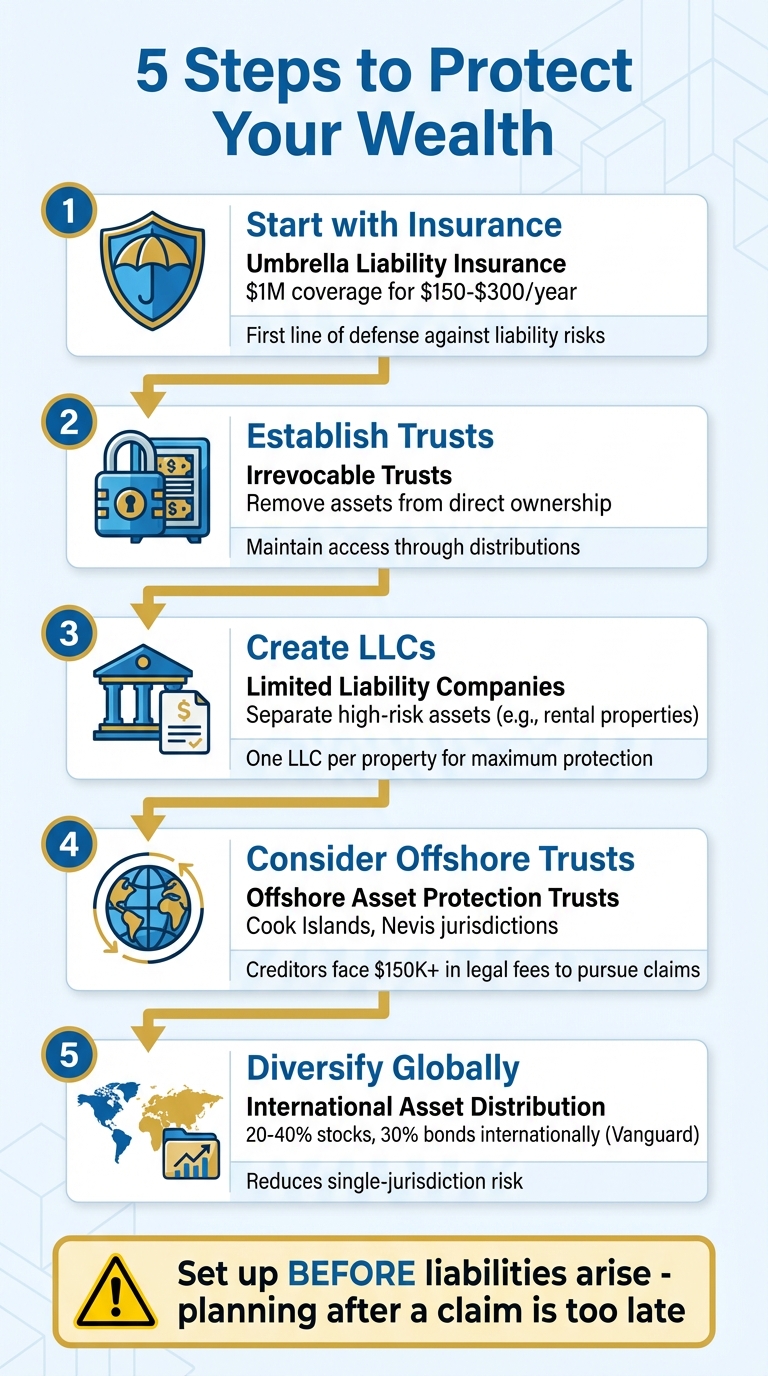
- Insurance: Start with umbrella liability insurance (e.g., $1M coverage for $150–$300/year).
- Trusts: Use irrevocable trusts to shield assets from direct ownership.
- LLCs: Separate high-risk assets (like rental properties) into individual LLCs.
- Offshore Trusts: Consider jurisdictions like the Cook Islands for added protection.
- Diversify Globally: Spread assets across countries to reduce exposure to single-jurisdiction risks.
Protecting your wealth isn’t just about security – it’s about peace of mind. Plan ahead, use the right tools, and shield your assets from avoidable threats.
What Happens When Investors Don’t Protect Their Wealth
Failing to safeguard your wealth can leave it exposed to risks that could quickly deplete years of hard work and savings. These risks are especially pressing for those who have built up significant assets, with potential consequences spanning from legal battles to financial market disruptions.
Lawsuits and Creditor Claims
Legal challenges often come without warning. Whether it’s a medical malpractice case, a tenant injury on a rental property, or an auto accident exceeding your insurance limits, the financial fallout can be devastating. Professionals like accountants, engineers, and architects face additional risks tied to professional liability, while business owners are frequently exposed to employment-related claims, including wrongful termination and discrimination lawsuits.
Here’s a reality check: many states only require a minimum of $25,000 in automobile bodily injury coverage, which pales in comparison to the costs of a severe accident. Similarly, while the FDIC insures up to $250,000 per depositor, per bank, and the SIPC covers up to $500,000 for brokerage accounts, these limits may not be enough to shield your wealth. Even retirement accounts, such as traditional and Roth IRAs, typically offer bankruptcy protection up to $1 million, but this safeguard often doesn’t apply to divorce or child support judgments.
Divorce and domestic claims can bypass many asset protections, further exposing your wealth. Business owners serving on nonprofit or corporate boards also face personal liability risks that may not be fully covered by standard insurance policies. All of this underscores the importance of a robust plan to protect your assets.
Market Volatility and Political Instability
Economic downturns, inflation, and political unrest can wreak havoc on unprotected investments. A market crash or currency devaluation can hit especially hard if your assets are concentrated in one country or institution. Bank failures, brokerage collapses, and sudden regulatory changes could freeze or even wipe out access to your funds. Assets not legally separated through trusts or other entities are also more vulnerable to risks like government policy shifts or banking system failures. Publicly visible assets only heighten this exposure.
Why Asset Visibility Creates Risk
When your assets are easy to find through public records, you become a clear target. Plaintiff attorneys often search these records to locate assets that can be quickly liquidated to satisfy judgments. Lawyers working on contingency are less likely to pursue cases when assets are obscured, as they rely on visible wealth to ensure payment.
For high-net-worth individuals, this visibility can be particularly dangerous. If your wealth is easily accessible, you may be seen as a "deep pocket" – a term used to describe someone who is an appealing target for lawsuits. Visible assets can invite frivolous legal actions that might otherwise be avoided with proper asset structuring. By using legal entities to shield wealth, investors can reduce their exposure and focus on growing their portfolios instead of defending against unnecessary litigation.
sbb-itb-39d39a6
How to Build a Wealth Protection Plan
Creating a solid wealth protection plan involves a strategic, layered approach. Timing is everything – your defenses need to be in place before any claims or liabilities arise. As Derek Thain, Vice President of Fidelity‘s Advanced Planning team, puts it:
"If you initiate this planning after you think liability is coming your way, it’s likely too late".
Start by assessing your specific risks. Different professions and asset types, whether in healthcare or real estate, require tailored strategies. Begin with the basics: take full advantage of statutory protections like ERISA-qualified retirement plans, which provide unlimited federal bankruptcy protection, and homestead exemptions for your primary residence. Add liability and umbrella insurance for an additional safeguard – a $1 million umbrella policy typically costs $150–$300 annually and serves as an important first line of defense.
Next, consider setting up irrevocable trusts. These trusts remove assets from your direct ownership while still allowing you access to distributions. The idea is to create multiple barriers that make it too expensive and complicated for creditors to pursue your assets. You can also explore international structures for even stronger protections.
Offshore Asset Protection Trusts
Offshore asset protection trusts (APTs) are among the most effective tools for safeguarding wealth. These trusts place your assets under the control of a foreign trustee, operating outside the jurisdiction of U.S. courts. This means that American legal judgments cannot be enforced in these jurisdictions.
Countries like the Cook Islands and Nevis are well-known for their strong asset protection laws. The Cook Islands International Trusts Act of 1984, for example, is considered a leading model and has influenced other jurisdictions. Under such laws, creditors face steep hurdles: they must prove fraudulent intent "beyond a reasonable doubt" – the highest standard of proof – and file any claims within a tight two-year window.
"Since the trustee of an offshore trust is not under the jurisdiction of the United States, any judgment or court order from any United States court will have no effect on them." – White & Bright, LLP
The deterrent effect is powerful. In some cases, creditors may need to spend upwards of $150,000 in legal fees just to pursue a claim. This often discourages contingency-fee lawyers from taking on such cases. For added flexibility, you can include an LLC within the trust. This allows you to manage the LLC’s day-to-day operations while giving the offshore trustee the ability to step in and protect assets if a legal threat arises.
Offshore trusts remain tax-neutral but require strict annual IRS disclosures through FATCA and FBAR. These tools are designed to protect assets legally, not to evade taxes.
Using Multiple Entities to Separate Risk
Another effective strategy is to separate assets using various legal entities. This approach isolates risks, ensuring that a claim against one asset doesn’t threaten your entire portfolio.
Limited Liability Companies (LLCs) are a popular choice for this purpose. For example, if you own rental properties, placing each property in its own LLC means that a lawsuit related to one property – say, a tenant injury – can only affect the assets within that specific LLC. Your other properties, savings, and investments remain protected. Similarly, if you operate multiple businesses, keeping each venture under a separate entity ensures that a liability claim against one won’t jeopardize the others.
To maintain these protections, it’s essential to operate each entity independently. This includes having separate bank accounts, proper record-keeping, and avoiding the mixing of personal and business funds. If these boundaries are blurred, creditors could "pierce the corporate veil", gaining access to your personal assets. For married couples, titling certain assets as "tenancy by the entirety" can also shield them from creditors, depending on state laws. Combining LLCs, trusts, and other legal tools creates a strong, layered defense against various threats.
Spreading Assets Across Multiple Countries
Relying solely on one country for your wealth creates a single point of vulnerability. Distributing assets internationally reduces this risk and diversifies your exposure to different governments, banking systems, and currencies.
From an investment perspective, Vanguard suggests allocating at least 20% of both stocks and bonds to international markets, with optimal diversification achieved by holding about 40% of stocks and 30% of bonds abroad. This approach helps cushion against domestic market swings and currency devaluation.
For asset protection, spreading wealth across jurisdictions makes it harder for creditors to pursue claims. When assets are distributed across countries with varying legal systems, creditors face the daunting task of filing separate claims in each jurisdiction. Many offshore locations, such as the Cayman Islands, Belize, and Bermuda, do not enforce U.S. court judgments. Additionally, international structures can obscure asset ownership, making it appear that you hold fewer assets than you actually do.
Choosing the right jurisdictions depends on your goals. Developed markets like the UK or France offer stability and established legal frameworks, while emerging markets such as India or Mexico provide growth opportunities, albeit with higher risks. For asset protection, prioritize locations with strong legal precedents and courts that favor asset holders over creditors. Together, these measures help safeguard your wealth against unexpected challenges.
Legal Requirements and Compliance
When it comes to safeguarding your wealth, staying within legal boundaries is non-negotiable. A well-constructed wealth protection plan uses structures that align with the law, especially in today’s regulatory environment, where transparency is not just encouraged – it’s mandatory. U.S. investors who utilize offshore tools must meet strict reporting obligations or face steep penalties that could derail their entire strategy.
It’s important to note that legal asset protection aims to shield assets from creditors and lawsuits through tax-neutral structures – not to hide income or evade taxes. As White & Bright, LLP explains:
"Offshore asset protection trusts are tax-neutral structures – they are not meant to dodge taxes or hide assets from the IRS."
Compliance is the bedrock of any asset protection strategy. Even the most robust plans depend on a commitment to legal reporting and operational standards.
Understanding CRS and FATCA Reporting
Two major regulations – The Foreign Account Tax Compliance Act (FATCA) and the Common Reporting Standard (CRS) – have reshaped how offshore assets are monitored globally. These frameworks ensure that financial data is automatically shared between governments, increasing transparency.
Under FATCA, U.S. taxpayers face specific filing requirements if their foreign financial assets exceed set thresholds. For example:
- If your foreign financial assets are worth more than $50,000 at the end of the year – or $75,000 at any point during the year for married couples or expatriates – you must file Form 8938 with your tax return.
- Separately, if you hold a financial interest in or signature authority over foreign accounts exceeding $10,000 at any time during the year, you must file the FBAR (FinCEN Form 114) electronically by April 15 (with an automatic extension to October 15).
Failing to file Form 8938 can result in penalties starting at $10,000 and climbing to $50,000, with an additional 40% penalty on any tax understatement. The statute of limitations extends to six years if more than $5,000 in income is omitted.
Here’s a quick comparison of the key features for Form 8938 and FBAR filings:
| Feature | Form 8938 (FATCA) | FinCEN Form 114 (FBAR) |
|---|---|---|
| Reporting Threshold | $50,000+ (varies by residency/filing status) | $10,000+ at any time during the year |
| Where to File | Attached to annual tax return (IRS) | Electronically via FinCEN’s BSA E-filing System |
| Assets Covered | Foreign stocks, bonds, interests in foreign entities | Foreign bank, brokerage, and financial accounts |
| Deadline | Tax filing deadline (usually April 15) | April 15 (automatic extension to October 15) |
For foreign trusts, additional disclosures are required. Transactions involving foreign trusts and ownership must be reported using Forms 3520 and 3520-A, while interests in foreign corporations require Form 5471. These filings are essential to ensure your asset protection strategy remains legally defensible.
Legal Asset Protection vs. Tax Evasion
Adhering to these reporting standards not only strengthens your asset protection plan but also draws a clear line between lawful strategies and illegal practices. Timing is critical – asset protection must be set up before any liabilities arise. Transferring assets after a claim has been filed or when one is anticipated constitutes a "fraudulent transfer", which courts can nullify.
Financial solvency is another key factor. If transferring assets leaves you unable to meet your personal expenses or pay existing debts, the courts may disregard your protection structure entirely.
Additionally, maintaining "arm’s length" operations is crucial. Each entity within your plan must function independently to prevent creditors from piercing the corporate veil. As J.P. Morgan Wealth Management advises:
"The more you respect the entity as being separate from your personal assets, the more likely the entity’s assets will be protected from your creditors."
Conclusion
Building wealth takes years of effort, but protecting it requires just as much dedication. Without a well-thought-out protection plan, your hard-earned assets could be vulnerable to lawsuits, market downturns, political upheaval, or creditor claims – any of which could undo decades of work in a matter of months.
Start with umbrella liability insurance – a policy offering $1 million in coverage typically costs just $150–$300 per year and provides immediate protection against liability risks. Beyond that, consider strategies like forming LLCs, setting up irrevocable trusts, or using offshore entities to distribute and manage risks effectively. For retirement accounts, tap into their built-in protections: employer-sponsored plans under ERISA provide unlimited bankruptcy protection, while traditional and Roth IRAs safeguard up to $1,512,350. Together, these tactics form a strong defense tailored to your overall financial strategy.
Timing is critical when implementing these measures. Establish protections before any liabilities arise, as courts can reverse actions taken after the fact. As Derek Thain from Fidelity’s Advanced Planning team cautions:
"If you initiate this planning after you think liability is coming your way, it’s likely too late".
A comprehensive plan does more than shield your assets – it also encourages creditors to settle on more favorable terms, making the upfront effort and cost worthwhile. As discussed earlier, spreading assets across different jurisdictions adds another layer of security, further enhancing your financial resilience.
FAQs
What does a wealth protection plan include?
A wealth protection plan is all about shielding your assets from risks like lawsuits, economic downturns, and unexpected events. It’s a mix of strategies and tools designed not just to protect your wealth but to help it grow over time.
Here are some key elements that typically make up a solid wealth protection plan:
- Insurance coverage: Policies like umbrella liability, auto, home, and professional insurance act as a first line of defense, protecting you from lawsuits and accidents.
- Legal structures: Setting up entities like LLCs, family limited partnerships, or trusts can create a barrier between your personal and business assets, making it tougher for creditors to reach your wealth.
- Asset titling strategies: Approaches such as tenancy-by-the-entirety or privacy trusts can help limit your exposure to claims.
- Protected accounts: Accounts like 401(k)s, IRAs, and life insurance policies often come with legal protections under U.S. law, giving your savings an extra layer of security.
- Jurisdictional diversification: Using offshore trusts or foreign LLCs in legally favorable locations can add privacy and reduce domestic risks.
When you combine these tools with a personalized estate plan and make it a habit to review everything regularly, you’ll be better prepared to handle life’s uncertainties. Plus, you can enjoy benefits like tax efficiency, financial stability, and peace of mind knowing your assets are secure.
How do offshore trusts help protect your assets from lawsuits?
Offshore trusts offer a layer of protection by legally transferring ownership of your assets to an irrevocable trust governed by foreign laws. Jurisdictions like the Cook Islands or the Cayman Islands are popular choices because they provide strong privacy measures and laws that make it tough for creditors to access assets held in the trust.
Since these trusts are managed by independent foreign trustees, anyone attempting to make a claim against the assets would need to initiate legal proceedings in the trust’s jurisdiction. These legal systems often have stringent requirements and protections that make such efforts difficult. Many of these jurisdictions also enforce "look-back" periods and require the trust to be established without fraudulent intent, further bolstering its security. This setup can help shield your wealth from legal claims, offering a reliable way to protect your financial future.
Why is it important to set up asset protection measures early?
Timing plays a crucial role in safeguarding your wealth. Asset protection strategies – like setting up trusts or forming LLCs – only work effectively if they’re implemented before potential risks such as lawsuits, creditor claims, or market downturns emerge. If you wait until trouble is on the horizon, you could face legal complications, including accusations of fraudulent transfers, which might leave your assets exposed.
Getting started early offers several benefits. It allows you to secure favorable jurisdictions, make the most of tax advantages, and ensure that your protection plan is legally sound. Plus, early planning helps you align these strategies with your overall financial and estate goals, giving you confidence and long-term security for your investments.
