
Offshore real estate offers a practical way to protect your wealth while diversifying investments. It involves buying property in foreign countries, which can shield assets from domestic legal systems, provide financial privacy, and help mitigate risks like currency devaluation and inflation. Key benefits include tax advantages, legal protections, and potential residency opportunities.
Here’s what you need to know:
- Tax Benefits: Offshore properties allow deductions for expenses like property taxes, management fees, and travel. Rental income under the IRS’s 14-Day Rule may not need to be reported, and foreign tax credits can avoid double taxation.
- Legal Protections: Jurisdictions like Nevis and Belize offer strong asset protection laws, making it difficult for creditors to access your property.
- Top Locations: The Cayman Islands, Belize, and Nevis stand out for their tax-friendly policies, stable economies, and secure legal systems.
- Costs: Investments typically require $200,000–$300,000, with additional setup costs for legal structures like LLCs or trusts. Properly structuring offshore trusts can further enhance these safeguards.
For those looking to safeguard their assets, offshore real estate provides a tangible, secure option with long-term benefits. However, thorough due diligence and expert guidance are essential to navigate legal and tax complexities.
Tax Benefits and Legal Protections of Offshore Real Estate
Investing in offshore real estate not only diversifies your portfolio but also provides financial and legal advantages that can help safeguard your wealth.
Tax Reduction Strategies
Owning rental property abroad can significantly reduce your tax liability. You can deduct various expenses, such as property taxes, mortgage interest, management fees, maintenance costs, and even travel expenses related to managing the property. These deductions directly lower your taxable rental income on a dollar-for-dollar basis.
Depreciation also works in your favor. Offshore rental properties often qualify for an annual depreciation deduction spread over a 30-year schedule, further offsetting your income. Additionally, if you pay taxes to a foreign government on your rental income, you can usually claim those payments as a foreign tax credit on your U.S. tax return, avoiding double taxation.
Another perk is the IRS’s 14-Day Rule. If you rent out your offshore property for 14 days or fewer in a year, you don’t need to report that income on your U.S. taxes – no matter how much you earn. And if the property serves as your primary residence for at least two of the five years before selling, you might qualify to exclude up to $250,000 (for individuals) or $500,000 (for couples filing jointly) in capital gains under IRS Section 121.
Beyond tax savings, owning property in certain offshore locations also offers valuable legal protections.
Legal Protections for Property Owners
Offshore jurisdictions are known for their strong legal frameworks that protect property owners from creditors and lawsuits. Countries like Nevis, the Cook Islands, and Belize, for example, do not recognize foreign court judgments. This forces creditors to re-litigate their cases locally under the jurisdiction’s laws, a process that is both costly and often impractical.
These jurisdictions also impose strict legal hurdles for creditors. In Nevis and the Cook Islands, creditors must prove "fraudulent transfer" beyond a reasonable doubt, which is a much higher standard than the U.S. civil standard. Nevis even requires creditors to post a $100,000 bond before filing a claim. Additionally, most offshore jurisdictions limit the time creditors have to challenge asset transfers to one or two years.
Belize stands out with its Trusts Act, which provides immediate protection for certain asset transfers, bypassing the fraudulent conveyance rules common in many other countries. Many of these jurisdictions also enforce strict confidentiality laws, ensuring that the identities of beneficial owners and property-holding structures remain private. This makes it extremely difficult for litigants to locate or target assets.
sbb-itb-39d39a6
How to Evaluate Safe Offshore Property Markets
Selecting the right offshore property market means digging into the legal, political, and economic factors that ensure your investment remains secure over time.
Political Stability and Legal Systems
A strong legal framework is essential for protecting your property. Focus on jurisdictions with laws specifically designed to attract and safeguard foreign investments. Examples include Samoa’s International Companies Act and the Cook Islands’ trust legislation, both of which demonstrate a clear commitment to asset protection.
Pay attention to how local courts handle foreign judgments. The most secure jurisdictions empower trustees and property owners to reject foreign court orders demanding asset repatriation. As Dominion, an asset protection expert, explains:
"In the legal system, everything eventually comes down to a judge’s interpretation… The only way to protect your assets is to make sure that a judge doesn’t have any legal right to demand compliance from you or a trustee."
Secure jurisdictions often include procedural hurdles that discourage lawsuits. These might involve short statutes of limitations on creditor claims – typically one to two years – reducing the risk of long-term legal challenges. High burdens of proof in these jurisdictions further enhance protection.
Privacy laws are another critical factor. Strong confidentiality protections for shareholders, directors, and trust settlors make it harder for potential litigants to locate or target your assets. While Germany, Switzerland, and Denmark rank as the most politically stable countries globally as of 2024, they may not offer the same asset protection benefits as specialized offshore markets.
These legal protections align with economic factors that help secure your investment.
Currency Stability and Economic Strength
Economic stability is just as crucial as a solid legal framework. A weakening economy can lead to declining property values, making assets harder to manage or sell.
Currency fluctuations can also impact returns. For instance, USD-based investors experienced a 12.2% loss in returns in 2023 due to exchange rate volatility. To reduce this risk, consider dollarized economies like Panama or regions with currencies pegged to the U.S. dollar, such as the UAE or Eastern Caribbean nations.
Offshore financing often differs from U.S. fixed-rate mortgages, featuring shorter terms, variable interest rates, and higher down payments of 30–40%. Keeping an eye on property value trends can also provide insight into market momentum. For example, residential property values in the EU rose by 5.7% year-on-year in early 2025, while Mexico‘s House Price Index for mortgaged homes increased by 8.7% in Q4 2024. Rental yields vary significantly across markets: Georgia offers up to 8%, Turkey exceeds 7%, and Greece ranges between 4% and 6%.
The stability of the local banking system is another critical consideration. Markets like Singapore, Switzerland, and the Cayman Islands are known for their strong regulatory frameworks, conservative lending practices, and efficient banking processes, creating a reliable financial environment for property investments.
3 Secure Jurisdictions for Offshore Real Estate
These locations are known for their robust legal systems, tax-friendly policies, and stable political environments, making them prime choices for offshore real estate investments. Let’s take a closer look at three standout jurisdictions.
Cayman Islands
The Cayman Islands is a tax-neutral haven, free from annual property, income, capital gains, and inheritance taxes. It’s one of just three Caribbean nations offering this kind of tax relief. Property ownership here is safeguarded by the Torrens system, which guarantees title registration and often eliminates the need for title insurance. A transparent Land Registry further protects investors from ownership disputes.
The islands continue to attract investors with active development projects that signal market growth and stability. However, buyers should note the one-time stamp duty of 7.5% on property purchases, which increases to 10% for properties valued at $2,000,000 or more. Additionally, mortgages incur a stamp duty of 1% for amounts up to $300,000 and 1.5% for higher sums.
"The Cayman Islands Government guarantees the entries on the land register which means that if there is an error or omission in the land register, you could be entitled to compensation."
– Carey Olsen
This system provides an extra layer of security for offshore investors.
Belize
Belize offers full freehold ownership to foreigners, granting them the same property rights as citizens without requiring any special permits or local partnerships. Its legal system, rooted in British Common Law and conducted entirely in English, simplifies processes and minimizes translation risks. The Land Certificate system guarantees absolute titles, reducing the chance of ownership disputes.
The Belize Dollar’s fixed 2:1 peg to the US Dollar ensures currency stability. The real estate market is on an upward trajectory, with a projected annual growth rate of 4% through 2029, supported by a 29.7% increase in overnight visitors in Q1 2024. Property taxes are low, ranging from 1% to 1.5% of the government-assessed value, and buyers face an 8% stamp duty, with the first $10,000 exempt. Belize also has no capital gains tax on property sales. For added privacy and easier estate planning, investors can hold property through International Business Companies (IBCs).
Belize combines affordability, a stable currency, and a secure legal framework, making it a compelling choice for offshore real estate.
Nevis
Nevis is celebrated for its strong asset protection laws. Foreign judgments are not recognized here, requiring creditors to re-litigate claims in local courts, which involves posting a bond – usually at least $100,000 – before proceeding. Fraudulent transfer claims must meet the high criminal standard of "beyond a reasonable doubt", and the statute of limitations for such claims is capped at two years.
"Nevis has some of the strongest asset protection laws in the world, which can help protect your personal assets from lawsuits and creditors."
– Southpac Group
Nevis also offers financial privacy, with no public registry of beneficial owners for offshore entities. It imposes no personal income, capital gains, or inheritance taxes. The Eastern Caribbean dollar, pegged to the US Dollar, adds financial stability. Property taxes are minimal – 0.156% for residential buildings and 0.75% for land. Property transfers incur a stamp duty of 6% to 10%, and non-Citizenship by Investment buyers must obtain an Alien Landholding License, costing 10% of the property’s value. The Citizenship by Investment program, launched in 1984, further enhances Nevis’s appeal by offering visa-free travel opportunities through approved real estate investments.
Nevis’s combination of asset protection, low taxes, and financial privacy makes it a strong choice for safeguarding wealth through offshore real estate.
Offshore Real Estate Jurisdiction Comparison
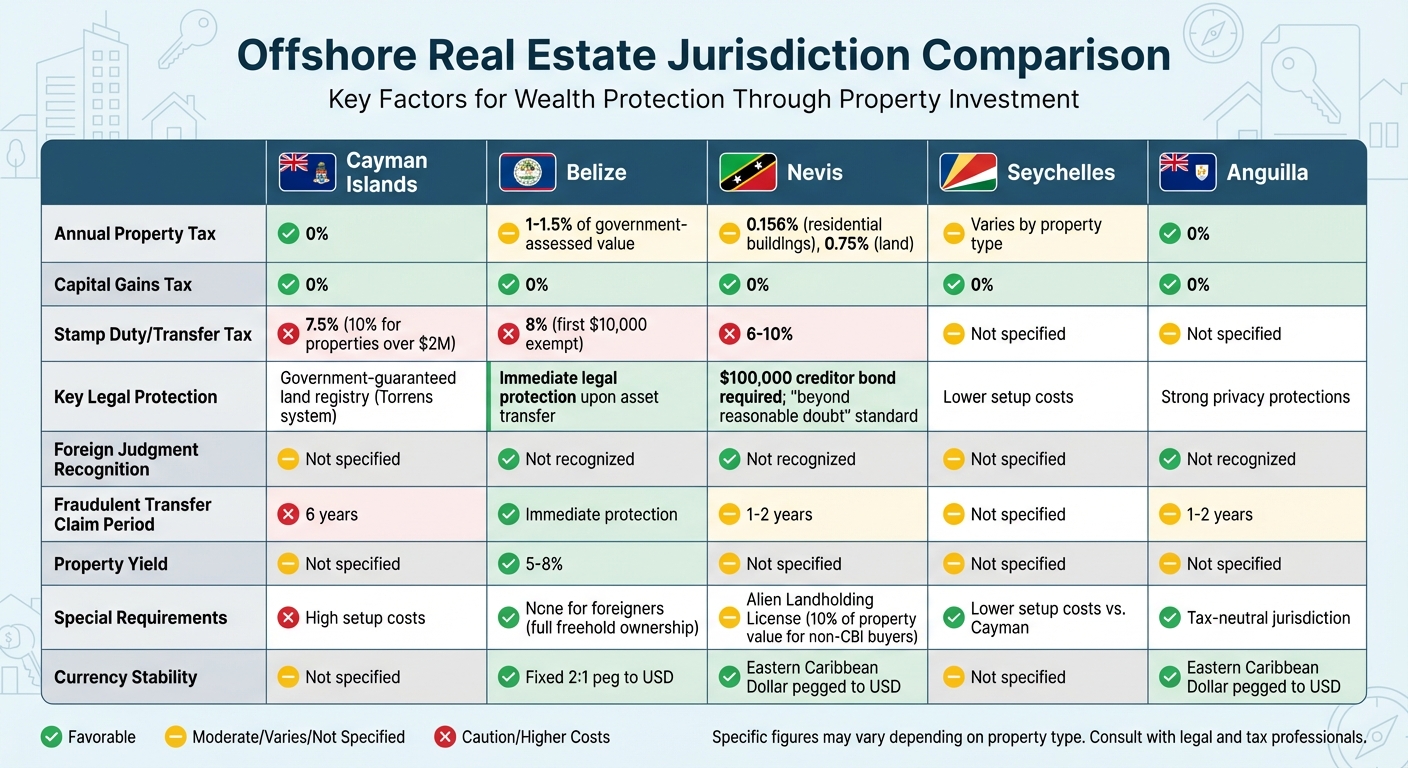
When evaluating offshore property markets, it’s essential to weigh the unique benefits and limitations of each jurisdiction. This comparison highlights key factors such as taxation, legal protections, and setup requirements, all of which can significantly influence your wealth protection and long-term returns.
Jurisdiction Comparison Table
Here’s a breakdown of important attributes across select jurisdictions. Keep in mind that specific figures may vary depending on the property type.
| Jurisdiction | Annual Property Tax | Capital Gains Tax | Key Setup Considerations |
|---|---|---|---|
| Cayman Islands | 0% | 0% | One-time 7.5% stamp duty on the purchase price; government-guaranteed land registry system |
| Belize | Not explicitly disclosed | 0% | Immediate legal protection upon asset transfer; lower setup costs compared to the Cayman Islands |
| Nevis | 0% | 0% | Requires an Alien Landholding License; known for strong asset protection measures |
| Seychelles | Varies by property type | 0% | Lower setup costs compared to the Cayman Islands |
| Anguilla | 0% | 0% | Considered tax-neutral; setup specifics may vary |
Nevis stands out for its robust asset protection framework, including a stringent bond requirement for creditors. This requirement, paired with a "beyond reasonable doubt" standard for fraudulent transfer claims, creates one of the most secure legal environments among these jurisdictions. Belize, on the other hand, offers unique immediate protection upon asset transfer, avoiding the typical 1-2 year waiting period often seen elsewhere.
For those prioritizing tax efficiency and property yields, the Cayman Islands is an appealing choice. With no annual property taxes and a government-guaranteed land registry, it ensures both simplicity and security. However, setup costs here tend to be higher compared to Belize or Seychelles. Belize also boasts attractive property yields, estimated at 5-8%, making it a strong contender for income-focused investors.
Timeframes for fraudulent transfer claims vary significantly. Nevis offers a shorter window of 1-2 years, compared to the 6-year period in the Cayman Islands. This shorter period can accelerate legal protection. Additionally, many of these jurisdictions do not recognize foreign court judgments, forcing creditors to re-litigate claims under local laws.
From tax advantages to legal safeguards, each jurisdiction offers distinct benefits that can shape your offshore property strategy. This comparison provides a clear starting point for identifying the best market to meet your wealth protection goals.
How to Acquire and Structure Offshore Properties
Conducting Due Diligence
Before diving into an offshore property purchase, it’s critical to ensure the title is clean – free of liens or competing claims. This is where hiring a local attorney comes in. They can perform a detailed title search, which is an absolute must. Keep in mind that measurement standards can vary globally, sometimes leading to inflated property sizes in listings.
You’ll also want to assess the political stability of the country and its treatment of foreign property owners. Some countries allow non-residents to own land outright, while others require specific ownership structures like trusts or land banks. For instance, in Mexico, foreigners cannot directly own land within 31 miles of the coast or within 62 miles of the border unless they use a fideicomiso (a bank trust) or set up a Mexican corporation. Similarly, Costa Rica restricts ownership within the first 164 feet from the high tide line, which is public land, and the next 492 feet is a concession zone requiring five years of residency before foreigners can lease it.
Take time to compare local property listings to ensure fair pricing. Also, check any banking requirements in the area and remember to comply with U.S. tax reporting for rental income. A handy way to evaluate markets is the "PIE" acronym: look at Population growth, Infrastructure development, and the strength of the Economy. For pre-construction purchases, research the developer’s track record and funding sources for the project.
"The ability to speak English is a guarantee of neither credibility nor expertise."
- Lief Simon, Offshore Living Letter
Once you’ve completed your due diligence, focus on structuring your ownership to protect your assets.
Structuring Ownership with Offshore Companies and Trusts
The right ownership structure is key to safeguarding your offshore property. Using an offshore LLC or International Business Company (IBC) can help shield your identity and limit liabilities to the company itself.
For added protection, you might consider a layered structure. This typically involves an offshore trust (like one in the Cook Islands or Nevis) owning an offshore LLC, which then holds the property title. This setup offers creditor protection and operational flexibility. Offshore Asset Protection Trusts (APTs) are governed by foreign laws, meaning local courts often don’t recognize U.S. judgments. Creditors would need to re-litigate in the trust’s jurisdiction, which can be very costly.
"Cook Islands or Nevis Trusts… are still considered the ‘gold standard’ for legitimate offshore protection. Courts in these jurisdictions don’t recognize U.S. judgments."
- James G. Bohm, Attorney, Bohm Wildish & Matsen, LLP
To maintain this protection, ensure the offshore company has its own bank account, and route all property-related income and expenses through it. Be prepared for ongoing costs such as registered agent fees and corporate filings, which typically range from $2,000 to $5,000 annually depending on the jurisdiction.
Before proceeding, verify whether the country allows offshore corporate ownership, as some nations impose restrictions. U.S. persons must also disclose offshore interests through FinCEN Form 114 (FBAR) and IRS Form 8938 – failure to do so can lead to serious legal consequences.
Financing and Title Ownership Options
Once your ownership structure is in place, explore financing options that align with your offshore investment goals. These strategies can help you maximize the benefits of your setup.
Cash purchases are often the simplest and most advantageous route for offshore properties. They can lead to discounts, upgrades, and quicker closings. However, if you need financing, there are several options to consider. Developer financing is a common choice for pre-construction properties, offering staged payments with less paperwork than traditional loans.
Local banks in the target country may also lend to foreigners, though terms are often less favorable. Borrowers typically face down payments of 30% to 50% and loan-to-value (LTV) ratios capped at 60% to 70%. Mortgage terms abroad are usually shorter – 10 to 25 years compared to the U.S. standard of 30 years – and often come with variable interest rates.
"The 30-year fixed-rate mortgage is largely unique to the U.S., whereas mortgages abroad often come with variable rates or shorter terms."
Alternatively, you can leverage domestic financing options like HELOCs, traditional mortgages, or securities-backed loans using your U.S. investment portfolio as collateral. If you’re using a self-directed IRA, it can also be an option for purchasing offshore real estate, provided the property is strictly for investment or rental purposes and not personal use.
Be aware that some foreign lenders may require borrowers to take out a life insurance policy naming the bank as the beneficiary. This can pose challenges for older investors due to age restrictions. Lastly, always conduct a title search through a local attorney to confirm the property is free of liens or squatters’ claims. For U.S. taxpayers, interest paid on a foreign mortgage is often deductible, and you can use a 30-year depreciation schedule for international residential properties.
Combining Offshore Real Estate with Asset Protection Strategies
Using Offshore Trusts with Real Estate
When it comes to safeguarding offshore real estate, pairing an offshore trust with a property-holding entity can add an extra layer of security. A common and effective setup includes combining an offshore trust with an International Business Company (IBC) or Limited Liability Company (LLC) to hold the title to the property. This approach creates multiple barriers between you and the asset, making it harder for potential creditors to reach your holdings.
Here’s how it works: the offshore trust – often established in jurisdictions like Anguilla, Nevis, or the Cook Islands – owns the LLC, which in turn holds the real estate. These jurisdictions are known for their strong asset protection laws. For instance, courts in Nevis and the Cook Islands typically do not recognize U.S. judgments. Creditors would need to re-litigate their claims in these jurisdictions, where the legal bar is significantly higher. In Nevis and the Cook Islands, creditors must prove fraudulent transfer claims "beyond a reasonable doubt", a much stricter standard than the "preponderance of evidence" required in U.S. civil courts.
Anguilla, governed by its International Trust Act of 2007, offers additional advantages. Trusts in this jurisdiction are exempt from income, capital gains, inheritance, and gift taxes. When paired with LLCs, this setup also ensures that liabilities tied to one property don’t spill over to others held within the structure. Moreover, Anguilla provides enhanced privacy protections, such as closed shareholder registers and nominee services, which keep the true ownership of assets out of public records.
"The most durable plans combine domestic protection (insurance, estate planning, entity structure) with limited, carefully documented offshore elements only after full legal and tax review." – Author, Finhelp.io
These structures should be established well in advance of any potential legal claims. Most top jurisdictions have short statutes of limitations – typically one to two years – after which transfers cannot be contested. It’s also crucial for U.S. persons to comply with reporting obligations like FBAR (FinCEN Form 114) and FATCA (IRS Form 8938), as offshore structures do not exempt individuals from domestic tax responsibilities.
This layered approach not only strengthens asset protection but also ensures compliance with international legal and tax standards.
How Global Wealth Protection Assists with Property Acquisition

Navigating the complexities of offshore real estate requires expertise, and that’s where Global Wealth Protection steps in. With over 25 years of experience, the firm specializes in helping investors structure and manage offshore property transactions. Their services include forming IBCs and LLCs in jurisdictions like Anguilla, arranging licensed registered agents, and ensuring compliance with local regulations and international standards like FATCA and the Common Reporting Standard (CRS).
Global Wealth Protection also assists with succession planning, enabling offshore trusts to clearly define how real estate assets should be distributed upon death. This often helps bypass forced heirship laws in the investor’s home country.
"Offshore Protection helped me structure my assets in a way I never thought possible. Professional, discreet, and thorough – I wouldn’t trust anyone else with my offshore strategy." – Private Investor, United States
The firm emphasizes the importance of working with dual counsel – legal professionals in both the U.S. and the offshore jurisdiction. This ensures that all documents meet local requirements while aligning with U.S. tax laws. Additionally, they help clients manage ongoing costs like registered agent fees and corporate filings, maintain precise financial records, and ensure everything is in order to defend against potential fraudulent transfer claims.
Conclusion
Offshore real estate provides a practical way to safeguard wealth, but success in this arena depends heavily on timing, structure, and the right expertise. It’s essential to establish asset protection measures before facing any legal challenges.
To navigate offshore investments effectively, you need more than just a plan – you need a team. This includes local real estate agents, cross-border attorneys, and tax advisors who can verify property titles and ensure full compliance with local regulations. Relying solely on a developer’s lawyer can leave you exposed to unnecessary risks.
"What separates success from disappointment is preparation. Due diligence, local expertise, currency hedging, and long-term planning are not luxuries – they are the foundation of sustainable offshore investing." – Offshore Protection
Be prepared for higher costs, especially with beachfront properties, which can carry up to 40% more in maintenance expenses. Additionally, management fees for offshore properties often range from 20–30%, compared to the 8–12% typically seen in the U.S. Having a clear exit strategy is equally important to guard against risks like currency fluctuations and political instability.
Diversification is critical in addressing market volatility and legal uncertainties. For instance, with around 5 million new court cases filed annually in the U.S. and the dollar losing over 10% of its value against major currencies by early 2025, the importance of spreading investments globally becomes clear. Global Wealth Protection’s expertise in structuring offshore investments and ensuring regulatory compliance offers a solid framework to tackle these challenges.
FAQs
What’s the safest way to hold an offshore property – personally, LLC/IBC, or trust?
When it comes to holding offshore property securely, using a trust is often the most reliable approach. Offshore trusts offer robust asset protection, helping to shield your holdings from U.S. creditors and certain legal claims. However, since real estate is still subject to U.S. jurisdiction, you might need to consider additional measures – such as equity stripping – to strengthen your protection.
Which IRS filings do I need for an offshore property and related bank accounts?
If you own offshore property or have foreign bank accounts associated with your real estate, you’ll need to file IRS Form 8938 to report your financial interests. Additionally, submitting an FBAR (Foreign Bank Account Report) is required for foreign accounts that meet specific thresholds. Depending on how your property is owned and the balances in your accounts, other reporting obligations might also apply. Always review the latest IRS guidelines to make sure you meet all necessary requirements.
How can I reduce currency risk when buying and renting property overseas?
To manage currency risk effectively, you might want to explore currency hedging strategies. Tools like options, forward contracts, or ETFs can shield you from unpredictable exchange rate swings, helping maintain the value of your property and rental income in USD.
Another approach is to invest in locations with either stable economies or dollar-based currencies, such as Panama or Dubai. These regions naturally reduce exposure to currency fluctuations. Pairing these strategies with in-depth market research can provide more stability for your international real estate investments.
